

When technology gets messy, the COO usually gets handed the bill, the blame, and the deadline.
You see it fast. Tool sprawl. Shadow IT. Projects that keep slipping. Reports that do not match what teams are actually doing. By the time the noise reaches your desk, the real problem is usually bigger than the stack.
The fix is not more software. It is operating discipline, which means clearer ownership, a steadier rhythm, and decisions that line up with the business instead of fighting it.
Key takeaways for COOs
- Technology chaos is rarely a tools problem first. It is usually a leadership problem with a technical wrapper.
- Operating discipline turns technology strategy into weekly execution, not another document nobody uses.
- When the gap is bigger than your internal team can close, executive technology leadership matters more than another dashboard.
Start with the decisions that went missing
Most technology problems do not begin with a failure. They begin with a missing decision.
Someone approved a tool and never named a business owner. Someone kept a vendor because replacing it felt painful. Someone treated a temporary workaround as a permanent process. That is how technical debt, technology debt, and vendor dependence pile up in plain sight.
For you, the first move is not a system review. It is a decision review. Ask where founder-led technology decisions are still driving the business, where CEO technology decisions were never translated into action, and where COO technology strategy is being replaced by habit.
That is where a business-aligned technology strategy helps. If you want a cleaner starting point, building a technology strategy that leaders can use is better than adding another project list. The point is to connect technology priorities for growing companies to actual business outcomes.
Ask three questions about every major item: What business result does this support? Who owns the outcome? What breaks if you stop it for 30 days?
If nobody can answer those in plain language, you have found the gap.
Build a technology operating rhythm people can follow
A COO cannot run technology by instinct. You need a technology operating rhythm that is boring in the right way.
That means a weekly cadence, a monthly review, and a quarterly reset. It means a systems inventory, a decision rights map, and stakeholder alignment that holds when pressure rises. It also means you stop treating reporting as an afterthought.
That is close to how AIChE describes operational discipline, not as red tape, but as a practical response when reality changes.
Operating discipline is not more meetings. It is clearer decisions, cleaner ownership, and a cadence that survives a bad week.
If you already have reporting, check whether it helps leaders act. If it only records activity, it is not helping enough.
Whether you call it strategic technology planning, technology strategy consulting, or a business technology strategy, it only matters if someone reviews it, questions it, and uses it to decide what happens next. A solid technology operating rhythm turns intention into follow-through.
Turn the roadmap into one shared plan
A lot of teams have too many plans and not enough direction.
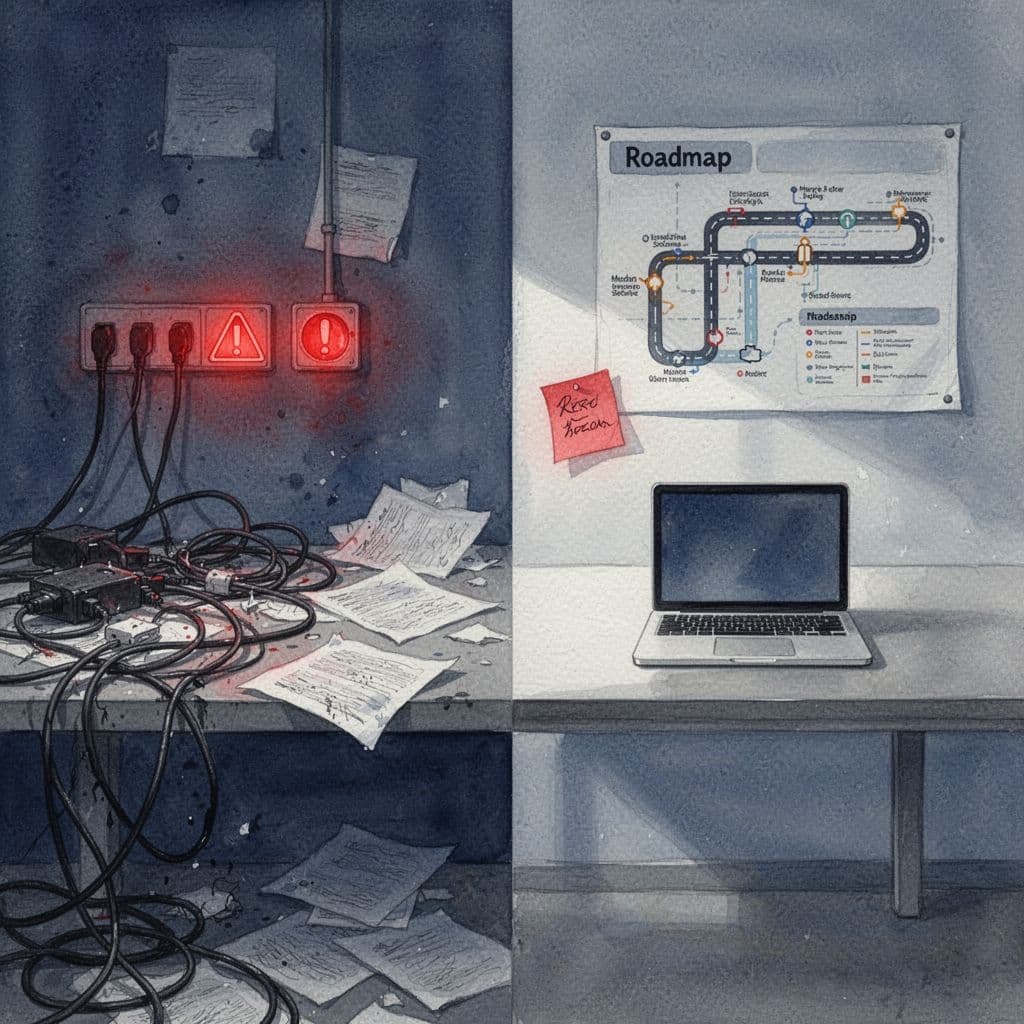
You may have a 12-month technology roadmap, a project tracker, a vendor plan, and a spreadsheet nobody trusts. That is not a strategy. That is a pile of motion.
You need an IT strategy and roadmap that links the next quarter to the next year. A one-page technology strategy can work better than a long deck if it names the outcomes, owners, and order of play. The goal is not to impress people. The goal is to help them decide.
When your team does not have a senior technology leader in the seat, fractional CTO services and executive technology leadership can give you control without forcing the wrong full-time hire too soon.
That support may come through a fractional CTO, interim CTO, outsourced CTO, virtual CTO, or part-time CTO. In some companies, the gap is closer to a fractional CIO, fractional CISO, virtual CISO, or interim CISO. The title matters less than the judgment.
What matters is closing the technology leadership gap before it becomes normal.
If you are still asking how to hire a CTO, the better question is whether you need technology leadership before hiring. In growth-stage technology leadership, the seat must fit the stage of the company, not just the org chart.
Put governance around spend, vendors, and risk
Operating discipline shows up in the budget.
It shows up in technology governance for CEOs and technology governance for boards. It shows up in whether your reporting is board-ready or just noisy. It shows up in whether vendors drive the roadmap or support it.
Your board does not need more dashboards. It needs board-ready technology reporting, board-ready reporting, a board-ready tech roadmap, and a board-ready risk summary that ties decisions to outcomes. If cyber is part of the picture, board cybersecurity reporting and cyber risk reporting to the board need to be clear enough to act on.
That means defining cyber risk appetite, tightening cybersecurity oversight, and building a practical technology risk management framework. It also means real technology risk oversight, not a quarterly nod and a slide deck.
The same logic applies to third-party risk management. Keep vendor management, vendor due diligence, third-party risk reporting, vendor offboarding, and a vendor incident response plan in one place. If a vendor creates concentration risk, the board should know.
Then look at spend. Technology spend optimization, tech spending ROI, IT cost optimization, IT cost reduction, and cost-per-outcome reporting all belong in the same conversation. If a tool does not move growth, control, or resilience, it needs a better reason to stay.
This is where a technology dashboard becomes useful only if it supports a decision. Otherwise, it is just a nicer way to look at drift.
Use the same discipline for AI, resilience, and due diligence
The same pattern shows up in AI, business continuity, and transactions.
If you are rolling out AI without AI governance, AI adoption strategy, AI acceptable use policy, AI transformation strategy, or AI vendor due diligence, you are building another layer of chaos. The same goes for AI opportunity assessment. New tools do not fix weak ownership.
You need the same discipline around risk and resilience. That means business continuity planning, disaster recovery planning, incident response readiness, ransomware readiness, and an executive incident response checklist. Cyber insurance renewal gets easier when your cybersecurity risk assessment and IT security assessment are current. So do access control best practices, data governance framework, data strategy, data quality, data privacy, and information governance.
If acquisition readiness is on the table, the work gets even more serious. You need technology due diligence, technical due diligence, cybersecurity due diligence, an acquisition due diligence checklist, a CTO transition plan, and a clear post-merger technology integration path. The same is true when you are evaluating software platform evaluation, technology vendor selection, or application portfolio rationalization.
That is where Get an Executive Technology Clarity Check can help if decisions feel scattered, risky, or too dependent on the wrong people.
If you do not have the right internal support, that is where a technology leader for growing companies matters. Sometimes you need a fractional CTO. Sometimes you need interim CTO services. Sometimes the problem points more toward a fractional CIO, fractional CISO, or virtual CISO. The point is to match the support to the problem.
Conclusion
COO work gets harder when technology stops behaving like a support function and starts acting like a drag.
The answer is not more effort. It is clearer ownership, a better rhythm, and reporting leaders can trust. When you put those pieces in place, technology becomes easier to govern and harder to waste.
The next time a team says the system is the problem, ask which decision was never made. That answer usually tells you where to begin.
FAQ
How does a COO create operating discipline in technology?
Start with decision rights, a weekly review cadence, and board-ready reporting. Then connect each major technology effort to a business outcome, an owner, and a deadline.
When should you bring in a fractional CTO instead of hiring full time?
When you need executive technology leadership now, but the business is not ready for a full-time hire. That is common in mid-market technology leadership, growth-stage technology leadership, and scaling technology leadership.
What should board-ready technology reporting include?
A short view of priorities, spend, delivery status, cyber risk, vendor exposure, and the decisions that need executive attention. If the board cannot see the tradeoffs, the report is not ready.