
Consider a hypothetical Monday morning. Your finance team needs to release payroll and a critical supplier payment. The balances appear sufficient, but a provider has restricted withdrawals following a security incident. Your usual approver is unavailable. Nobody can immediately confirm which alternative account is ready to use.
The first leadership question is practical: who can keep the business moving without making the situation worse?
The October 29, 2026 Binance incident gives executives a reason to examine those decisions. TRM Labs estimated that approximately $6.36 billion left Binance wallets across ten blockchains. Binance confirmed a security incident and temporarily suspended withdrawals while investigating and checking affected systems.
In its November 2 update, Binance said it had covered approximately 95% of the impacted amount and was continuing to restore withdrawal access progressively. Those statements concern replacement funding and service restoration. They should not be read as confirmation that the stolen assets were recovered.
You do not need cryptocurrency exposure to use this case as a prompt. Review the providers, accounts and approval paths your business relies on to move money.
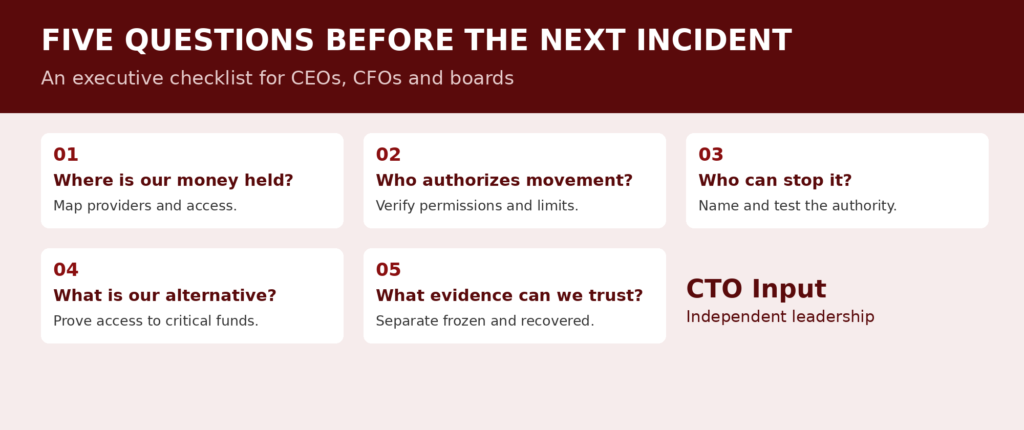
1. Where is our money held, and what could prevent access?
Ask the CFO or treasury owner for a current map of operating accounts, payment platforms, processors and other places where business funds are held.
For each, identify the legal account owner, available balance, withdrawal restrictions, settlement timing and operational contact. Separate funds that can be used today from balances that depend on processing, conversion or another party’s approval.
Then connect those funds to obligations. Which account supports payroll? Which supports the supplier whose missed payment could interrupt delivery?
The useful output is a short, maintained map showing where a loss of access would affect operations. An account list without those dependencies leaves leadership guessing about priorities.
2. Who can authorize a transfer or change the rules?
Have finance and technology review the full path from request to release. Include people, service accounts, payment integrations and administrators who can change permissions.
Look beyond the named payment approvers. Who can add a beneficiary, reset an approver’s access, change a transfer limit or alter the approval workflow? Can one person make several of those changes?
Ask the process owner to demonstrate the controls in a safe review. Check whether access reflects current responsibilities and whether exceptions have an owner and an expiry date.
Leadership needs evidence that authority is appropriately separated, including when the usual approver is absent.
3. Who can stop activity when something looks wrong?
Name the person authorized to suspend payments, revoke access or contact the provider’s emergency team. Name a backup with the same practical ability to act.
Agree on the conditions that justify a temporary stop, the escalation path and the person who authorizes resumption. Include finance, security, operations and legal where their responsibilities are relevant.
A short tabletop exercise can expose uncertainty without interrupting real payments. Present an unfamiliar beneficiary change or an unexplained transfer and ask each owner what they would do next.
Record missing access, disputed authority and unreachable contacts as actions with deadlines. The exercise is useful when it changes readiness.
4. What alternative keeps essential obligations moving?
Ask the CFO and operating leaders to identify the obligations that cannot wait through a provider outage. Establish the amount and timing needed to support them.
Review alternatives before treating them as available. Is the account active? Are funds accessible? Are authorized users ready? Do transfer limits and payment cutoffs fit the requirement?
Avoid concentrating every alternative behind the same access dependency. A second account provides little operational flexibility if the same unavailable person or compromised identity controls it.
Document the activation decision and test the process safely. Do not assume that a credit arrangement, reserve balance or insurance policy supplies immediately usable cash; verify its terms and practical availability with the appropriate advisers.
5. What evidence will leadership receive?
Agree on a concise reporting pack before an incident. It should distinguish confirmed facts, working estimates, unresolved questions and decisions requiring approval.
For financial impact, report stolen or missing funds separately from frozen assets, recovered assets and replacement funding. For operations, report which services work, which remain restricted and which essential obligations are exposed.
Assign an owner and update time to each critical fact. Boards and executives should be able to see what changed and what decision follows.
Put the answers into one working page
Bring the CFO, technology or security lead and operations owner together. Capture the five answers, supporting evidence, unresolved gaps, accountable owners and next review dates.
Start with the weakest answer affecting an essential payment or service. Close that gap, verify the result and keep the page current.
If the review exposes unclear decision rights across finance, technology and vendors, use CTO Input’s executive technology oversight approach to frame the leadership responsibility that needs to be filled.