
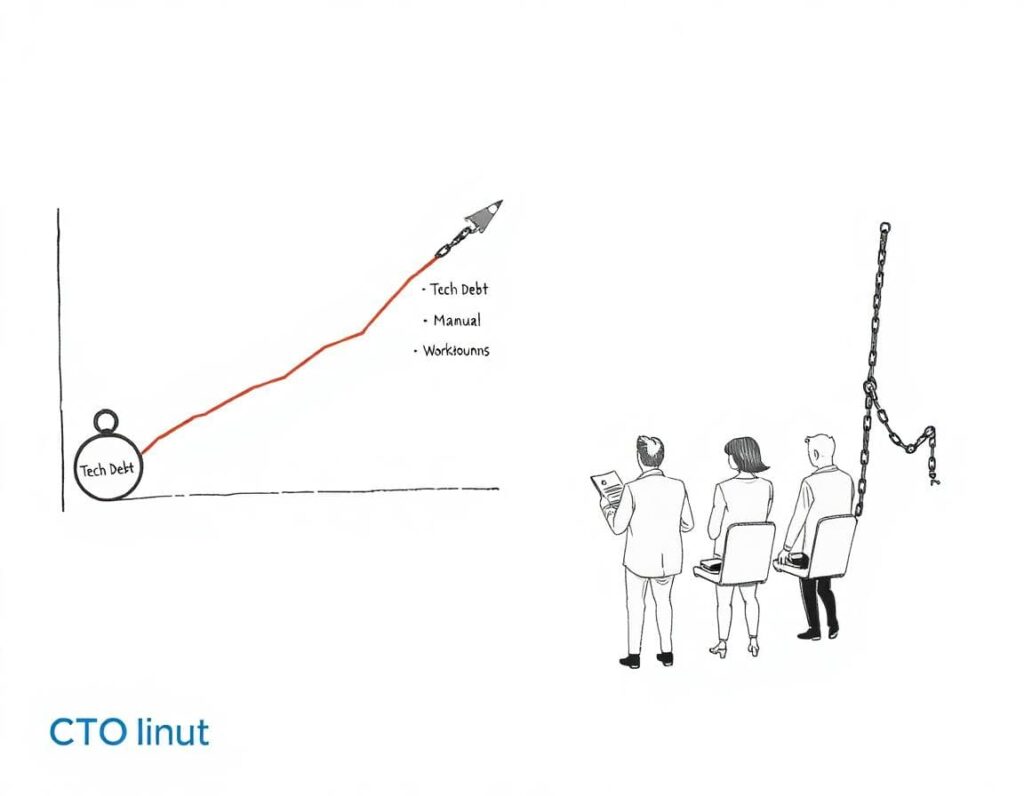
Technology should make your company faster, safer, and more profitable. For many mid-market leaders, it now feels like the opposite.
Projects drag. IT spend climbs. Cyber questions in board meetings get harder to answer. And yet nothing seems broken enough to justify a full rebuild.
That quiet drag is often technology debt in business. Think of it as a hidden tax on growth. You do not see it as a clear line on the P&L, but you pay it every day in margins, speed, and risk.
This article unpacks what that hidden tax really is, how to spot it without getting lost in jargon, and what practical steps a CEO, COO, or board can sponsor to turn it into a controlled investment instead of a permanent drag.
What Is Technology Debt In Business And Why It Feels Like A Hidden Tax

Technology debt in business is like taking a shortcut on a new building. You open faster, you spend less up front, and on day one everything looks fine. Years later, you are paying higher maintenance, dealing with leaks, and discovering that simple changes need major structural work.
In board language, technology debt is the extra cost, time, and risk you carry today because past technology decisions were made for speed or price, not for current needs.
It is not only about old code. It includes:
- Legacy systems that no vendor wants to support.
- Quick, one-off integrations between platforms.
- Rushed software choices to hit a deadline.
- Underfunded platforms that never got finished, so people rely on manual work instead.
Like a tax, you rarely see it clearly. It is buried in overtime, extra staff, rework, outages, and “temporary” workarounds that became permanent. Global research shows that technical debt now consumes 20% to 40% of IT budgets, and developers spend up to 50% of their time dealing with it instead of building new value. That means a large slice of your technology spend is servicing the past, not funding the future. Sources such as CAST’s research on global tech debt and industry analysis indicate that companies are burning billions of workdays trying to manage this drag on productivity. You can see a stark view of this in CAST’s findings on companies worldwide burdened with 61 billion workdays of tech debt.
Consider two simple examples:
- A payment system that “no one wants to touch” because every change risks downtime.
- An ERP that requires three spreadsheets and a manual approval trail to get a basic order through.
These are normal side effects of growth, acquisitions, and tight budgets. They are not signs of failure. The problem comes when the debt is invisible and unmanaged, and it starts taxing every new growth initiative.
A Simple Board-Level Definition Of Technology Debt
A board-friendly definition you can repeat:
Technology debt in business is the extra cost, delay, and risk you carry because your current systems were built for a different time, under different constraints.
In practice, it is like taking a loan to move faster. You “borrow” by taking shortcuts on architecture, integrations, or process. You get speed today, but you pay interest later.
The interest shows up as:
- Higher operating cost.
- Slower change.
- More outages and incidents.
Some debt is strategic. You may accept it to beat a competitor to market or to hit a regulatory date. The key is to treat it like financial debt. When you stop tracking it, or stop paying it down, it shifts from helpful fuel to a drag on growth.
How Normal Business Decisions Create Hidden Technology Debt
Most debt does not come from reckless choices. It comes from normal decisions made under pressure, such as:
- Buying point solutions for each department
Sales picks a CRM. Ops picks a scheduling tool. Finance picks a billing platform. None of them were designed to work together, so you pay for custom integrations and duplicate data. - Delaying upgrades to avoid disruption
You skip a major ERP or core system upgrade for one more year. Then one more. Eventually, the vendor support window closes and upgrades become risky projects instead of routine events. - Custom one-off integrations
A partner needs data fast, so IT wires two systems together in a hurry. That “temporary” integration is still in place five years later and now no one is sure how it works. - Pushing IT to hit impossible deadlines
When “just get it live” wins every argument, architecture, documentation, and testing take a back seat. The work ships, revenue flows, but technical interest starts to accrue.
None of these decisions look reckless at the time. Taken together, they create a complex, fragile stack that behaves like a silent tax on every new initiative.
Why Leaders Rarely See Tech Debt On A P&L, But Always Feel Its Impact
Technology debt rarely appears as a clear line item. It hides in:
- IT labor spent on fixes instead of improvements.
- Vendor fees for emergency work and custom support.
- Extra headcount in operations to work around systems.
- Project delays that push revenue into the next quarter.
- Higher security and compliance costs tied to older platforms.
This makes it easy to blame individuals and vendors. The CIO looks slow. The IT team “cannot keep up”. The new SaaS provider “overpromised”. In reality, the structure of the stack is the problem.
When you see rising IT spend, slower change, and more board questions about cyber and resilience, you are feeling technology debt in business, even if you cannot name it yet.
How Technology Debt Quietly Eats Margins, Agility, And Growth
Analysts expect IT investment to keep rising as companies chase AI, automation, and new digital revenue. Deloitte’s recent 2025 technology industry outlook highlights growing spend in these areas. If your base is weighed down by old debt, a large slice of that new investment will go into patching the past instead of building the future.
Recent studies across 2024 and 2025 show that 20% to 40% of IT budgets now go to servicing technical debt, and 80% of leaders report delays and higher costs as a result. That is real margin erosion.
The Margin Hit: Extra Cost Hidden In Maintenance, Workarounds, And Vendor Spend
Every time a team says “we will handle that in Excel for now”, your margin takes a hit.
Technology debt shows up in operating cost as:
- Extra staff to rekey data between systems.
- Overlapping tools that grew up in silos.
- Higher support contracts for legacy platforms.
- Emergency vendor projects to “stabilize” critical systems.
In board terms, every dollar you save by delaying modernization may cost you two or three dollars over the next few years. JetSoftPro, in its review of technical debt economics, notes that technical debt can eat up to 40% of IT budgets, crowding out funds for growth initiatives, as described in their piece on technical debt in 2025 and balancing speed and scalability.
For a $50 million revenue company spending 4% to 6% on technology, even a modest 15% debt tax on that tech spend can quietly remove hundreds of thousands of dollars from EBITDA each year.
The Agility Drag: Slow Change, Delayed Projects, And Missed Opportunities
When systems are tightly coupled and poorly documented, even small changes carry risk. Lead times get longer. Simple requests turn into multi-month projects.
You feel this when:
- A retail or e-commerce business cannot change pricing rules without a code freeze.
- A fintech firm needs months to onboard a new partner bank because each integration is bespoke.
- A logistics company struggles to expose shipment data to customers in real time because the core system is too hard to integrate.
By the time a new feature reaches market, the window has shifted. Growth plans bend to fit what the old systems can handle. Your strategy becomes a captive of your stack.
The Risk Premium: Outages, Cyber Exposure, And Board-Level Compliance Worries
Legacy platforms and rushed fixes do not only cost money. They increase risk.
Technology debt raises the odds of:
- Outages in core customer journeys.
- Security gaps in old code, forgotten APIs, or unsupported systems.
- Compliance problems where audit trails live in emails and spreadsheets.
Boards are already watching macro risk. EY’s global economic outlook points to continued uncertainty and pressure on returns. Against that backdrop, repeated tech incidents and mounting cyber exposure feel less like bad luck and more like governance failure.
The direct cost of a breach or outage is only part of the story. The larger hit often comes later, in lost trust, higher insurance, tighter audits, and deals that die in due diligence when buyers see the state of the systems.
The Human Cost: Burnout, Talent Turnover, And A Culture Afraid Of Change
Technology debt also taxes your people.
Engineers get stuck in firefighting instead of building. Business teams live in manual workarounds and shadow spreadsheets. Leaders stop asking for improvements because they expect resistance.
Over time, you get:
- Burned out IT teams who cannot see a way out.
- Rising turnover among your best technical talent.
- A culture that avoids ambition, because “that will never get approved” or “the system cannot do that”.
This is where growth really stalls. The company stops dreaming bigger because the technology feels too hard to change.
How Mid-Market Leaders Can Turn Technology Debt Into A Controlled Investment
The goal is not to rebuild everything. It is to measure the hidden tax, make it visible, and then retire the worst parts with targeted investment.
A seasoned, neutral advisor can help, but the shift starts with how you as a leader choose to see and talk about technology debt in business.
Make The Hidden Tax Visible: Measure Where Technology Debt Hits Your Business
You do not need a 200-page assessment. Start with a focused view of where the pain is highest.
Ask your team three simple questions:
- Where do we keep saying, “we cannot change that system”?
- Where are projects always delayed or over budget?
- Where are we most nervous about outages, cyber risk, or compliance?
Overlay that input with basic data: outage logs, incident lists, manual workarounds, and expensive vendor contracts. Many companies discover that a small number of systems create a large share of the drag.
Turn this into a simple visual map for the board. Red, amber, green by system, with brief notes on margin impact, agility, and risk. No jargon, just business language.
Prioritize Like A Portfolio: Which Debt To Pay Down First For Margin And Agility
Once the map is visible, treat tech debt like a portfolio of obligations.
Rank each item by:
- Impact on margins and operating cost.
- Impact on customer experience and revenue.
- Impact on risk, outages, and compliance.
- Impact on speed of change.
Focus first on 3 to 5 areas where a modest investment can produce visible results in 6 to 12 months. Examples include consolidating overlapping tools, automating a high-volume manual process, or replacing a fragile integration with a stable, well-documented interface.
The test is simple: does this action free cash, reduce risk, or unlock speed within a year? If yes, it belongs near the top of the list.
Turn One-Off Fixes Into A Simple Roadmap The Board Can Track
Most mid-market companies run from project to project. What they lack is a clear, believable 12 to 24 month roadmap that links each action to a business outcome.
That roadmap should:
- Name the specific tech debt item to address.
- State the target outcome, for example lower support cost, faster onboarding, better compliance evidence, fewer outages.
- Give an expected timeline and investment range.
- Assign a clear business and technology owner.
This is where a fractional CTO or CIO can add real value, acting as a translator between the board, the internal team, and vendors. The role is not to sell tools, but to keep every project tied to the roadmap and the growth plan.
Build Simple Habits To Keep Technology Debt Under Control
Technology debt will never be zero. The goal is controlled, intentional debt that you track and manage, not blind accumulation.
A few simple leadership habits help:
- Include a brief technology debt discussion in quarterly business reviews.
- Set guardrails for “quick fixes”, such as time limits or required follow-up work.
- Make sure every major new project shows how it interacts with existing debt.
- Review a short list of high-risk systems at the board level at least once a year.
These habits create a culture where moving fast is still possible, but the long-term cost of shortcuts is visible and discussed.
Technology debt in business is a normal side effect of growth. When it stays invisible, it becomes a hidden tax on margins, agility, and trust with customers and the board.
You do not need to become a technologist to change this. You need clear visibility, a short list of choices, and a plan you believe in. With the right advisor at your side, you can redirect a meaningful slice of your tech spend from servicing the past to funding the future.
If this feels familiar in your company, take the next step. Visit the CTO Input website to see how a fractional CTO, CIO, or CISO can help you measure and reduce this hidden tax, and explore more practical guidance on the CTO Input blog to make technology a real asset to your growth story.