
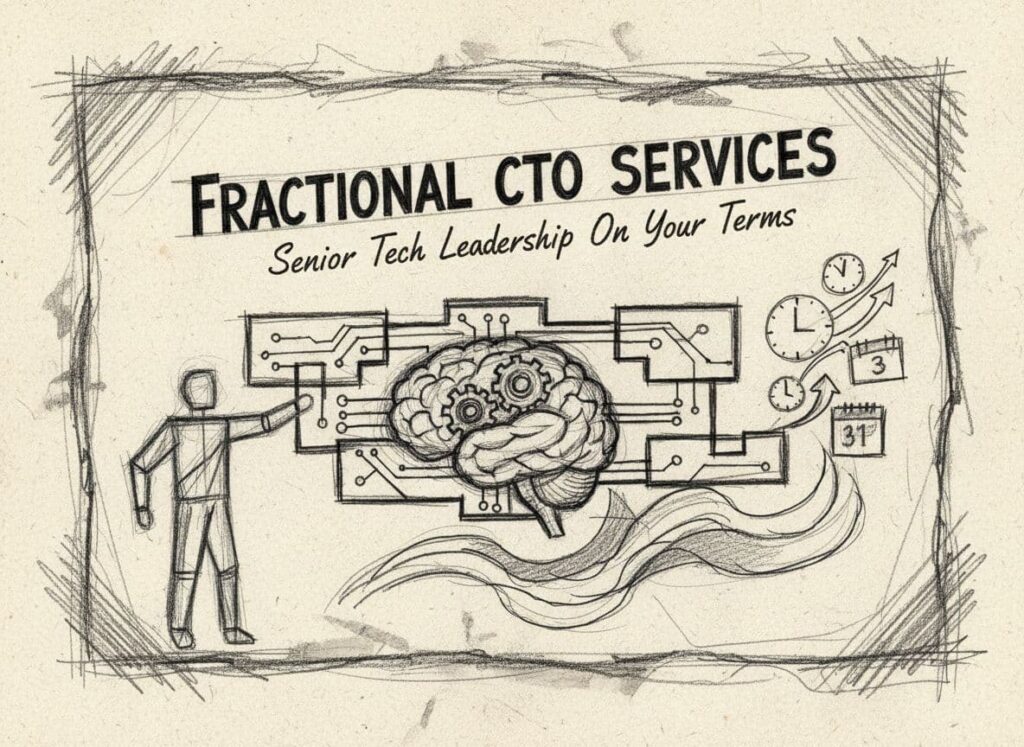
You are under pressure to navigate digital transformation and make smart tech bets. Customers expect more, competitors move fast, and investors keep asking hard questions about product, security, and scalability.
But you do not have a salaried Chief Technology Officer. Or the one you want costs more than your entire dev budget.
This is where fractional Chief Technology Officer services come in. They act as a senior technology executive who works with your company on a as needed flexible basis. You get real executive-level technology leadership and ownership, without the full-time price tag or long hiring cycle.
In 2025, more CEOs and boards are turning to fractional executives, including CTOs, CIOs, CISOs, CMOs, CFOs and CROs. Studies show a clear rise in growing businesses using part-time leaders because they want flexibility, faster onboarding, and less overhead.
In this guide, you will see what these experts actually do, how they plug into your leadership team, what they cost compared with full-time hires, and how to know if this model fits your company.

Seasoned technology leader aligning the tech roadmap with business executives. Image created with AI.
What Are Fractional Technology Leadership Services and How Do They Work?
At its core, a fractional CTO is a CTO on schedule that is flexible to your needs. They bring the same level of experience as a full-time chief technology officer, but you pay for the value they bring you instead of a full-time salary.
Most services in this model include:
- Defining technology strategy and roadmap
- Managing or mentoring your technology, compliance and cybersecurity teams
- Building partnerships and relationships with your other executive leaders
- Owning architecture decisions and tech stack choices
- Overseeing vendors, agencies, and key tools
- Handling security, reliability, and technical risk
- Aligning your technology goals with your business goals
- Translating between “business speak” and “engineering speak”
You are not just buying advice. You are hiring someone who owns decisions and outcomes, similar to how a full-time chief technology officer, chief information officer and chief information security officer behaves.
Common engagement models
This work is usually structured in a few ways, offering flexible engagement options:
- A few days per week
Example: An early-stage SaaS company among startups that just raised seed funding brings in the role 2 days a week. They help hire the first engineers, set up the stack, and define a 12 month roadmap. - Monthly retainer
Example: A family-owned distributor is going digital for the first time. They pay a monthly retainer for ongoing advisory, vendor oversight, and quarterly planning. - Project based
Example: A company needs to rebuild a legacy platform or handle product development for a new launch. The role leads the project for 6 to 9 months, then transitions to a light advisory role. - Interim CTO
Example: A private equity portfolio company just lost its CTO. The role steps in for 9 to 12 months while the board searches for a permanent hire.
Typical engagements run 6 to 18 months, sometimes longer if both sides see strong value. The role usually joins leadership meetings, board calls, and investor updates, especially when technology is an important part of the conversation.
For a broader overview of what this role includes, the Founder Institute offers a clear explanation of fractional technology executive roles and costs in their guide: Exploring Fractional CTO: Roles, Benefits, Costs, and More.
Fractional vs full-time CTO vs consultants
How is this different from other options on your table?
- Full-Time Traditional CTO
Best once your company reaches a certain size or complexity. A full-time CTO is all-in, owns long-term tech culture, and is usually a key part of the equity story.
The challenge: a seasoned CTO often costs a large six-figure salary plus equity, bonuses, and benefits. Hiring one can take 3 to 6 months. - Tech consultant or agency
Consultants often provide advice, audits, or deliver a specific project. Agencies build software or handle managed services.
They might not sit in your leadership team or take ongoing ownership of results. Once the contract ends, accountability often ends too. - Fractional Strategic Technology Leader (CTO, CIO & CISO)
Sits in leadership and sometimes board meetings. Owns roadmap, architecture, and team health. Feels like part of your executive team, just not full time.
You get more control and accountability than with a typical consulting engagement, but at a lower cost and faster start than a permanent CTO, CIO or CISO.
Think of the role as a bridge between “no tech leader” and “full-time C-level hire.”
Key responsibilities covered by a fractional relationship
What does this actually look like week to week? A strong role usually leads:
- Tech strategy and roadmap
Turning fuzzy product ideas into a step-by-step 12 to 24 month plan. - Product and platform architecture
Overseeing software development by choosing the right tech stack for your tech infrastructure, setting standards, and keeping things scalable. - Hiring and mentoring technology teams
Helping you avoid bad hires, growing team leads, and setting clear expectations. - Vendor management
Selecting partners, reviewing contracts, and holding them to outcomes. - Cloud and software cost control
Tuning cloud setups, removing waste, and picking tools that match your stage. - Security and compliance oversight
Making sure data is safe, access is controlled, and you are not ignoring key regulations. - Investor and board communication
Turning complex tech topics into clear, honest updates and metrics.
The best in this role are not just producing slide decks. They join stand-ups, review designs, and talk with customers when needed.
Benefits of Fractional Technology Services for CEOs, Founders, and Boards

Business leaders reviewing product and technology performance metrics. Photo by Artem Podrez
From your seat, this is not about technology for tech’s sake. It is about hitting revenue targets, reducing risk, and keeping your board confident. Fractional technology services offer strategic leadership to guide your company through these challenges.
Strategic tech leadership without the full-time price tag
A seasoned full-time CTO often costs $250k+ per year in salary in the US, plus equity, benefits, and bonuses. Many growth-stage companies simply are not ready for that level of spend.
Fractional CTO pricing in 2025 often ranges from:
- Monthly retainers: roughly $5,000 to $25,000, depending on scope and experience
So you get top-level technology leadership for a fraction of the full-time cost, and you can scale hours up or down as your needs change.
The real value is not just a lower bill. This cost-effective approach reduces failed projects, trims wasted engineering time, and avoids expensive “build the wrong thing” mistakes.
Stronger technology roadmap that supports your business goals
Many CEOs have a list of ideas, customer requests, and investor asks. What they lack is a clear, honest plan.
An expert advisor turns that chaos into:
- A prioritized backlog tied to revenue and retention
- A step-by-step plan for the next 12 to 24 months
- Clear tradeoffs between features, tech debt, and performance
They help you answer questions like:
- “What will it take to handle 10 times more users?”
- “What do we need in place to win enterprise deals?”
- “Where are the real bottlenecks?”
This strategic guidance brings focus to your product and helps align technology with business goals in board meetings, fundraising decks, and customer conversations.
Better technology team performance and less chaos
Many leaders say things like, “I do not know what the tech team is doing,” or “Projects always slip.”
An expert advisor attacks those pain points head-on by:
- Setting clear priorities and realistic timelines
- Fixing broken processes, like releases or QA
- Improving how product, design, and engineering work together
- Mentoring team leads so they can run a smoother operation
Often, the tech team you already have is capable. They just need direction, boundaries, and support to improve efficiency. When that happens, morale improves, output goes up, and you do not have to over-hire to make progress.
Reduced risk around security, compliance, and technical debt
Security, privacy rules, and growing technical debt can quietly turn into major business risks.
In 2025, this role often includes:
- Basic security reviews of cloud setups and code practices, with a focus on cybersecurity
- Setting up role based access and stronger authentication
- Backup and disaster recovery checks
- Compliance awareness for health, finance, and EU data (HIPAA, PCI, GDPR)
They also create a plan to tackle the worst technical debt first, so you are not building your future on shaky ground.
If you want to see more examples of how these services reduce risk, this breakdown of fractional CTO benefits for different types of organizations shows how nonprofits and companies with tight budgets get more out of their tech spend.
How to Decide if Fractional Services Are Right for Your Company
Not every company needs fractional CTO services. Some need a full-time leader, others just need a good senior engineer or a specialist consultant.
Use this as a quick decision guide.
Signs your company is ready for a fractional CTO
You may be ready if:
- Non-technical leaders are making key tech decisions by gut feel, signaling a lack of solid technology strategy
- Releases are slow, unstable, or keep breaking production
- You miss deadlines for launches that matter to sales or investors
- Customers complain about outages, speed, or missing features
- You are unsure whether to build or buy major systems
For example:
- A funded startup heading toward Series A that must scale operations and prove product scalability
- An SMB with 10 to 50 staff that wants to modernize an old system through custom software development without blowing the budget
- A private equity portfolio company that has strong revenue, but poorly run tech
In each case, the business has real stakes, real customers, and real complexity. They just lack senior tech leadership, which is essential for driving innovation in the product or platform.
For more signs and hiring guidance, we have have shared helpful hiring tips and benefits at CTOInput.com.
When a full-time staff CTO, CIO and CISO or other option might be better
A fractional tech executive is not always the right answer. You probably want a full-time one if:
- You have a large technology team that needs daily, on-site leadership
- Your product is safety critical, such as medical devices or aviation
- Tech risk is so high that you need a dedicated executive focused only on this
Other times, a different solution might fit better:
- Idea-stage startups with no product yet: a strong senior engineer plus a product partner could be enough
- Narrow security concern: a specialized security consultant might be the right call
- Strong CTO already in place: maybe you need a VP of Engineering, not another full-time CTO
How to choose a fractional CTO and set them up for success
Picking the right person matters as much as the model itself. Look for someone who:
- Has built or scaled organizations with similar goals to yours
- Can speak clearly with non-technical leaders
- Has a track record of growing teams or stabilizing chaos related to technology and culture
- Brings the technical expertise to push back with facts when needed
Before you start, align on:
- Clear goals and success metrics
- Scope and decision rights (what they own vs advise on)
- A 60 to 90 day plan with visible wins and regular check-ins
Agree on how they will work with your existing team and what the endgame looks like, such as hiring a full-time CTO later or extending the engagement. For additional perspective, this overview of fractional CTO benefits and FAQs covers common questions about setting expectations and outcomes.
Conclusion
Fractional Technology Executive Services give you senior technology leadership at the moment you need it most, without the cost and delay of a full-time hire. You get a clearer roadmap, stronger teams, smoother IT operations, and a more honest view of risk and technical debt, all through essential strategic guidance.
If you feel pressure to make high-stakes tech decisions with limited information, this model can give you confidence and control. Take a hard look at your current tech challenges, missed deadlines, and security worries, and ask where leadership gaps sit.
Your next step can be simple: talk to a few fractional strategic technology service providers, ask your current team what support they need, and share this article with other decision makers. A small change in leadership at the top of your tech stack can change the trajectory of your entire business, including software development, while driving innovation and helping you align technology with business goals.
If this sounds like your world, do not guess your way through the next round of decisions. Visit CTOInput.com to see how fractional technology leadership can give you a clear roadmap, reduce risk, and turn your technology spend into measurable results.
If you want more practical, plain language guidance on aligning technology, risk, and growth, spend a few minutes exploring the rest of the articles on the CTO Input blog. You can find them here: https://blog.ctoinput.com