

Picture the typical owner of a $2 million to $250 million company. You built or grew the business over decades, you know every key customer by name, and your instincts have steered you through more than one crisis. Now you are starting to think about what comes next.
Succession, whether sale or handoff to the next generation, is both emotional and financial. It is also where hidden weaknesses in systems, data, and cybersecurity step into the spotlight. Many transitions stall or fall apart not because of the story in the pitch deck, but because the underlying technology cannot support a new leader or a skeptical buyer.
This article offers a simple way to think about Mid Market Owner Succession: Why Technology Belongs in the Transition Plan, and where to focus first. The goal is calm, practical steps that protect value, reduce risk, and support your legacy.
Why Mid Market Owner Succession Often Fails Without a Technology Plan
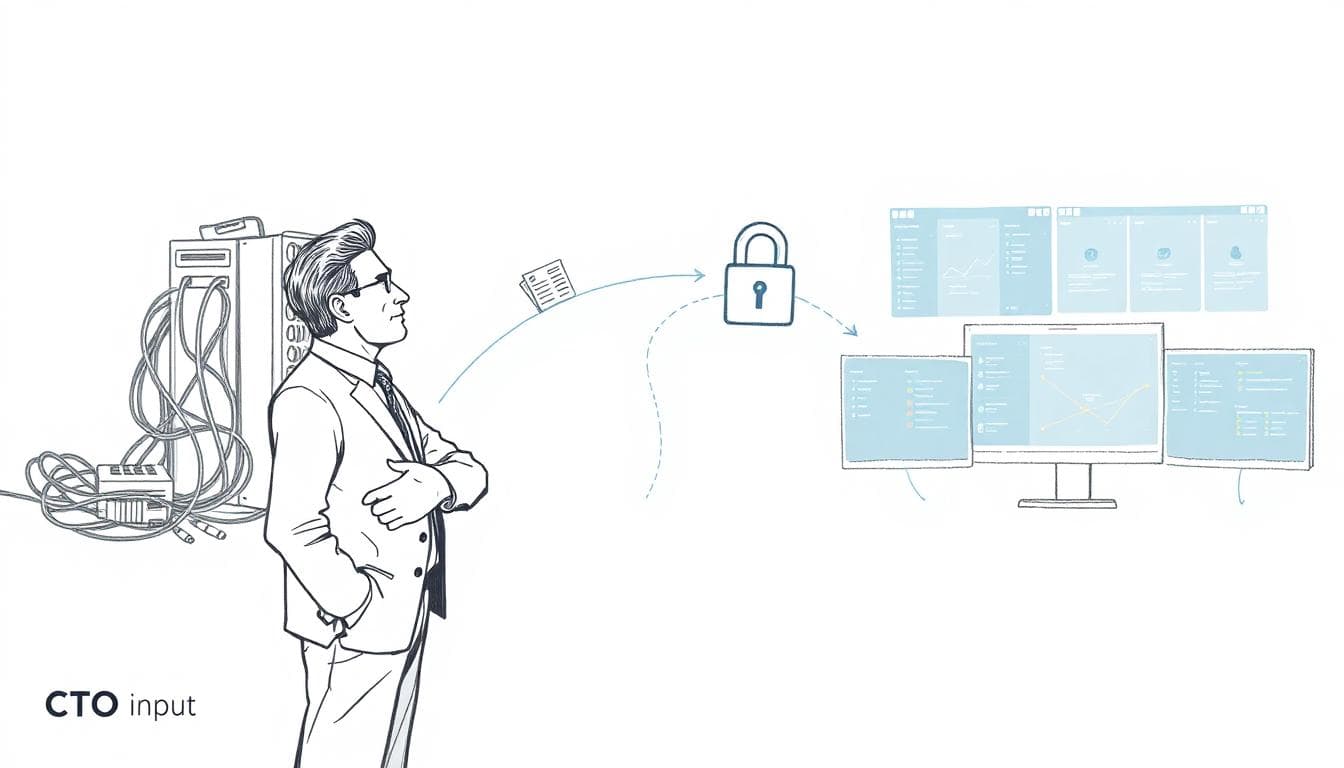
Mid-market owner looking at a technology roadmap that supports a smooth leadership handoff. Image created with AI.
Transition failure usually gets framed as a people or timing problem. In reality, it is a mix of emotional readiness, leadership gaps, and buried technology risk that surfaces at the worst moment.
Recent research on family and mid-market businesses shows that more than half of ownership transitions fail. Many never reach a clean sale or a stable handoff to the next generation. In some surveys, only about 46 percent of private mid-market owners report having a formal succession plan, while roughly 30 percent have no plan at all. Similar patterns show up in studies of family firms, including the PwC survey of US family owned business, where succession and technology readiness rank as persistent weak spots.
When there is no clear plan, everything turns into a rush. Buyers raise more questions. Lenders push harder on risk. Key executives feel exposed and start taking recruiter calls. Technology amplifies this pressure. Old systems, fragile integrations, weak reporting, and fuzzy cyber practices turn what should be a value story into a risk story.
Leaving technology out of succession planning is not a minor oversight. It directly affects:
- The valuation a buyer is willing to pay
- The confidence a successor feels about stepping in
- The trust lenders, boards, and key partners place in the business
Ignoring this side of the house does not keep it quiet. It only delays the hard questions.
The hard truth: most mid market owners are not truly ready to step back
Many owners do not have a formal, written, shared succession plan. The plan, if it exists, lives in their head.
Common patterns show up again and again:
- No documented plan or timeline, just a “someday soon” idea
- Fear of letting go of key relationships, decisions, and deals
- No clearly prepared successor, or a successor that others do not trust yet
- Limited communication with the leadership team about what will actually happen
Studies suggest that more than half of mid-market and family businesses fail during succession. Some close, some shrink, some get sold at a discount. A major reason is that owners wait too long to prepare both people and systems for life without them.
If you are a CEO or founder who built the business over 20 or 30 years, this is understandable. You are not just handing over a company. You are handing over your life’s work. That is exactly why you cannot afford surprises during the transition.
How hidden technology debt quietly kills deals and scares successors
Technology debt is simple. It is all the old systems, manual work, and half-finished fixes that let you “get by” but make real change hard.
Examples you probably recognize:
- An outdated ERP that only one person truly understands
- Custom software that the original developer no longer supports
- Shadow IT, where teams buy their own tools with credit cards
- Critical spreadsheets that sit on one person’s desktop
- No current diagram of how systems connect or what data flows where
During normal operations, these issues are annoying. During succession, they are glaring red flags.
Buyers see technology debt as future cost and risk. Lenders ask uncomfortable questions about outages, recoverability, and cyber incidents. Successors worry they will be blamed when something breaks that they never had a chance to fix.
Middle-market risk research, such as the analysis from Risk & Insurance on protection gaps, shows that many companies feel unprepared for operational and cyber risk even before a sale process starts. Technology debt is a big part of that gap.
Why ignoring systems, data, and cyber risk puts your legacy at risk
Your legacy is not just the sale price. It is whether the company stays healthy after you leave, protects customers, and continues to employ your people.
Weak technology foundations cut against all three.
Poor data quality and reporting make due diligence slow and painful. If customer records are messy, revenue is hard to reconcile, or margins by product are unclear, buyers start discounting. They are paying not just for the business, but for the cleanup they will need to fund.
Cyber and compliance risk is just as serious. Unclear access controls, missing policies, no tested incident plan, or weak backup practices all show up in modern due diligence. Guidance on cyber and compliance risk for mid-market firms makes the pattern clear: weak controls stall deals, increase insurance costs, and can even block certain customers or contracts.
If technology, data, and cyber risk are not addressed before succession, you put both valuation and reputation on the line.
How Technology Strengthens Your Mid Market Owner Succession and Exit Plan
Technology does not need to be perfect to support a smooth transition. It does need to be understandable, documented, and credibly under control.
Think of it as creating a simple, buyer-grade story:
- Here is how our business runs on technology
- Here is where the risk is today
- Here is what we are doing about it over the next 12 to 24 months
You can build that story with your own team, but many owners find value in a neutral advisor, similar to a fractional CTO or CIO, who sits on the business side of the table and speaks both board and tech.
Start with a simple technology health check that a buyer could understand
The first step is a light but serious technology health check. Not a 200-page technical audit, but a clear inventory that a buyer or new CEO can read.
At a minimum, capture:
- Core systems and what they do
- Major vendors and contracts
- Key integrations between systems
- Critical reports the business depends on
- Security basics, such as how you manage access and backups
- Single points of failure, where one person or one system is a risk
Write this in business language. Instead of “microservices and container clusters,” describe “the systems that run order processing and customer billing.”
An outside, neutral advisor, like a fractional CTO, can help keep this honest and fast. The model many firms use for executive-level technology leadership, often on a part-time basis, is built for exactly this kind of work.
Turn messy systems into clear processes, documentation, and accountable owners
Once you see the landscape, the next move is to make the operating manual visible.
Focus on:
- Documenting core workflows, such as order-to-cash, quote-to-cash, procurement, and support
- Mapping which systems and vendors support each workflow
- Listing the key reports that leaders use to run the business
Every significant system should have a named business owner and a clear backup. This is not an IT detail. It is a governance issue.
When you do this, key person risk drops sharply. A new CEO or COO can step in and see who owns what, how decisions are made, and where they need to invest.
Use data and reporting to prove stability, growth, and lower risk to buyers
Buyers and successors are not just buying your story. They are buying your numbers.
Clean, consistent reporting sends a powerful signal. Priority areas include:
- Customer and revenue data that match financials
- Gross margin by segment or product line
- Churn and retention metrics
- Sales pipeline quality
- Operational KPIs for service levels, error rates, or on-time delivery
You do not need a massive analytics project. Often, standardizing a small set of dashboards and monthly reports creates enough confidence to support valuation.
Modern middle-market due diligence, as described in Aon’s guidance on changing priorities in the middle market, now expects clear visibility into both financial and operational data. Better reporting helps you meet that expectation.
Reduce cyber and compliance surprises before they show up in due diligence
Cybersecurity and compliance are now table stakes for most mid-market companies. Vendor contracts, lenders, major customers, and boards all ask about it.
You can make meaningful progress with a focused list:
- Clean up user access and remove old accounts
- Turn on multi-factor authentication for key systems
- Test backups and basic recovery scenarios
- Keep systems patched on a regular schedule
- Create short, clear policies for acceptable use and data handling
- Write and test a simple incident response plan
Guides on cybersecurity threats for mid-sized businesses show that even modest steps can remove big red flags.
Fractional CISO-style support can help you answer board and lender questions with confidence, without hiring a full-time security team.
A Practical 12–24 Month Technology Roadmap for a Smoother Owner Transition
You do not need a five-year saga. A clear 12 to 24 month roadmap, tied to your personal timeline, is enough to change the conversation.
Think in three phases.
Phase 1 (first 90 days): quick wins that cut risk and reveal hidden issues
Start with a focused sprint, not a giant program.
Key outcomes:
- Complete a technology and cyber risk assessment
- Build a system and vendor inventory
- Fix obvious cybersecurity hygiene gaps, such as access and backups
- Identify the top 3 to 5 high-value, low-effort improvements
Share the findings with your leadership team. The goal is a shared picture of reality, not perfection.
Phase 2 (next 9–12 months): align technology with the succession and value story
In this phase, link technology work directly to your exit or handoff goals.
Typical priorities:
- Improve reporting to support valuation and buyer trust
- Simplify or replace fragile systems that scare successors
- Close key cyber and compliance gaps that show up in contracts
- Reduce dependence on one or two people for core processes
Resist the pull to spread effort across 20 projects. Focus on the handful that directly support sale readiness or internal handoff readiness.
Phase 3 (final 6–12 months): prepare the new leader and tell a clear technology story
As the transition date approaches, shift focus from fixing to communicating.
Important steps:
- Onboard the successor or new CEO to the technology roadmap
- Document open risks and the plan to manage them
- Create a simple, executive-level technology briefing for buyers, lenders, or the board
That briefing should not claim perfection. It should show that technology, cost, and risk are understood, prioritized, and actively managed.
Conclusion: Protecting Value and Legacy Starts With a Simple Tech Plan
Mid Market Owner Succession: Why Technology Belongs in the Transition Plan is not an IT question. It is a value and legacy question.
A clear technology health check, a short list of focused improvements, and a 12 to 24 month roadmap can change due diligence from a hunt for risk into a confirmation of strength. You do not need flawless systems. You do need a believable story backed by evidence.
Start small. Do a practical health check. Pick your first three moves. Then build the roadmap that supports both your exit and the company’s future.
If you want a seasoned, neutral technology leader at your side, schedule a conversation at https://www.ctoinput.com. To go deeper on aligning technology, cost, risk, and succession, explore the CTO Input blog at https://blog.ctoinput.com.