
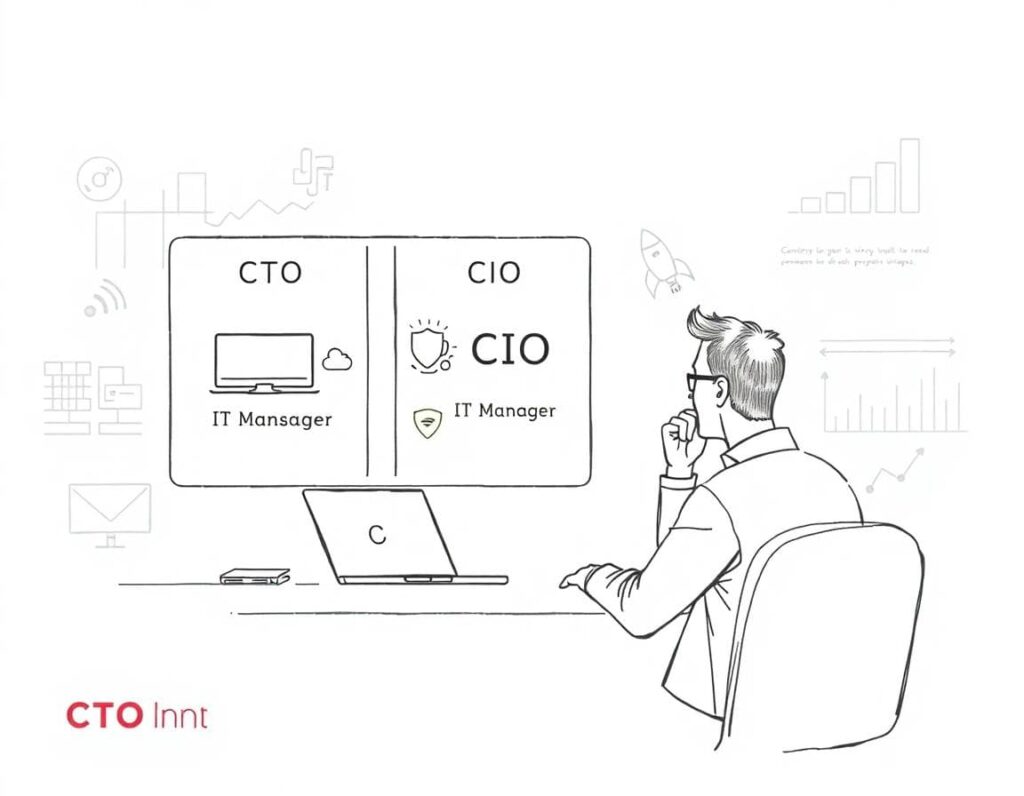
You are not alone if you are staring at your tech spend and wondering: “Do I need a CTO, CIO, or just a good IT manager?”
For a CEO, COO, or founder in the $2M to $250M range, technology often feels like a black box. Costs keep climbing, cyber risk keeps growing, AI vendors are pitching hard, and projects stall just when you need them most. The board wants clear answers. The team wants fewer outages. You want proof that every dollar is pulling its weight.
This article gives you a simple, practical way to match the level of technology leadership to the problems you actually have today. Not the org chart a Fortune 500 company uses, and not what a software vendor wants you to buy. By the end, you will know whether you need stronger IT management, a true CIO, a CTO, or a mix that includes fractional leadership.
What a CEO Really Needs From Technology Leadership Today
You do not wake up wanting a job title. You wake up wanting outcomes.
You want fewer outages that disrupt customers and staff. You want lower cyber risk that will stand up to investor and lender scrutiny. You want a tech budget that supports growth, not a mysterious tax on it.
In 2025, mid-market teams are trying to control cost, strengthen cybersecurity, and use AI in a focused way, all with lean teams and limited time. That tension is why your choice of technology leadership matters so much.
The right leader helps you:
- Turn scattered IT spend into a clear, ranked roadmap.
- Turn vendor pressure into vendor control.
- Turn stalled projects into predictable delivery.
- Turn vague cyber concerns into risk you can explain to the board.
Titles like CTO, CIO, and IT manager are just different tools for getting those outcomes.
Signals Your Current Tech Setup Is Holding the Business Back
You do not need a technical audit to see the warning signs. If any of these feel familiar, your current setup is already costing you growth, margin, or sleep:
- Constant firefighting: The team spends most of its time reacting, not planning.
- Late or missing projects: Key projects slip quarter after quarter, with no clear owner.
- Unclear cyber ownership: No single executive can confidently answer, “How exposed are we?”
- Vendors calling the shots: Your roadmap feels like a patchwork of what vendors sold you.
- Systems that do not talk: Teams re-enter data, export to spreadsheets, or build side databases.
- No simple roadmap: You cannot see a 12 to 24 month view of priorities, cost, and payback.
- Tense board or lender meetings: You get detailed questions about security, AI, or resilience and the answers feel thin.
These are leadership problems first, technology problems second.
Why Titles Like CTO, CIO, and IT Manager Get Confusing
Many mid-market companies use titles loosely. The “CTO” is really the lead engineer. The “IT manager” is doing CIO work at a discount. The “VP of Technology” sits somewhere in the middle and reports to the CFO.
At a simple level, each role focuses on a different kind of problem:
- IT manager: Keeps the lights on and the basics secure.
- CIO: Runs internal systems, risk, and efficiency.
- CTO: Drives customer-facing tech, products, and platforms.
Even large-firm explanations of the difference between CIO and CTO can miss how these roles look inside a $20M or $80M company. The key is to match the role to the problem you are trying to solve, not to copy a big-company org chart.
CTO vs CIO vs IT Manager: Which Role Matches Your Real Problem
When a Strong IT Manager Is Enough (and Still Very Powerful)
Think of the IT manager as the “keep the engine running” leader. When this role is strong, the basics feel boring in the best way.
A strong IT manager usually owns:
- Service desk and end-user support.
- Networks, Wi‑Fi, and core infrastructure.
- Basic security tools like backups, antivirus, and access control.
- Vendor coordination for things like email, devices, and basic cloud tools.
- Simple reporting on uptime and ticket volumes.
This is often enough when you:
- Have 10 to 75 employees.
- Rely mostly on standard software (Microsoft 365, a common CRM, basic ERP).
- Face lighter compliance and cyber scrutiny.
- Spend modestly on technology, mostly on licenses and support.
You probably need to upgrade your IT manager or small IT team, rather than hire a CIO or CTO, when:
- Outages and support issues hurt morale.
- Devices, accounts, and access are messy.
- Vendors are unmanaged and costs drift up every year.
- Staff complain daily about tools, but core strategy conversations do not depend on technology.
When You Actually Need a CIO to Own Systems, Risk, and Efficiency
A CIO is an executive, not a senior technician. Their job is to run technology as a business function that supports your strategy.
A good CIO will:
- Build and maintain a clear 12 to 36 month systems roadmap.
- Align technology projects directly to revenue, margin, and risk goals.
- Own the technology budget and make tradeoffs you can understand.
- Manage vendor risk and contracts across the company.
- Report to the board on cyber, resilience, and major incidents.
You are in CIO territory when:
- You run multiple core systems that must integrate well (ERP, CRM, billing, warehouse, etc.).
- Regulatory pressure or cyber insurance requirements are getting serious.
- Outages or data issues have already hurt customers or brand.
- Your annual tech spend is in the high six or seven figures.
- Investors, lenders, or the board keep asking deeper questions about risk and controls.
If you want a clear contrast of how CIOs and CTOs split internal systems vs external products, references like the CIO vs CTO definitions and differences can help, even if you adapt the ideas to a smaller scale.
When a CTO Is the Right Call for Product, Platforms, and Innovation
A CTO focuses on technology that touches customers and drives revenue. This is the person you trust with your product and platform future.
A real CTO will typically:
- Own the architecture and roadmap of your digital product or platform.
- Lead engineering teams that ship features, APIs, and integrations.
- Decide how you use data, AI, and automation inside customer experiences.
- Balance speed of delivery with reliability and security for your product.
You are ready for a CTO when:
- You are a SaaS or platform business where tech is the product.
- You depend on heavy custom software to stand out in your industry.
- Digital experience is becoming your main competitive edge.
- You run multiple engineering or product teams that need a single technical leader.
In this pattern, a CIO may still handle internal systems, but the CTO owns the revenue engine.
How Your Size and Revenue Shape the Right Role
Revenue is not the only signal, but it is a helpful shorthand when you combine it with complexity and risk:
- Roughly $2M to $20M: A strong IT manager, plus trusted outside advisors, is often enough. The priority is stability, basic security, and smart vendor choices.
- Roughly $20M to $100M: A CIO pattern starts to make sense once tech spend, integration, and risk hit a certain level. You need an executive to own systems, information, and cyber.
- Above $100M or product-led at any size: If digital products or platforms drive a big share of growth, a CTO becomes key, even if the company is still mid-market on revenue.
The real triggers are complexity, risk, and growth ambition, not revenue alone. Some $15M firms already need CIO-level thinking. Some $80M firms still struggle with the basics and should start with better IT management plus fractional help.
For more context on how companies split technology titles as they grow, articles that map out technology leadership titles and responsibilities can be a helpful cross-check.
Fractional CTO or CIO vs Full-Time Hire: A Practical Path for Mid-Market Teams
Hiring a full-time CIO or CTO is a big fixed cost. In many mid-market companies, it is also premature.
A common sweet spot is this: a strong internal IT manager for day-to-day operations, backed by fractional CTO or CIO leadership for strategy, risk, and large projects. You get senior experience a few days a month instead of a full-time salary.
Fractional leaders can:
- Build the roadmap.
- Translate board pressure into a clear tech plan.
- Coach your IT manager into a stronger role.
- Lead major initiatives like ERP replacement or data platform work.
This model matches the trend in 2025 where mid-market firms want flexible access to senior talent rather than large permanent teams.
When a Fractional CTO or CIO Is the Best Fit for Your Stage
The fractional model is usually a fit when:
- The board is pushing for clearer cyber and resilience answers.
- A CRM or ERP replacement has stalled or keeps missing milestones.
- Your vendor and SaaS stack is messy and nobody owns the big picture.
- You are planning an acquisition that will add complex systems and data.
- You know you will need a full-time CIO or CTO later, but not yet.
In these cases, a fractional leader can step in for 12 to 24 months, set direction, clean up risk, and build internal capability. Firms like CTO Input specialize in exactly this pattern, acting as your side-of-the-table advisor rather than another vendor.
Simple Checklist: What to Do in the Next 90 Days
Use this as a quick 90-day plan:
- Write down your top three technology problems in plain business language.
- Map who currently owns operations, risk, and product, and where the gaps are. A technology leadership team structure shows how CIO, CISO, data, and product seats divide that ownership.
- Decide whether your primary need is stronger operations (IT manager), better strategy and risk ownership (CIO), or product and platform leadership (CTO).
- Explore fractional CTO or CIO options before you commit to a full-time C-level hire.
- Set a simple 12-month target, such as “fewer outages, clear cyber story, and one major project delivered on time.”
Conclusion: Start With the Problem, Not the Title
The right question is not only, “Do I need a CTO, CIO, or just a good IT manager?” The real question is, “What problem am I trying to solve, and what level of technology leadership matches that problem?”
For many mid-market companies, the winning pattern is a strong IT manager who runs the basics well, guided by fractional CTO or CIO leadership that connects technology, cost, and risk to the growth plan. That mix gives you clarity for the board, control over spend, and a path to smarter use of AI and data without locking you into a premature full-time hire.
If you want help thinking this through for your own company, visit CTO Input and explore more practical guidance, examples, and use cases on the CTO Input blog.