

Your company is no longer scrappy and small. At around 20 million in revenue, you have real customers, real risk, and a board or investors who expect clear answers about how technology supports growth.
At this stage, technology is not just email, Wi‑Fi, and a ticket queue. It is tied tightly to revenue, margin, brand trust, and how lenders view your risk. Which is why the question, “What should a growing company expect from a technology leader?” stops being theoretical and starts feeling very personal.
By “technology leader,” think of a CTO, CIO, head of technology, or a fractional executive who owns the intersection of systems, data, and business strategy. This article gives you a practical checklist for what “good” looks like, in plain language, so you can judge your current setup and any future hires without getting lost in technical jargon.
Why a $20M company needs more than an “IT person”
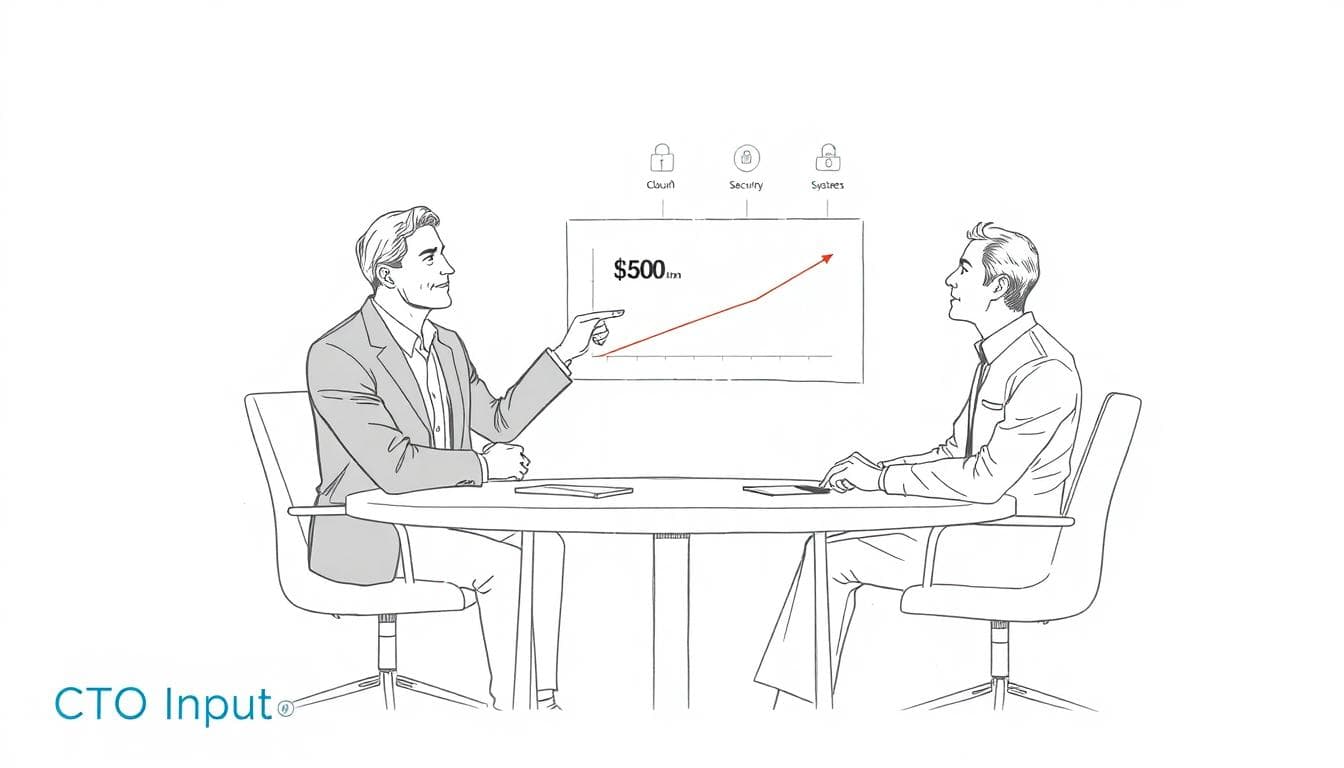
Illustration of a CEO and technology leader aligning on a growth roadmap. Image created with AI.
Around 15 to 25 million in revenue, the character of your technology problems changes.
You feel it in small ways first. Projects drift for months. New tools are bought but never used properly. Teams export data into spreadsheets because systems do not talk to each other. Then the stakes rise. Cyber insurance forms take longer to fill out. A lender asks about your recovery time after a cyber incident. The board asks how AI is being used and whether it is safe.
If you only have an “IT person,” their day is consumed with outages, access requests, and vendor calls. Useful work, but not leadership.
At this stage, what should a growing company expect from a technology leader? At a high level, you should expect someone who:
- Connects technology choices directly to revenue, margin, and risk
- Sets a clear direction so random projects stop hijacking your roadmap
- Gives you simple, honest views of risk, not dense technical briefings
- Treats your tech budget like their own money
Modern descriptions of CTO responsibilities, such as this review of key roles and responsibilities of a CTO, echo the same point: the job is now part strategist, part risk manager, part operator.
From fixing systems to setting direction
A hands-on IT manager focuses on tools, tickets, and keeping lights on. You need that capability, but at 20 million in revenue it is not enough on its own.
A technology leader:
- Starts from the business plan, not the tool catalog
- Translates goals like “grow EBITDA by 5 points” into a simple tech roadmap
- Says “no” when a request does not fit the plan, and explains why
Think of the IT manager as the mechanic and the technology leader as the head of operations. Both matter. Only one is hired to decide where the business is driving and how it gets there safely.
The hidden cost of not having real technology leadership
When nobody owns technology at the executive level, the costs compound quietly:
- Vendors steer strategy because nobody inside has time to challenge them
- Security is handled as an afterthought, until a serious incident or a failed audit
- “Transformation” projects stall halfway, leaving you with half-old and half-new processes
- Friction grows between business and tech teams, because nobody is translating
Articles on the evolving CTO role, like this piece on how CTO responsibilities are changing, show the same pattern at scale-ups: companies without clear technology leadership spend more, move slower, and carry more risk than they realize.
The rest of this article turns that concern into a concrete benchmark, so you can judge if your current leader or a fractional option meets the mark.
What a growing company should expect from a technology leader
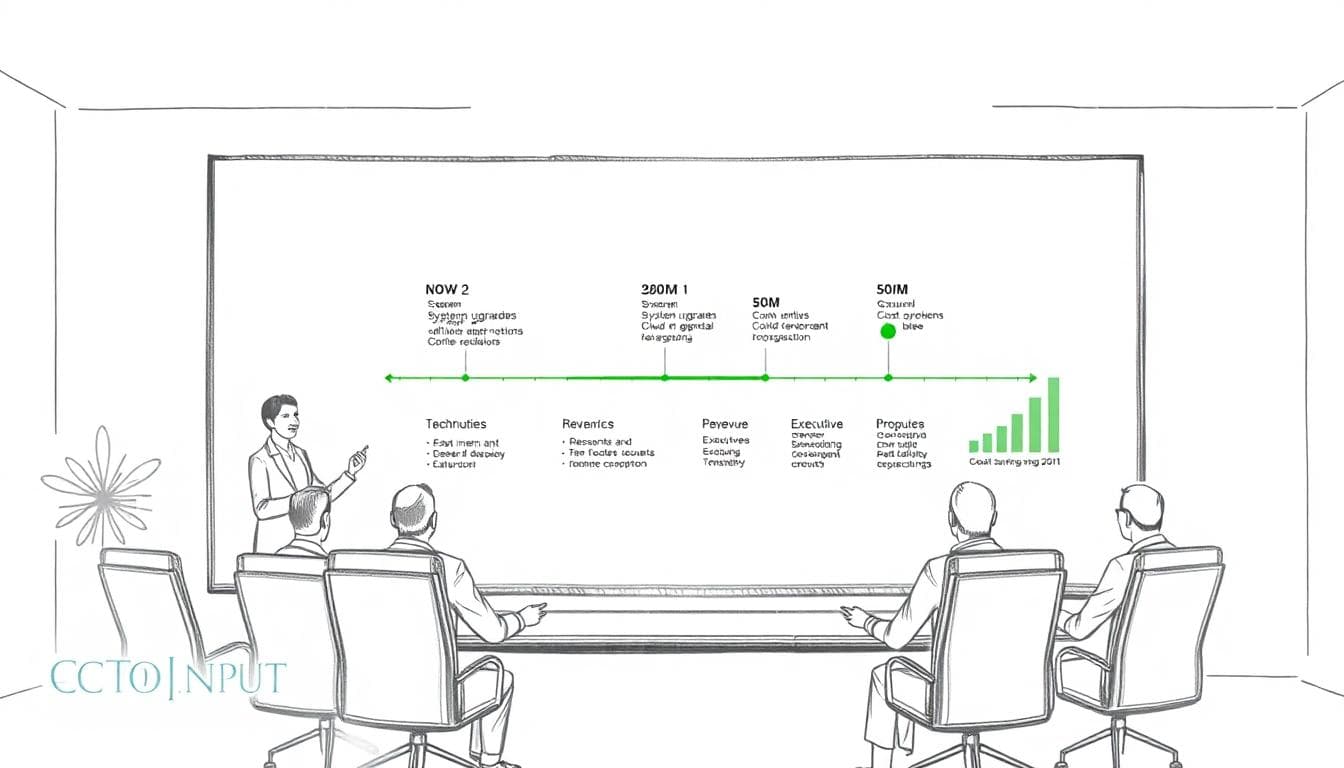
Illustration of a technology roadmap review with the leadership team. Image created with AI.
This is the core answer to what should a growing company expect from a technology leader. Think in six buckets: strategy, scalability, risk, spend, people, and communication.
Clear technology strategy that matches the growth plan
Your technology leader should own a 12 to 24 month roadmap that:
- Maps directly to revenue targets and margin goals
- Shows which systems will change, when, why, and at a rough cost
- Flags what must be done first to unblock growth or reduce risk
This roadmap should let you answer board and lender questions without guessing. For example, if you plan to grow from 20 to 50 million in revenue, you should be able to point to how the CRM, billing, and data stack will support that growth, not just “we will add more people.”
Leaders who have scaled from startup to mid-market, like in this CTO journey from 10M to 20M ARR, stress the same thing: the technology roadmap must mirror the business roadmap.
Systems and data ready to scale from $20M to $50M
Your technology leader should be constantly asking, “What breaks at 2x volume?”
You should expect them to:
- Review current systems for bottlenecks, weak integrations, and heavy manual work
- Select cloud tools that can handle more customers without surprise costs
- Clean up and standardize data so leadership can trust reports
- Protect performance for customer-facing systems as traffic grows
The goal is simple. When the business wins more deals, you should not have to pause and “catch up” your systems every quarter.
Serious focus on cybersecurity, resilience, and compliance
At 20 million in revenue, cyber risk is not just an IT problem. It is a board issue.
A modern technology leader owns that conversation at the executive table. That means:
- Multi-factor authentication on key systems
- Regular backups that are tested, not just configured
- A basic incident response plan, with named roles and clear steps
- Vendor risk checks for critical partners and apps
- Alignment with key regulations in your industry
You should receive plain-language updates on risk, including where you are strong, where you are exposed, and what it would cost to close the gap. No jargon wall, no 40-page PDFs.
Smart control of technology spend and vendor decisions
Your technology leader should act as a steward of your tech budget.
That includes:
- Reviewing licenses and cloud spend for waste and overlap
- Challenging large vendor renewals and “upsell” packages
- Showing how changes will impact EBITDA, not just uptime
- Framing choices as trade-offs, not as “must-buy” decisions
Their loyalty belongs on your side of the table. They should be the person who can calmly say, “We are overspending here, we are underinvesting here, and here is the return if we rebalance.”
A healthy, accountable tech team that works with the business
Finally, your technology leader is responsible for the human system, not just the technical one.
You should see:
- Clear roles, with someone accountable for each key system
- Simple processes for requests, priorities, and changes
- Basic documentation, so knowledge does not live in one person’s head
- A culture where business leaders feel heard, not dismissed
The leader’s job is to reduce friction between tech and the rest of the company. Projects should have owners, timelines, and visible progress. Non-technical leaders should understand what is happening without having to chase.
How to tell if your current technology leadership is enough

Photo by Mikael Blomkvist
You might have a strong internal leader who just needs clearer expectations. You might have someone who grew up from “IT person” and is now stretched thin. Or you might have a gap at the top altogether.
Here is a simple self-check.
Simple signs your technology leader is serving the business
You are in better shape than you think if:
- You have a 12 to 24 month roadmap that connects tech work to revenue and risk
- Leadership receives regular, non-technical updates on projects and cyber risk
- Outages and surprises have dropped over the past year
- Vendor requests feel calmer, not louder
- You can link major tech spend to clear business outcomes
In short, you sense that technology is an engine for your strategy, not a random cost center.
When to consider fractional CTO, CIO, or CISO support
A full-time, senior technology leader is a serious hire. Many 20 million revenue companies cannot yet justify the cost or struggle to attract the right person.
This is where fractional leadership can make sense. As described in discussions of fractional CTOs for mid-market companies, a fractional executive can:
- Bring a proven playbook for strategy, risk, and scale
- Build your roadmap and board story
- Mentor your existing team and managers
- Stay engaged part-time to keep things on track
You keep your current staff, gain senior judgment, and align technology with the business without adding a full-time executive seat before you are ready.
Conclusion: Turning technology into a trusted growth engine
So, what should a growing company expect from a technology leader at around 20 million in revenue?
You should expect a clear roadmap tied to your growth plan, safer and more reliable systems, technology spend that you can explain in financial terms, and a stronger team that works with the business, not around it. Most of all, you should expect clarity instead of noise.
Take an honest look at where you stand today across strategy, scalability, risk, spend, and people. If the gaps feel wide or fuzzy, you do not have to solve them alone.
Visit https://www.ctoinput.com to see how fractional technology leadership works in practice, and how it can support your next stage of growth. Then keep learning and pressure-testing your thinking by exploring the CTO Input blog at https://blog.ctoinput.com.