

Every notification on your screen feels like a fire. A security alert. An AI vendor pitch. A CRM issue that is “blocking sales.” A board member forwarding an article about the latest breach with a one-word note: “Thoughts?”
You keep asking yourself, “How do I prioritize technology investments when everything feels urgent?”
You are not short on ideas or pressure. You are short on a simple way to sort the noise, make clear tradeoffs, and explain to your board why you are funding some projects now and parking others. Especially when you do not have a senior technology leader you fully trust.
This article gives you a practical system you can run from a single page. It will help you separate urgent from important, decide where your next dollar goes, and defend those decisions with confidence.
Why everything feels urgent when you look at technology
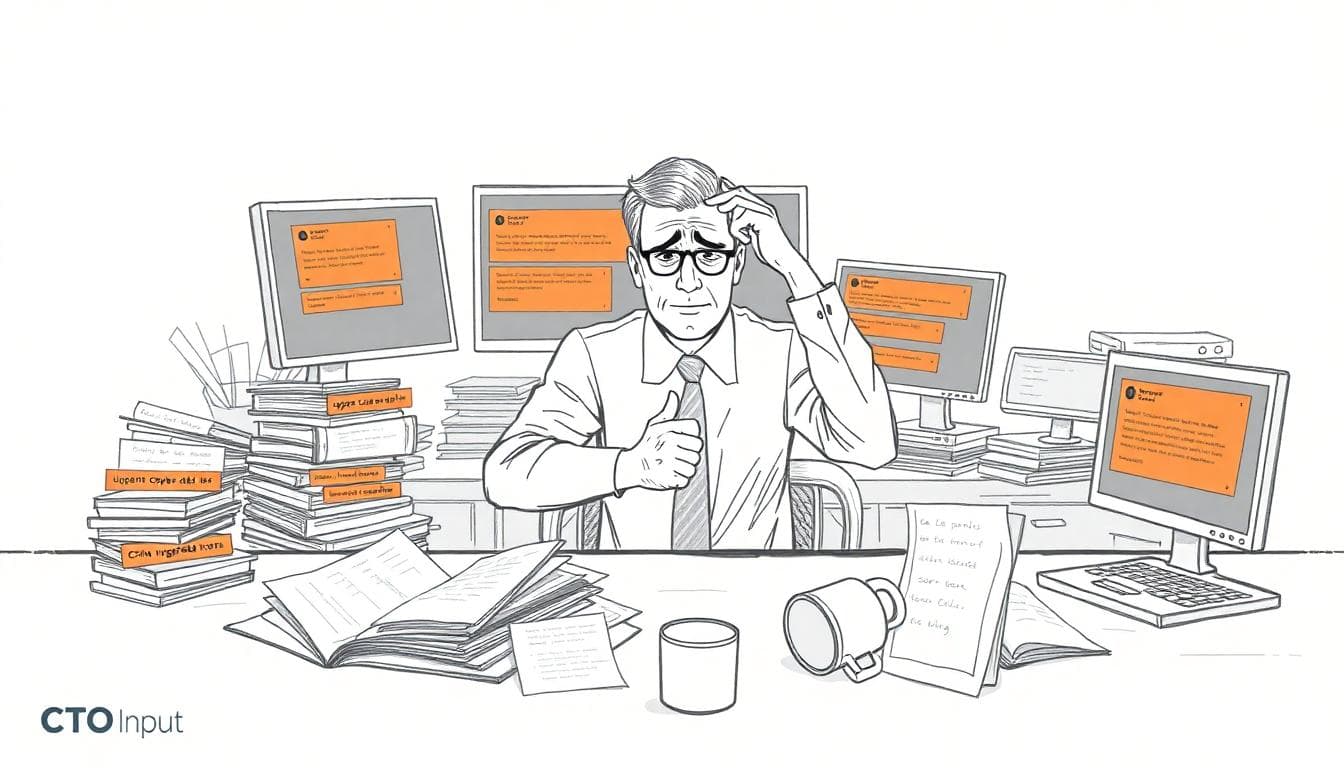
Mid-market CEO overwhelmed by competing technology priorities. Image created with AI.
For most mid-market leaders, technology has turned into a noisy trading floor. Everyone is shouting at once, and the prices keep changing.
Part of this comes from real change. Customer expectations keep rising. Cyberattacks keep climbing. New tools like AI show up weekly and promise “10x” gains. Articles about small business tech budgets, like this one on integrating technology for growth, tell you that smart tech spending is now table stakes.
The other part comes from how your company grew. You added systems, tools, and vendors one decision at a time. Each one made sense in the moment. Over time, you ended up with overlapping systems, manual workarounds, and gaps no one fully owns.
You feel the result as delay, risk, and noise. Your team feels it as burnout.
You are getting pulled in five directions at once
On a normal week you might hear:
- “Marketing needs this new CRM feature to hit next quarter’s target.”
- “Finance cannot close the books on time without better reporting.”
- “Operations keeps losing hours to outages on that old system.”
- “IT says the servers are at risk and must be upgraded now.”
- “Security wants another set of tools to handle new regulations.”
- “The AI vendor says we are falling behind competitors.”
Each of those sounds urgent. Each links to real money, trust, or risk.
You also have vendors whose business depends on convincing you their piece is top priority. Articles about rightsizing tech spending, like this one from BizTech Magazine on tech investments, warn about this exact pattern: tool sprawl, rising cost, unclear value.
The real risk: trying to do everything and moving nothing
When you do not have a clear way to prioritize, a familiar pattern shows up.
You say “yes” to too many projects. Your IT and operations teams spread thin across upgrades, integrations, and fixes. Projects slip. Shortcuts stack up. People get tired and start making mistakes.
You start seeing:
- Delayed go-lives that push revenue into “next quarter.”
- Fragile integrations that break under load.
- Security work postponed to “after the launch.”
- Vendors controlling the timeline instead of you.
Trying to do everything at once becomes its own risk. It threatens revenue, trust, and compliance as much as any single cyber incident.
The answer is not buying more tools. It is making better choices about what gets time, money, and attention first.
A simple system to prioritize technology investments with confidence
You do not need a 50-page IT strategy to regain control. You need a simple, repeatable way to answer: How do I prioritize technology investments when everything feels urgent?
Here is a lightweight system you can run with your team in a half day, then refine each quarter.
Step 1: List every tech request in plain business language
Start by putting everything on one list:
- New projects and features.
- System upgrades and replacements.
- Vendor tools and renewals.
- Security fixes and compliance work.
- AI and automation ideas.
Write each item as a business outcome, not a technical task.
- Say “reduce payment failures by 30%” instead of “replace payment gateway.”
- Say “cut warehouse picking errors in half” instead of “upgrade WMS.”
- Say “reduce ransomware exposure” instead of “deploy EDR.”
This forces clarity. It also levels the field between IT, finance, operations, and security. Invite leaders from each area to the table so nothing critical stays hidden or “off the books.”
Step 2: Score each item on value, risk, and effort
Next, score every item on three simple criteria, using a 1 to 5 scale. You are not doing precision math. You are creating a shared view.
| Criteria | Question to ask | Score 1 vs 5 example |
|---|---|---|
| Business value | How much will this help revenue, margin, or customer experience? | 1 = small, 5 = major growth or savings |
| Risk impact | How much does this reduce cyber, compliance, or downtime risk? | 1 = minor, 5 = major risk reduction |
| Effort | How much time, money, and people will this take to deliver well? | 1 = very light, 5 = large cross-team project |
For each project, talk it through in plain terms. Align with your strategy: growth, trust, and stability. Do not let it turn into a deep technical debate.
If you want a deeper background on this idea, there is a helpful article on prioritizing IT investments that uses similar scoring, tailored for smaller businesses.
Step 3: Use an impact versus effort view to find quick wins and big bets
Now, use those scores to create a simple impact versus effort view.
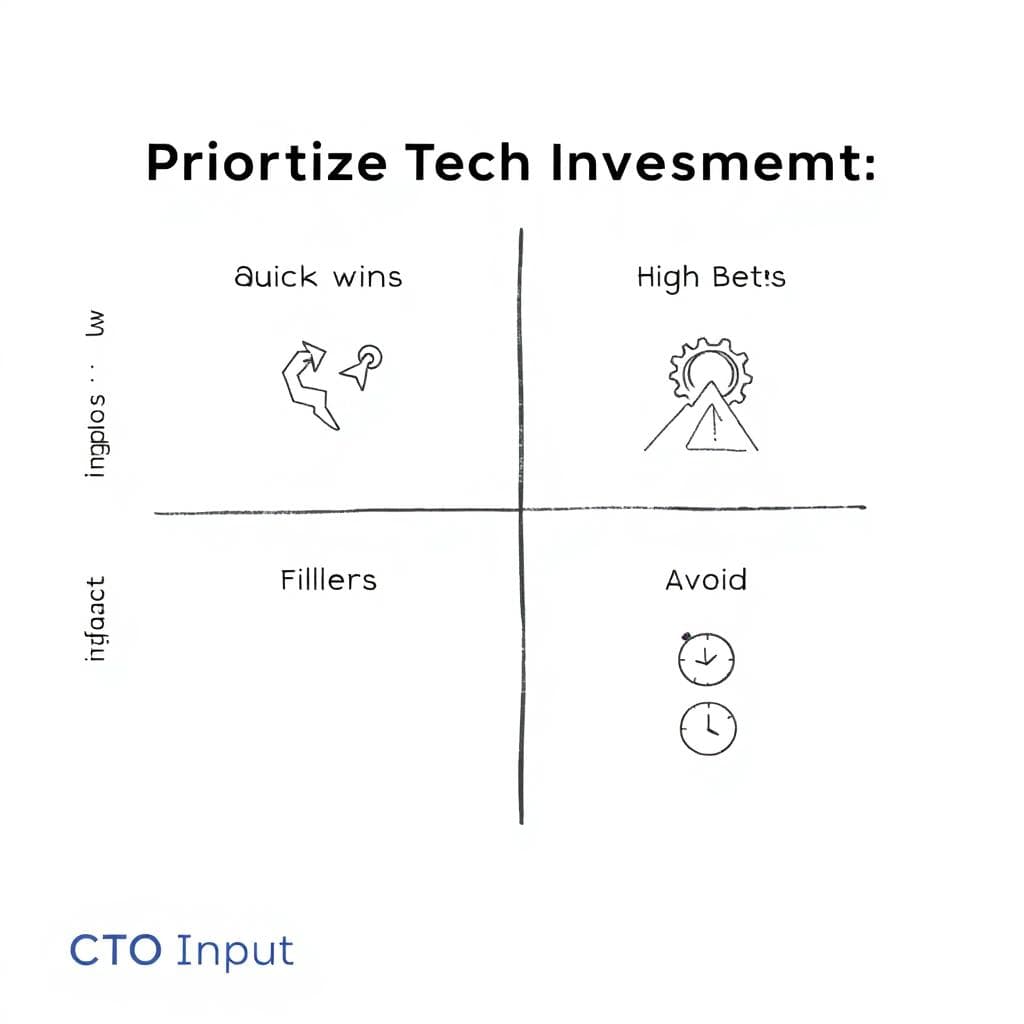
Impact vs effort matrix for technology investments. Image generated by AI.
Group items into four buckets:
- Quick wins: High value, low effort. These build momentum, free up cash, and earn trust fast.
- Strategic bets: High value, high effort. These are your big moves for growth or efficiency.
- Hygiene and risk basics: Core security and stability work you must do to protect revenue.
- Nice-to-haves: Lower value items, especially if they take real effort.
Quick wins and risk basics usually go first. Then you pick a small set of strategic bets.
This gives you a visual and a language to answer, “How do I prioritize technology investments when everything feels urgent?” You are no longer reacting to noise. You are choosing based on impact and effort.
Step 4: Limit active projects and protect capacity
Finally, decide how many major tech projects your company can truly run at once. Be honest.
For many mid-market firms, that number is between 3 and 7 meaningful initiatives, not 20. Everything else goes into “not yet” or “later this year.”
This kind of work-in-progress limit:
- Speeds up delivery on the most important items.
- Lowers operational and security risk.
- Reduces burnout in IT and operations.
Revisit the list each quarter. Strategies, risks, and capacity change. So should your priorities.
When new vendor pitches or sales tools show up, use the same system. Some leaders even use guidance like this sales tech investment article to challenge whether another tool is really needed, or if they should fix usage and process first.
Turning your tech priority list into a clear roadmap the board will trust
You now have a scored list and clear buckets. The next step is turning that into a roadmap your board, lenders, and leadership team can stand behind.
Connect each tech investment to revenue, risk, and customer outcomes
For every priority item, write a one-line business case:
- The problem it solves.
- The metric it moves (revenue, margin, uptime, risk, or NPS).
- When you expect value to start showing up.
For example:
- “Reduce payment failures by 30%, lifting monthly collected revenue by 2 to 3 percent within 6 months.”
- “Cut outage-related downtime in half, protecting an estimated $500k in at-risk revenue per year.”
- “Meet new security standard to keep key banking partner and avoid contract penalties.”
Use this framing to push back on vendor-driven urgency. When a vendor says, “You will fall behind if you do not buy this now,” your team can respond, “Here is where it sits on our impact and effort grid, and what it would replace.”
Your board will start to see a pattern: you are funding clear outcomes, not shiny tools.
Share a simple 12 to 24 month roadmap, not a long wish list
Your roadmap should fit on one page. Aim for:
- A short list of committed projects for the next 3 to 6 months.
- A set of likely projects for the next 6 to 12 months.
- A small group of options and investigations beyond that.
Make the tradeoffs visible. Show what you are not doing so the board understands you are making conscious choices, not leaving gaps by accident.
Many teams ask a seasoned outside CTO or CIO advisor to run this process across business and IT, especially when trust is low or the agenda is crowded. That neutral voice can keep the scoring honest, right-size scope, and tie every line of spend back to the growth plan and risk posture.
Conclusion: From chaos to a clear tech story you can defend
When everything feels urgent, the real advantage is not more tools. It is a simple, shared way to compare value, risk, and effort, then pick a few things to do very well.
You now have a system you can run with your team: plain-language requests, simple scoring, an impact versus effort view, and firm limits on what runs at once. That gives you control of tech spending and risk, and a story your board can respect.
The next time you ask, “How do I prioritize technology investments when everything feels urgent?”, you do not need a guess. You have a method.
If you want help building and running this kind of roadmap for your own company, visit CTO Input to see how experienced fractional CTO, CIO, and CISO leadership can sit on your side of the table. To go deeper on technology, cost, and risk topics, explore more practical articles on the CTO Input blog.