
You look at your tech stack and feel that familiar knot in your stomach. Outages hit at the worst times. New features crawl out the door. Tech spend keeps rising, yet the board is asking sharper questions about risk, security, and resilience.
You catch yourself thinking, “We have technical debt everywhere. How do I prioritize what to fix first?”
In plain terms, technical debt is the stack of shortcuts, quick fixes, and old decisions that now slow you down or add risk. It is not a moral failure. It is the interest you pay on past growth.
This article gives you a simple, business-friendly way to rank technical debt so you can decide what to fix first, defend those choices to your board, and bring your team into the same conversation. No jargon. Just a clear method you can use in your next leadership session.
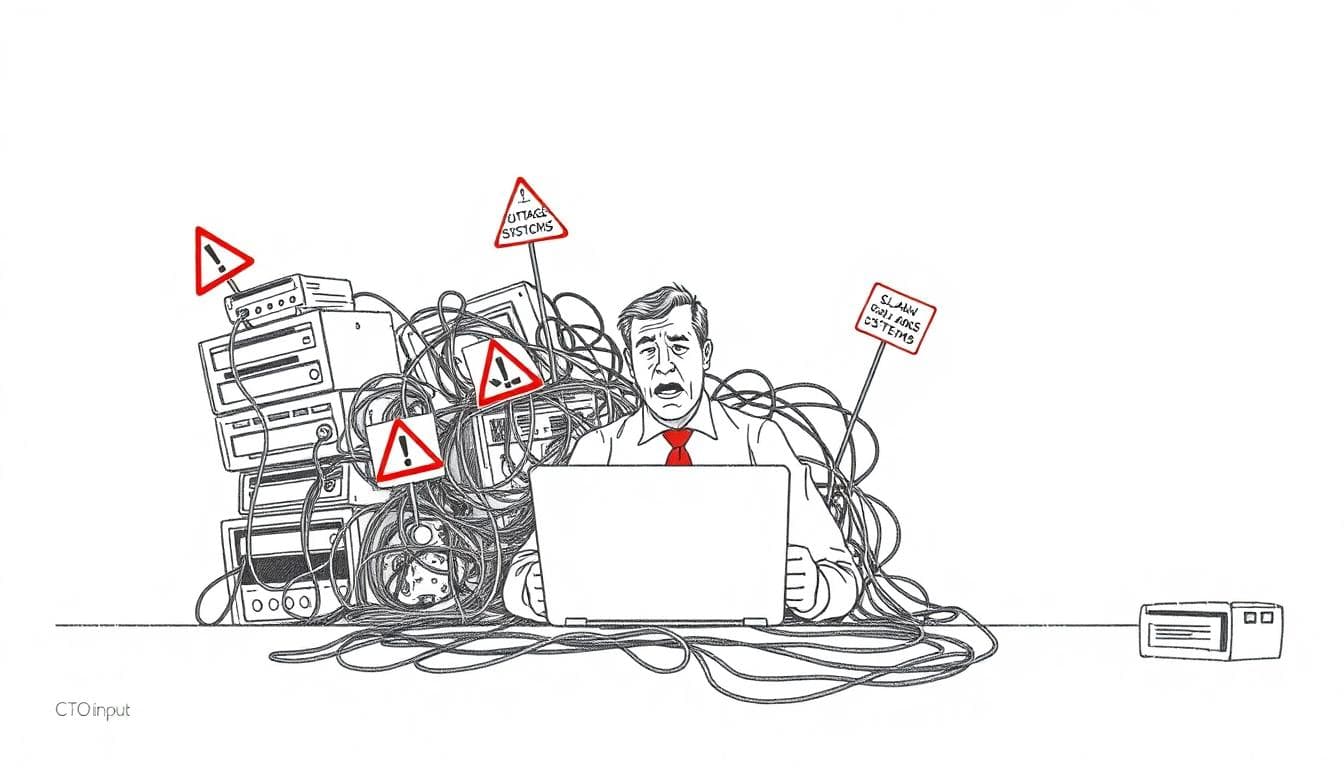
Overwhelmed executive surrounded by messy systems and warnings, symbolizing technical debt everywhere. Image created with AI.
What “Technical Debt Everywhere” Really Means for Your Business
You feel the pain long before anyone shows you a system diagram. The signals are business signals: missed revenue, unhappy customers, overtime, and awkward answers in board meetings.
Simple definition: how technical debt shows up in day-to-day operations
You see technical debt every day, even if no one uses the term:
- Fragile systems: A key platform goes down during peak hours. You lose sales and trust in a single afternoon.
- Manual workarounds: Teams patch missing features with spreadsheets and copy-paste. People work late, errors grow, and morale drops.
- Slow changes: A “simple” feature takes three months. Sales loses deals because prospects hear, “We can’t do that yet.”
- Security gaps: Old servers, weak access controls, no clear view of who can see what. Your exposure grows with every new integration.
- Vendor lock-in: One vendor controls pricing and pace. You know the terms are bad, but moving off feels risky and expensive.
Each one lands as lost revenue, slower sales cycles, staff burnout, or more compliance risk. That is why technical debt is not just an IT topic. It is a business drag.
For a product angle, some product leaders tie technical debt to customer outcomes and KPIs, as described in this guide on how product managers manage technical debt. You can apply the same thinking at the company level.
Why you feel it everywhere at once (and why that feeling is valid)
If your company is in the 2 to 250 million range, your story is common:
- You grew quickly, sometimes through acquisitions.
- Different teams bought different tools.
- Old systems stayed because they “still work.”
- Security and compliance requirements kept rising.
Now you have old platforms, half-finished projects, messy data, and rising cyber risk, all at the same time. Of course it feels like everything is on fire.
The key move is not “fix everything.” That is impossible. The key move is to decide what matters most to the business now, then sequence the rest so you can show steady progress.
A Simple Framework to Prioritize Technical Debt Like an Executive
You do not need a 200-line backlog to regain control. You need a clear, shared way to rank a short list of issues.
Here is a simple framework you can work through in a single workshop with your leaders and your top tech person.
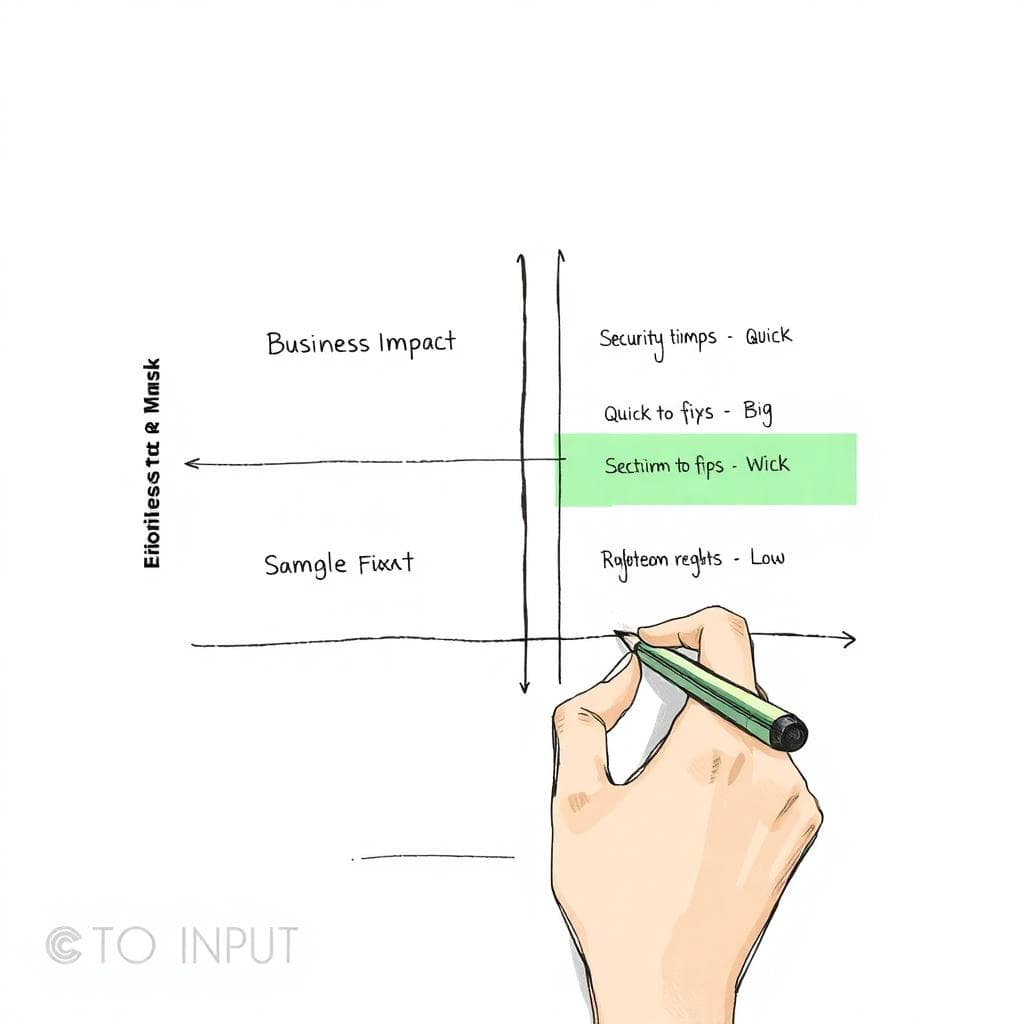
Simple impact-versus-effort grid for technical debt decisions. Image created with AI.
Step 1: List your top 10–15 technical debt pain points, not every flaw
Trying to document all technical debt is like trying to count every grain of sand on a beach. You do not need that.
Start with 10 to 15 items that actually hurt the business today. Ask your leaders:
“Where do we feel real pain, delay, or risk at least once a month?”
Typical entries:
- Repeated outages or slow performance in a revenue-critical system
- Manual processes that block billing, onboarding, or renewals
- Data quality problems that make reporting slow or unreliable
- Compliance gaps that could fail an audit
- Clear security weaknesses, such as shared admin accounts or no backups
Talk to operations, sales, finance, and your tech lead. Capture problems, not solutions. “Billing batch fails twice a month” is better than “rewrite billing system.”
Step 2: Score each item by business impact, risk, and friction
Next, score each item from 1 to 5 on three simple factors. Keep it rough, not precise.
- Business impact
How much does this hurt revenue, customer experience, or brand?- 5: Direct revenue loss or major customer impact
- 3: Noticeable hits to internal efficiency or some customers
- 1: Local annoyance, mostly internal
- Risk
How much does this expose you on security, compliance, or “single point of failure” risk?- 5: Could trigger a breach, major outage, or failed audit
- 3: Moderate risk that worries you and your board
- 1: Low risk, even if annoying
- Friction
How much does this slow teams and projects?- 5: Multiple teams complain, core projects stall
- 3: One key team slowed, but work still moves
- 1: Inconvenient, but not a big blocker
Do this in one joint session. Business leaders bring impact and risk. Tech leaders bring which items are fragile and how often they break. The goal is shared truth, not perfect scoring.
If you want a deeper model later, you can borrow ideas from this article on strategies to prioritize tech debt, but start simple.
Step 3: Estimate effort to fix: quick win, medium, or big lift
You do not need a full project plan to judge effort. Ask your senior tech person or vendor to put each item into one of three buckets:
- Quick win: Days of work, no major dependency.
- Medium: A few weeks, some coordination across teams.
- Big lift: Months, multiple teams, or significant vendor change.
Use language that your whole team understands. “Quick win” and “big lift” are clearer than “5 story points.”
For now, “good enough” is good enough. You are looking for relative effort, not exact cost.
Step 4: Use a simple grid to pick what to fix first
Now picture a simple grid in your head.
- Vertical axis: Impact and risk (low to high)
- Horizontal axis: Effort (quick win to big lift)
Use that grid to sort your list:
- Top priority now: High impact and risk, quick wins or medium efforts
These give you strong return on investment and early risk reduction. - Next wave: High impact big lifts
These deserve a place in a 12 to 24 month roadmap. They are major bets. - Later or never: Low impact items, regardless of effort
You keep them on record, but they do not drive near-term spending.
This is where the conversation shifts from “who is shouting loudest” to “where is the best return on each dollar and hour.” It also gives you clear talking points for your board or lenders when you explain how you are reducing risk.
For another perspective on linking technical debt to customer value, you might find this piece on redefining technical debt with customer value in mind helpful once you have the basics working.
Step 5: Make technical debt part of normal planning, not a side project
Technical debt should not be a one-time “special project.” Fold it into how you already plan.
A simple pattern:
- Reserve a set slice of capacity each quarter, for example 15 to 25 percent, for agreed debt items.
- In monthly leadership meetings, ask for a 5-minute update on debt progress and risk reduction.
- When you approve new projects, ask, “What technical debt does this create and how will we pay it back?”
This rhythm stops new debt from piling up, keeps visible progress in front of the board, and shows your team that you take their pain seriously without freezing innovation.
Turning Your Technical Debt Plan Into Action in the Next 90 Days
Once you have your ranked list, you need movement. Not a glossy slide. Actual change inside the company.

Two engineers collaborating to stabilize systems and reduce recurring technical issues. Photo by Christina Morillo
Start with 2–3 high impact wins that your team can deliver fast
From your grid, pick two or three items that:
- Sit in the high impact and risk group, and
- Are quick wins or medium efforts
Examples:
- Stabilize the system that fails during quarter-end close.
- Close a known security gap, such as weak access controls.
- Remove a painful manual step in your quote-to-cash flow.
Make these your “90-day wins.” Announce them to your leadership team and your board. Share before-and-after metrics where you can, such as fewer outages or faster processing time.
Early wins do three things:
- Prove that your framework is real, not theoretical.
- Build trust with the board that you are reducing risk in a focused way.
- Free up capacity that was tied up in constant firefighting.
Build a clear one-page roadmap that your board can understand
You do not need a giant deck. You need one page that answers three questions:
- What are we fixing?
- Why does it matter to the business?
- When will we see the benefit?
Your one-pager should include:
- The high priority debt items you picked.
- Expected benefits in plain language, such as “less downtime in X system,” “faster customer onboarding,” or “lower audit risk.”
- Rough timing across the next 3, 6, 12, and 24 months.
- Simple measures of success, such as outage hours, ticket volume, or time to deploy.
Keep acronyms to a minimum. Focus on outcomes, not tools. This page becomes a shared map for executives, the tech team, and vendors, not just something IT presents once a year.
Conclusion: From Overwhelm To A Clear, Defensible Plan
You might still feel, “We have technical debt everywhere. How do I prioritize what to fix first?” The answer is not a magic formula. It is a simple, disciplined habit: look at business impact, risk, and effort, then act on a short, focused list.
By listing your top pain points, scoring them in plain language, and sorting them into quick wins, medium efforts, and big lifts, you create a story your board can follow and your team can execute. Technical debt becomes a managed portfolio, not a lurking monster.
Start with a 60 to 90 minute working session with your leaders and your senior tech voice. Build your first ranked list. Pick 2 or 3 wins for the next quarter. Then repeat.
If you want experienced, neutral leadership to turn that list into a road map that fits your growth plan, explore how fractional CTO, CIO, or CISO support from CTO Input can help at https://www.ctoinput.com, and dive deeper into related topics on the CTO Input blog at https://blog.ctoinput.com.
Ready to turn anxiety about technical debt into a clear plan for growth and risk reduction? Visit CTO Input and keep exploring practical guidance on the CTO Input blog.