
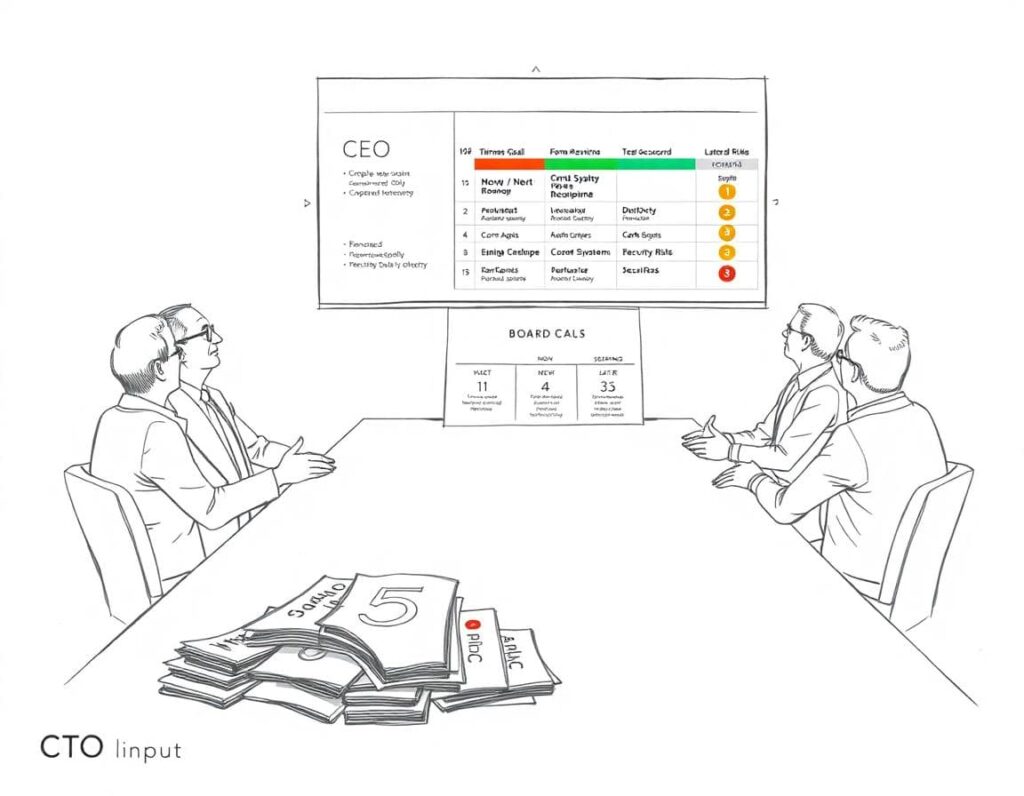
You are not crazy. Technology really has become loud, messy, and expensive in this era of digital transformation. Every week a new AI tool tied to the latest AI strategy, vendor pitch, or board question lands on your desk, and somehow you are the one who is supposed to make sense of it all without a technical background.
This technology strategy guide for CEOs is built for that exact moment. It is a simple, step by step approach to strategic technology planning that connects technology, cost, and risk directly to your business plan, using plain language you can take to your team and your board.
You will walk away able to:
- Define a clear, one page tech strategy,
- Choose a small set of smart bets, and
- Stop reacting to every vendor email or AI headline.
If you run a mid market firm in a trust heavy, regulated sector like healthcare, fintech, logistics, or manufacturing, you feel extra pressure from lenders and the board to “get tech right,” especially around cybersecurity risks. This guide will help you do that with focus, not noise. At the end, you will see how to get expert help from a fractional CTO, with a clear call to action and links to CTO Input resources if you want support putting this into practice.
 ## Get Out of the Tech Weeds: Why Your Strategy Starts With Business Goals
Most overwhelmed CEOs start in the wrong place. The conversation begins with artificial intelligence tools, cloud platforms, or the latest vendor demo, not with the business outcomes that actually matter.
That is how you end up with noise, wasted spend, and more cyber risk than you realize.
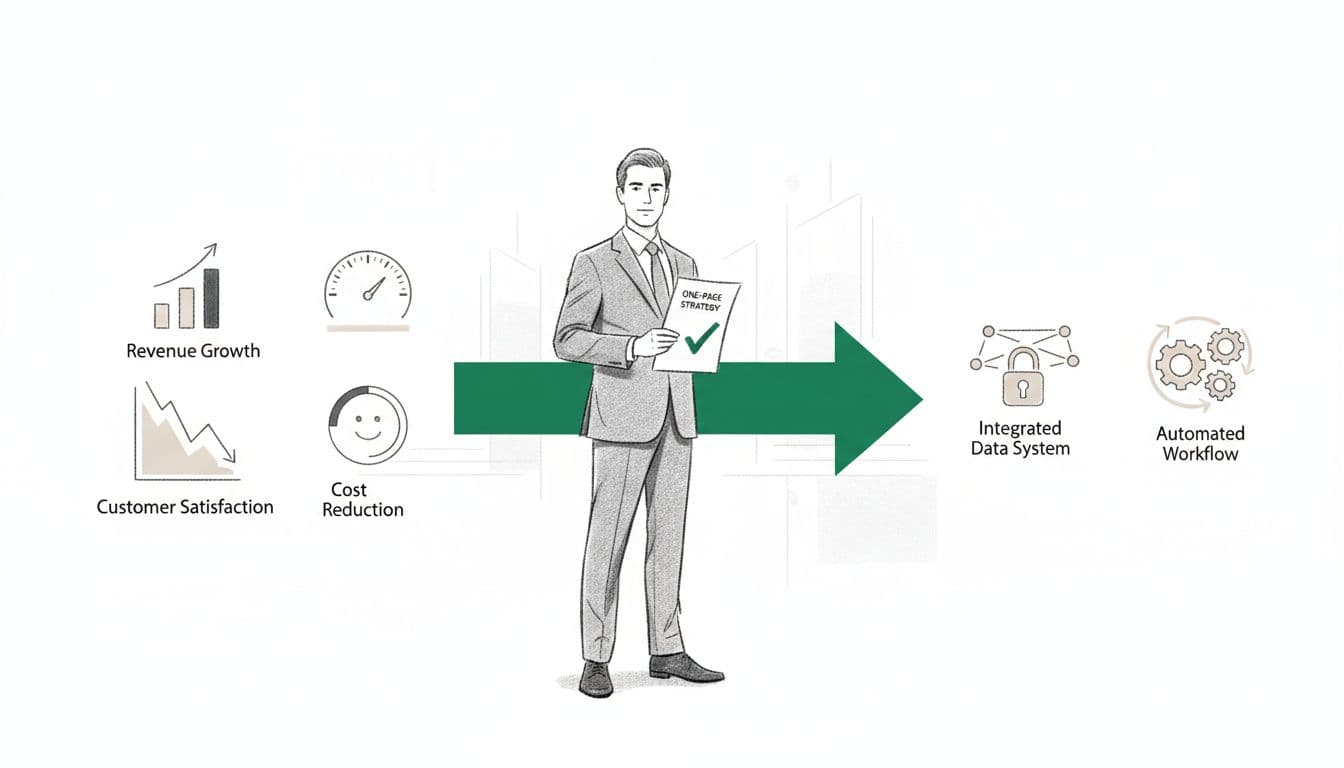
A strong technology strategy starts with your growth story, not with your tech stack, ensuring alignment with business goals. As Deloitte’s work on C-suite executives in health systems shows, when leaders line up around a small set of business goals, technology decisions become clearer and less political through effective strategic technology planning.
For a mid market CEO in healthcare, fintech, logistics, or manufacturing, those goals usually sound like this:
- Grow revenue in a clear segment, without blowing up risk.
- Reduce unit cost so margin improves, not just top line.
- Protect customer trust by staying reliable and compliant.
A good strategy limits your focus to 3 to 5 business outcomes for the next 12 to 24 months. Technology is then judged by a simple test. Does this help us hit those outcomes, reduce risk tied to them, or lower the cost to reach them?
You are not trying to create a perfect “enterprise architecture.” You are building a clear story that connects your balance sheet, your customers, and your board questions to the systems and data under the hood.
Name Your Top 3 Business Outcomes for the Next 12–24 Months
Start with one simple prompt:
“If we only hit three wins with technology in the next 18 months, what would they be?”
Keep it concrete. Examples:
- Grow revenue by 15% in mid market healthcare clients.
- Cut claims processing cost per transaction by 10%.
- Improve customer experience by raising NPS 10 points in our SMB segment.
Pick no more than three. Write each as a short, simple sentence that fits on one page. This page is not for your CIO. It is for you, your CFO, and your board.
Translate Each Goal Into a Simple Technology Question
Now, turn each outcome into a plain language tech question. You do not need the answer yet.
Examples:
- “What systems stop us from seeing our full customer picture?”
- “What manual steps slow this process down the most?”
- “Where would a cyber incident most damage this goal?”
- “What would a board member ask about risk here?”
You are building a bridge between business language and technology work.
Put all of these questions on a single page. That page becomes the top of your tech strategy. You can walk into any leadership or board meeting, put it down, and say, “These are the business outcomes, and these are the questions we expect technology to solve.”
 ## Know Where You Stand: A Simple Technology Health Check for Non Technical CEOs
Once you know what you want, you need a fast, honest technology assessment of where you stand today.
You do not need a 60 page audit. You need a CEO level snapshot of:
- Core systems and data,
- Security and compliance,
- People and vendors,
- Current projects and spend.
Your aim is to see three things: what is working, what is fragile, and where money and risk are concentrated. That picture decides where the first dollars and hours go, and what gets paused.
If you want a deeper dive later, you can always run a more formal audit using tools like this practical IT audit checklist for leaders. For now, we keep it simple and direct.
When you are ready to have an outside expert pressure test your view, you can bring in fractional CTO and CIO leadership from a partner like CTO Input to validate, refine, and translate this into a board ready plan.
Score Your Core Systems, Data, and Security on One Simple Page
Use a 3 color scale. No jargon, just judgment.
- Green: works and feels stable.
- Yellow: works, but painful or risky.
- Red: broken, unknown, or keeps you up at night.
Score three areas:
- Core business systems
ERP, EHR, payment platforms, warehouse tools, reservation systems. Ask, “Would I bet next year’s plan on these holding up?” - Data and assets
Can you get accurate numbers, by product or region, within days, not weeks? - Security and compliance
Ask yourself, “Would I be comfortable explaining our cyber posture to the board tomorrow?”
Put your colors on one page. Then ask your IT lead or head of engineering to do their own red, yellow, green rating. Compare. The gaps are where you need a clearer story.
 ### Follow the Money and Risk: Where Is Tech Helping or Hurting the Business?
Next, look at where the money and risk really sit.
Identify your three biggest tech cost buckets for effective management of technology investments:
- Licenses and subscriptions,
- Vendors and consultants,
- Internal teams and contractors.
For each, ask:
- Which systems clearly drive revenue or protect our brand?
- Which feel like overhead that no one loves, but we keep paying for?
- Where have outages, slow systems, or incidents actually hurt operations or audits?
List three to five concrete pain points, such as:
- Warehouse system outages that delay shipments twice a month.
- Onboarding a new banking partner takes 45 days instead of 10.
- Lack of capacity for innovation and experimentation due to legacy systems.
- Repeated findings in SOC 2 or PCI reviews tied to the same system.
These pain points, plus your red, yellow, green scores, show where your first tech bets should focus. If you want a deeper view on how other CEOs think this through, explore outside guidance on technology cost and risk tradeoffs for CEOs, then bring the best ideas back into your own plan.
Turn Chaos Into a Clear Plan: Choose a Few Smart Tech Bets and Build Your Roadmap
At this point you have:
- Three business outcomes,
- A page of technology questions,
- A simple health and cost picture.
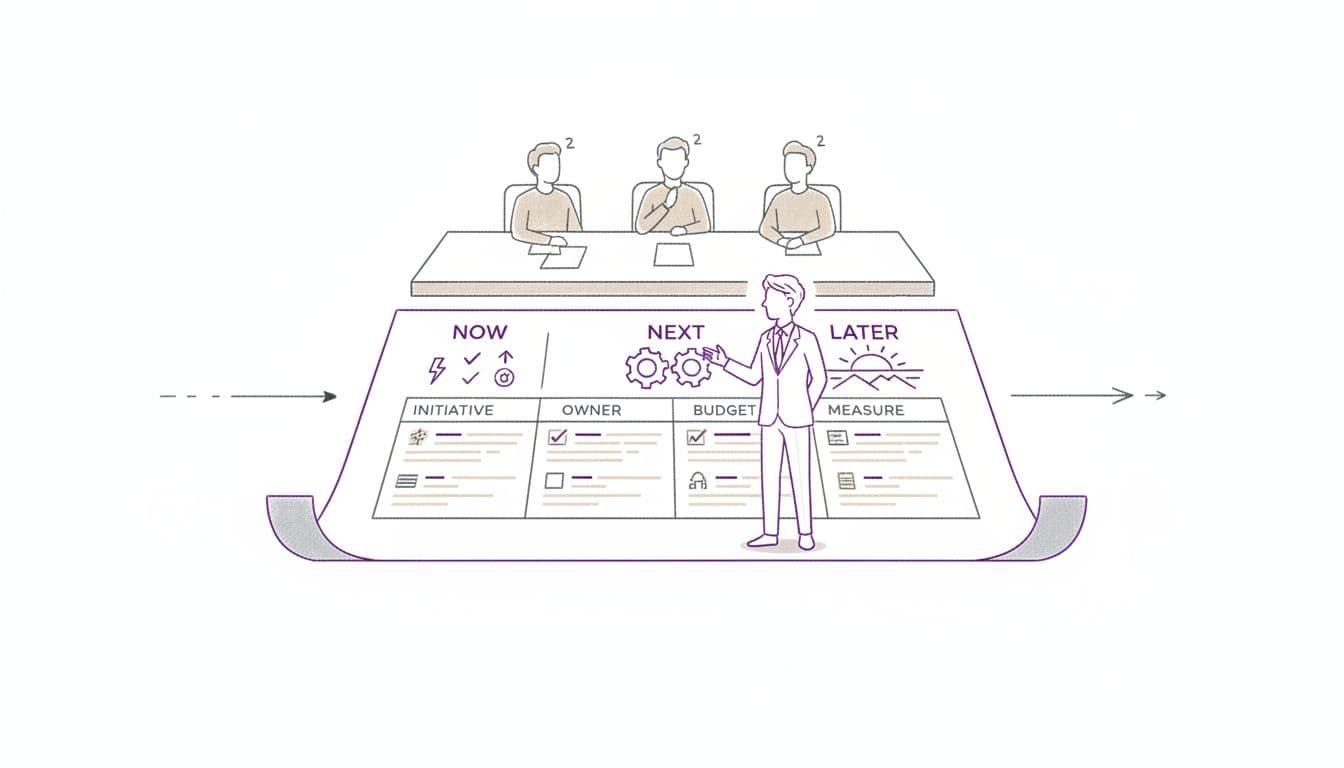
Now you turn that into a Technology roadmap that narrows choices instead of adding more, as part of your overall Technology Strategy for CEOs. Through Strategic Technology Planning, break your plan into three time buckets:
- Now (0 to 3 months): quick wins and urgent risk fixes.
- Next (3 to 12 months): key projects that move major metrics.
- Later (12 to 24 months): ideas worth tracking, not funding yet.
This structure lines up with how boards and lenders think, ensures greater Agility and resilience, and also aligns with common “Now, Next, Later” frameworks used in product planning, like the approach described in this overview of Now‑Next‑Later roadmaps.
As you fill each bucket, match initiatives to Technology budget, people, real capacity, and your Technology investments. Then set one firm rule: if a new tool or project does not land on this roadmap, it is a “no for now.”
If you want to pressure test that roadmap before you show it to your board, you can talk to a fractional technology executive who lives in this work every day.
 ### Pick 3 to 5 Technology Bets That Directly Support Your Top Goals
You do not need 20 projects. You need a handful of strong bets.
For each idea you hear from your team or vendors, test it with three questions:
- Does this clearly move one of my top three business outcomes, driving Value creation?
- Can we see real value in 6 to 12 months?
- Does it reduce a risk or cost we already feel, achieving Competitive advantage?
Bets that pass this test might include:
- Consolidate customer data into a single, trusted system to improve Customer experience.
- Automate the highest friction workflow in Business processes for claims, orders, or onboarding to streamline Business processes and increase Operational efficiency.
- Replace a fragile legacy app that causes outages and audit issues.
- Close a cyber gap that your board already worries about.
Avoid pet projects that are “cool” but not tied to outcomes.
Write one sentence for each bet:
“We will do X to achieve Y by Z date.”
If it cannot be written that clearly, it is not ready for your roadmap.
Build a Simple Now, Next, Later Roadmap So You Stop Chasing Every New Tool
Now place each bet into your three time buckets.
- Now (0 to 90 days):
A few quick wins and the most urgent risk fixes. These build trust that the plan works. - Next (3 to 12 months):
Larger projects that touch many teams, such as a CRM overhaul, data platform, or major security uplift. - Later (12 to 24 months):
Bets to revisit when capacity or market timing improves, including some Generative AI use cases that need more proof as part of your AI Strategy.
Put this on one page with four columns:
InitiativeOwnerRough budgetSuccess measure
Tie the Success measure column to Measuring success and KPIs. Anything not on that page is a “no for now.” That gives you a simple script when vendors or internal teams push a shiny new tool that does not fit the plan, so you stop chasing every new tool like the latest Generative AI without a solid AI Strategy.
This Technology roadmap structure requires strong Execution capabilities to deliver results. If you want a ready made structure, you can explore practical technology roadmaps for CEOs and adapt a format that fits your leadership style.
Conclusion: From Tech Chaos To a Clear, Confident Story
Effective CEO leadership does not require you to be a technologist. You need a clear story for your digital transformation.
You just walked through that story: the Technology Strategy for CEOs starts with business goals, not tools, run a fast health check on systems, data, and security, then choose a few focused bets and organize them into a simple Now, Next, Later roadmap. That is enough to link tech, cost, and risk directly to your growth plan while managing organizational change.
Update this roadmap every quarter to secure leadership buy-in. Let it guide which vendor emails you ignore, which AI pilots you approve, and which projects you pause for efficient risk mitigation, thereby fostering a culture of disciplined decision-making. Over time, your C-suite executives, including board members and lenders, will see a pattern: technology is no longer random, it is tied to a steady, believable plan, fostering a culture of strategic alignment across the organization.
If you want help turning this into action, visit CTO Input to see how fractional CTO, CIO, and CISO leadership can support your team with talent and workforce transformation and building solid infrastructure without a full-time hire. You can schedule a focused conversation at https://ctoinput.com/talk-to-a-fractional-technology-executive and keep building your leadership edge with more CEO-focused insights on the CTO Input blog.