
Are you spending more and more on technology, but everything feels like it’s slowing down? That new software that was supposed to be a game-changer just created more headaches. And you’re starting to wonder if the technology you were sold as a speedboat is actually a boat anchor, dragging your progress to a halt.
If that sounds familiar, you're not alone. Many leaders feel trapped in this cycle. This isn’t just a tech problem; it’s a business problem. It’s the gap that opens up when your technology isn’t aligned with where your business is truly headed. This guide provides a clear framework to close that gap, transforming your IT from a frustrating cost center into your most powerful engine for growth.
When Your Technology Becomes a Boat Anchor
It’s a scenario I’ve seen play out with leaders time and time again. The quarterly IT budget review lands on your desk, and the numbers are just… climbing. You’re pouring more money in, but everything feels slower. The new software projects that were supposed to revolutionize a department landed with a thud, creating more work for the very teams they were meant to help.
Your technology, once a promise of speed and efficiency, now feels like a dead weight.

This isn't a minor issue. It’s a business problem with very real consequences that you can feel across the entire organization.
The Internal Frustration and External Fear
Inside the company, the friction is palpable. The sales team wrestles with a clunky CRM that makes simple tasks difficult. Operations is bogged down by systems that don't talk to each other. Finance can't pull the data it needs for an accurate forecast. Morale takes a hit when every day involves frustrating workarounds. It’s a constant, low-grade anxiety fueled by spending a lot of money without seeing a clear return.
At the same time, you’re looking over your shoulder. Your competitors seem to be launching new features without breaking a sweat, and their customer experience feels effortless. You can't help but wonder what they know that you don't. This creates an external fear—the fear of being outmaneuvered not because of your product or your people, but because your technology is holding you back.
This gap between investment and results is a classic sign of a strategic disconnect. Your tech isn’t aligned with your business goals. Instead of a foundation for growth, you have a patchwork of past decisions. Every quick fix just adds another layer of complexity, making the core problem worse. This buildup of unaddressed issues is often a symptom of technical debt, which you can learn more about in this CEO playbook for prioritizing technical debt and start fixing what hurts the business first.
Symptoms of a Misaligned Tech Strategy
This isn't just a theoretical problem; it shows up in very real ways that hit your P&L and jam up your daily operations. A misaligned tech stack throws off clear warning signs.
Does any of this sound painfully familiar?
- Costs are unpredictable and rising. You’re constantly blindsided by new licensing fees, emergency support bills, or surprise overages that have no obvious link to business value.
- Productivity is stalling. Your team spends more time fighting their tools than helping customers. Hours are wasted on manual data entry and repetitive tasks that could be spent on work that actually moves the needle.
- Simple questions are hard to answer. Getting a single, accurate view of your customers or your sales pipeline requires mashing together reports from multiple, conflicting systems.
- Security feels like a guessing game. You aren't truly confident that your customer data is secure or that you're meeting compliance regulations, creating a massive, unmeasured business risk.
If these scenarios are hitting close to home, you're not just dealing with a few IT hiccups. You're dealing with the consequences of having technology without a strategy. The good news? Recognizing the problem is the first and most important step. With a clear plan, you can finally cut that anchor loose.
From IT Firefighter To Business Strategist
Does your company’s approach to technology feel like a constant state of emergency? One minute the server is down, the next a key software license expires without warning. Suddenly, everyone is scrambling.
When this happens, your IT team—whether internal or outsourced—is forced to act like a crew of firefighters, racing from one blaze to the next.
This is reactive IT. It’s necessary, but it’s not a strategy for growth. It’s like having a bookkeeper who only records expenses after the money is gone, instead of a CFO who builds a financial model to guide future investments.
Strategic IT consulting flips that script. The goal shifts from fixing what’s broken today to building a technology foundation that prevents fires from starting—and actively drives your business forward.
The Mindset Shift: From Expense To Asset
A firefighter’s job is to manage a crisis. A strategist’s job is to prevent the crisis and find a better path forward. When your technology is stuck in firefighter mode, it’s seen as a cost center—an unpredictable and often frustrating line item on your P&L. You’re just spending money to keep the lights on.
True strategic IT leadership reframes technology as a core business asset, no different from your top sales team or your intellectual property. It becomes an investment designed to generate a tangible return.
Shifting from a tactical "fix-it" mindset to a strategic one is the single most important technology decision a growing company can make. It's the difference between merely surviving and actively building a competitive advantage.
This change in perspective is everything. The conversation moves from, "How much is this going to cost us?" to "What specific business goal will this help us achieve?"
What Strategic IT Consulting Actually Delivers
So, what does this shift look like in the real world? It isn’t about buying more servers or the latest shiny software. Strategic IT consulting services are about delivering tangible, business-focused outcomes.
- Aligning Technology with Revenue Goals: Every dollar spent on technology is tied directly to a business objective, like increasing customer lifetime value or launching a new product line faster than the competition.
- Building a Scalable and Resilient Foundation: Systems are designed to handle 3x your current volume without crumbling, ensuring your operations can grow smoothly without technology becoming a bottleneck.
- Proactive Cybersecurity and Risk Mitigation: Instead of dealing with the fallout from a data breach, a strategist builds a security posture that protects your reputation and customer trust from day one.
This proactive approach is why more leaders are turning to expert guidance. The global IT consulting market was valued at $101.67 billion and is on track to hit $111.95 billion, a surge driven by companies that see the power of connecting technology directly to business strategy. You can discover insights on the IT consulting market here to learn more.
Ultimately, the goal is to break the endless cycle of emergencies. If you're tired of the constant firefighting, our guide on how to turn IT firefighting into a 12-month technology roadmap offers a clear path forward. A strategic partner helps you trade chaos for the confidence of a plan.
The Four Pillars Of A Profitable Technology Strategy
An effective technology strategy isn't a dense binder of technical jargon. It’s a straightforward framework that ties every technology decision directly back to the business. It’s the compass that helps you answer the crucial question: "Is this investment helping us win, or is it just another cost?"
To make this tangible, we break down a winning technology strategy into four core pillars. Think of them like the four legs of a table—if one is weak, the whole thing wobbles. This model lets you quickly see where your own organization stands and pinpoint your biggest risks and opportunities.
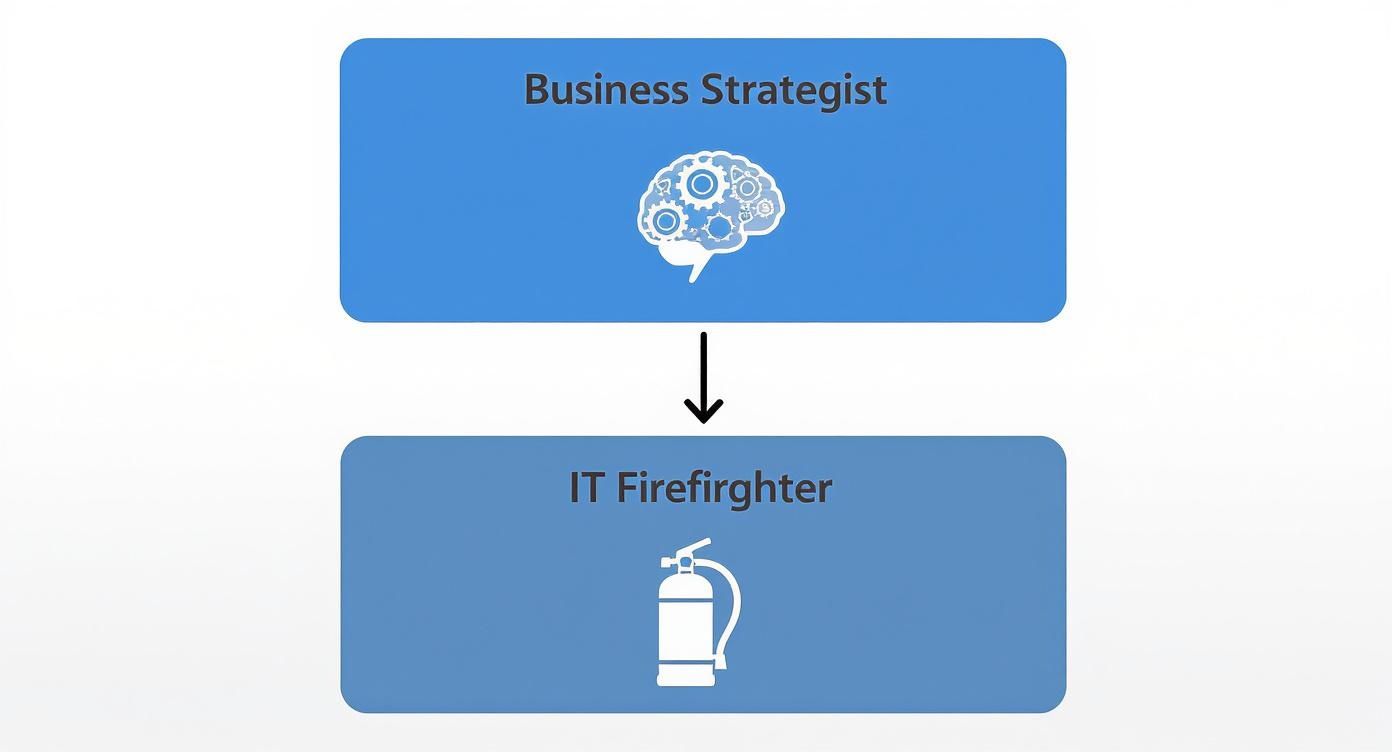
The difference between a tactical team and a strategic leader is night and day. A tactical IT team puts out fires; a strategic IT leader designs a fire-proof building from the ground up.
Tactical IT Support vs. Strategic IT Leadership
| Area of Focus | Tactical IT Support (The Fixer) | Strategic IT Leadership (The Builder) |
|---|---|---|
| Primary Goal | Resolve immediate issues, keep systems running. | Drive business growth, create competitive advantages. |
| Key Activities | Helpdesk tickets, password resets, server maintenance. | Technology roadmaps, budget forecasting, vendor management. |
| Perspective | Reactive: "What's broken right now?" | Proactive: "What do we need in 18 months?" |
| Business Impact | Minimizes downtime. | Maximizes revenue, efficiency, and market share. |
| Measures of Success | Ticket resolution time, system uptime. | ROI on tech investments, cost reduction, market agility. |
Seeing technology through this strategic lens is what separates companies that merely survive from those that truly thrive. Now, let’s dive into the four pillars that make this a reality.
Pillar 1: Business and Technology Alignment
This is the bedrock. Every dollar spent on technology must serve a specific, measurable business goal. Without this, you’re just buying gadgets.
-
What Bad Looks Like: The sales team buys a flashy new CRM after a cool demo, but it doesn't talk to your finance software. Now, the finance team wastes hours manually entering data, leading to costly mistakes. The "solution" created a new problem.
-
What Good Looks Like: Before anyone looks at a CRM, leadership defines the goal: "We need to shorten our sales cycle by 15%." The platform they choose is selected because it integrates smoothly, creating a single view of the customer journey. The technology serves a business outcome.
Pillar 2: Scalability and Performance
Your systems must be built for where you're going, not just where you are. A scalable infrastructure grows with you. Poor performance is a hidden tax on every single transaction.
-
What Bad Looks Like: Your e-commerce site crashes on Black Friday because the servers can't handle the traffic spike. You don't just lose thousands in sales; you lose customer trust.
-
What Good Looks Like: Your systems are built on cloud infrastructure that automatically scales to meet demand. When traffic surges, your site remains fast and reliable. Your technology enables your biggest growth moments, not a barrier.
Pillar 3: Security and Risk Management
This pillar is about protecting your most valuable assets: your data, your reputation, and your customers' trust. It’s not about eliminating every possible risk—that's impossible. It’s about understanding your risks and managing them intelligently.
-
What Bad Looks Like: A preventable data breach exposes sensitive customer information. The fallout is a nightmare of regulatory fines, legal fees, and a catastrophic loss of customer confidence.
-
What Good Looks Like: You have a documented cybersecurity plan, regular employee training, and periodic risk assessments. You meet industry compliance standards (like PCI DSS or HIPAA) not as a box-ticking exercise, but as a way to prove your trustworthiness. Security becomes a competitive advantage.
Pillar 4: Data and Analytics
Your business generates a mountain of data. This pillar is about turning that raw data from a storage problem into a strategic weapon. It’s how you finally stop guessing and start making confident decisions.
-
What Bad Looks Like: Valuable data is locked away in different systems that don't communicate. Answering a simple question like, "Which marketing channel has the best ROI?" takes weeks of manual work.
-
What Good Looks Like: You have a centralized dashboard that gives your leaders a clear, real-time view of key business metrics. You can easily spot trends, identify what’s profitable, and make data-driven decisions. Your data starts working for you.
This four-pillar framework demystifies strategic IT consulting services, showing how they directly build a more resilient and profitable business. With the digital transformation market expanding at a CAGR of 28.5%, the need for this structured, expert guidance has never been more urgent. You can explore more on these consulting industry trends to see how other leaders are staying ahead.
Your First 90 Days With a Strategic IT Partner
Bringing in a strategic partner shouldn’t feel like signing a blank check and hoping for the best. A real partner gives you a tangible roadmap that delivers value from day one.
The first 90 days aren't about fixing everything at once. They're about stamping out immediate risks and building a solid foundation for long-term growth.
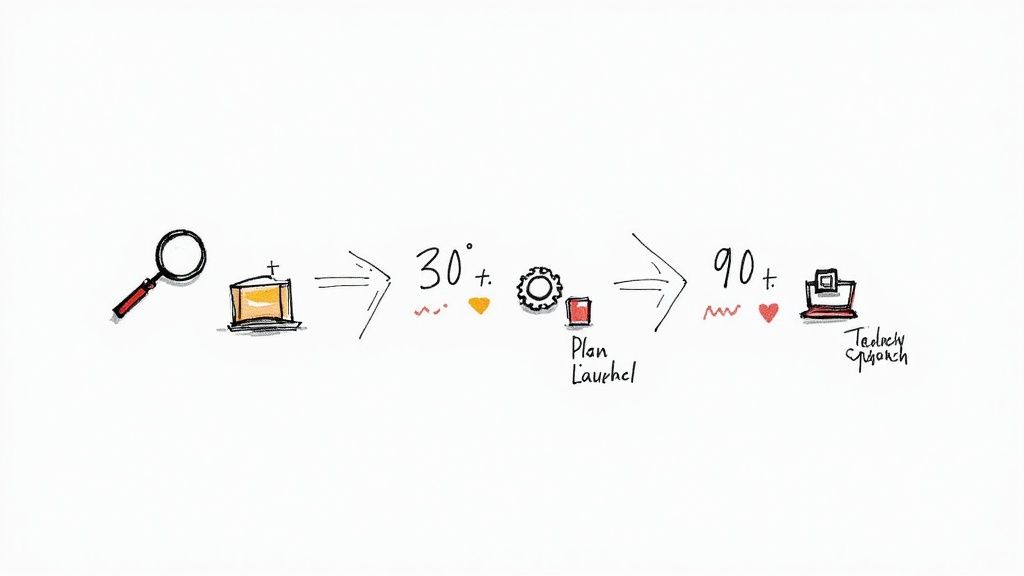
Month 1: Discovery and Risk Assessment
The first 30 days are all about listening. A true strategic partner spends time understanding your business model, revenue drivers, and biggest operational headaches—not just your servers. This is a business conversation first, technology second.
We dive deep to find the high-priority issues that pose an immediate threat or create a major drag on the business.
- Key Activities: We interview your leadership team, review existing systems and vendor contracts, and run a high-level security check.
- Primary Outcome: By day 30, you'll have a Risk & Opportunity Report. This document clearly lays out the top 3-5 immediate threats (like a critical security hole) and real opportunities to save money or boost efficiency.
This initial phase gives you immediate clarity, backing up your gut feelings with hard data and providing a clear, actionable starting point.
Month 2: Roadmap Development
With a solid understanding of your current state, the next 30 days are dedicated to planning. This is where we translate your big-picture business goals—like breaking into a new market or improving margins—into a concrete technology plan.
This isn't a wish list of expensive new toys. It’s a business-focused roadmap that ties every project to a specific, measurable outcome.
The point of a technology roadmap is to make your business strategy achievable. It aligns every technical decision and dollar spent with a measurable step toward your company's most important goals.
We work with your leadership to define and sequence projects for the next 12-24 months. The plan tackles immediate needs while building the scalable foundation for what comes next.
Month 3: Foundation and Execution
The final 30 days of this kickoff phase are about putting that plan into action. We shift from strategy to execution, starting with the initiatives that deliver the biggest impact first. This might mean consolidating redundant software or rolling out foundational cybersecurity controls.
More importantly, this is when we establish the rhythm for ongoing success.
- Establish KPIs: We define the key metrics that will measure the success of your technology strategy, such as system uptime and ROI on new projects.
- Implement Governance: We set up a simple framework for making future technology decisions, ensuring they stay aligned with the roadmap and breaking the cycle of reactive purchases.
- Launch Quick Wins: We kick off the first one or two projects from the roadmap, delivering tangible results that your team can see and feel.
This 90-day structure is designed to be a powerful, predictable start. For a deeper dive, check out our guide on what happens in the first 90 days of fractional tech leadership. It shows how strategic IT consulting services deliver clarity, reduce risk, and build momentum from the very beginning.
How To Choose The Right IT Consulting Partner
You get the stakes. You see the potential. But now comes the most important decision: picking the right guide for the journey.
Choosing a strategic IT partner is nothing like hiring a vendor. You're not just buying a service; you're investing in a relationship built on trust and a shared vision for your company's future. The wrong firm will talk about servers and specs. The right one will start by asking about your revenue goals, operational headaches, and what keeps you up at night. They lead with your business, not their tech.
Look for a Partner, Not a Vendor
A vendor takes orders. They do what you ask, send an invoice, and move on. A true partner sits on your side of the table.
They have the confidence and experience to challenge your assumptions and ask tough questions. They'll even disagree with you if it means preventing a costly mistake. A vendor relationship is transactional; a partner relationship is built on a shared definition of success.
A vendor sells you a tool and walks away. A partner helps you build a capability. Find a firm that cares more about your P&L than their product sheet.
Key Questions To Ask A Potential Firm
You need a simple filter to cut through the sales pitches. Forget the jargon and focus on these business-first questions. The answers will tell you whether you're talking to a truly strategic firm or just another IT shop.
- Do they speak in business outcomes? Is the conversation about ROI, reducing risk, and gaining a competitive edge? Or are they stuck on technical details? A real partner connects every technology decision back to its direct impact on the business.
- Do they have experience at your revenue stage? The problems of a $5 million company are worlds away from those of a $150 million enterprise. Look for a firm with a proven track record of guiding businesses of your size and complexity.
- Do they act like a leader or an order-taker? Do they push back and ask clarifying questions to get to the root of an issue? A partner wants to understand the "why" behind your request, not just the "what." It’s a sure sign they’re thinking about your long-term success.
- Can they provide clear, predictable engagement models? Be wary of open-ended hourly billing. Look for firms offering fixed-fee projects or retainer models for strategic work. This structure shows they are confident in their process and aligns their incentives with yours.
The global market for strategic IT consulting services is massive. The broader strategic consulting market was valued at $78.20 billion and is poised for major growth, which means you have plenty of options but also a lot of noise to filter through. Discover more insights about this growing market to better understand the landscape.
Taking the time to choose the right firm ensures you find a guide who will bring clarity, reduce risk, and finally help you turn technology into the growth engine it was always meant to be.
The Choice Ahead For Your Business
The path forward really boils down to one decision. It’s a choice between two different futures, and the one you end up with is a direct result of the actions you take—or don't take—starting now.
One path is the "do nothing" approach. You keep pouring money into a technology stack that feels more like a boat anchor than an engine. Your team’s productivity is quietly drained by clunky systems, while the risk of a data breach hangs over your head. In this future, you watch tech-savvy competitors move faster and innovate more freely. You’re losing ground because your technology is holding you back. This is the path of stagnation.
The Vision of Success
But there is another way. This is the future where technology becomes a predictable, scalable asset that actively fuels your growth.
Imagine a boardroom where you have complete clarity on your tech investments and total confidence that every dollar spent is tied directly to a business goal. Picture your teams empowered by tools that actually make their jobs easier, freeing them to focus on high-value work. In this reality, your business is resilient, your data is secure, and your technology roadmap is a clear blueprint for winning your market.
This isn’t a far-off dream. It's the direct outcome of making a strategic choice.
The decision to align technology with your business strategy is the pivot point between stagnation and scalable growth. It's how you trade chaos for control and turn a source of anxiety into your most powerful competitive advantage.
Choosing this path means embracing strategic IT consulting services not as a cost, but as the mechanism to build a stronger, more profitable, and more secure company. The frameworks in this guide are the first steps toward making that vision your reality. Which future will you choose?
Frequently Asked Questions About IT Strategy
Here are a few straight answers to the questions we often hear from CEOs and founders when they start thinking about bringing on a strategic IT partner.
How Much Do Strategic IT Consulting Services Cost?
The price depends on your needs and company stage. However, a good partner will steer clear of open-ended hourly billing for high-level work. Look for fixed-fee arrangements tied to concrete outcomes.
For a mid-market company, a fractional CTO or CISO engagement typically falls between a few thousand and $15,000+ per month. Think of this less as a cost and more as an investment. You're getting executive-level expertise to drive growth and cut risk for a fraction of a full-time hire’s cost.
When Is The Right Time To Hire An IT Strategy Consultant?
The best time is either right before a big growth spurt or right after you've hit a major pain point. If any of these sound familiar, it's probably time:
- You're preparing for a capital raise or an acquisition. Buyers and investors will dig into your technology and security. You need to be ready.
- You're growing fast, but it feels like chaos. Your systems are creaking, and what worked last year is now holding you back.
- New compliance or security requirements have landed on your desk. A big customer contract or a new regulation is demanding a level of security your team can't handle.
- Your IT budget feels like a black box. You're spending money on technology but have no idea if it's actually delivering value.
The bottom line is, if technology feels more like a risk than a competitive advantage, it's time for a conversation.
We Already Have An "IT Guy," Why Do We Need This?
That's a great question. Your "IT guy" or managed service provider (MSP) is fantastic at the day-to-day, tactical work. They are the firefighters—keeping servers humming and laptops working. You absolutely need that.
Strategic IT consulting services fill a completely different role: the architect. A strategic leader doesn't fix a broken printer; they build the technology roadmap that aligns with your three-year business plan. They manage risk at a business level and ensure your tech stack is built for where you're going, not just where you are.
The two roles aren't in competition; they're complementary. One keeps the lights on today, while the other designs the building you'll need for tomorrow.
At CTO Input, our job is to turn tech complexity into a clear business strategy. If you're ready to stop putting out fires and start building for the future, let's have a quick, no-pressure discovery call. We can explore if our fractional leadership model is the right fit for you. Book your call today.
Article created using CTO Input