
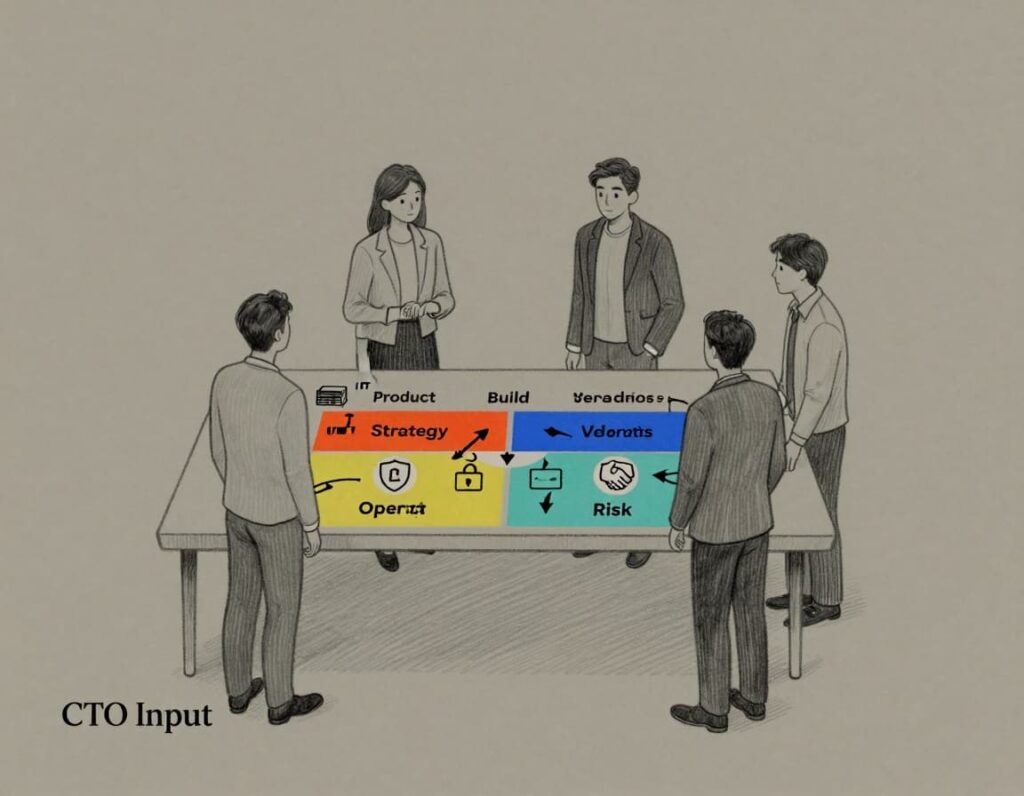
For many CEOs and COOs, technology now feels like a crowded committee. IT, product, security, and a web of vendors all touch the same systems, yet no one clearly owns the outcome when a launch slips or an outage hits. You feel it in board meetings when someone asks, “Who owns this risk?” and the room goes quiet. You feel it when a vendor pitches a platform upgrade that sounds nice, but no one can say if it matches the growth plan. This problem is not about org charts. It is about ownership.
This post lays out a simple way to split ownership between IT, product, security, and vendors so decisions are faster, risk is clearer, and vendors stop steering your strategy. It is sized for small to mid‑market companies, roughly 2 to 250 million in revenue, and it works even if you do not yet have a full‑time CIO or CISO.
Why clear ownership between IT, product, security, and vendors matters for your business
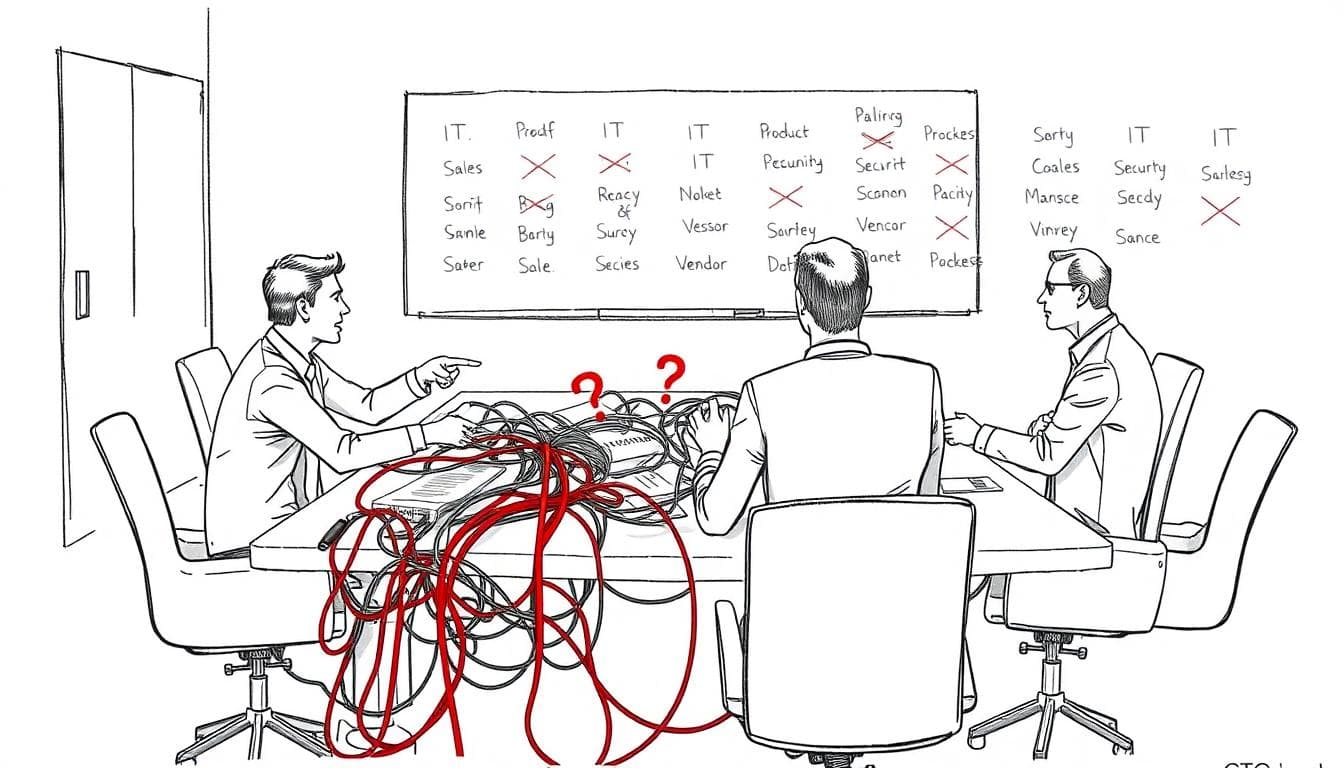
Unclear ownership turns every project into a blame game. Image created with AI.
When ownership is fuzzy, cost, risk, and drama creep in fast.
Product promises dates that IT cannot hit. Security raises red flags after money is already spent. Vendors sell features that look shiny but do not solve your business problem. Then everyone wonders why revenue projects keep missing and why customers keep feeling the pain.
You also pay a trust tax. In board or lender meetings, simple questions about cyber risk, AI use, or vendor concentration turn into long, vague answers. That does not build confidence.
The core idea is simple: every important technology activity should have one clear owner, shared input from others, and a short written view of who does what. No more “shared responsibility” as a default. Shared input is fine. Shared ownership is not.
Common ownership failure patterns in mid‑market companies
From a CEO or COO seat, the patterns tend to look like this:
- “IT owns everything with a wire.” If it plugs in or has a login, it gets thrown at IT. Product and security show up late and bolt on changes after decisions are made. Deadlines slip, and IT takes the blame.
- Security is the “Department of No.” Security gets pulled in right before launch. They are asked to rubber‑stamp choices that are already locked. If they push back, they are a blocker. If they stay quiet, risk lands on your balance sheet.
- Product owns roadmap, but not risk. Product leaders set priorities, but no one asks who owns technical debt, vendor lock‑in, or data exposure tied to those choices. The backlog grows, and so does risk.
- Vendors act like your strategy team. A big platform provider or MSP starts telling you what your architecture and roadmap should be. Remember, they are paid to sell their platform, not tune your risk, cost, and growth picture.
These patterns are fixable, but they do not fix themselves.
The business risks of fuzzy ownership and overlapping roles
Fuzzy ownership shows up first in missed numbers, not in policy documents.
A “minor” delay on a core system slips by 90 days, then pushes revenue out of the quarter. Nobody can say who decided to change scope. Everyone can say, “It was not my call.”
Compliance gaps appear because no one owns specific controls. A vendor stores cardholder data or health data, but no one knows who signed off on that choice. When auditors arrive, you are stuck piecing together emails.
Vendor renewals land as surprises with big price jumps. Procurement thinks IT owns the relationship. IT thinks the business owner owns it. The vendor knows no one owns it, so they push through high‑margin bundles.
Inside the company, IT burns out. They get the call for every outage, security scare, and vendor slip, yet they do not control priorities, budget, or scope. You end up with slow decisions, defensive behavior, and “shadow IT” as teams go around them.
The fix is not more meetings. The fix is clear answers to three simple questions: Who decides? Who signs off? Who gets the call when it breaks?
A simple ownership model: using a RACI to split work between IT, product, security, and vendors
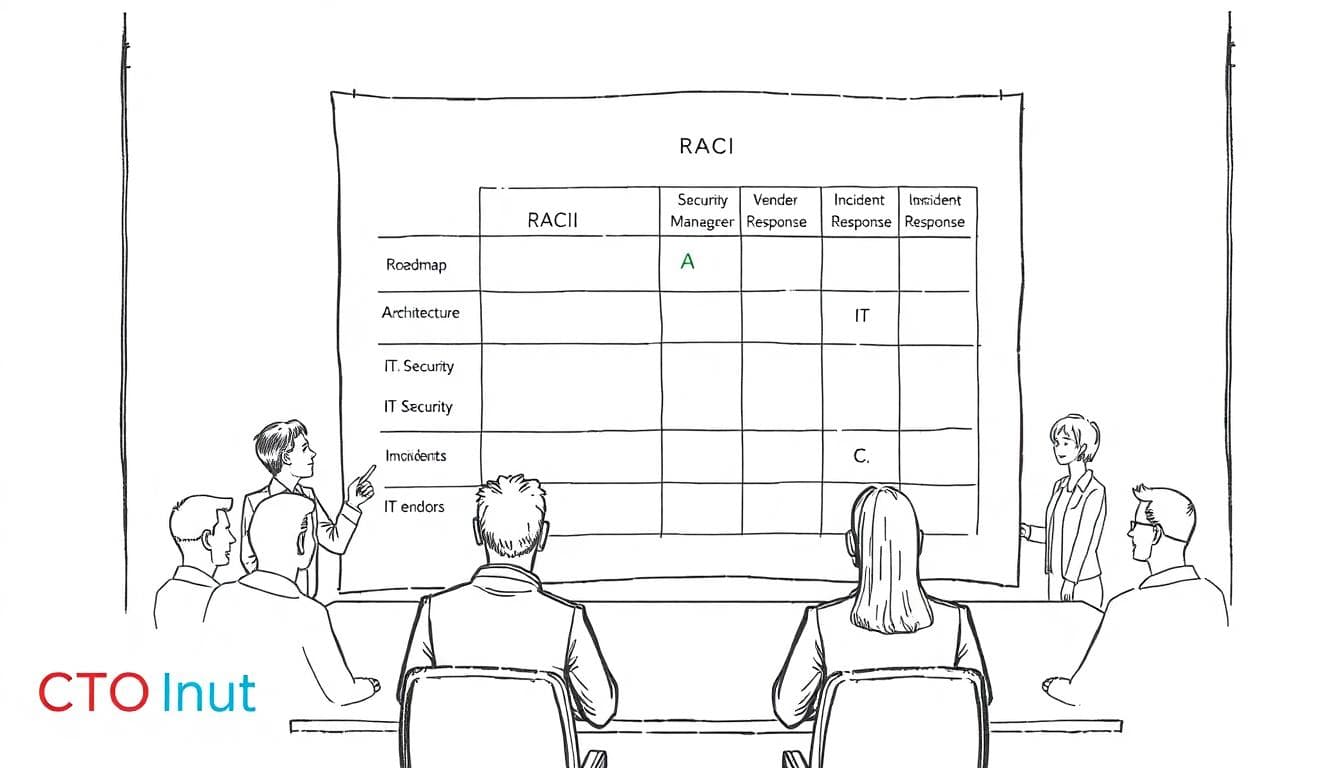
A simple RACI turns chaos into clear roles. Image created with AI.
You do not need a thick policy manual. You need a simple, shared picture of who does what.
The most practical tool for this is a RACI: Responsible, Accountable, Consulted, Informed. It is a small table that maps roles to activities, and it works well for mid‑market companies that want clarity without heavy process.
A good overview of the method is in this guide to the RACI responsibility assignment matrix.
Two rules matter most:
- There is only one Accountable owner per activity.
- Security is involved early for work that touches data, not just at the end.
Vendors fit in this model too, but they should rarely be Accountable for outcomes that matter to your business.
Plain language RACI roles: who does the work, who owns the result, who advises, who is updated
Keep the language simple.
- Responsible: does the work.
Example: IT is Responsible for deploying a new system, or a vendor is Responsible for building an integration. - Accountable: owns the result and the decision.
Example: the Head of Product is Accountable for a new feature meeting customer needs. - Consulted: gives expert input before decisions.
Example: security is Consulted on a change that touches customer data or payment flows. - Informed: kept in the loop after decisions.
Example: executives are Informed when a key vendor is swapped out.
If everyone understands these four words, half of your current friction goes away.
Sample RACI for key activities: roadmap, architecture, security, vendors, and incidents
You do not need to map everything. Start with a few high‑value activities.
A simple pattern for mid‑market companies looks like this:
| Activity | Accountable | Responsible | Consulted | Informed |
|---|---|---|---|---|
| Product roadmap & priorities | Product leader | Product team | IT, Security | Executive team |
| System & data architecture | IT leader | IT team, key vendors | Product, Security | Affected business |
| Security controls & compliance | Security leader | IT (implementation) | Product | Executive, Board |
| Vendor selection & management | Business or Product owner | Vendors (delivery), IT | Security, Finance | Executive, IT ops |
| Incident response & communication | Security leader | IT (technical fix) | Product, Legal | Customers, Board |
For roadmap work, product stays in the driver seat. A useful guide on how RACI supports product ownership is this overview of the RACI matrix for product ownership.
For vendor work, your business or product owner is Accountable, vendors are Responsible for their part, and IT plus security are Consulted. The RACI model is also common in third‑party risk, as shown in this piece on using RACI for vendor risk roles.
For security, a security or risk leader is Accountable, not IT. Security sets the bar, IT makes it real.
How to avoid power struggles: one owner, clear tradeoffs, and written rules
A bad RACI creates turf wars. A good one makes tradeoffs visible.
Three tips keep you on the right side:
- One Accountable per decision. No co‑owners. If two leaders share accountability, you just moved the debate upstream.
- Plain tradeoffs. Write simple rules like, “Product can adjust scope within budget, security can stop a launch on serious risk, IT can push back on dates that threaten stability.”
- Short and focused. Start with RACI tables for your top 5 to 10 recurring activities. Keep each one on a single page.
As you grow, a fractional CTO or virtual CISO can help tune this model so it scales with your risk and vendor mix. For security‑heavy work, it can help to study a focused security RACI matrix guide and adapt ideas to your context.
Turning the model into action: 5 steps to reset ownership with your teams and vendors
You can reset ownership in a few weeks with focused conversations and one simple table, not a reorg.
Here is a tight playbook you can run yourself.
Step 1: List the 10 technology decisions that create the most friction today
Start with pain, not theory.
Write down 8 to 10 repeating activities where ownership is muddy: picking new software, handling outages, approving security exceptions, signing vendor renewals, shaping each product release.
Ask your IT, product, and security leads who they think owns each one today. The gaps in their answers will show you where to focus.
Step 2: Assign one clear accountable owner for each activity
Give each activity one accountable owner, mapped to a role, not a name, such as “Head of Product” or “IT Director.”
Make accountable owners as business‑facing as possible for roadmap, vendor selection, and customer impact. Let security stay accountable for risk and compliance outcomes.
This alone speeds decisions and kills the “too many cooks” problem.
Step 3: Define how IT, product, security, and vendors support each decision
For each activity, fill in who is Responsible, Consulted, and Informed.
Simple pattern: vendors are often Responsible for delivery, but internal teams stay Accountable for results. Security is Consulted early on anything that touches customer data or rules. IT is Responsible for integration and uptime. Product is Responsible for feature choices and tradeoffs.
Keep it to one short line per role per activity.
Step 4: Share the new ownership map and test it on a live project
Walk through the new RACI in a short session with your IT, product, and security leaders.
Then test it on your next real initiative, like a new customer portal or a major vendor renewal. Watch where decisions stall or where vendors step outside their lane, then update the table so it matches reality.
Step 5: Review ownership every quarter as your tech and risk profile changes
Ownership is not a one‑time exercise.
Do a light quarterly review to match roles to new vendors, new regulations, or new products. Use this rhythm to stay on top of cyber risk, AI use, and major tech bets without getting dragged into deep technical detail.
A neutral fractional CTO, CIO, or CISO can lead these reviews and keep the model honest when stakes and personalities are high.
Conclusion: Clear ownership turns technology into an asset, not a drag
Clear ownership across IT, product, security, and vendors gives you faster decisions, fewer surprises, and cleaner board conversations about risk and growth. You do not need a giant reorganization. You need a simple, shared map of who owns what, and a habit of tuning that map as your business evolves.
If you are tired of vendors driving strategy, projects slipping, and risk questions hanging in the air, this is the moment to reset the rules.
To see how an experienced technology leader can help you untangle ownership and align tech, cost, and risk with your growth plan, visit the CTO Input website at https://www.ctoinput.com. To keep learning about technology leadership, vendor strategy, and practical risk management for mid‑market companies, explore the CTO Input blog at https://blog.ctoinput.com.