
You’re spending more on technology than ever, but growth feels like you’re running through mud. Deals are stalling, operations are clunky, and your team is visibly frustrated. That gut feeling that your technology is holding back business growth isn’t just in your head—it’s a reality for countless leaders at ambitious companies, probably just like yours. This isn’t about blaming your team or the software. It’s about a disconnect between your goals and your tools. The good news? It’s a solvable problem.
Your Gut Feeling Is Right—Your Tech Is Holding You Back
It’s a painfully familiar story. You’re sitting in a quarterly review, looking at a healthy tech budget, but the business results just don’t add up. Your head of sales complains the CRM is a “data graveyard” that slows down proposals. Your COO points to the endless manual workarounds and duplicate data entry that kill efficiency. Everyone is busy, but the business isn’t getting faster, smarter, or more profitable.

This isn’t a sign of bad software or an incompetent team. It’s a symptom of a much deeper problem: a fundamental disconnect between your technology, your business strategy, and your people. When tech is treated as a cost center, it becomes a drag on the business instead of a growth engine.
The Real Cost of Technology Drag
This drag creates friction that shows up in predictable and painful ways:
- Slowed Decision-Making: Your leadership team can’t get clear, timely data, forcing you to rely on gut feelings instead of real insights.
- Wasted Payroll: Your best people spend hours on repetitive, low-value tasks that should be automated, burning them out and wasting expensive time.
- Lost Opportunities: Clunky systems prevent you from launching new products, entering new markets, or delivering the kind of customer experience your competitors do.
- Increased Risk: Outdated platforms and security gaps leave your company exposed to data breaches and costly downtime.
This problem is incredibly common. Global research on digital transformation shows that only about 35% of companies actually meet their value targets from these projects. This means roughly two-thirds of organizations investing in new technology fail to get the efficiency gains or revenue growth they were counting on. You can discover more insights on 2025 business trends here.
The core issue is trying to solve a business strategy problem with a technology budget. You buy new tools hoping for a silver bullet, only to add more complexity and cost without moving the needle on what truly matters.
Signs of Technology Drag vs. A Healthy Tech Engine
It can be tough to distinguish between normal growing pains and a genuine technology problem. Use this quick diagnostic to see where you stand.
| Symptom of Unhealthy Tech | Outcome of Healthy Tech |
|---|---|
| Data is Siloed and Inaccessible: Teams can’t get the information they need without manual reports or asking someone. | A Single Source of Truth: Everyone works from the same trusted, real-time data to make fast, informed decisions. |
| High-Paid Staff Do Repetitive Work: Your best people are stuck with manual data entry and administrative tasks. | Automation Handles the Grunt Work: Repetitive tasks are automated, freeing up your team for high-value strategic work. |
| The “Swivel Chair” Problem: Employees constantly switch between different apps to complete a single task. | Integrated and Seamless Workflows: Systems talk to each other, creating a smooth process from one step to the next. |
| New Initiatives Are Slow to Launch: Getting a new product or service to market is a complex, painful process. | Agile and Scalable Foundation: The business can quickly adapt, test new ideas, and scale successful initiatives without a tech overhaul. |
| IT Is Always Putting Out Fires: Your tech team is constantly in reactive mode, fixing what’s broken instead of building for the future. | IT Is a Strategic Partner: The technology function is proactive, focused on finding opportunities and driving business goals. |
If the left column feels familiar, you’re not alone. The good news is that this is a solvable problem. It requires shifting your perspective from viewing technology as an expense to be minimized to seeing it as a strategic asset to be put to work. This guide will give you a clear path to make that shift.
The Three Hidden Reasons Your Tech Investments Fail
That feeling in your gut that your technology is holding back business growth? It’s not about one bad piece of software. It’s almost always the result of deeper, more subtle problems that quietly undermine your investments.
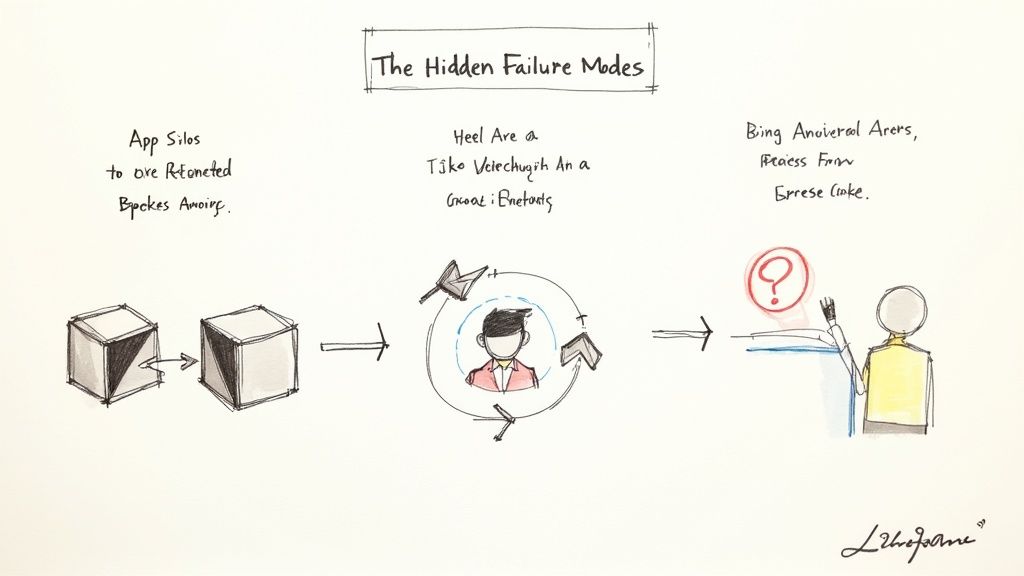
When we get called in to help growing companies, we consistently find the same three issues lurking under the surface. Once you can name them, you can start to solve them. These are business challenges, not technical puzzles.
1. Fragmented Systems and Data Silos
Picture this: your sales team lives in the CRM, operations runs on a massive set of custom spreadsheets, and finance is locked into its accounting software. For most mid-market companies, this is just another Tuesday.
This digital patchwork creates data silos. Critical information gets trapped, forcing your team to stitch everything together manually. They waste hours exporting data from one system only to re-type it into another—a process that’s both slow and a magnet for human error.
The business impact is staggering:
- No Single Source of Truth: Ask two department heads for the same number, and you’ll get two different answers. This makes confident decision-making impossible.
- A Painful Customer Experience: When your team can’t see a customer’s entire history, service tanks. This is why a frustrated client has to explain their problem for the third time to a third person.
- Crippling Operational Drag: Basic workflows, like generating a quote or fulfilling an order, become fragile and complicated, relying on a few key people who know how to connect the dots.
You can’t buy your way out of this with another app. The only fix is a real strategy for integrating your core systems.
2. Reactive Tech Leadership
Here’s a common story. A company promotes its best IT manager to a leadership role but never gives them the strategic coaching or business training to actually lead. They are brilliant at putting out fires—keeping servers humming and laptops online—but they’re stuck in a permanent cycle of reaction.
Their calendar is hijacked by urgent helpdesk tickets and day-to-day fixes. There’s no time left to step back and think about the bigger picture. Questions like these never even get asked:
- “How can technology get us to our three-year business goals faster?”
- “What major security risks are we ignoring that could shut us down?”
- “Are we building a tech foundation that can scale, or is it a house of cards?”
When your technology leader is measured by how quickly they close helpdesk tickets, you get a world-class firefighter. But you don’t get a strategic architect. This reactive posture guarantees your technology will always lag behind your business needs.
This isn’t the IT leader’s fault; it’s a structural failure. The business has never defined a strategic role for technology. Instead, IT is treated like a necessary evil, a cost center. And with that mindset, your technical debt just keeps piling up. For a deeper look, see our guide on why your tech spend feels high while your ROI feels low.
3. The Strategy and Skills Gap
This last one is the real killer: the business simply doesn’t have the in-house expertise to connect technology decisions to actual business outcomes. The leadership team knows they need to “do something with tech,” but they don’t have a trusted expert who can translate vague goals into a concrete, actionable plan.
When this gap exists, you see the same mistakes over and over:
- Chasing Shiny Objects: The company gets excited about the latest buzzword (like AI) and invests a ton of money without a clear problem to solve. These projects almost always end up as expensive orphans.
- Vendor-Driven Decisions: Slick software salespeople end up setting your strategy for you, selling you bloated platforms you don’t really need and can’t possibly manage.
- Analysis Paralysis: When faced with a big, complex decision like modernizing a core system, the team gets overwhelmed and defaults to doing nothing. Meanwhile, the legacy tech gets older and more fragile.
Without a leader who is fluent in both business and technology, you can’t build a credible roadmap. Every dollar spent on tech feels like a roll of the dice because it’s not tied to a measurable improvement in revenue, profit, or risk reduction.
The 90-Day Momentum Plan: Quick Wins and Lasting Clarity
You don’t need a massive, multi-year project to stop feeling like your technology is working against you. The best way to break the cycle of technology holding back business growth is to build momentum with small, visible wins.
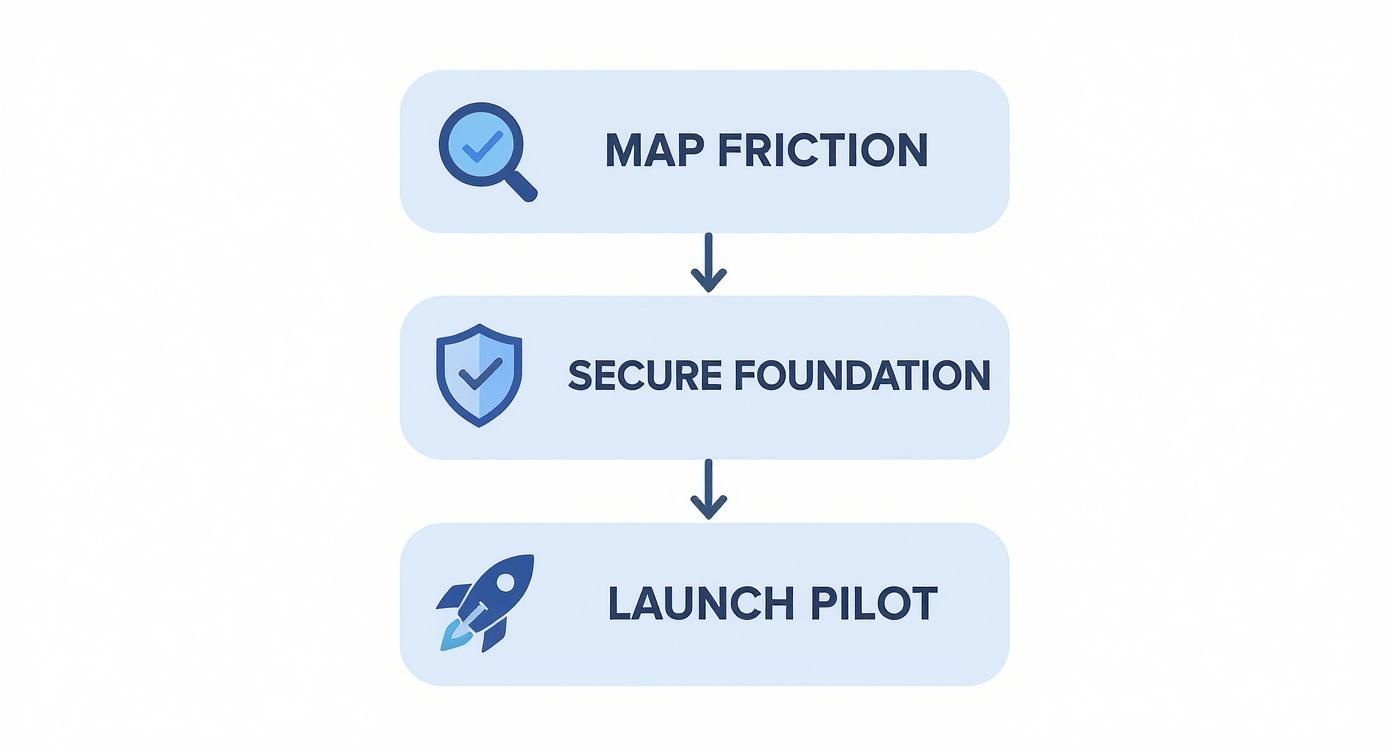
This simple 90-day plan delivers immediate relief and proves that a more thoughtful approach works. You can hand this framework to your team today. It’s not about boiling the ocean; it’s about making a tangible difference in one quarter.
Step 1: Map The Real Friction (Days 1-30)
First, forget about technology. For the next 30 days, focus entirely on the business friction. Sit down with your department heads and ask one question: “What are the top three operational bottlenecks that cost your team the most time and frustration each week?”
Don’t let them talk about software. Ask about the painful, manual workarounds they’ve cobbled together.
- Is your sales team wasting hours building quotes by hand instead of selling?
- Is your finance department stuck chasing approvals through messy email chains?
- Is your operations team manually re-entering the same order information into three different systems?
Your only job here is to identify the three most expensive points of friction. By starting with the business pain, you guarantee that any fix you put in place will deliver an immediate and noticeable return. This is a business diagnostic, not a technical audit.
Step 2: Secure The Foundation (Days 31-60)
With your friction map in hand, use the next 30 days to tackle immediate risks. Have a competent resource assess two critical areas: data backups and core security controls. You aren’t aiming for a complete overhaul, just shoring up the absolute essentials.
The goal here is brutally simple: make sure a catastrophic event like a ransomware attack can’t put you out of business tomorrow. Verify your backups are actually tested and recoverable, and confirm that basic security measures like multi-factor authentication are enforced everywhere they should be.
This step doesn’t make you money, but it protects every dollar you have. It’s the foundational work that lets you pursue growth with confidence. Think of it as a quick win for your own peace of mind.
Step 3: Launch One High-Impact Pilot (Days 61-90)
In the final 30 days, it’s time to act. Pick just one of the friction points you identified and launch a single, high-impact pilot project. Don’t try to fix everything at once. Choose one measurable problem and solve it with a targeted solution—maybe a small automation, a simple system integration, or a new tool.
This is where so many companies get bogged down. Ironically, another way technology is holding back business growth is the struggle to get real value out of new tools like AI. Recent data shows a staggering 78% of organizations used AI in 2024, a huge jump from 55% in 2023. Yet, most are stuck in pilot mode, unable to turn small experiments into meaningful business impact. You can learn more about what’s happening with AI in 2025 and beyond to see just how common this is.
Your pilot needs a clear business metric attached to it—no exceptions. For example, your goal could be to cut the time it takes to generate a sales quote by 50%. By focusing on one highly visible win, you build credibility and prove that strategic tech investment really does pay off.
Building Your 18-Month Strategic Technology Roadmap
Those quick wins from your 90-day plan feel good, don’t they? You’ve proven that focused effort can deliver real results. Now it’s time to zoom out. We need to shift gears from putting out fires to building a proactive, long-term strategy that turns your technology into an engine for growth.
A great technology roadmap is really a business plan. It’s written in plain English and connects every major tech decision directly to a commercial outcome. Think of it as your guide for the next 18 months, making sure the phrase “technology is holding back business growth” is officially retired from your vocabulary.
The process you just went through—mapping friction, securing your foundation, and launching a pilot—is the perfect springboard.
You’ve earned the credibility to build a roadmap people will believe in. A solid plan rests on four key pillars.
Pillar 1: Platform Modernization
Let’s be honest: legacy systems are anchors dragging on your business. They’re expensive to maintain, a nightmare to integrate, and often, only one or two people in the company know how they work. Platform modernization is the disciplined process of replacing these dinosaurs with flexible, modern solutions.
The goal isn’t to chase shiny new objects. It’s about reducing complexity, cutting long-term costs, and building a tech foundation that can keep up with your company’s ambition.
- Bad move: A massive “rip and replace” of a core system, pushed by a vendor’s slick sales pitch with no clear business case.
- Smart move: Methodically swapping an old, on-premise accounting system for a cloud platform, justified by a 25% reduction in the manual work needed for month-end closing.
Pillar 2: Proactive Security
For too long, security has been seen as an IT-only problem—a purely defensive cost center. A modern approach flips that script. It treats security as a business enabler that protects revenue, reputation, and customer trust.
This means shifting from just reacting to threats to building a mature security posture from the ground up. It involves understanding your unique risks, implementing essential controls, and fostering a culture where everyone feels they have a role in protecting the company. It’s about being prepared, not just panicky.
A mature security posture is a competitive advantage. It helps you win deals with larger enterprise customers, reduces the risk of costly downtime, and gives your board confidence that you are managing risk responsibly.
Pillar 3: Data-Driven Operations
Your business generates an incredible amount of data. The problem? In most companies, that data is stuck in different systems, making it almost useless. The goal here is to turn that raw data into your most valuable strategic asset.
It starts by creating a single source of truth for your most critical business numbers—your sales pipeline, operational efficiency, and customer lifetime value. When everyone works from the same trusted data, you stop having arguments based on opinion and start making smart decisions, faster.
- Bad move: Buying a pricey business intelligence tool and just hoping your team stumbles upon some interesting insights.
- Smart move: Integrating your CRM and ERP to create a single, unified dashboard that gives leadership a real-time view of the entire sales-to-fulfillment process.
Pillar 4: Organizational Alignment
You can have the best technology on the planet, but it will fail miserably if your team isn’t aligned. This final pillar is the one most often ignored, yet it’s critical. It’s about getting the right people in the right roles and creating a culture that sees technology as a tool for improvement, not a threat.
This means investing in training, clarifying roles, and making sure your tech leadership can translate business goals into a technical strategy. Without this alignment, even the most brilliant roadmap will fall flat. Building a great team is as important as building a great tech stack.
Putting a plan like this together can feel like a massive undertaking. That’s why we wrote a detailed guide on how to turn IT firefighting into a 12-month technology roadmap. It gives you a step-by-step process built on these pillars.
Finding the Right Guide When You Lack the Expertise
Executing a strategic technology roadmap calls for a unique leader—someone fluent in both business and tech. You need a guide who can take your commercial goals, translate them into a clear technical plan, and then see it through to completion.
The catch? Most growing companies don’t need—and can’t afford—the $400k+ salary that comes with a full-time, big-company CTO. This reality often creates a dangerous leadership vacuum right when you need guidance most.
The Common Missteps That Cost You Growth
When faced with this gap, leaders make one of two costly mistakes.
The first is to overburden a loyal IT manager. You promote them into a strategic role they were never trained for, asking them to architect a future-state roadmap when their entire career has been about keeping the lights on. It’s an unfair position that almost guarantees they—and the business—will struggle.
The second is handing the keys to a non-technical leader, like a COO or CFO. While they understand the business objectives, they don’t have the deep expertise to properly vet vendors, challenge a developer’s assumptions, or spot the hidden risks in a project plan. This is how you end up with bloated software contracts and projects that go nowhere.
Both paths lead to the same frustrating destination: your technology continues to be a bottleneck. You feel stuck, knowing you need strategic guidance but unsure how to get it without making a massive, risky hire.
A Smarter Model for Strategic Leadership
Thankfully, there’s a more pragmatic solution: bringing in an experienced guide who provides clarity and reduces risk, all without the full-time cost. A Fractional CTO becomes a part of your leadership team, offering precisely the level of strategic oversight needed to align your technology with your growth ambitions.
This model is a game-changer when you’re facing high-stakes decisions, such as:
- Evaluating a major platform change: Deciding whether to finally rip out your core ERP or CRM system.
- Navigating M&A: Performing the critical technical due diligence to understand the risks and opportunities of an acquisition.
- Unsticking a stalled leadership team: Providing an objective, expert voice to break through analysis paralysis and get things moving again.
This isn’t about hiring just any consultant; it’s about finding the right strategic IT consulting services that deliver true executive-level guidance.
Closing the Widening Skills Gap
A huge reason technology is holding back business growth is the ever-widening IT skills gap. Research shows that by 2026, a staggering 90% of organizations are expected to feel the pain of IT skills shortages. The resulting productivity losses are projected to hit $5.5 trillion globally. This gap is especially severe in complex fields like AI and cybersecurity, where top-tier talent is incredibly scarce.
For a growing business, trying to hire your way out of this is not feasible. A good Fractional CTO doesn’t just bring their own experience; they bring a network of vetted experts to the table. This ensures you have the right skills at the right time to execute your roadmap and unlock your next stage of growth.
From Dragging You Down to Driving Growth
Let’s talk about what the other side looks like—where technology stops being a bottleneck and starts being the engine that powers your business forward.
Imagine your sales cycle getting shorter because your CRM and marketing platforms finally talk to each other. Think about your operations running like a well-oiled machine, with smart automation taking care of the grunt work. This frees up your best people to think, create, and innovate.
This isn’t a far-off dream. It’s what happens when you have a clear, business-first technology roadmap and an experienced guide to help bring it to life.
The Two Paths Ahead
You’re at a fork in the road. The decision you make will shape where your company is in the next few years.
Path 1: The High Cost of Doing Nothing
If you stick with the status quo, the small frustrations you feel today will compound into major roadblocks.
- Talent walks away: Your top performers get tired of fighting clunky systems and leave for competitors where they can actually do their jobs.
- Money gets wasted: You’ll continue to buy new tools that promise a quick fix, only to add another layer of complexity. This just reinforces the feeling that technology is holding back business growth.
- The competition overtakes you: Your more agile competitors, free from the weight of technical debt, will out-innovate you and steadily chip away at your market share.
This path leads to a slow decline, where the business is constantly held hostage by the very tools meant to enable it.
Success isn’t about having the flashiest technology. It’s about empowering your leadership team to make smart, data-backed decisions in real-time because their systems deliver clarity, not confusion.
Path 2: The Payoff for Taking Action
Following a deliberate plan like the one outlined here creates a completely different future.
- Momentum builds: You start with quick wins, proving that change is possible. This gets your team energized and builds the confidence needed to tackle bigger goals.
- Growth accelerates: With a modern and integrated tech foundation, you can scale operations, launch new products, or expand into new markets with speed and precision.
- Risk goes down: Taking a proactive stance on security and data governance protects your reputation and transforms your resilience into a competitive advantage.
This is the future where technology finally becomes the strategic asset you always knew it could be.
Getting there requires a guide who has seen this movie before. At CTO Input, we bring the practical experience needed to turn your technology from a source of chaos into your biggest growth driver. The first step is a simple conversation to figure out where you are today.
Answering Your Toughest Questions About Business Technology
Let’s tackle some of the common questions I hear from leaders when they feel their technology is more of a liability than an asset.
How can I tell if we’re spending the right amount on technology?
There’s no magic percentage of revenue that fits every business. The real question is, “Is our technology spending moving the needle?” If you’re pouring money into tech but not seeing tangible improvements in how you operate, that’s a huge red flag. It’s a classic sign that technology is holding back business growth.
The 90-day plan we covered creates a clear baseline by targeting quick, high-impact wins. From there, an experienced leader like a fractional CTO can benchmark your spending against your industry and, more importantly, tie every dollar to a specific business outcome. This changes the conversation from “How much does this cost?” to “What return will this generate?”
My IT team is great at fixing problems. Isn’t that enough?
Having a responsive IT team is fantastic for keeping the lights on, but it’s a completely different function from strategic technology leadership. Fixing problems is reactive. Building for the future is proactive.
Think of it this way: if your team is constantly putting out fires, they don’t have the time—or the strategic business context—to architect a fireproof building. A great IT team keeps the engine running day-to-day; a strategic technology leader charts the course for where the business is going.
The kind of roadmap we’ve been discussing requires someone who can connect technology decisions directly to your three-to-five-year business goals. This leadership role doesn’t replace your IT support; it gives them a clear direction to build toward.
We tried a big software project before and it was a disaster. How is this different?
This is a painful and common story. Those massive, “big bang” projects often fail because they’re treated as isolated IT initiatives, disconnected from the business’s actual needs. The approach in this guide is built on a different philosophy.
It works because it:
- Starts with small, measurable wins. This builds momentum, demonstrates value almost immediately, and gets everyone on board.
- Is built on a strategic roadmap. This plan is owned by the company’s leadership, not siloed within the IT department.
- Is guided by true expertise. A leader who speaks both “tech” and “business” bridges the gap that causes most projects to fail.
This model is designed to drastically lower your risk. It ensures technology becomes a tool for growth instead of another expensive project that never delivers.
If these problems sound familiar, the next step is straightforward. CTO Input provides the executive-level guidance needed to transform technology from a source of frustration into your company’s strategic advantage. We always start with a no-pressure discovery call to understand your business and map out a clear path forward.
Schedule your call today at https://www.ctoinput.com.