
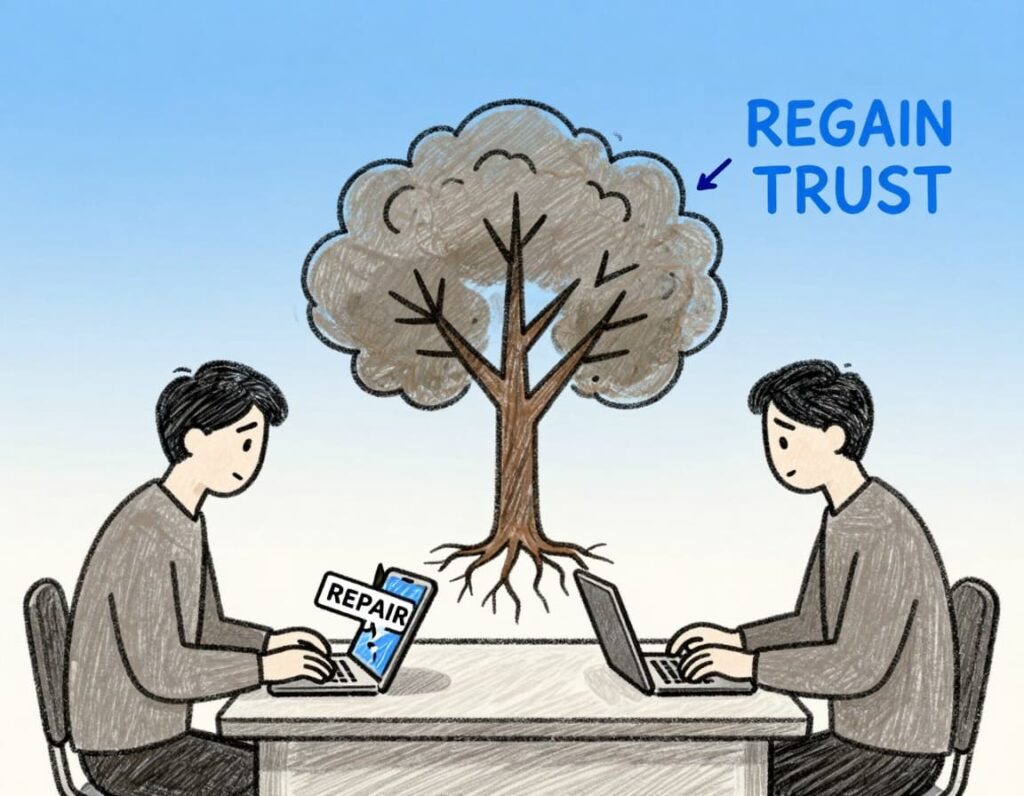
Systems went down, data looked wrong, payments stalled, a data breach occurred, or alerts went silent. Frontline teams took the heat. Your board texted you before you had answers. You slept with your phone on the pillow and still woke up feeling behind. You are now quietly searching how to regain customer trust after outage, and wondering if your customer trust will ever feel “solid” again.
You are not uniquely broken. CrowdStrike, AT&T, Optus, and other giants have had painful outages and public criticism. What separates leadership is not perfection. It is how they respond, and what changes after.
 You are a CEO or founder who just lived through a bad night.
This article is a 10 minute, practical recovery plan. Three moves: stabilize and tell the truth, rebuild trust through clear actions and communication, and put guardrails in place so this is less likely to happen again. CTO Input shows up as the experienced guide on your side of the table, not as another vendor selling tools.
https://user-images.rightblogger.com/ai/05b38fbb-ada9-4fc3-99ea-80816b22b7ee/stressed-ceo-it-outage-late-night-ccd8726d.jpg\ Mid-market CEO facing a late night outage crisis, reviewing alerts and impact. Image created with AI.

Step 1: Stabilize Fast And Tell The Truth About The Outage
In the first 24 to 72 hours, your job is simple to state and hard to do: implement immediate corrective action, then speak plainly.
Customers do not care which subsystem failed. They care that payroll did not run, orders did not ship, or medical results did not appear. The first step to regain customer trust after outage is not spin. It is stability plus honest communication.
Your role is to set tone and direction, not debug code. You decide:
- Who owns the response.
- What you will say externally and internally.
- How often you will update customers and the board.
- Where you will draw the line between speed and safety.
When big outages hit, companies that recover trust fastest act with visible ownership. For example, guidance from Kayako on system downtime communication stresses ownership and clarity as the core of recovery, not excuses or silence.
Own the impact in plain language, not technical jargon
Start with what customers felt, not what the servers did. Prioritize transparent communication and accountability to emphasize clarity and honesty.
Did they:
- Fail to log in.
- See wrong balances.
- Miss critical alerts.
- Fear that data was lost or exposed.
Your incident message should answer three questions, in one short screen:
- What happened, in human terms.
- Who is affected.
- What you are doing right now.
Here is a contrast.
Vague, legalistic note:
“We experienced a temporary service disruption due to an unexpected systems issue. Our team took immediate action to restore functionality. We regret any inconvenience this may have caused.”
This says nothing. It sounds like a lawyer wrote it for every possible incident.
Clear, human note:
“From 9:12 a.m. to 11:47 a.m. Eastern, many customers could not log into our platform or process payments. The issue came from a failed software update on our side, not from your systems. Your data remains safe. Our team has rolled back the update and services are stable. We are monitoring closely and will share a full summary once we complete our review.”
One paragraph. Plain words. Clear ownership. This tone, following a sincere apology, signals respect, which is the fastest way to start regaining trust.
Stand up a small cross-functional “incident cell”
During the crisis, big groups create noise. You need a tight “incident cell” to run crisis management.
Keep it small:
- Technology lead (CIO, CTO, or senior engineer).
- Operations leader.
- Customer service lead.
- Legal or compliance.
- Senior business leader, often you or your COO.
This group controls four decisions:
- Confirm the scope of the failure and who is impacted.
- Agree on facts that are safe and accurate to share.
- Set a cadence for updates to customers, staff, and the board.
- Approve temporary workarounds so customers can keep operating, even if the fix is not perfect.
You do not need fancy tools for this. A shared channel, a simple war-room call schedule, and a clear owner for each action beat scattered emails every time.
Communicate early, then update on a clear cadence
Silence is the fastest way to turn frustration into anger.
A simple rhythm works well:
- First notice as soon as the problem is confirmed. Even if you do not know the cause yet.
- Interim updates on a fixed cadence, for example every 60 or 90 minutes, until stable.
- Resolution summary once services are steady and the technical team is no longer in firefighting mode.
“We are still investigating” is better than nothing. Large providers like Microsoft and CrowdStrike now publish ongoing incident updates during events because customers expect that level of transparency. Articles like this CrowdStrike outage lessons summary show how public updates shape the story long term.
Use multiple communication channels, and keep them aligned:
- Status page.
- Email to affected customers.
- In-app banners or notifications.
- Briefing notes for account managers and support.
Your goal is simple: no customer should learn about the outage from social media before they hear from you.
Step 2: Regain Customer Trust After Outage With Concrete Actions
Once systems are stable, the next 30 to 90 days decide the story.
Customer trust will not return because you issued one good apology. It returns when customers see stability, fairness, and care in how you act. This is where you move from crisis handling to repairing customer relationships.
You now control some powerful levers:
- Who you talk to personally.
- How you compensate or support affected customers.
- What visible changes you ship in the product and in operations.
Research on rebuilding trust after service failures, including work on utility and telecom crises like this review of restoring brand trust in utilities, points to the same pattern. The service recovery paradox shows that clear communication plus visible investment in “this will be better next time” carries more weight than marketing campaigns.
Segment your customers and prioritize the ones hit hardest
Not every customer felt the outage in the same way.
A simple impact map helps:
- Mission critical users: downtime blocks core operations, such as hospitals, logistics operators, payments.
- Financially sensitive users: they lost revenue or incurred penalties due to delays.
- Lower impact users: annoyed, but workarounds were available and impact was low.
Ask your team to build a short list of top accounts in the first two groups. Then personally review it.
For the top tier, a direct call from you or your COO will do more to regain customer trust after outage than any polished email. On that call:
- Acknowledge their specific customer concerns.
- Share what you know about cause and fix.
- Ask how this changed their internal standing.
- Offer a clear next step, such as a follow-up session on resilience.
This is also the point where a neutral advisor like CTO Input can help quantify business impact and frame responses that are fair and consistent, without letting emotion drive one-off deals.
Offer fair compensation and support without teaching customers to “game” outages
You do not want to train customers to wait for outages to get discounts. You do want to show that you share the pain.
Simple, fair options:
- Service credits tied to actual downtime or missed SLAs.
- Fee waivers for a billing period for heavily affected customers.
- Extra customer service hours or onboarding help so teams can catch up on backlogs.
The goal is partnership, not payoffs. Make sure:
- You avoid large promises that you cannot repeat next time.
- You write a short, clear policy so account managers deliver on promises consistently.
- You log who received what, and why, to avoid resentment when customers compare notes.
Research, like the guidance in this piece on rebuilding customer trust, shows that fairness and consistency matter as much as the dollar value of compensation.
Show your work: make visible, simple improvements customers can feel
Customers listen to your words, but they believe your changes.
Pick a small set of improvements that they will notice:
- A clearer, more detailed status page with real-time updates.
- Better in-product alerts when something is wrong, so they are not surprised.
- A priority support queue that activates during live incidents.
- A simpler backup path for critical actions, such as exporting data or running manual reports.
After major outages, companies like AT&T and Optus publicly discussed stronger change control and testing for updates. Reviews of these events, including news analysis of the Optus network outage and trust rebuild efforts, show how much weight customers give to “what we changed” versus “what we said.”
Thirty to sixty days after the incident, send a brief “what we changed” note:
- One paragraph on what happened.
- Three to five bullets on what is now different.
- A pointer to how customers can get more details if they want them, including an invitation for feedback on the changes.
This helps the incident fade into “the time they took a hit, owned it, and got stronger,” instead of “the time they went dark and hoped we forgot.”
Step 3: Turn A Painful Failure Into A Stronger Technology Strategy
The fear now is simple. Will this happen again, eroding customer trust, and how will you answer that question in the next board meeting.
You do not need a 60 page post-mortem. You need a short, sharp learning loop to prevent recurrence that changes how your company makes decisions about risk, change, and investment.
Think of this step as converting panic into a clear, calm plan.
Run a clear, blameless post-incident review focused on decisions
If your review turns into hunting for who “messed up,” people will hide problems next time.
Structure the review around decisions, not individuals, to foster accountability:
- What did we believe about risk and vulnerabilities that turned out to be wrong.
- Where were early warning signs that we ignored or missed.
- Which tradeoffs did we make between speed, cost, and safety, and would we make them again.
- How did our communication help or hurt customers during the event.
Keep it short and sharp, no more than 60 to 90 minutes. Capture a one page summary that covers root cause, impact, key decisions, and changes you will make.
That single page becomes your board-facing document. It sends a strong message through transparent communication: “We take this seriously, and here is how our behavior as an executive team is changing.” This reaches the board, internal teams, and other stakeholders.
Define your risk tolerance and minimum “resilience baseline”
An outage feels random when there are no clear rules.
Use the incident to set a simple “resilience baseline” for your business, in plain language. Examples:
- Maximum acceptable downtime for core customer services in a month or a quarter.
- Maximum acceptable data loss window, such as “no more than 15 minutes for core systems.”
- Minimum redundancy for key systems, such as “no single data center or vendor failure should stop all operations.”
- Expectations for vendor updates and change control before pushing new code or configuration.
After public outages, many large firms tightened their update and deployment policies. The pattern is consistent in incident reviews: clearer rules upfront lead to fewer surprises later.
This clarity helps your internal team and your vendors. It gives them a decision frame, not just pressure to “move fast and not break anything.”
Build a 12 to 24 month roadmap that connects resilience to growth
Finally, turn your lessons into corrective action through a roadmap that your board can read in five minutes.
Group the work into three buckets:
- Next 90 days (quick wins): better monitoring, a contingency plan with tested backups, runbooks and playbooks, live incident drills.
- Next 12 months (structural fixes): infrastructure upgrades, refactoring fragile components, shifting away from risky vendors, clearer API and integration patterns.
- 12 to 24 months (strategic bets): more automation for recovery, smarter alerting, selective use of AI to detect patterns and reduce human error.
Tie each item to business outcomes:
- Revenue protection from fewer and shorter outages.
- Cost control from less firefighting and rework.
- Risk reduction that shows up in audit, insurance, or lender conversations.
This is where a fractional CTO or CISO model like CTO Input fits well. You get senior leadership to shape and defend this roadmap, without adding a full-time executive before you are ready.
Bringing It All Together
Regaining customer trust after a painful disruption is a Leadership test, not just a technical repair.
You stabilize and tell the truth in the first 72 hours. You rebuild trust with fair compensation, direct outreach, and visible improvements over the next 30 to 90 days. Then you take corrective action to harden your technology strategy so this event becomes the turning point where your systems and decisions got stronger.
The outcome that matters is simple: cleaner incident metrics, a calmer board, high customer satisfaction, strong customer retention, solid customer relationships, customer loyalty with customers who stay and still recommend you, and a technology function that feels like a partner instead of a liability. Even the biggest brands have come back from serious failures when they responded with clarity and integrity.
If you want a neutral, senior voice at the table as you work through this, schedule a short diagnostic conversation at https://ctoinput.com/schedule-a-call. For more practical playbooks and case-style stories, explore the CTO Input blog at https://blog.ctoinput.com, or start at the main site, https://www.ctoinput.com, to see how fractional technology leadership could support your next phase of growth.