
That nagging question, “Are we actually secure?”, never fully goes away.
If you lead a justice-focused organization, you know the feeling. It’s the low-grade anxiety that hums in the background. You handle incredibly sensitive data—client immigration files, youth case details, strategic litigation plans—but your systems weren’t built with a grand security design. They grew organically, piece by piece, as your mission expanded.
That anxiety spikes when a sophisticated phishing email almost fools a senior partner. It flares up during a funder audit when they ask for a data protection policy you can’t immediately find. And it becomes sharp and pointed when a board member asks about your plan for ransomware.
This isn’t a sign you’re failing. It’s a rational response to the stakes. The information you protect represents people’s lives, their safety, and their futures. A breach isn’t just a financial headache; the consequences are deeply human and could derail your entire mission. For too long, the response has been a patchwork of vendor advice and reactive fixes, which never builds real confidence.
The only way to move from constant worry to a state of calm resilience is with a formal, repeatable process. This is where a cybersecurity risk assessment template stops being a technical chore and becomes a strategic tool. It gives you a structured way to identify, evaluate, and prioritize risks, turning a daunting process into a manageable plan.
The Problem: Why Ad-Hoc Security Is No Longer Defensible
Many organizations scraped by for years with a patchwork approach to security. You had a trusted IT vendor handling the basics, you put out fires as they arose, and it felt like enough. That era is over. Relying on informal fixes and hoping for the best is no longer a defensible position for any leader, especially when the data you protect is tied to people’s lives.
An informal security posture creates invisible but dangerous gaps. Your client data might live in one system, donor information in another, and strategic plans in a third. Without a unified view, it’s impossible to know where your biggest vulnerabilities truly are. This scattered approach doesn’t just leave you open to attackers; it exposes you to tough questions from funders, regulators, and your own board.
The Myth of “Our IT Vendor Has It Covered”
I once worked with a rapidly growing immigration support network. They had a fantastic IT provider who kept their systems running smoothly. The leadership team assumed this meant security was handled, too. Then, a program manager clicked a link in a clever phishing email, and a minor malware incident flared up on their laptop.
Their IT vendor neutralized the threat quickly. But the scare forced a much bigger, more uncomfortable question: What if that had been ransomware?
The scramble that followed revealed terrifying gaps.
- No Clear Inventory: They couldn’t quickly produce a list of all the places sensitive client data was stored.
- Untested Backups: They had backups, but no one had ever tried to restore everything from scratch. They had no idea if they could get their data back or how long it would take.
- Unclear Responsibility: When the board asked for the incident response plan, they realized they didn’t have one.
The incident was small, but the lesson was huge. Their “security” wasn’t a strategy; it was a collection of unverified assumptions. They lacked a defensible security posture—a clear, documented understanding of their risks and the specific measures in place to manage them.
A defensible posture means you can stand confidently before your board, funders, and partners and explain exactly how you’re protecting your most critical information. It transforms security from a fuzzy, technical problem into a clear, strategic asset.
This is the problem a structured process solves. A cybersecurity risk assessment template gives you a repeatable framework to methodically figure out what you need to protect, understand the threats you face, and make smart decisions about where to spend your limited time and money.
The Plan: A 4-Stage Path to a Clear Risk Picture
Moving from a vague sense of unease to a clear, defensible plan can feel overwhelming. But a good assessment isn’t about creating more work; it’s about creating clarity through a structured, repeatable process.
Think of it less like a technical audit and more like a strategic planning exercise for your digital operations. This four-stage framework is about asking straightforward business questions that get to the heart of what you need to protect and why. The process moves your organization along a maturity curve—from a reactive, ad-hoc state to a structured and, ultimately, defensible one.
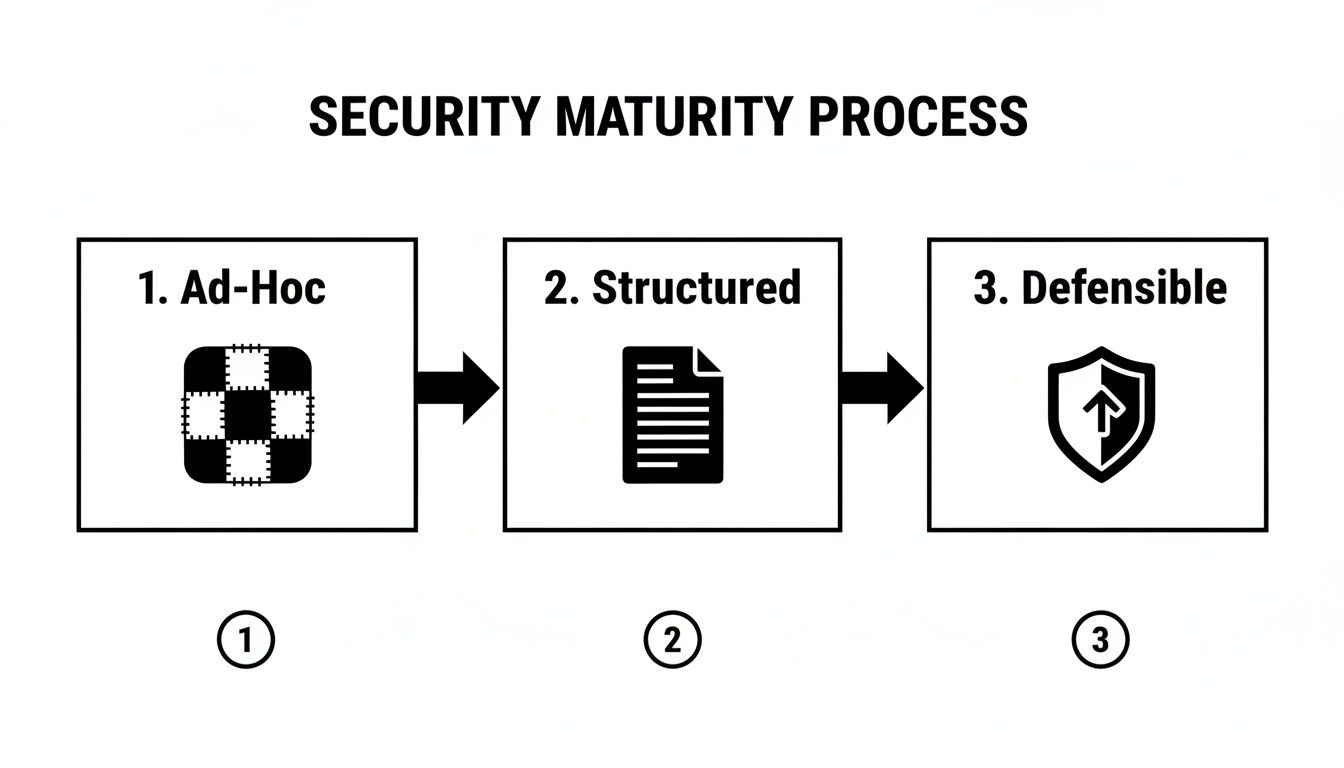
This journey from chaos to confidence is what a structured assessment is designed for, helping you stop reacting to incidents and start proactively managing risk.
Stage 1: Identify What Matters Most (Your Crown Jewels)
Before you can protect anything, you have to know what you have and why it’s important. The first stage is an inventory of your critical digital assets. This goes beyond a list of servers; you need to think in terms of information and processes.
Get your team in a room and ask simple questions:
- What information would trigger a crisis if it were leaked, lost, or unavailable for a week?
- What systems are essential for us to deliver our core services?
- Where does our most sensitive client, donor, or strategic data actually live?
The answers will point you to your crown jewels: your client database, donor lists, shared drives with legal strategies, or even the email accounts of your executive team. The goal is a prioritized list of the digital resources your mission depends on.
Stage 2: Map Plausible Threats
Next, think through the realistic ways your critical assets could be compromised. This isn’t about imagining every doomsday scenario. It’s about mapping plausible threats relevant to your organization.
Consider these common situations:
- Human Error: A well-meaning employee emails a spreadsheet with sensitive client data to the wrong person.
- Insider Threat: A disgruntled former employee, whose access wasn’t revoked, downloads the entire client list.
- External Attack: A ransomware attack encrypts your main server, making all operational files inaccessible.
- System Failure: The cloud service that hosts your case management system goes down for two days.
By focusing on believable scenarios, you move security from an abstract concept to a set of practical problems you can solve.
Stage 3: Assess Real-World Impact
With assets and threats identified, you now connect the dots to determine the business impact. This is where you score each risk, not with complex math, but with a simple framework your leadership team can grasp instantly.
For each threat scenario, assign two scores on a simple 1 to 5 scale:
- Likelihood: How likely is this to happen? (1 = Very Unlikely, 5 = Almost Certain)
- Impact: If this happened, how damaging would it be to our mission, reputation, or operations? (1 = Minor Inconvenience, 5 = Catastrophic)
Multiplying these gives you a Risk Score. This simple quantification forces you to move beyond gut feelings and prioritize based on a consistent, defensible logic. An event that is highly likely but has low impact might be less of a priority than a rare event with catastrophic consequences. To get the “Impact” score right, a formal business impact analysis is the best way to accurately quantify potential damage.
Sample Risk Scoring Matrix
This matrix turns abstract threats into a prioritized list you can work with.
| Identified Risk | Affected Asset | Likelihood (1-5) | Impact (1-5) | Risk Score (Likelihood x Impact) | Priority |
|---|---|---|---|---|---|
| Ransomware Attack | Main File Server | 3 | 5 | 15 | High |
| Accidental Data Leak | Client Database | 4 | 3 | 12 | High |
| Extended Cloud Outage | Case Management Platform | 2 | 5 | 10 | Medium |
| Insider Data Theft | Donor List | 2 | 4 | 8 | Medium |
| Phishing Attack | Employee Credentials | 5 | 1 | 5 | Low |
The highest scores immediately draw your attention to the most critical vulnerabilities.
Stage 4: Build a Prioritized Action Plan
Finally, arrange your risks from the highest score to the lowest. This sorted list becomes your strategic roadmap. The risks at the top are your non-negotiables.
For each high-priority risk, decide on a course of action:
- Mitigate: Implement a control to reduce the risk (e.g., enforce multi-factor authentication).
- Transfer: Shift the financial component of the risk (e.g., purchase or review your cyber insurance policy).
- Accept: Formally acknowledge the risk and do nothing—a valid choice for low-scoring risks where the cost to fix exceeds the potential loss.
- Avoid: Change a business process to eliminate the risk entirely (e.g., stop collecting a certain type of sensitive data).
This structured process, guided by a good cybersecurity risk assessment template, is becoming standard practice. Industry data from sources like the 2025 State of Cyber Risk Management Report shows that leading organizations are moving towards standardized templates to quantify risk. Similarly, analysis from firms like BitSight shows a trend toward automated tools that make this process faster and more accessible.
This process transforms an overwhelming list of “what-ifs” into a manageable, prioritized action plan you can defend to your board.
The Action: Turning Your Assessment Into a 90-Day Plan
You’ve finished the risk assessment. You have a clear, prioritized picture of where your organization is vulnerable. But a document is just potential energy. The real value begins when you turn insights into action.
The best way to do this is with a 90-day plan.
A 90-day sprint creates focus and momentum. It’s a short enough window to maintain urgency but long enough to make a measurable dent in your risk profile. It signals decisive leadership to your board, funders, and team, and it stops your hard work from becoming just another report collecting dust.
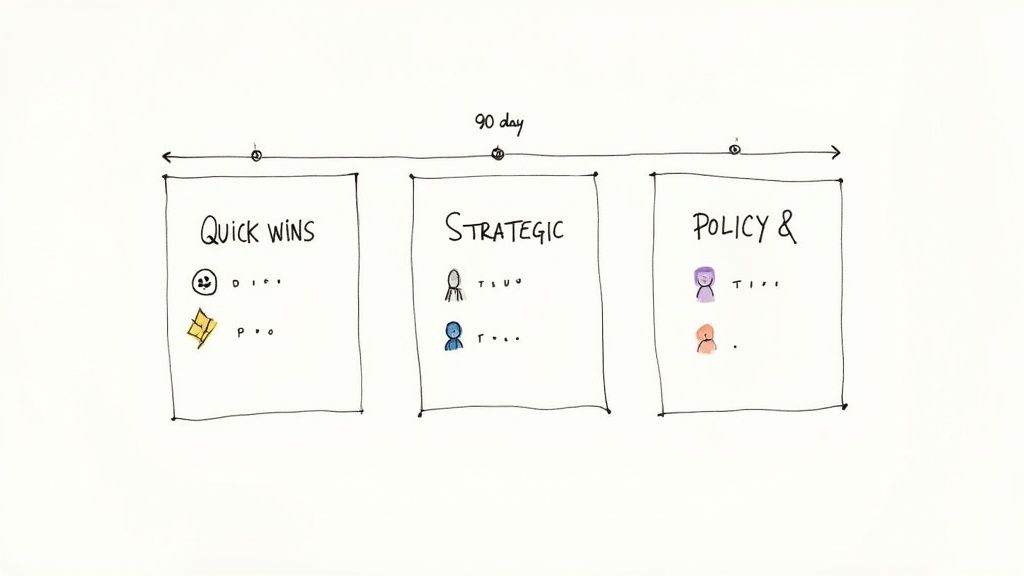
Organizing Your First 90 Days
Group your high-priority items into three practical buckets. This framework balances quick fixes with foundational, long-term goals.
- Quick Wins (Days 1-30): High-impact, low-effort tasks you can tackle immediately. A classic example is enforcing multi-factor authentication (MFA) across all critical systems. Another is decommissioning old, unused user accounts that attackers love to exploit.
- Strategic Projects (Days 30-90): Bigger initiatives that address systemic weaknesses. This might mean finally consolidating sensitive client data from a dozen scattered spreadsheets into a single, secure case management system.
- Policy & Training (Ongoing): This bucket is about the human element. Your technology is only as good as the people using it. Here you might launch a mandatory phishing awareness program or formalize an incident response plan so everyone knows what to do when something happens.
This structure makes your plan easier to communicate and defend. It shows you’re methodically building a more resilient organization.
The Proof: Making the Business Case
I once worked with a COO at an impact litigation hub. Her risk assessment uncovered a terrifying vulnerability: years of highly sensitive legal documents were on an old local server with spotty backups. The risk score for a ransomware attack was through the roof.
She used the 90-day framework to build an airtight case for her board.
- Quick Win: Immediately deploy encrypted, cloud-based backups for that server (Week 1).
- Strategic Project: Begin a phased migration of all case files to a secure, compliant cloud platform (Month 2).
- Policy & Training: Develop and roll out a new data handling policy and train staff on the new system (Month 3).
By presenting the assessment findings alongside a tangible 90-day plan, she wasn’t just asking for money for “IT stuff.” She was presenting a clear, evidence-based case for protecting the organization’s most vital asset. The board approved the investment without hesitation.
And never forget the human element. The 2025 Human Risk Report from Living Security found that targeted training dropped phishing simulation failure rates from a scary 28% to just 8%. Your 90-day plan must include initiatives that build a culture of security awareness.
The Stakes: A Choice Between Worry and Confidence
Every leader eventually faces this choice.
Path 1: The Status Quo. You continue in a constant, reactive scramble. You patch holes as they appear, juggle mismatched security tools, and hope for the best. On this path, you’re always one clever phishing email or one lost laptop away from a crisis that could undermine your mission. Failure means a potential data breach, loss of funder trust, and real harm to the communities you serve.
Path 2: A Defensible Future. You build a future where security is not a source of anxiety, but a strategic asset. Your team feels more secure, backed by clear policies. Your board and funders see proof of responsible leadership. Success means your systems become a reliable backbone that supports the advocates standing with vulnerable people.
This isn’t a pipe dream. It’s the direct result of a structured approach to cybersecurity, starting with a proper risk assessment. This is how you stop reacting and start proactively managing risk. The goal isn’t to eliminate every threat—that’s impossible. It’s to build resilience so that when incidents happen, you can withstand them and continue your vital work.
Your Guide on This Journey
Making this shift requires more than a spreadsheet. It requires a seasoned guide who understands the unique pressures you face. At CTO Input, we provide that senior leadership and a clear roadmap.
We help turn your assessment findings into a practical plan your team can get behind. A huge part of this is finding your weak spots before an attacker does, which is why it’s critical to understand how to test your cyber resilience before attackers do.
The journey from worry to resilience begins with one manageable step. Let’s schedule a brief, no-pressure call to discuss how to build a security posture you can defend to your board, funders, and communities.
FAQs: Common Questions from Leaders
Taking on a formal risk assessment for the first time brings up valid questions. Here are the ones I hear most often.
We have an IT vendor. Don’t they handle this?
Most IT vendors are pros at keeping the lights on—managing networks, fixing laptops, and ensuring operational uptime. A cybersecurity risk assessment, however, is about managing business risk. It’s a strategic exercise that requires understanding your mission, your critical data, and your operational vulnerabilities. Your IT vendor is a key partner in implementing controls, but the responsibility for deciding what to protect and why must start with leadership. Our cybersecurity risk assessment template is designed to help you lead that conversation.
How much time will this actually take? We’re already stretched thin.
Your first assessment is a time investment, but it pays you back by creating focus. For a typical mid-sized organization, plan for a focused effort over two to four weeks, involving a handful of structured workshops with key staff. The real time-saver is the clarity you gain. Instead of chasing every new threat, you’ll have a prioritized plan, allowing you to spend far less time putting out fires and more time putting resources where they count.
Do I need to be a technical expert to use a template?
Not at all. A good process is designed for organizational leaders, not IT gurus. It frames security around business impact, not technical jargon. You’ll be asking questions like, “What would happen to our operations if this client database was down for a week?” or “How would our reputation be damaged if our strategic plan leaked?” Your job is to lead the strategic discussion; your tech team’s job is to supply the technical details after you set the direction.
What’s the difference between a risk assessment and a security audit?
This is a critical distinction. Think of it this way:
- An audit looks backward. It’s a pass/fail test to check if you’re following a specific set of rules or standards (like for compliance).
- A risk assessment looks forward. It’s a strategic process to identify what could go wrong, what the damage would be, and what you’re going to do about it.
An assessment helps you make smart decisions about where to invest your limited resources. While audits are often required, a risk assessment is the foundation of a genuinely strong security program. Navigating compliance gets much easier once you have a solid risk assessment in place, as explained in our guide to cybersecurity compliance services.
Ready to turn technology from a source of chaos into a strategic superpower? At CTO Input, we provide the fractional executive leadership to build a clear, believable roadmap for growth, security, and scale. If you’re ready to move from firefighting to focused progress, schedule a no-pressure discovery call today at https://www.ctoinput.com.