
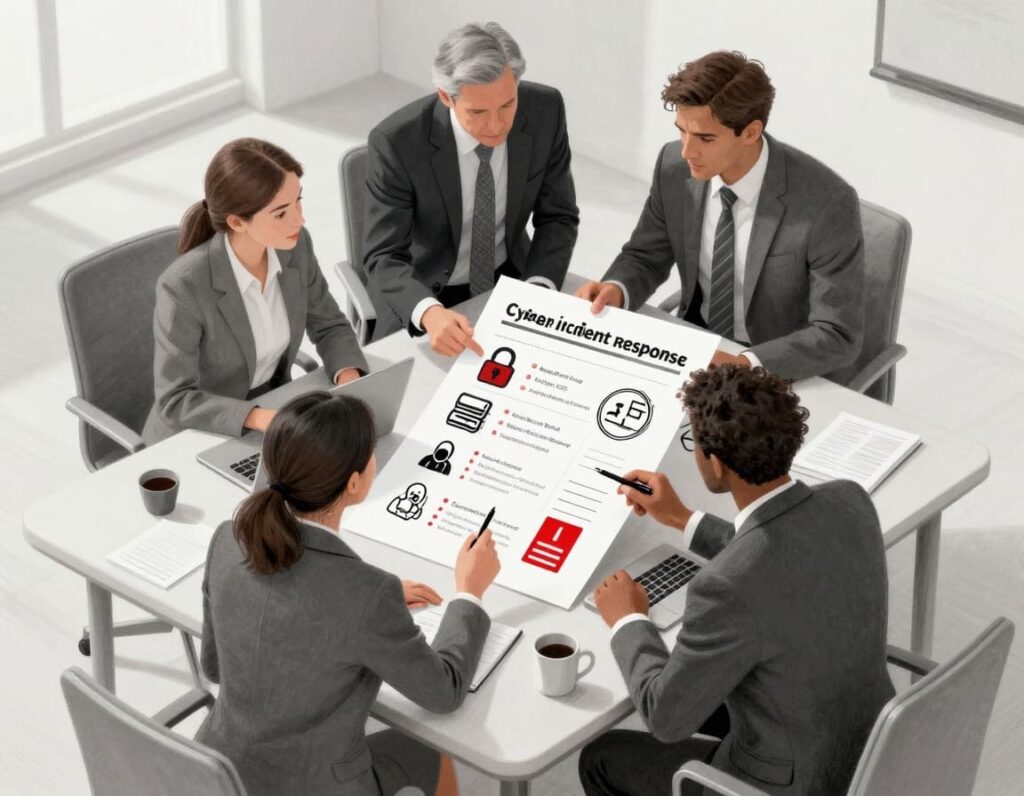
You are a CEO, COO, or founder. It is 11:47 p.m. Your phone lights up.
Systems are locked. Someone says “ransomware.” Another says “data might be out.”
In that moment, you are not thinking about firewalls. You are thinking about board calls at 7 a.m., customer emails, wire transfers, payroll, and whether this hits the news. The stress is real: margins, reputation, and lender trust all feel like they are on the line.
This guide is built for you, not for your IT team. It covers C-suite responsibilities with an executive cyber incident checklist for the first 72 hours, focused on incident management for decisions, communication, and business impact. You already have IT people. What you do not have is a trusted CISO who has seen this movie before.
CTO Input plays that role for mid-market companies every year, walking leaders through live incidents and helping them build cyber resilience to come out stronger. The checklist below breaks your first 72 hours into simple moves in 0 to 24, 24 to 48, and 48 to 72 hour windows. Follow it, and you protect three things that matter most to you: margins, board confidence, and customer trust.
The Executive Cyber Incident Checklist: First 72 Hours at a Glance

This is not a technical playbook. Through planning and preparation, think of it as your board-ready, decision-focused view of a cyber event.
- 0-24 hours: Stabilize and contain
Stay calm, confirm there is a real incident, name a single incident leader, back IT as they contain the problem, and control internal and external messages. - 24-48 hours: Understand impact and make calls
Gain a clear view of affected systems and data, map business impact, and decide on notifications, law enforcement, and first public statements. - 48-72 hours: Communication and start safe recovery
Give credible updates to staff, customers, and the board, approve a phased recovery plan, and commit to lessons learned and stronger controls.
For added context, many executives keep a copy of the Cyber Incident Response Executive Checklist nearby as a reference alongside their own internal Cyber Incident Response Plan and the NIST Incident Response Checklist, bolstering their preparation.
0-24 hours: Stabilize, Contain, and Take Control as a Leadership Team
The first day is about control, not heroics.
Your goals are simple:
- Stay calm in front of your people.
- Confirm that something real is happening.
- Appoint one incident commander and route all updates through them.
- Authorize containment moves that may hurt in the short term but protect you in the long term.
- Control internal and external communication.
Avoid three early traps: making promises you cannot keep, blaming people while facts are still fuzzy, or rushing to pay a ransom before you understand scope and options.
24-48 hours: Understand the Impact and Align on Tough Choices
By the second day, the spotlight intensifies. Board members and investors want detail. Customers and partners may be asking questions.
Your focus shifts to:
- What systems, data, and business processes are actually affected.
- How this touches revenue, operations, legal exposure, and brand.
- Initial decisions on regulator notifications, customer messages, and law enforcement.
This is where an organized, one page view of impact separates calm leadership from chaos.
48-72 hours: Communicate Confidently and Start Safe Recovery
By day three, you should move from “we are hit” to “here is our plan.”
Your tasks:
- Share credible, consistent updates to staff, customers, board, and key partners.
- Approve which systems come back online first and under what extra controls.
- Agree on how you will learn from this and strengthen your posture.
This closes the initial crisis window and sets up the longer term clean up.
0–24 Hours: Your Immediate Cyber Incident Response Checklist
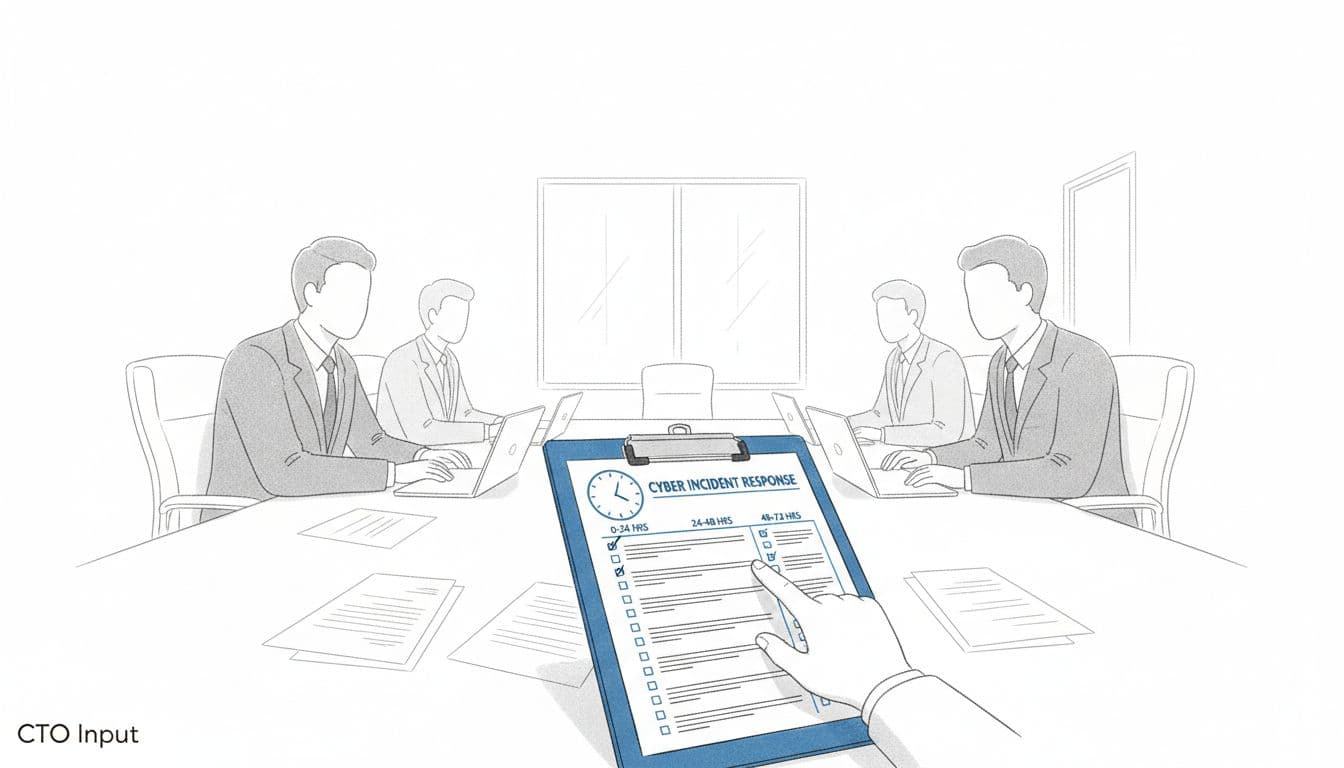 The first day is when your behavior as a leader either calms the system or fuels panic. Use this checklist to set the tone.
Confirm there is a real cyber incident and name a single incident leader
Start with clarity.
Ask simple, direct questions:
- What exactly did we see or receive?
- Who discovered it and when?
- Which systems or data seem affected right now?
Then, name one incident commander. This might be your CIO, IT lead, or an external advisor. The title matters less than the clarity that this person handles coordination of the response.
Your job is to:
- Back this person publicly.
- Route all incident questions through them.
- Stop side conversations that create mixed messages.
Establish clear roles and responsibilities by doing so. This mirrors guidance in many expert resources, such as the Cyber Incident Response Checklist, which puts clear ownership at the top of the list.
Support containment: authorize quick technical actions without micromanaging
Containment often hurts in the short term. You may need to shut down key systems, block remote access, or lock user accounts.
Your role is to give clear permission for pain now to avoid damage later.
Ask your incident commander:
- Do you need my approval to isolate networks or servers?
- Are we stopping staff from “self-fixing” machines or wiping devices?
- Have we initiated digital forensics?

Photo by Markus Winkler
Well-meaning staff can destroy key evidence by reimaging laptops or restoring from old backups. Make it clear: all tech work in response to the incident runs through the incident commander and their plan.
Also confirm that sensitive conversations use a secure communication platform, not systems that may be compromised.
Control internal communication and loop in legal, risk, and board chairs early
Information spreads faster than malware.
You need a simple communication frame:
- Who inside the company needs to know now.
- What exactly they should be told.
- Where and how updates will be shared.
Involve legal counsel and any risk advisors as soon as the incident looks material. Do not wait days. Ask for quick guidance on:
- What can go in writing.
- What should stay in controlled verbal updates.
- How to record decisions for later review.
Notify your board chair early with a calm, factual summary and a promised cadence of updates. Short, clear internal notes reduce rumor and fear far better than silence.
Decide on outside help: incident response partners, insurance, and law enforcement
The final decision block in the first 24 hours is: who else should be in the room.
Key questions:
- Do we have a partner we trust to guide us right now?
- What does our cyber insurance policy require us to do in the first 24 hours for insurance claims?
- At what point do we notify law enforcement?
Many cyber insurance policies require the use of pre-approved external vendors. Some, like those highlighted in the Incident Response Executive Preparation Checklist, spell out early steps in detail. Have your team review those requirements immediately.
If you do not have an existing incident partner, this is where firms like CTO Input step in as neutral leaders who can coordinate technical teams, legal input, and communication.
24-72 Hours: Lead the Business Recovery, Not Just the Technology Response
By day two and three of Incident Response, you are no longer just “fighting the fire.” You are leading the business through impact, risk, and recovery choices as part of Incident Response.
Map the business impact: data, customers, cash, and critical operations
Ask for a simple, one-page view that covers:
- What types of data were likely touched in data breaches, such as customer, employee, financial, or IP.
- Which revenue streams or services are affected by business interruption.
- Which critical operations are down and what manual workarounds exist.
- How long you can safely run in crisis mode before business continuity, cash flow, or compliance is at risk.
This summary becomes your anchor for board, lender, and major customer calls. It helps you align with reference material like the Federal Cybersecurity Incident Response Playbooks, without drowning in detail.
Make clear calls on notification, regulators, and customer communication
Next, decide what you must say, to whom, and when.
Work with legal counsel to answer:
- Do any laws or contracts require notice within a set time frame?
- Which regulators or industry bodies expect alerts?
- Which customers or partners will feel blindsided if they hear this from someone else?
Your public posture should be simple: share facts you can stand behind, explain what is still being investigated, state what you are doing now, and say what support you will offer affected parties.
Clear, honest updates almost always reduce long-term damage, even if the news is bad. Silence or spin tends to cost more later.
For many leaders, checklists like the Cyber Incident Response Readiness Checklist help frame these duties in advance so decisions are faster under pressure.
Approve a safe recovery plan and define “good enough” to exit crisis mode
By the 48- to 72-hour mark, your technical team or outside responders should propose a recovery plan.
You should ask:
- Which systems come back first and why.
- What extra monitoring or access controls will be in place.
- What risks we are knowingly accepting in the next 7 to 14 days from threat actors.
Agree on a clear definition of “good enough to exit crisis mode,” for example: no active attacker activity. This closes out the Containment, Eradication and Recovery process.
Capture lessons learned from the event through a post-incident review to inform cybersecurity awareness training and strengthen controls against future attacks. Use this recovery phase to enhance planning and preparation, including follow-up tabletop exercises to test the “good enough” definition and updated plan.