
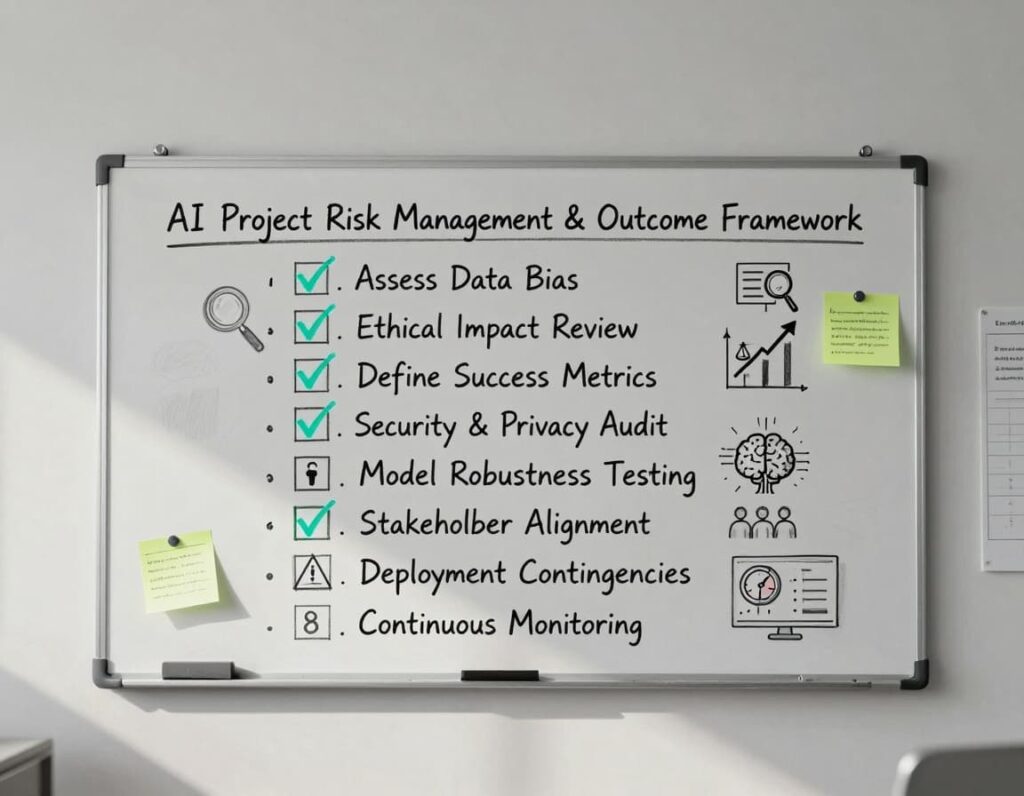
You are a CEO, COO, or founder who is spending more on tech and getting less back. Your inbox is full of AI pitches, your team brings slide decks to every planning session, and your board asks, “What is our AI strategy?” while also warning you about risk. You feel the squeeze from every side.
Saying yes feels dangerous. Saying no to everything feels even worse. Margins, customer trust, and regulatory scrutiny are all on the line. You need a simple board checklist for AI projects that lets you green light, pause, or kill ideas without guessing.
That is where a seasoned, neutral guide like CTO Input sits next to you, not across the table, and helps you turn AI from noise into a small set of controlled, high-value bets.
Why Your Board Needs a Clear Checklist For AI Projects
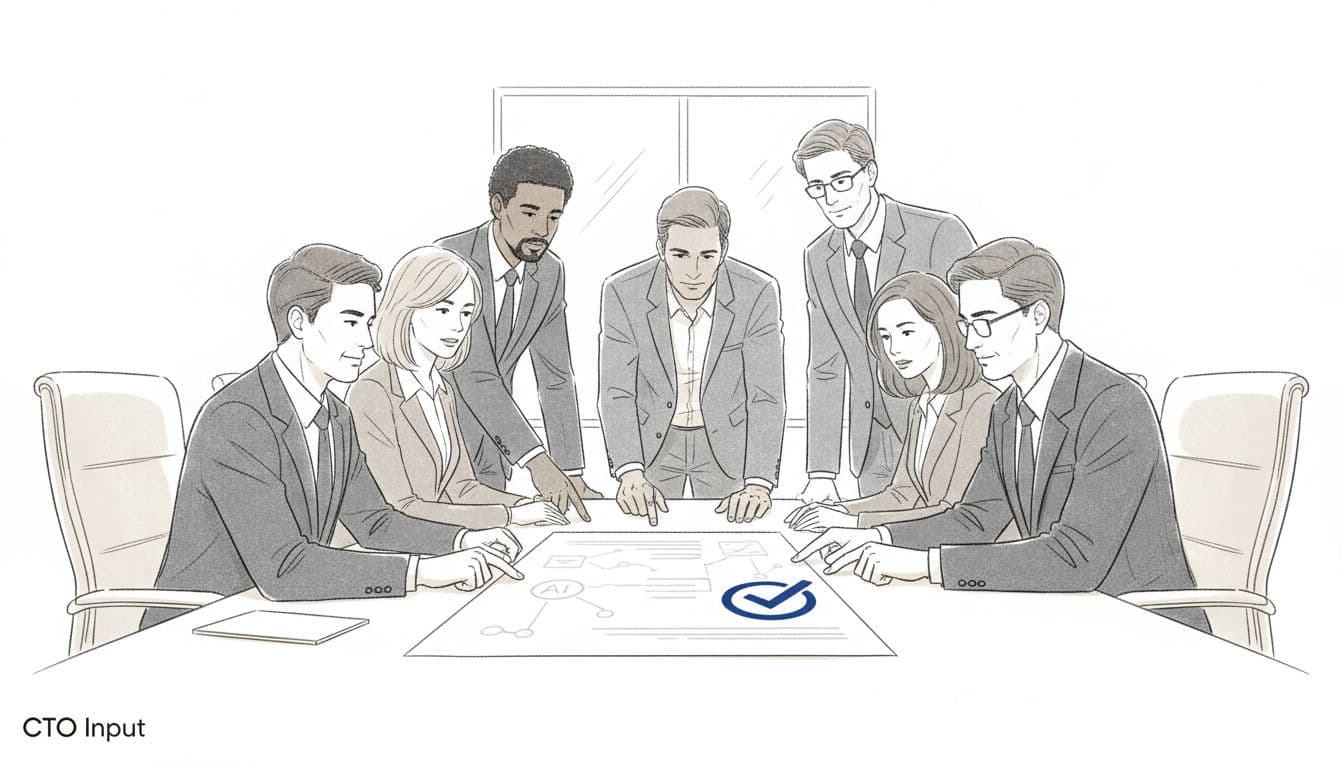
Image: Board executives reviewing an AI project checklist. Image created with AI.
Vendors, internal teams, and even investors are all pushing AI ideas at you. Some are smart, many are vague, and almost all sound urgent. Without a clear filter, your board is left reacting to sales pressure and buzzwords instead of business value.
Most mid-market boards do not have time to unpack model types, training data, or prompt engineering. Yet they are exposed on cyber risk, privacy, and compliance if something goes wrong. That tension is exactly what global advisors highlight in resources like KPMG’s guidance on preparing boards for generative AI, which stress board responsibility for AI risk oversight.
A simple, shared checklist changes the conversation. It shifts the focus from “Is this tool cool?” to “Does this project protect or grow our business?” Used well, it protects margins, reputation, and trust, while still letting you move fast enough to compete.
The real risks of saying yes to the wrong AI project
The wrong AI project does not just waste budget. It can leak sensitive customer data, create biased decisions, or flood your teams with support issues they cannot handle.
At board level, that means real exposure. Think regulatory fines after an investigation, failed audits because AI activity was undocumented, or broken promises to customers about how their data is used. Practical AI governance checklists, like this AI governance guide for CTOs and CIOs, show how quickly a “small pilot” can touch core risk areas.
A calm, simple filter at board level is no longer a nice-to-have. It is part of basic duty of care.

Image: Visual summary of AI project risks like data leaks, bias, and wasted budget. Image created with AI.
The cost of moving too slow or saying no to everything
On the other side, blocking all AI work is its own risk. Manual processes stay slow and expensive, while competitors quietly automate, personalize, and analyze at scale.
You feel it as higher labor costs, slower sales cycles, and frustrated teams who cannot get basic insights on demand. When every AI proposal dies in committee, your best people stop bringing ideas at all.
The goal is not “AI everywhere” or “AI nowhere”. The goal is a focused portfolio of AI projects that are safe, legal, and directly tied to your strategy.
A Board Checklist For AI Projects
Here is a board-ready checklist you can bring into your next meeting. It stays at decision level, not tool level, so you do not need a PhD to use it.
1. Is the AI project tied to a clear business outcome you care about?
Start with the problem in plain language. What business outcome will this project improve: revenue, margin, risk, or customer experience?
Ask the sponsor to write a one-page business case, not a 40-slide deck. It should state how you will know, in 6 to 12 months, if the project worked. If they cannot explain it in a page, the project is not ready for board approval.
2. Do you understand the total cost, timing, and expected payback?
AI projects often hide work in data cleanup, integration, and ongoing tuning. You need the full picture: build or buy costs, data costs, licenses, change management, and support.
Ask for a simple view of payback: expected annual savings or revenue gain versus total cost over 12 to 24 months. If the numbers rely on soft guesses or “future upsell,” flag it. A clear cost and payback frame is a non-negotiable board decision input.
3. Is data, privacy, and security risk clearly addressed?
Every serious AI project should answer four questions in plain terms. What data will it use, is any of it sensitive or regulated, where will it live, and who can see it?
You also want clarity on protection. How are access controls set, what logging is in place, and what is the incident response plan if something goes wrong? If the answers sound fuzzy, you are not ready for yes.
For a more detailed reference, you can compare your questions to this AI governance checklist for executives.
4. Does the AI project meet your legal, compliance, and ethics bar?
Boards are expected to ask about laws, contracts, and ethics, not just revenue. You should hear a clear view on how the project fits current and expected AI and privacy rules in your regions.
Push for a simple plan to detect and handle bias or unfair outcomes. Ask how customers, employees, or partners will be told that AI is involved. These answers should be documented before approval, so you can show the board did its job if questions come later.
5. Do you have the right people, owners, and guardrails in place?
Technology does not fail on code first. It fails on ownership. Every AI project needs a named executive sponsor, a business owner for outcomes, and a technical lead.
Ask about training for front-line teams, a support model after launch, and simple guardrails like usage policies. There should also be a plan for regular reviews of performance and incidents. If everyone owns it, nobody owns it.
6. Can you test small, measure results, and shut it down if needed?
The best AI portfolio behaves like a set of controlled experiments, not a pile of giant bets. Ask if you can run a low-risk pilot first, with clear metrics and a small, defined group.
Agree on early warning signs that would trigger a pause or stop, such as error rates, complaints, or rising support tickets. Name who has authority to pull the plug. A strong board checklist for AI projects includes a clean exit plan, not just an entry plan.
How to Use This Board Checklist AI Projects In Your Next Meeting
You do not need a full AI committee to use this. You need a better way to frame the AI part of your existing agenda.
Before the next board or leadership session, send this checklist out as the standard. Tell your team and vendors that all AI proposals must answer these questions in one page each. This alone will filter out weak, buzzword-heavy ideas.
During the meeting, keep the conversation calm and focused. You are not comparing models, you are comparing business outcomes, risk, and payback. Over time, this shared filter becomes how your company talks about AI, not just how you approve it.
For further structure, you can look at external AI governance examples like this AI governance checklist update and adapt the parts that fit your context.
Turn AI proposals into a one-page decision brief
Ask every team or vendor to bring a one-page brief that maps to the checklist items. It should cover: business outcome, cost and timing, data and security risk, compliance and ethics, people and ownership, and the pilot and exit plan.
No jargon, no architecture diagrams unless asked. This gives you a like-for-like way to compare very different projects in a few minutes.
Decide which AI projects to green light, pause, or kill
Once each proposal is in the same format, sorting becomes simple. Some projects will be ready to approve, a few will need more work, and many will clearly not make the cut.
Back a small number of high-quality projects and say no to the rest. If you want a neutral expert at the table to run this filter, build a wider AI and technology roadmap, and keep board conversations grounded, that is exactly the role CTO Input plays.
Conclusion
A clear board checklist for AI projects turns AI from noise into a controlled part of your growth plan. You get fewer surprises, clearer tradeoffs, and a smaller portfolio of AI bets that you actually understand.
Picture your next board meeting. You walk in with simple answers on AI risk and value, a shortlist of projects backed by numbers, and technology spend that finally feels under control. That is the shift from guessing to governed action.
If you want help building a broader technology and AI roadmap, visit https://www.ctoinput.com and explore more practical guidance on the CTO Input blog at https://blog.ctoinput.com.