

That late-night email with the subject line “Security Incident” is the one every nonprofit leader dreads. Your stomach drops. Has donor data been exposed? Are confidential case files from your immigration clinic now in the wrong hands? For justice-focused organizations, a data breach isn’t just a tech problem—it’s a direct threat to the communities you serve and the trust you’ve worked so hard to build.
Without a clear plan, the next few hours descend into chaos. Who do you call first? Your board chair? A lawyer? Your IT vendor is on the phone asking for decisions you have no context for, while the clock ticks on legal notification deadlines that change from state to state. This is the reality for too many nonprofits that have grown fast on top of fragile systems, where sensitive data is scattered across tools that don’t talk to each other.
A well-crafted data breach response plan for legal nonprofit is your legally required roadmap for navigating this crisis. It turns panic into a methodical process, protecting your mission, your funding, and the vulnerable people who depend on you.
Key Takeaways for Nonprofit Leaders
- A Plan is Not Optional: Data breach notification laws apply to all organizations, regardless of size. A formal response plan is a legal and operational necessity for protecting your mission and meeting your duties to funders and communities.
- Privilege is Paramount: Your first call after confirming a breach should be to your cyber insurance carrier, followed immediately by their recommended outside legal counsel. This wraps the investigation in attorney-client privilege, protecting your internal discussions.
- Communication is Strategic: You need a communications plan that speaks to each audience—board, funders, staff, and beneficiaries—with empathy and clarity. Transparency without a strategy can backfire.
- Recovery is an Opportunity: The “lessons learned” from a breach are your roadmap for modernization. Use the forensic report to justify investments in stronger systems, better training, and more resilient processes.
The Nightmare Scenario: A Breach in the Real World
Imagine it’s 10 PM on a Tuesday. You get that urgent email.

This is where the stakes become painfully real. You aren’t just protecting credit card numbers; you’re the steward of intensely personal information—someone’s immigration status, their incarceration history, or their involvement in sensitive impact litigation. A breach is a direct assault on the trust you’ve built with your community and funders, and it triggers a cascade of legal duties that are as complex as they are unforgiving.
The High Cost of Being Unprepared
Without a predefined plan, you’re forced to make massive legal, financial, and reputational decisions under unimaginable stress. I see this happen all the time, especially with organizations whose systems haven’t kept pace with their growth. When case files and program data are scattered across a dozen different tools, just figuring out what was compromised becomes a frantic exercise.
The fallout can be devastating:
- Crippling Fines: Miss a legal deadline for notifying authorities or affected individuals, and you can face significant financial penalties.
- Loss of Funding: Foundations and major donors expect sophisticated risk management. A mishandled breach is a giant red flag that says you can’t protect their investment or your community.
- Erosion of Trust: The people you serve trust you with their lives. As I’ve written before, a breach of privacy is a brand problem first, a technical problem second. Losing that trust can cripple your mission.
- Mission Paralysis: Your team, already stretched thin, gets completely consumed by the crisis, grinding your vital program work to a halt.
A calm, methodical response plan is the antidote to this chaos. It’s not a dense technical document filled with jargon. It’s a strategic playbook that tells your team exactly what to do, who to call, and what to say. It is a core pillar of your mission’s resilience.
What Your Board Needs to See: A Clear, Defensible Plan
When an incident hits, your board and leadership team don’t want a lecture on network security. They need answers to a few core questions: Are we in control? What is our liability? What are we doing right now to fix it?
This is where your data breach response plan for your nonprofit’s legal obligations becomes your most valuable asset. It’s the executive-level playbook that shows you are managing the crisis, not just reacting to it. It translates technical and legal chaos into a clear, defensible process that protects the mission, keeps faith with donors, and meets your legal duties.
The Simple Framework for a Sound Response
A well-crafted plan guides you through clear stages, each with its own purpose and critical legal checkpoints. This structure is what allows you to make smart, deliberate decisions when the pressure is on. Remember, solid governance isn’t just for sunny days. In fact, many of the best practices for IT governance are what will make or break your response when a breach occurs.
The goal is to replace panic with process. When your team knows who to call and what to do first, you can immediately contain the damage and communicate effectively, instead of wasting precious hours in confusion.
Here is the simple, legally sound framework your plan should follow. This is how you’ll answer the board’s first, most important question: “What’s the plan?”
| Response Phase | Your Primary Goal | Key Legal Consideration |
|---|---|---|
| Detection & Analysis | Quickly confirm a breach occurred and understand its initial scope. | Preserve evidence for forensic investigation; avoid actions that could destroy crucial logs. |
| Containment | Isolate affected systems to prevent further unauthorized access or data loss. | Document every containment step for legal and insurance reporting purposes. |
| Notification & Legal | Determine who must be notified and by when, according to state, federal, and international law. | Engage outside counsel immediately to guide notification strategy under attorney-client privilege. |
| Remediation | Eradicate the threat, restore systems securely, and implement new controls. | Fulfill any legally mandated remediation, such as offering credit monitoring to affected individuals. |
| Post-Incident Review | Analyze the incident to identify and address the root cause, strengthening future defenses. | Create a formal record of lessons learned to demonstrate due diligence to regulators and funders. |
Having this framework defined ahead of time ensures that your response is not only technically effective but also legally and regulatorily defensible.
The First 72 Hours: Your Step-by-Step Playbook
The moment you confirm a security incident, a clock starts ticking—loudly. The first three days are a controlled sprint, not a panicked scramble. Every decision carries significant legal weight. Your goal is to move from reactive shock to a methodical, defensible process as quickly as possible.
Step 1: Assemble Your Core Response Team
Your first move is to get the right people in a room—virtual or physical. This is not an all-staff meeting. Convene your pre-designated Incident Response Team, a small, empowered group that can make critical decisions without delay.
This core team should include:
- The Incident Lead: A COO or senior operations leader who owns the process.
- Executive Leadership: Your Executive Director or CEO, who manages board and funder communications.
- Technical Lead: Your IT manager, vendor, or fractional CTO who translates jargon into business risk.
- Communications Lead: The person responsible for shaping the narrative for all stakeholders.
Everyone else should continue their normal duties. The goal is a single point of control to prevent conflicting messages or well-intentioned actions that could make things worse, like deleting forensic evidence.
Step 2: Make the Two Most Important Calls
Before you do anything else, activate your expert support. These two calls must happen within the first hour.
- Call Your Cyber Insurance Carrier: Your policy isn’t just a checkbook; it’s a playbook with strict rules. Most require immediate notification and mandate that you use their pre-approved legal and forensic experts. Failing to follow their process can void your claim.
- Engage Outside Legal Counsel: Your insurance carrier will connect you with a “breach coach”—a lawyer specializing in this work. Their first job is to wrap the entire investigation under attorney-client privilege, which protects your internal discussions from being discoverable in potential litigation.
This structured flow of detection, containment, and recovery is the backbone of any effective response.
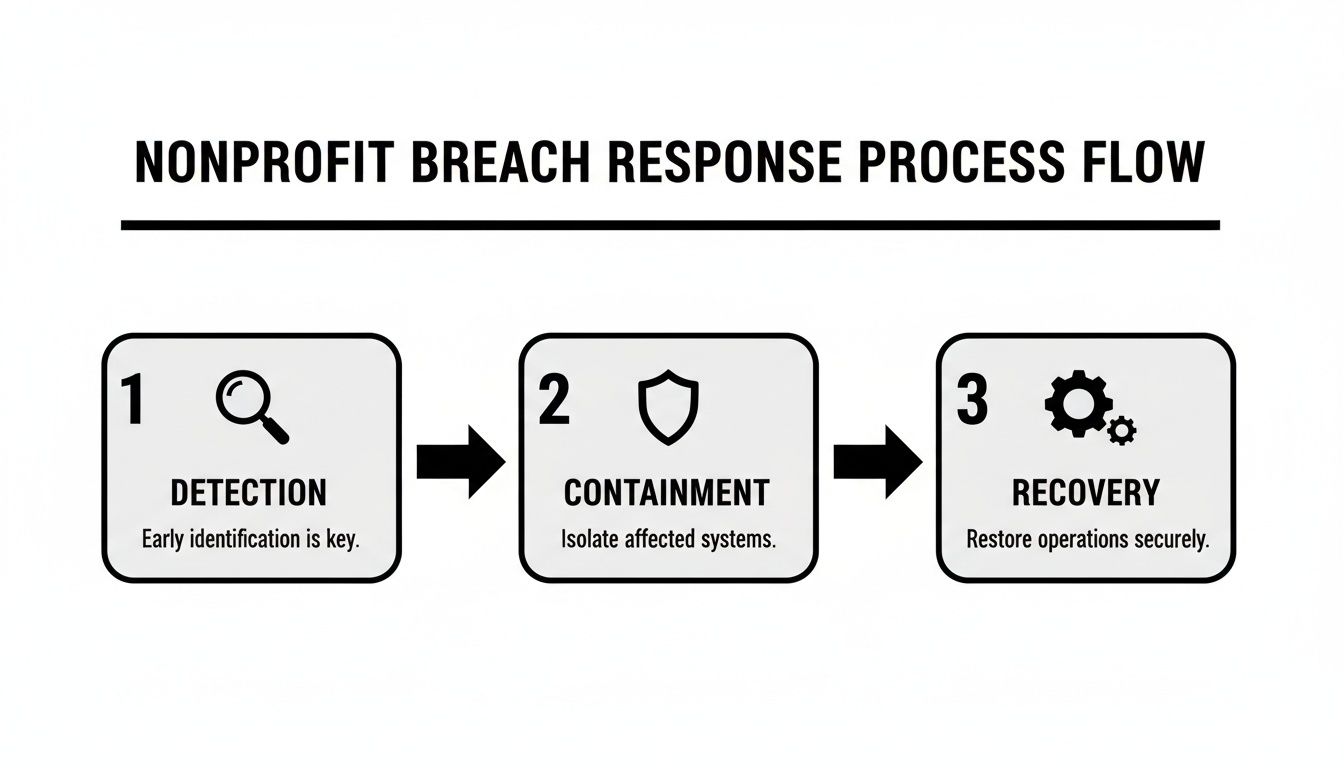
These initial steps establish the legal and financial guardrails for everything that follows.
Step 3: Contain the Threat (Without Destroying Evidence)
With legal and insurance partners engaged, the focus shifts to containment. Let’s say your donor database has been hit with ransomware. The gut impulse is to shut everything down.
But there’s a trade-off. Aggressive actions like wiping servers can destroy the very evidence the forensic firm needs to determine how the attacker got in and what data was stolen. Your forensic partner, guided by legal counsel, will direct your technical team on how to isolate affected systems while preserving this crucial information.
The core tension in the first 72 hours is speed versus precision. Rushing to restore from backups before you understand the breach can mean you’re restoring the attacker right back into your network. A methodical, evidence-based approach is always the safer path.
Data protection laws create clear, time-bound notification obligations. The EU’s GDPR, for example, requires notification to authorities within 72 hours of awareness. This imposes an immediate, hard deadline on your team. You can find more insights on these complex global data breach requirements on brightdefense.com.
While this is happening, start a detailed incident log. This simple timeline of every action, decision, and conversation will become invaluable for your legal defense, insurance claim, and post-incident review.
Navigating the Legal Maze of Breach Notification
Once the immediate threat is contained, the crisis shifts. The frantic energy of the first 72 hours is replaced by the methodical, high-stakes process of legal notification. This is where your plan proves its worth, turning a legal nightmare into a manageable compliance exercise.
You’re now caught in a complex web of state, federal, and sometimes international laws, each with its own rules, deadlines, and penalties. A misstep here can bring significant fines, pouring salt in the wound.
What Triggers a Notification?
The first question your legal counsel will help answer is: based on the type of data exposed and where the affected individuals live, are we legally required to notify anyone?
Imagine your nonprofit, which provides resources to refugee families, discovers a breach affecting individuals in California, Virginia, and a few EU member states. That single incident triggers multiple legal frameworks:
- California: The California Consumer Privacy Act (CCPA) has strict definitions of personal information and requires notification to affected residents and the state Attorney General.
- Virginia: The Virginia Consumer Data Protection Act (VCDPA) comes with its own set of rules on timelines and notification content.
- European Union: If any affected individuals are in the EU, the General Data Protection Regulation (GDPR) and its strict 72-hour reporting deadline kick in, making it your most pressing fire.
Each law defines “personal information” differently. This is why specialized legal counsel isn’t a luxury; it’s a necessity to navigate this patchwork and determine your exact obligations.
Who, What, and When to Tell
Once your legal team confirms notification is mandatory, the next phase is executing a carefully planned communication strategy. Your plan needs to clearly outline three critical elements for each jurisdiction:
- Who to Notify: This starts with affected individuals but almost certainly includes regulatory bodies like the state Attorney General and, if Social Security numbers were involved, major credit reporting agencies.
- What to Say: Laws are prescriptive about the content. Notifications must describe the incident, the type of information involved, steps people can take to protect themselves, and clear contact information for your organization.
- When to Notify: Deadlines are non-negotiable. Some states give you 30 or 45 days, while others use ambiguous language like “without unreasonable delay.” Your legal counsel will build a master timeline to ensure every deadline is met.
Dropping the ball here is costly. Recent surveys show nonprofits are now targeted at rates similar to small businesses. A single breach can cost $200,000–$2,000,000—enough to wipe out years of program funding. You can discover more insights about these nonprofit cybersecurity statistics on tardigradetechnology.com.
This stage is about precision and defensibility. Every word in your notification letters will be scrutinized by regulators. Your outside counsel is there to craft communications that are transparent and empathetic while ticking every legal box.
Communicating with Stakeholders Without Losing Trust
How you communicate during a crisis can either shatter the trust you’ve spent years building or make it stronger. While your team wrestles with the technical and legal mess, your stakeholders have simpler questions: Are you in control? Are you being straight with us? What does this mean for me?
A generic “be transparent” message is lazy advice. You need a deliberate, audience-specific communication plan. If your data breach response plan for nonprofit legal compliance is missing a communications playbook, you’re risking the very foundation your mission is built on.

A Different Message for Each Audience
A one-size-fits-all email blast will amplify anxiety. Your outreach must be segmented and intentional.
- Your Board: They need to see confident leadership and a clear plan. Your message is about control and governance. Give them a high-level briefing—what happened, the steps you’re taking, and the experts you’ve engaged.
- Your Funders: Their concern is reputational risk and stewardship. Communication must be proactive. Tell them before they read it somewhere else. Convey that you are managing the situation responsibly to protect the mission they support.
- Your Staff: Your team is on the front lines. They will be worried. Give them clear direction and calm internal fears. Tell them what they need to know and, critically, what to say if asked—which is to direct all questions to a single, designated person.
- The Communities You Serve: This is where the stakes are highest. Your message must be built on empathy and provide simple guidance. No jargon, no excuses. Focus on what happened and how they can protect themselves.
How you show up in these moments defines your organization’s character. Calm, clear, and honest communication demonstrates you value your relationships more than just managing legal liability.
A Real-World Scenario: Notifying Clients
Imagine your immigration support nonprofit discovers a spreadsheet with client names and case statuses was accidentally exposed. You are legally required to notify every affected individual.
Your notification cannot be a cold, legalistic form letter. It must be written with a deep understanding of the fear this news will cause.
- Lead with Empathy: Acknowledge the shock immediately. “We are writing with difficult news. We recently discovered a security incident that involved some of your personal information.”
- State Facts Clearly: Explain what happened and precisely what data was involved. Just as important, state what was not involved. “This did not include financial information or government identification numbers.”
- Provide Actionable Steps: Give them simple, concrete instructions, like being wary of phishing emails or providing a dedicated phone number they can call with questions.
- Show Accountability: Briefly explain the steps you’re taking to ensure this doesn’t happen again. This shows a renewed commitment to their safety.
This approach transforms a legally mandated chore into an act of trust-building. You meet your legal requirements while reaffirming your commitment to the people you serve.
After the Breach: Forging a More Resilient Future
A data breach is a trial by fire. Once the immediate crisis has passed and notifications are out, the real work begins: shifting from reactive damage control to proactively building a more resilient organization. This is your chance to turn a painful event into a catalyst for change.
This final stage isn’t about pointing fingers. It’s about a clear-eyed “lessons learned” review focused on strategic improvement. The forensic report from your legal and tech teams isn’t just a file for the insurance company—it’s your roadmap, detailing exactly where your defenses buckled.
From Forensic Report to Modernization Plan
The insights from that report must become a tangible action plan. Now is the time to finally tackle the rickety systems and manual processes that have been on the back burner. Ask the hard questions:
- Did a lack of training leave staff vulnerable to a phishing email?
- Was the weak link an unvetted vendor you trusted with your data?
- Did an old, unpatched server leave a door wide open?
Answering these honestly helps you build a compelling case for a modernization plan your board and funders can get behind.
The smartest organizations don’t just patch the one hole the attacker exploited. They use the breach as the undeniable reason to fund the broader security and systems overhaul they probably needed all along.
Third-party access is a massive blind spot. A 2025 global analysis revealed that 35.5% of all breaches in 2024 were linked to third parties. If your donation platform gets hit, you could still be on the hook for notifications. You can dig into the specifics by reviewing the full third-party breach report on securityscorecard.com.
Building Lasting Resilience
Your post-breach roadmap should focus on getting the biggest reduction in risk for your investment. This usually means a mix of new technology, better processes, and a cultural shift toward security. A full-scale security review using a comprehensive IT security assessment checklist is a great starting point.
Maybe it means investing in a secure, centralized database to get client info off scattered spreadsheets. Or it could be implementing mandatory, recurring security training for everyone. This is the step that transforms a crisis into a long-term asset. You show your board, funders, and community that you didn’t just survive the storm—you came out stronger, smarter, and better equipped to protect the sensitive data central to your mission.
FAQs: Answering Your Pressing Questions
When facing a potential data breach, the same questions come up again and again. Let’s tackle the most common ones I hear from nonprofit leaders.
We’re a small nonprofit. Do we really need a formal response plan?
Yes, absolutely. Attackers often see smaller organizations as easier targets, assuming you lack robust defenses. More importantly, data breach notification laws don’t give you a pass for being small. A single incident can wreck your budget and reputation. A straightforward data breach response plan for your nonprofit isn’t bureaucracy; it’s a survival tool that allows you to act fast, make smart decisions, and prove to funders you’re a responsible steward of their trust.
How does cyber insurance fit into this?
Think of cyber insurance as a critical financial safety net, not the whole plan. It helps cover hard costs like forensic investigators, legal fees, and notification expenses. However, most policies have strict requirements, often dictating which lawyers or forensic firms you must use. Your response plan needs to align with your policy. Make sure one of your first calls after confirming a breach is to your insurance carrier to avoid jeopardizing your coverage.
How often should we test our response plan?
A plan gathering dust on a shelf creates a false sense of security. Review it at least once a year and anytime you have a major change, like new key personnel or IT systems. More importantly, you need to test it with an annual tabletop exercise. This is a simulated crisis where you walk your team through a realistic breach scenario. It’s the only way to find the hidden gaps in your plan and build the muscle memory your team needs to handle a real emergency without panicking.
Feeling the weight of getting this right? You don’t have to figure it all out alone. CTO Input acts as a calm, seasoned advisor, helping justice-focused nonprofits build practical plans that protect their mission. We cut through the technical jargon and legal complexity to create a roadmap that gives you, your board, and your funders peace of mind.
Schedule a no-pressure discovery call today to start building a more resilient organization.