

You are a growth-minded CEO, COO, or founder who sleeps with one eye on revenue.
You are spending more on tech, security tools, and vendors, yet despite these investments in cybersecurity preparedness, you still cannot answer simple board questions like
“Could we keep shipping if our core system went down?”
“How long before we tell customers if data leaks?”
That tension is real. Uptime, customer trust, audits, and loan covenants sit on one side of the scale. A messy mix of tools and vendors sits on the other.
A cyber resilience tabletop exercise offers a practical way to address this.
In plain terms, cyber resilience is your ability to keep the business running, and recover fast, when something bad happens. Not “if.” When.
A tabletop exercise is a safe rehearsal of a simulated cyber incident instead of a live disaster. No systems touched, no headlines, just your leaders around a table walking through the scenario and seeing where things break. CTO Input works with mid-market companies to run these tabletop exercises so they feel focused and practical, not like a six-month project.
What Cyber Resilience Really Means For Your Business
Cyber resilience is not an IT slogan. It is the answer to three questions that your board, lenders, and strategic customers already care about:
- Can we keep operating if a core system is hit?
- How fast can our incident response limit the damage?
- How quickly can we prove control to auditors, partners, and legal and compliance?
Classic cybersecurity tries to keep the bad guys out. It accepts that some cyber attacks will land and focuses on how your business bends without breaking.
Industry data shows ransomware demands for mid-market firms often cross seven figures, and downtime can run into weeks. Phishing, supply chain attacks, and insider mistakes add more entry points every quarter. Public guidance from groups like CISA on cybersecurity tabletop exercise tips urges leaders to shift from paper plans to live simulations.
For your world, this is not about perfect security. It is about cash flow, customer promises, and reputation. When something hits, can you keep payroll running, keep orders moving, and keep your board calm with clear facts instead of guesses?
From “Cybersecurity” To “Can We Keep Operating Under Attack”
Think of traditional cybersecurity as a locked front door. Helpful, but not enough if someone slips in through a side window.
It asks a different question: if someone gets inside, can we still run the business?
Picture this:
- A ransomware attack locks your order system on a Monday morning.
- A key vendor suffers a breach and your customer data appears on a criminal forum.
- Your CFO’s email is taken over and fake wire instructions go out to your bank.
In each case, tools matter, but they are not the main show. Outcomes depend on roles and responsibilities:
- Who decides whether to shut down a system.
- How you route orders or customer support in the meantime.
- How fast legal, finance, and communications move in sync with an incident response plan.
- What you say to customers, regulators, and your own team.
A tabletop exercise puts these decisions on the table before the emergency.
Why Mid-Market Management and Executives Cannot Rely On Tools Alone
Most mid-market leaders live in a strange place. You have:
- Firewalls, backups, and endpoint tools.
- A mix of internal IT and outside vendors.
- Reports that rate “high, medium, low” risk.
Yet no one can clearly answer:
- Who calls the shots if we are locked out of our systems?
- Who talks to customers, and with what message?
- How quickly can we inform key stakeholders and regulators without guessing?
Attackers know this. They now target mid-market firms because you hold valuable data, run real money, and often have thinner defenses than global brands. Double-extortion ransomware, AI-driven phishing, and supply chain attacks exploit security gaps between teams more than gaps in software.
Rehearsing through a structured tabletop exercise exposes these gaps in a low-risk way. You get to see where handoffs fail, where roles are fuzzy, and where the story to your board falls apart, without any real damage.
How A Cyber Resilience Tabletop Exercise Works (Without Getting Too Technical)
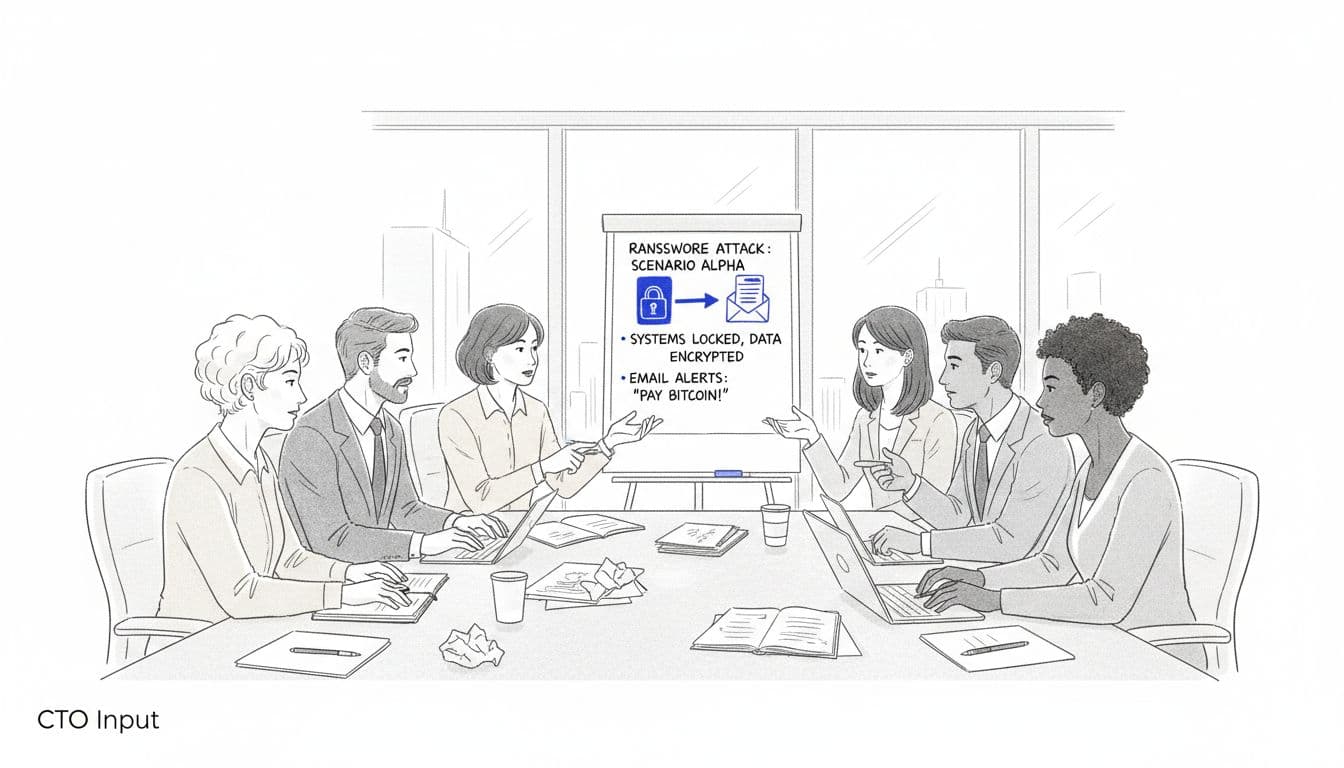
At its core, a cyber resilience tabletop exercise is a structured, discussion-based story. No live systems, just a realistic incident, the right people in a room, and a guided conversation.
Here is how it works when done well.
Pick One Risky Scenario That Feels Uncomfortably Real
Start with one or two scenarios that could hurt revenue, trust, or compliance. Common choices for 2025 include:
- A ransomware attack locks your main SaaS platform, and the attacker also steals sensitive files.
- A phishing email tricks a senior leader, and their email account is abused for fake payments.
- A software vendor you rely on suffers a breach from a zero-day exploit, and your customer data is part of it.
- Insider threats where an employee shares confidential data to a personal cloud account.
These are not sci-fi hacks. They match what you see in news stories and incident reports. Groups like the Center for Internet Security share concrete tabletop scenarios that echo real events.
For your tabletop exercise, you use real names for systems, vendors, and customers. The closer the scenario feels to an actual Monday morning, the more useful the security gaps you uncover.
Get The Right People In The Room, Not Just IT
A strong tabletop exercise looks more like a leadership meeting than an IT workshop.
You want management and executives such as:
- CEO or COO
- Finance leader
- Operations leader
- Legal or compliance
- HR
- Communications or PR
- Head of IT or engineering, and any security lead or vendor
Each of them sees the same incident through a different lens:
- Finance thinks about cash flow, payments, and loan covenants.
- Operations worries about shipments, plant uptime, or service levels.
- Legal tracks contract terms, regulator deadlines, and liability.
- HR focuses on staff safety, payroll, and internal messaging.
- Communications protects brand trust and social media signals.
- IT looks at systems, logs, and recovery paths.
Getting these key stakeholders views in one room exposes where answers conflict or stall. The real goal is simple: who decides what, in what order, and how fast.
Walk Through The Attack Step By Step And Practice Decisions
A facilitator opens the session with the chosen scenario. Then, over 60 to 90 minutes, the situation escalates in stages to improve team coordination.
For example:
- “Your team discovers that the order system is offline and a ransom note appears.”
- “Backups look intact, but restoring will take at least 48 hours.”
- “A regulator calls asking if customer data is involved.”
- “A major client emails, saying they heard a rumor and want answers.”
- “A journalist reaches out for comment about a possible breach.”
At each step, the group talks through questions like:
- What do we do in the first 30 minutes? The first 2 hours?
- Who has authority to shut down a system or declare an incident?
- Who informs customers, partners, and staff, and how?
- How do we keep operations moving while IT works?
Best practice, reflected in sources like the Bitsight guide to cybersecurity tabletop exercises and NIST guidelines, is to focus on communication, roles and responsibilities, and timing, not deep technical fixes. The exercise is about how leaders think under pressure, not how fast someone types.
Debriefing Session: Identify Gaps And Turn Them Into A Simple Action List
The last 30 to 45 minutes matter most.
You review what worked and what broke. Common gaps include:
- Missing or outdated contact lists.
- Confusion over who can approve paying a ransom, or refusing.
- No clear owner for regulator or law enforcement contact.
- Vendor contracts that say nothing about security incidents.
- Slow internal sign-off for external media statements.
From there, you build a short, prioritized action list to identify gaps:
- 5 to 10 items.
- Each with a clear owner.
- Each with a realistic deadline.
Many organizations then run shorter “micro” tabletop drills at staff meetings or lunch breaks. Current practice, echoed in guides like CISA’s tabletop exercise packages, is to do smaller, more frequent drills instead of one giant event per year.
Three Practical Ways To Start Testing Your Cyber Resilience This Quarter
You do not need a giant program to make progress. You need a few smart moves that create fewer surprises, smoother audits, and sharper answers for your board.
Run A One-Hour “Starter” Cyber Resilience Tabletop Exercise
Choose one critical process, such as:
- Taking and fulfilling customer orders.
- Running payroll.
- Handling patient or client data.
Invite 5 to 7 key people who touch that process. Pick a simple scenario, such as ransomware on the core system or a phishing attack on a key email account.
Spend:
- 10 minutes setting context.
- 30 minutes walking through the scenario.
- 20 minutes in a debriefing session on gaps and actions.
In this low-pressure environment, the goal is not perfection but insight into incident response. You want to identify gaps, such as where decisions slow down, where phone numbers are missing, and where messages to customers would clash.
A seasoned, neutral advisor like CTO Input can facilitate that first cyber resilience tabletop exercise so it stays focused on business impact, not jargon. If you want to explore a starter session, you can schedule a short conversation at https://ctoinput.com/schedule-a-call.
Turn Exercise Lessons Into A Clear, Executive Cyber Playbook
Each tabletop exercise produces raw notes, questions, and “we should fix that” ideas from the debriefing session. Turn those into a simple incident response plan that leaders can actually use.
Keep it to a few pages:
- Who leads when an incident is declared.
- Who can approve major decisions like paying a ransom or shutting off a key system.
- Who speaks to customers, partners, and regulators.
- Where to find updated contact lists and vendor details.
Review this playbook in leadership meetings and board sessions, just like you review budgets and KPIs. Treat it as a living response plan, not a binder that gathers dust.
If you want more examples of how technology risk ties into growth strategy, you can explore articles on the CTO Input blog, which go deeper into board questions, cyber risk, and technology planning.
Build A Simple Quarterly Rhythm So Testing Becomes Habit
The final step is rhythm to build cyber resilience.
Set a light schedule:
- One focused tabletop exercise per quarter, each on a different scenario.
- Occasional shorter drills, for example, “who would we call in the first hour?”
This aligns with 2025 trends, where boards, insurers, and lenders now look for proof of cybersecurity preparedness that cyber plans are practiced, not just written. They want to know you have tested decision paths, not only tool configs.
A fractional CTO, CIO, or CISO partner can design and run this rhythm with your team. You keep ownership of decisions and relationships. They bring structure, experience, and a neutral voice who is on your side of the table.
Over a year, you should see faster response times, clearer roles, better team coordination, fewer surprises, and better answers to the questions that show up in every serious review.
Conclusion: Test Your Cyber Resilience Before Someone Else Does
You cannot control when a cyber attack shows up, but you can choose to test your cyber resilience first, on your terms.
One focused cyber resilience tabletop exercise (a simulated cyber incident) can show you, in a single afternoon, where you are exposed and what to fix. From there, you build a simple response plan, a steady rhythm of practice, and a leadership team that stays calm when something breaks.
The payoff is real: fewer ugly surprises in board meetings, smoother audits, faster and clearer decisions when incidents happen, and technology that supports your growth instead of feeding anxiety while helping you improve overall security posture.
If you want a seasoned partner to guide that journey, you can learn more about CTO Input’s fractional CTO, CIO, and CISO support at https://www.ctoinput.com, and continue exploring practical guidance on the CTO Input blog.