
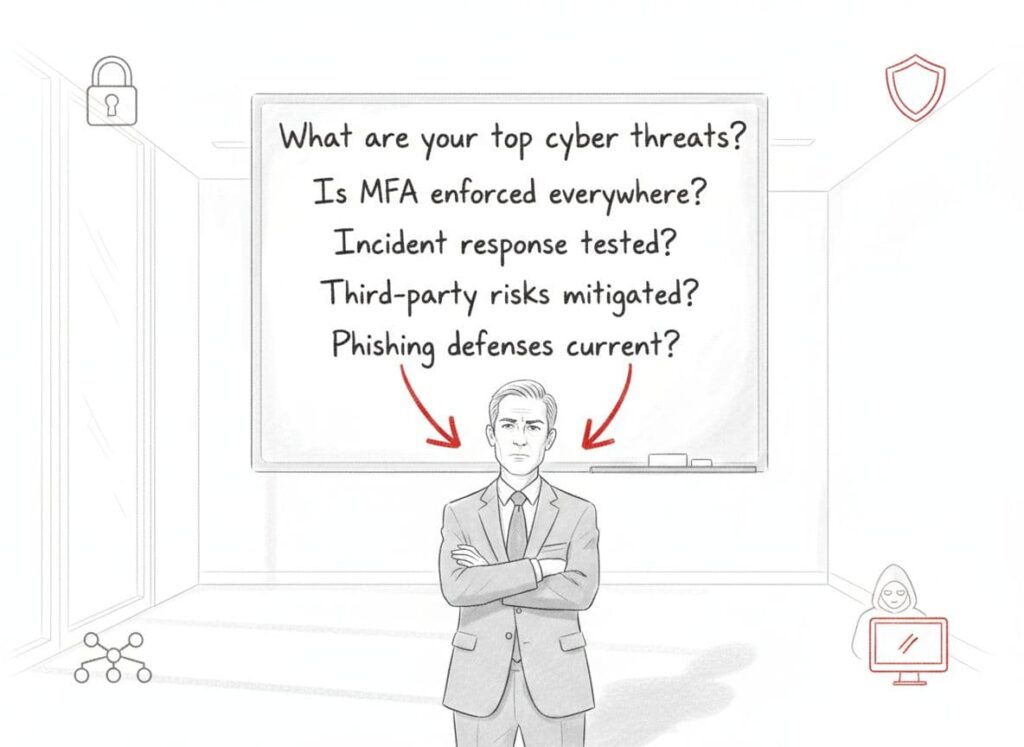
You are a growth-minded CEO or founder who dreads the moment board members ask, “Are we ready for ransomware?”
You feel the tension. Cyber risk goes up every quarter, your technology spend keeps rising, yet you still do not have a story about ransomware readiness that you trust. You get technical answers, not business answers.
The stakes are real. A single attack can hit margins, customer trust, and your own reputation with investors and lenders, creating significant financial exposure. Mid-sized companies are prime targets, with most ransomware attacks now hitting organizations with fewer than 1,000 employees and ransom demands that often reach seven figures.
CTO Input works with leaders in exactly this position, acting as a neutral, executive-level guide who can translate cybersecurity into clear choices and roadmaps, not tool lists.
This article gives you a short set of practical, board-ready board questions about ransomware to ask your CISO or outsourced security leader. Use them to gauge how protected you really are, where the gaps sit, where your next dollar should go, and to enable effective board oversight.

Start With the Big Picture: What Is Our Real Ransomware Risk?
Before tools, vendors, or acronyms, you need a clear picture of exposure. That starts with a simple, shared understanding of how ransomware could hurt the business, not just IT.
A good CISO can describe our cybersecurity and ransomware risk the same way you describe market risk or supply chain risk management. They talk in terms of revenue at risk, downtime, customer impact, and brand damage that are crucial for resiliency planning, not just “malware” and “endpoints.”
You are not looking for a horror story. You are looking for a clean, honest baseline for your preparedness plan that you can carry into a board deck, a lender discussion, or a cyber insurance coverage renewal. Think of this part as your opening scene: what is the current threat of ransomware attacks, in plain language, for a company of your size and profile?
If you want to see how other boards are thinking about this, the Forbes guidance for boards on ransomware preparedness gives a useful outside-in view.
Use these two questions to set the stage.
Ask: How would a ransomware attack actually hit our business today?
Ask your CISO to walk you through a realistic story.
You want a narrative, not a spreadsheet:
- How would attackers most likely get in today?
- Which systems would they hit first?
- How long might those systems be down?
- Who feels it first, customers or internal teams?
A strong answer ties every step to business impact. For example, “If our order management platform is locked, we stop shipping within four hours, our call center gets flooded, and we lose about $600,000 in revenue per day.”
Push for recent examples. Ask, “What ransomware attempts or sophisticated attacks have already hit us or our peers in the last 12 months, and what did we learn?” That turns a vague threat into a concrete pattern you can manage.
Ask: How do you explain our ransomware risk to the board in numbers?
Good board questions about ransomware always come back to numbers.
Ask for a small, repeatable set of metrics, such as:
- Estimated cost per day of outage for your top 3 systems
- Recovery time objective (RTO) for those systems
- A simple risk rating for each, such as low, medium, high
Then ask, “Can you show this on a one-page dashboard for the next board meeting?” You do not need a 50-slide deck. You need a simple, visual way to track risk over time, the same way you track margins or churn.
Resources like the Top 10 ransomware questions for executives and directors can help you compare your own metrics with what other leadership teams are seeing.
Dig Into Readiness: Can We Detect, Recover, and Keep Operating?
Once you understand the big picture in cybersecurity, shift to a blunt question: “If ransomware hits us, how ready are we to keep the business running?”
Ransomware attacks are now a volume business for threat actors, with new victims listed on extortion sites every day and mid-sized firms making up a large share. You cannot fully avoid attempts, but you can control how quickly you detect them, how cleanly you recover, and how much customer pain they cause.
Keep your questions tight and practical. You want to walk away with a sense of time, sequence, and ownership, not just a list of products.
Ask: How quickly can we detect and respond to a ransomware attack?
Time is the difference between an annoying incident and a multi-week crisis.
Ask your CISO:
- “What is our typical detection time today for a serious threat, including baseline controls like multi-factor authentication?”
- “Is our environment monitored 24/7, or only during business hours?”
- “Who makes the first three decisions when an incident starts, including who handles the forensic investigation?”
Then ask about practice. “When was our last ransomware simulation or tabletop exercises, and what changed afterward?” You are looking for evidence that your team learns and adjusts, not just runs drills.
A confident CISO will describe clear playbooks, such as, “Within 15 minutes we isolate the affected segment using network segmentation, within 2 hours we brief the executive team, within 4 hours we decide whether to shut off certain services.”
Ask: What is our backup and recovery plan if systems are locked?
Data backups decide whether you have options or you are at the mercy of criminals, forced to pay a ransom.
Ask where data backups live and how they are protected:
- “Are our data backups using immutable backups, isolated from the main network so they cannot be hit by data encryption too?”
- “How often do we test full recovery, not just file restores?”
Then ask for two plain-language answers:
- “Which systems come back first in recovery?”
- “How long before we can safely process revenue again?”
You want real test results, not “our vendor says we are fine.” For extra context, you can compare your setup with the kind of practices discussed in ransomware preparedness FAQs for organizations.
Ask: Can we keep serving customers during a ransomware incident?
This is where technology meets brand.
Ask, “If we had to shut down parts of our environment for 48 to 72 hours, which customer-facing services could stay up, and what workarounds exist for the rest?”
Key follow-ups:
- “What manual or backup processes can we use to keep revenue flowing?”
- “Who owns communication with customers, partners, and regulators?”
- “Do we have a ransomware playbook that we have rehearsed, not just filed?”
Look for an answer that treats communication as part of readiness, not an afterthought. For example, some boards are advised to ask about this in resources like what to do in a ransomware attack for board members.
If you leave this section with a clear picture of what stays up, what goes down, and who speaks for the company, you are ahead of many peers.
Clarify Ownership, Tradeoffs, and Your Next Steps as a Leader
By this point, you have the shape of your risk and your current level of readiness. Now you move from “What is happening?” to “What will we do about it in the next 90 days?”
Think of this as the final act of the movie where the protagonist regains control. You are deciding what to fix first, who owns which piece, and what support your CISO needs from you.
You do not need to become a cyber expert. You do need to sponsor a focused cybersecurity preparedness plan and protect it from distractions.
Ask: What are the top three gaps we must close in the next 90 days?
End the conversation with focus.
Ask, “If we did only three things in the next 90 days to reduce the risk of ransomware attacks the fastest, what would they be, how much would they cost, and what business outcome would we see? These might include addressing critical vulnerability exposure.”
Examples might include:
- Tightening access controls for high-risk systems, such as implementing Zero Trust architecture
- Hardening and testing backups for core revenue platforms
- Running tabletop exercises with the full leadership team
Connect each action to a clear result, such as “reduce likely downtime by 50 percent” or “shorten recovery of billing systems from five days to one day.”
You can also compare that list with broader cybersecurity risk planning guidance, such as the NIST Cybersecurity Framework or the kind of structured roadmaps advisory firms like CTO Input build for growth-focused companies.
Ask: What support do you need from me and the board to succeed?
Ransomware readiness is not just an IT project. It is a leadership decision.
Ask your CISO:
- “What budget, staffing, or specialized resources do you need to hit these 90-day goals?”
- “Where do you need faster decisions from me, management, or board oversight?”
- “Which outside partners help you, who is truly accountable for outcomes, and who owns communication with regulators and law enforcement?”
Listen for whether they frame answers in business terms and tradeoffs, not only in tools. You want to hear phrases like “this will cut outage risk by half” rather than “we need a new XDR platform.”
If the answers feel vague, vendor-driven, or disconnected from business impact, that is a signal. Many mid-market CEOs bring in an independent advisor like CTO Input to stress test the plan, align it with growth goals, and provide fractional CISO leadership that sits firmly on the business side of the table.
Conclusion: Turning Ransomware Fear Into Clear Decisions
Strong board questions about ransomware turn a scary, technical topic into a short list of business choices you can explain in one slide. You do not need to be a cybersecurity specialist to lead this. You only need to ask focused questions about real risk, readiness, and ownership.
When you do, the story changes. Board packs get cleaner, surprises and their reputational consequences get smaller, and your team responds faster and calmer when threats appear. You go from hoping the controls work to knowing which gaps matter and how you are closing them.
If you want help turning these questions into a concrete plan, you can schedule a short assessment call through the CTO Input website, or scan related strategy and cyber articles on the CTO Input blog. The next step is simple: get a clear, honest picture of your ransomware readiness, then turn it into a roadmap your board, your customers, and you can trust, one designed to avoid having to pay a ransom to criminals.