
Grant reporting season feels like a recurring fire drill. Your team spends days, maybe weeks, piecing together client outcomes from one system and financial data from another. The whole process is held together by spreadsheets and heroic manual effort. This isn’t just an inconvenience. It’s a strategic risk that burns out your best people and obscures the true impact of your work.
You know the progress your clients are making is incredible. But when that story is scattered across systems that don’t talk to each other, you can’t tell it with the confidence you should have. You’re forced to prove your impact with data that’s hard to gather, harder to trust, and nearly impossible to present clearly to your board and funders.
This guide provides a calm, pragmatic plan to fix this. We’ll show you how to finally connect your case management and grants systems, turning chaotic reporting into a clear, powerful demonstration of your mission’s success.
Key Takeaways
- Stop the Scramble: Disconnected systems create constant fire drills for grant reporting, burning out staff and putting funding at risk. The goal is to build a unified data flow where client outcomes automatically and accurately inform financial reports.
- Map Before You Buy: Don’t start with software demos. First, map how critical data actually moves through your organization—from client intake to the final grant report. This blueprint becomes your most powerful tool for making smart technology decisions.
- Choose the Right Connection: You have three main options for connecting systems: simple pre-built native connectors, flexible third-party tools like Zapier (middleware), or powerful custom APIs. The right choice depends on your budget, team’s technical comfort, and specific needs.
- Start with a Quick Win: Don’t try to overhaul everything at once. Begin with a phased approach. In the first 90 days, automate a single, high-pain report to prove the value and get your team on board.
- Security is Non-Negotiable: When handling sensitive client data, security is the bedrock of trust. Prioritize encryption, strict access controls, and thorough vendor vetting to protect the communities you serve.
The True Cost of Your Disconnected Data Story
Imagine you run a network supporting immigration advocates. A key funder asks for a simple report: “How many clients achieved permanent residency status last quarter?” The frantic search begins. The outcome is locked in the case management system. The grant deliverable is tracked in a separate spreadsheet. Your program manager and grants writer spend hours reconciling the numbers, hoping they match.
This isn’t a sign of a bad team; it’s a symptom of broken systems. When your case management and grants systems don’t talk, your mission suffers.
Why a Fractured System Holds You Back
When the incredible progress your clients are making isn’t directly tied to the funding that supports it, you can’t tell a clear story. The manual effort required to bridge that gap is a breeding ground for errors, wastes countless staff hours, and delays the very insights you need to make critical decisions.
This isn’t a hypothetical problem. Even well-funded government initiatives run into this wall. A case study on community mental health clinics funded under ACA grants found that integrating their systems successfully slashed manual reporting time by a massive 30%. But even then, the project’s long-term success was held back by organizational and policy roadblocks, proving that technology alone isn’t a silver bullet.
The consequences of doing nothing compound over time. You get stuck in a cycle of inefficiency that eats away at your capacity to serve. For a deeper look at these risks, it’s worth understanding the full financial and operational impact of tech debt.
The real problem isn’t a technology failure but a fractured data story. You’re forced to prove your impact with data that’s hard to gather, harder to trust, and nearly impossible to present with confidence.
The Human Cost of Data Chaos
The operational drag is only half the story. The true cost is measured in your people.
- Staff Burnout: Your best program managers spend their time chasing numbers instead of supporting advocates. This administrative burden is a leading cause of burnout in mission-driven organizations.
- Missed Opportunities: While your team compiles last quarter’s report, you’re missing the chance to spot emerging trends in client needs or pivot your strategy based on what the data is telling you right now.
- Eroded Trust: Inconsistent or delayed reporting can make funders and board members question your organization’s effectiveness and stewardship. This puts future funding at risk.
You don’t have to live with this quiet source of stress. There is a clear path forward.
Step 1: Map Your Data Flow Before You Talk to a Vendor
I’ve seen it happen a hundred times. An organization gets excited about new technology and jumps straight into software demos. It feels like progress, but it’s a classic misstep. You end up with a tool that forces your team to change how they work, leading to frustrating workarounds and a system that gathers digital dust.
Before you even think about vendors, step back and create a blueprint of how information actually moves through your organization. This isn’t about becoming a database administrator. It’s about getting real about your process, from the first time a client walks through the door to the final grant report you submit.
Only then can you find a system that serves your mission, not the other way around.
Where Does Your Data Live Now?
Let’s get practical. Trace the journey of your most critical data points. This is often where the chaos becomes crystal clear. You’ll likely find vital information scattered across a dozen different places: your case management system, random spreadsheets on a shared drive, a program manager’s inbox, or worse, stuck in someone’s head.
The goal here is to create a simple map. For example, the “Number of asylum applications filed” might start as a case note, get copied to a central tracking spreadsheet by a paralegal, and then manually counted by the development director for a grant report. Sound familiar?
This kind of workflow is incredibly common, but it’s also a huge source of risk and wasted time.
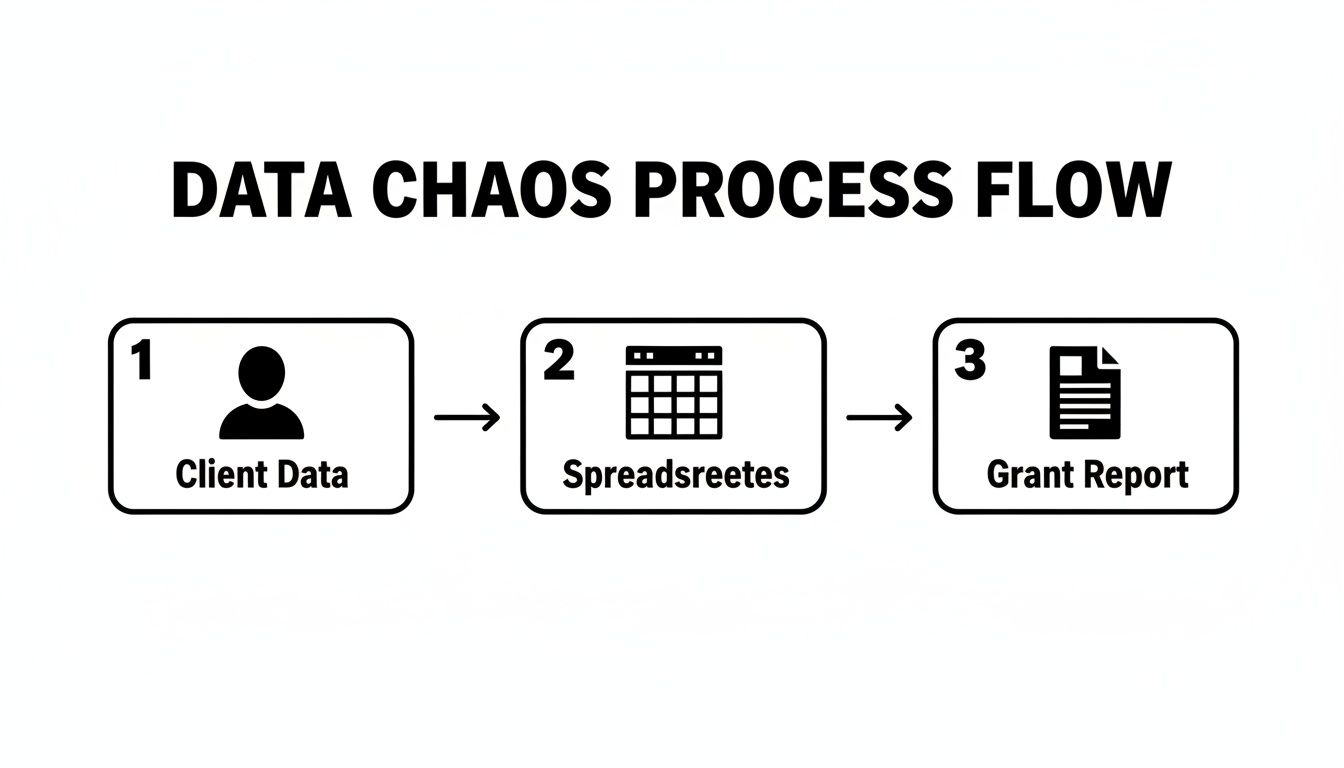
As this visual shows, every manual handoff is a chance for errors to creep in, making reliable reporting a constant uphill battle.
To cut through this complexity, build an integration blueprint. This isn’t just a technical exercise; it’s a strategic one that gets everyone on the same page about what matters most. Answering these questions forces you to define your needs before a salesperson tells you what you need.
Key Questions for Your Integration Blueprint
| Strategic Question | What to Document | Example (Immigration Services Org) |
|---|---|---|
| What do funders require? | List specific, contractual data points for each major grant. Avoid vague terms. | Vague: “Client outcomes.” Specific: “Number of clients who achieved permanent residency status per quarter.” |
| Where does this data live? | Trace each data point back to its original source. Identify all systems, files, and people involved. | The case outcome is in the case management system. The grant report metric is in a shared Excel file. |
| Who owns the data? | Assign a name/role to each step: who collects, enters, verifies, and reports the data. | The case manager enters the outcome. The paralegal updates the spreadsheet. The grant manager pulls the final number. |
By documenting this, you create an undeniable picture of your current state. This blueprint becomes your most powerful tool in any vendor conversation. It’s the foundation for a truly business-driven data strategy that puts your mission first.
Once you’ve mapped what data you need, where it lives, and who owns it, you’ve created your “source of truth.” This document is your north star. It guides every decision you make and is the essential first step to connect case management and grants systems in a way that actually works.
Step 2: Pick the Right Way to Connect Your Systems
With your data map sorted, you can have a practical conversation about how these systems will actually talk to each other. This isn’t about getting bogged down in jargon. It’s about understanding the trade-offs so you can find the right fit for your budget, technical comfort level, and future plans.
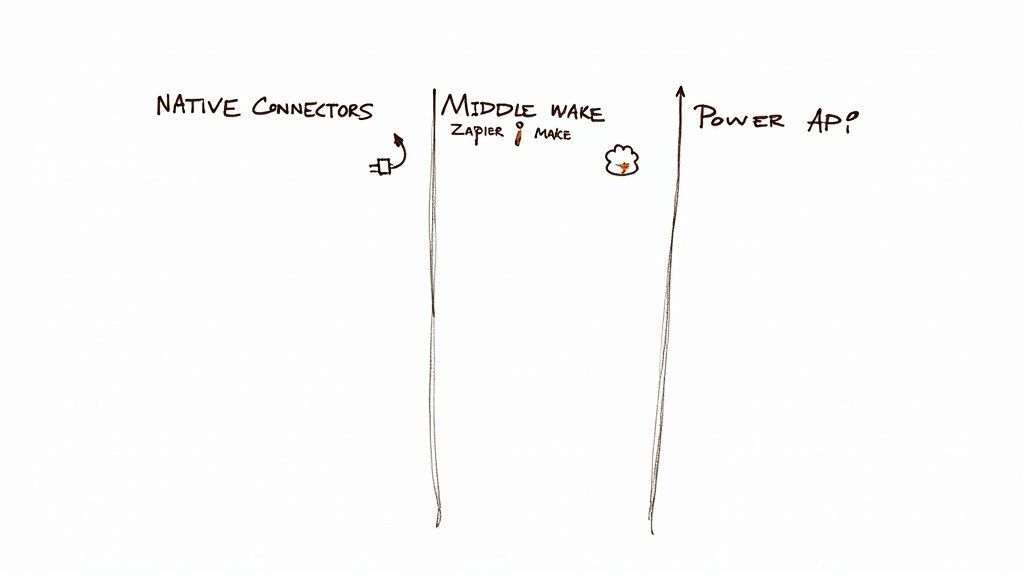
I often tell clients to think of it like connecting two buildings. You could build a simple skywalk, hire a shuttle service that runs between them, or construct a custom-built highway. Each gets people from A to B, but they come with different price tags, capabilities, and maintenance needs.
Path 1: Native Connectors (The Skywalk)
The most straightforward route is a native connector—a pre-built integration your software vendor has already created. If your case management platform has an official connection to your grants or accounting software, it’s usually the quickest and most stable way to go.
These are your “skywalk”—simple to set up, relatively inexpensive, and the vendor handles all maintenance. The big catch? They can be rigid. If you need to move data in a way the connector wasn’t designed for, you’re usually out of luck.
Path 2: Middleware (The Shuttle Service)
Next is using a third-party service called middleware, or an Integration Platform as a Service (iPaaS). Think of tools like Zapier or Make. They act as a universal translator, creating bridges between thousands of different apps through a visual interface.
This is your “shuttle service.” It’s incredibly adaptable and doesn’t require a developer to get basic workflows running. You can connect just about any modern cloud software to another. The trade-off is the recurring subscription cost, which usually goes up as you move more data. You’re also relying on another company for a critical piece of your operations.
Path 3: Custom API Development (The Superhighway)
Finally, there’s the most powerful approach: custom API development. An API (Application Programming Interface) is a set of rules that lets software programs communicate directly. Building a custom integration means bringing in a developer to write code that connects your systems exactly how your unique process demands.
This is your “superhighway.” It gives you absolute control, but it’s also the most expensive and complex option, demanding specialized skills not just to build but, crucially, to maintain down the road.
Choosing your path is a balancing act between upfront cost and ongoing fees, simplicity and custom control, vendor support and self-reliance. Your data blueprint is the guide that helps you make this call with confidence.
To lay it all out, here’s a high-level look at how these three approaches stack up.
Comparing System Integration Approaches
| Approach | Best For | Key Trade-Offs (Cost, Complexity, Flexibility) |
|---|---|---|
| Native Connectors | Organizations using popular platforms that offer pre-built links. | Low Cost, Low Complexity, Low Flexibility. Simple and reliable, but you’re limited to the vendor’s design. |
| Middleware (iPaaS) | Teams needing flexibility without developers; connecting multiple cloud tools. | Medium Cost, Low-Medium Complexity, High Flexibility. Fast to set up but creates ongoing subscription fees. |
| Custom API Development | Orgs with unique workflows, high data volume, or specific security needs. | High Cost, High Complexity, Maximum Flexibility. Total control but requires significant upfront investment and ongoing maintenance. |
After walking through these options, many justice-focused organizations find that starting with a middleware tool is a great sweet spot. It allows you to automate a painful process quickly, prove the value to your leadership, and learn more about your real-world needs before committing to a massive custom build. It’s a pragmatic first step that delivers crucial quick wins.
Step 3: Follow a Realistic Roadmap to Get It Done
Trying to overhaul your core systems all at once is a classic mistake. It sounds bold, but it almost always leads to chaos, blown budgets, and a burned-out team. A smarter approach is a phased rollout that delivers real value right away, building momentum and proving the concept as you go.
This isn’t about playing it safe. It’s about turning a massive, intimidating project into a series of clear, achievable wins. When you break the work down into quarterly sprints, you create a story that your board, funders, and staff can actually believe in.
Quarter 1: The Quick Win
The first 90 days are about a single, powerful proof point. Don’t try to solve every problem. Your mission is to find one high-pain, low-complexity grant report and automate it.
You know the one. It’s that report cobbled together from three different spreadsheets that always needs manual fixes right before the deadline. That’s your target.
By zeroing in on this single workflow, you:
- Deliver immediate value. When your grant writer suddenly saves hours of tedious work, they become your biggest advocate.
- Get genuine buy-in. A real, tangible win is the best way to silence skeptics.
- Create a safe space to learn. You will find quirks in your data. This approach lets you find and fix them on a small, manageable scale.
This first victory is everything. It turns an abstract plan into something everyone can see and feel.
Quarter 2: Expand and Refine
With a win on the board, the second quarter is for building on that success. Now you take what you learned and apply it to an entire program area, like your immigration legal services team.
Here, you’ll move beyond a simple data sync to a more thoughtfully designed workflow. You’ll sit down with that program team to truly understand their day-to-day, making sure the data flows seamlessly from their case notes into the grants system. This is your chance to iron out the kinks before going organization-wide.
This is more than a tech project; it’s an investment in your organization’s capacity. The goal isn’t just to make reporting easier. It’s to give your program staff a clearer line of sight into their own incredible impact.
There’s a reason this is a hot topic. The global grant management software market is projected to hit USD 6.19 billion by 2033, fueled by this very need to connect funding to outcomes. We’re seeing organizations slash grant processing times by up to 40% and cut data errors by 25% with well-planned integrations. This isn’t just about efficiency; it’s about being audit-ready, always.
Quarters 3 & 4: Scale and Govern
The second half of the year is about taking your proven model and scaling it across the organization. You’ve refined the process, so now you have a playbook you can repeat with confidence. The focus shifts from the tech to people and process.
You’ll concentrate on two main things:
- Training and Support: Rolling out the integrated system to every other team, complete with hands-on training and designated internal champions who can provide peer-to-peer support.
- Data Governance: Establishing the non-negotiable rules for data entry, quality, and security. This means defining ownership and making sure everyone understands why consistent, accurate data is the foundation of everything.
This methodical rollout avoids the classic “launch and pray” scenario. By the end of year one, your connected systems won’t just be a technical success—they’ll be a fully adopted part of how your organization operates. For a more detailed guide on structuring this type of plan, our technology roadmap template is a great place to start.
Step 4: Protect Client Data in Your Connected Systems
Tying your systems together is a game-changer, but it also introduces new risks. When you’re handling sensitive information—especially around immigration status, incarceration history, or youth services—security isn’t just an IT line item. It’s the bedrock of your mission and your credibility.
Connecting your case management and grants systems creates a larger digital footprint. A security lapse isn’t a technical glitch; it’s a fundamental breach of trust with the people you serve, and it can put your funding and reputation at serious risk.
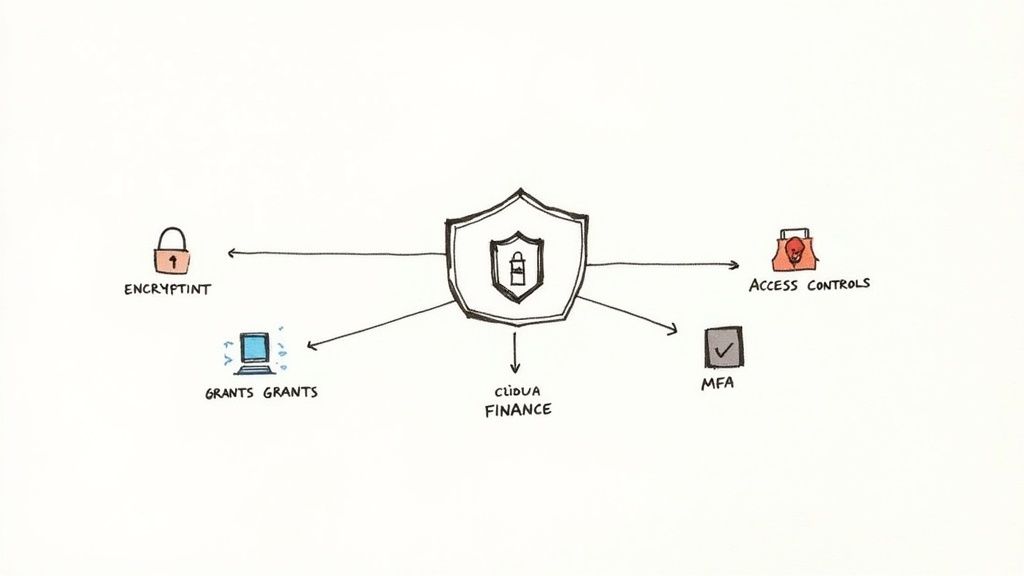
This isn’t about building an impenetrable fortress. It’s about taking smart, practical steps to manage that risk.
The Pillars of Practical Security
Let’s cut through the tech-speak. Protecting your data boils down to a few core ideas.
- Data Encryption (The Sealed Envelope): Encryption scrambles data so only the right people can read it. You need it both at rest (sitting in a database) and in transit (moving between systems). Any reputable cloud software should offer this. Your job is to ask the question and demand a clear “yes.”
- Access Controls (The Right Keys): Not everyone needs to see everything. The principle of least privilege is simple: people should only have access to the data they absolutely need to do their jobs. Your finance team doesn’t need to see detailed client notes, and program staff shouldn’t be in payroll.
- Vendor Due Diligence (Trust, but Verify): When you sign up with a software vendor, you’re handing them your clients’ data. Before you sign anything, vet their security. Do they have certifications like SOC 2 or ISO 27001? A slick sales demo means nothing if their security is leaky.
Strong security isn’t a barrier to your work; it’s a prerequisite for building and maintaining trust. A secure, integrated system becomes a core asset that protects both your mission and your reputation from very real threats.
Simple Steps to Reduce Risk Now
Beyond those pillars, there are a few immediate things you can do to make your systems safer. These aren’t complex IT projects; they’re smart decisions.
- Turn on Multi-Factor Authentication (MFA): This is the single most effective thing you can do to prevent unauthorized access. Requiring a second step—like a code from a phone app—makes a stolen password almost useless. Make it mandatory.
- Draft a Simple Data Breach Response Plan: What happens if the worst-case scenario unfolds? Having a one-page plan that says who to call and what to do first turns a catastrophe into a manageable crisis.
- Review User Access Regularly: At least twice a year, review who has access to what. People change roles, and people leave. Their old permissions need to be shut down immediately. It’s simple digital hygiene.
Integrating your systems is an act of trust—in your technology, partners, and processes. Building this secure foundation from the start ensures that trust is well-placed.
From Chaos to Clarity and Lasting Impact
Imagine generating grant reports with a few clicks, pulling real-time, accurate data directly from your case management files. Your program team has a crystal-clear view of their impact, helping them make smarter, faster decisions. Your board and funders see the undeniable connection between their investment and the lives you’re changing.
This isn’t a dream. It’s the tangible outcome when you thoughtfully connect your case management and grants systems.
The Real Prize: Building Lasting Resilience
This journey from manual data wrangling to automated insight is a strategic investment in your organization’s resilience. It’s about building a stable data backbone that frees your team to focus on the work they were hired to do. You shift from proving your value through painstaking effort to demonstrating it with confident, data-backed clarity.
This goes far beyond internal efficiency. In global health, for example, integrating community case management with grants funding dramatically expanded access to critical treatments. This model streamlined compliance and cut administrative overhead by up to 25%, which meant funds got to frontline workers far more efficiently. The result? It attracted millions in additional funding. You can see the details of this grant-funded model and its effects for yourself.
This isn’t just a technology project. It’s a direct investment in your mission’s capacity. The goal is to build a foundation that supports your advocates and proves your impact, freeing your best people from the tyranny of spreadsheets.
What Happens if You Do Nothing?
Staying with the status quo means accepting the recurring fire drills, the staff burnout, and the constant risk of reporting errors. Your systems remain a quiet source of stress, slowly eroding your team’s capacity and your credibility with funders. You miss opportunities to learn from your own data and adapt your strategy to better serve your community.
What Success Looks Like
Following this plan means less chaos for your staff and safer handling of sensitive information. It means clearer evidence of your impact and more capacity to support your frontline partners. In one to three years, your systems are no longer a source of stress but a reliable backbone that supports advocates who stand with vulnerable people.
You don’t need another sales pitch or a complex, one-off implementation. You need a calm, seasoned guide who starts with your mission, understands how your work really happens, and helps you build a simple, believable modernization path.
The first step is a conversation, not a contract. Schedule a no-pressure discovery call with CTO Input to start building a roadmap that turns your systems into the reliable backbone your team deserves.
Frequently Asked Questions
When leaders start talking about connecting their case management and grants systems, a few key questions always come up. Here are straight answers based on what we see in the field.
What’s a realistic budget for connecting these systems?
It depends entirely on your approach. You could be looking at a few hundred to a few thousand dollars a year in subscription fees for a simple connection using middleware like Zapier. On the other end, a fully custom API development project often starts in the tens of thousands and comes with ongoing maintenance costs. The best way to get a real number is to map your data flow first. Once you know exactly what needs to move where, you can get a much more accurate estimate.
We’re a small team with no IT department. Can we really do this?
Yes. In fact, automation is often a game-changer for smaller teams. The key is to keep it simple at the start. Don’t try to solve every problem at once. Look for systems with native integrations that are easy to configure, explore no-code middleware tools, or consider bringing in a fractional CTO or consultant for more complex needs. This gives you top-tier expertise without the overhead of a full-time hire.
How do we get staff to actually use the new system?
This is about people, not technology. Bring your team into the conversation from day one. Map out their current workflows to understand their frustrations. Frame the project as a way to solve their problems, like eliminating duplicate data entry. Find enthusiastic ‘champions’ on your program teams to help test the process and become go-to experts for their colleagues. Most importantly, launch with a quick win. Once they feel a tangible benefit, adoption will follow.
What’s the biggest mistake organizations make?
The single biggest risk is jumping straight to a software solution without doing the prep work. Too many organizations get excited by a flashy demo and sign a contract, only to realize later that the tool doesn’t fit their actual workflows or security protocols. This is a classic recipe for a costly failure. Taking the time to build a clear blueprint and a phased roadmap is the most effective way to protect your investment and ensure it genuinely advances your mission.
You don’t need another generic platform pitch. You need a calm, seasoned advisor who can help you build a modernization path that starts with your mission. For a no-pressure conversation about your organization’s specific challenges, schedule a discovery call with CTO Input today.