

You have a growth plan, real pressure, and a clear problem.
Your team brings forward a well argued technology or cybersecurity proposal. The numbers line up, the risk is real, the vendor looks solid. Then, in the board meeting, it quietly dies.
If you have ever walked out of that room frustrated and confused, you are not alone. Understanding Why Boards Reject Good Tech Investments is now part of the job for any CEO, COO, or founder.
This article unpacks why smart projects get a “no,” even when the business case looks strong, and how to present them in a way that fits how boards think. The goal is simple: help you translate technology into board-ready language, cut friction with directors, and raise approval rates for the projects that actually move the business.
The Real Question: Why Do Boards Reject Good Technology Investments?
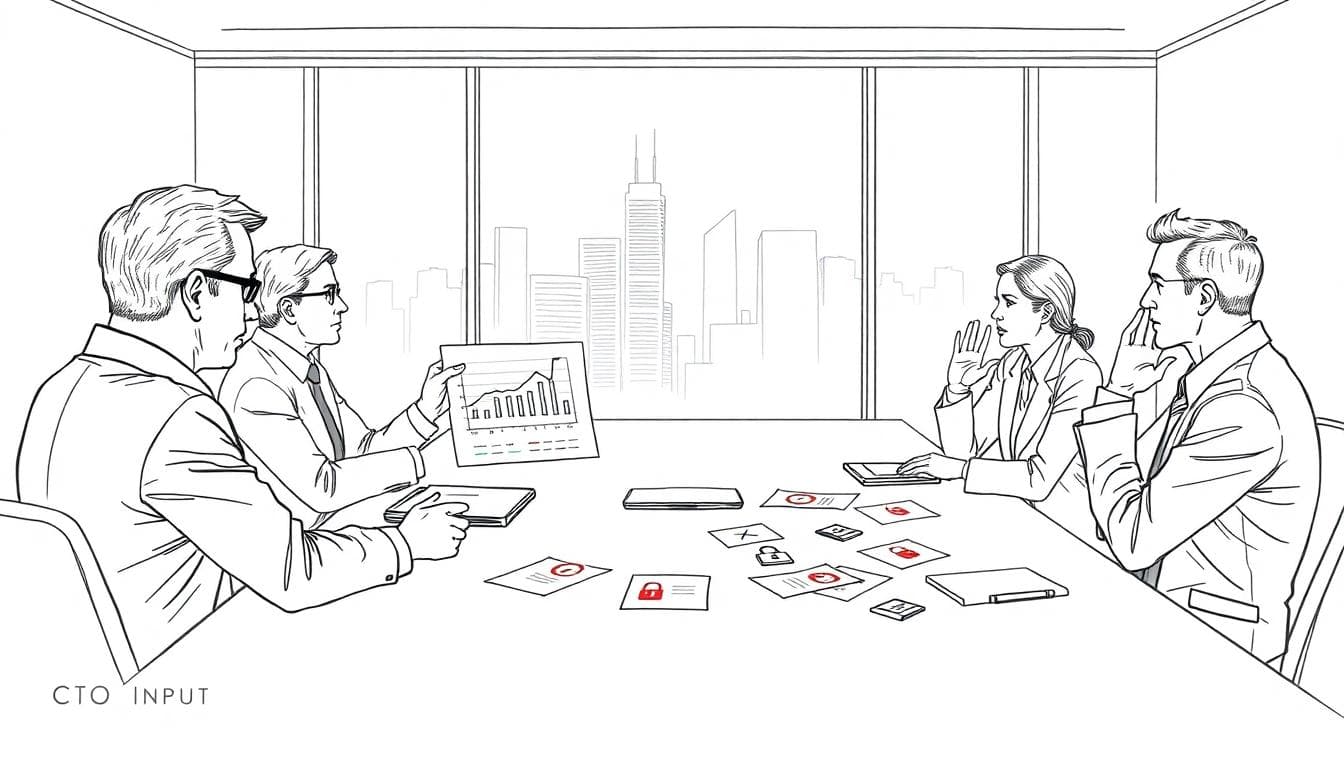
Image that show why boards reject good tech investments created with AI
Most boards are not anti-technology. What they dislike is surprise, fuzzy economics, and unclear risk.
In 2025, directors are under intense pressure on AI, cybersecurity, and regulatory oversight. Investors and regulators expect boards to show that they understand tech risk and can explain why they backed, delayed, or rejected each major spend. When they are not sure, they often stall or say no.
The hard truth: the problem is rarely the tool. It is the story, the framing of risk, and the board’s trust in the company’s ability to execute at scale. Good tech can look like a bad bet if those three elements are weak.
How boards see their job: protect, grow, and avoid surprises
Strip the role down to its core and most boards see three duties:
- Protect the company from events that could damage value, reputation, or continuity.
- Grow value over time, not just hit the next quarter.
- Avoid nasty surprises that make them look asleep at the wheel.
Every technology proposal is judged through that lens. A cybersecurity upgrade is not a firewall, it is protection of cash flows and brand. An ERP is not a system, it is a single point of failure if done badly.
If a proposal helps protect, grow, and avoid surprises, it has a real chance. If directors cannot see that link in simple terms, they hesitate.
Why technology decisions feel different and more threatening
Boards are comfortable with plants, stores, or acquisitions. Those feel tangible. They can visit them.
Technology feels different:
- The benefits are abstract and spread across functions.
- The language is full of acronyms and black-box diagrams.
- The pace of change is fast enough to embarrass smart people.
On top of that, boards are now expected to oversee AI, cyber, and data risk at a level that many directors do not feel trained for. Studies already show that most companies are not getting real returns from AI projects, as highlighted in this analysis from Berkeley Haas on failed AI investments. When directors see that, caution goes up.
So when your AI pilot or security overhaul lands on the agenda, it arrives in a context of hype, fear, and public examples of failure.
Seven Common Reasons Boards Say No to Strong Tech Proposals
Understanding these patterns lets you fix them before the next meeting.
1. The value story is fuzzy, even if the tech is great
If directors cannot see how a project drives revenue, protects cash, reduces risk, or frees capacity, they default to no.
Weak framing sounds like: “Modernize our data stack so we can be more data-driven.”
Stronger framing sounds like: “Cut quote-to-cash time by 30 percent, shorten DSO by 5 days, and free 3 FTEs in finance through automation.”
Slides full of features, vendors, and architectures confuse. Slides that tie outcomes directly to P&L lines, working capital, or customer experience calm the room.
A simple test: could a non-technical board member explain the value of your proposal to another director in two sentences?
2. The board cannot gauge the real risk, so they default to no
Directors worry about outages, cyber breaches, AI mistakes, vendor lock-in, and compliance failures. When they cannot size those risks, they often assume the worst.
This is made worse by public stories of AI and cyber projects that go wrong, or never pay off, which show up in market commentary and reports that unsettle investors. You can see that mindset in pieces like this AI report discussion that has Wall Street spooked.
If your proposal does not spell out:
- What could go wrong,
- How likely it is, and
- How you would contain it,
then the board is being rational when they slow it down.
3. Weak strategic fit: the project feels like “IT for IT’s sake”
Boards will often reject even high quality tools if they cannot see a direct line to the agreed strategy.
When an ERP replacement is presented as “our system is old,” but the growth strategy talks about entering two new markets and cutting cost-to-serve, the board sees a gap. They start to suspect that IT is following vendor roadmaps or industry buzz rather than the company’s strategy.
Directors back technology that:
- Makes a stated strategic move possible, or
- De-risks a core part of the current business model.
If that link is not explicit, the default label is “nice to have.”
4. Doubt about the team’s ability to execute at scale
Past scars matter. Boards remember the CRM that never went live, the e-commerce replatform that slipped by 18 months, the “90 percent done” projects that never finished.
Even if they like the idea in front of them, they may not trust your ability to deliver it.
Warning signs for the board:
- No single accountable owner.
- Vague milestones.
- No clear cutover or rollback approach.
- Change management treated as an afterthought.
On big moves like ERP or core platform changes, trust in execution can matter as much as ROI.
5. Sticker shock and unclear ROI timing
Technology spend often comes in big, lumpy chunks. Boards see multi-year contracts, high day rates, and internal time that displaces other work. Then they hear, “We expect value in year three.”
Common mistakes that amplify sticker shock:
- Using only the vendor’s ROI slide.
- Ignoring internal change costs.
- Failing to quantify downside risk if you do nothing.
Investors already debate whether some tech bets are worth the cost, as seen in discussions about avoiding certain tech exposures in public markets. Your board is having a similar debate in their head about your project.
If they cannot see when the payback window starts, how big it is, and how it compares to other options, they pause.
6. Limited technology expertise inside the boardroom
Plenty of boards still do not have deep experience in AI, data platforms, or cybersecurity. Some directors have run large P&Ls without ever owning a major system implementation.
Without a trusted interpreter, they fall back on old mental models. They compare a modern data platform to an on-prem server refresh from ten years ago, or they treat AI like a bolt-on feature rather than a shift in process design.
In that environment, high quality proposals can be mistaken for science projects. Resistance to new architectures or AI-heavy moves is often a skill gap, not a character flaw.
7. Politics, timing, and competing priorities crowd out good ideas
Even the best proposal competes with everything else on the board’s plate:
- A recent acquisition that needs integration.
- Lender pressure to preserve cash.
- A cost-cutting cycle.
- Leadership churn.
If the board feels that the company is already juggling too many transformations, they will often slow or block new tech projects, even those with a strong case.
Sometimes a “no” really means, “Not now, not with this much on our plate.”
How CEOs Can Get Good Technology Investments Approved
You cannot control every variable, but you can control how you frame the work.
Translate technology into a business case the board actually understands
Anchor every proposal in a simple shape:
- Current pain and who feels it.
- Cost of doing nothing over 12 to 24 months.
- Options considered and why you rejected some.
- Chosen path and expected impact on revenue, margin, cash, and risk.
Use plain language and a few clean visuals that show how systems connect to customers and cash. Talk less about “data lakehouses” and more about “faster, cleaner sales and inventory data so we can ship on time and bill correctly.”
If you would not use a term in a lender meeting, do not lead with it in the boardroom.
Frame cyber, data, and AI as risk decisions, not technical debates
Boards understand risk. Use that.
For each cyber, data, or AI decision, lay out:
- Likelihood of incidents today.
- Potential impact in dollars, reputation, and downtime.
- How the proposed move changes those numbers.
Map investments to clear risk changes, such as “lower chance of a material breach from 1 in 10 to 1 in 30 over the next three years” or “cut recovery time from days to hours.”
Then make the choice explicit: “If we reject this, our risk stays here. Are we comfortable with that?”
Show a realistic roadmap, not a wish list of disconnected projects
Boards get nervous when they see 15 projects with no clear sequencing.
Instead, show a 12 to 24 month roadmap that:
- Groups work into clear phases.
- Highlights quick wins in the first 90 days.
- Steps up spend and risk in line with capacity.
Cut low-value vendor noise before the deck goes out. The board should see focus, not chaos.
A good roadmap reads like a story of how you will improve reliability, data quality, and security in stages, not a catalog of tools you want to buy.
Build board trust with better oversight and independent voices
Trust is built between meetings.
Short, plain-language technology and cyber updates at every board meeting reduce anxiety. Directors start to see patterns and progress instead of episodic drama.
Many mid-market firms add a neutral advisor or fractional CTO, CIO, or CISO to help with this work. That person can stress test vendor pitches, translate jargon into business terms, and give the board confidence that someone is looking around corners, not just reacting.
Prepare your technology and finance teams to speak the same language
Conflicting numbers can kill a good proposal faster than any technical issue.
Before the board pack goes out:
- Align IT or engineering and finance on assumptions and timing.
- Build one-page summaries of each major project with ranges, not fake precision.
- Prepare simple scenario views: base case, upside, and downside.
Boards know that forecasts are imperfect. They just want to see that you have thought about the edges, not only the sunny middle.
Warning Signs Your Board Will Reject a Good Technology Investment
You can often see a “no” coming if you know what to look for.
Board questions and body language that signal doubts early
Common signals in committee or pre-reads:
- Repeated questions about basic elements of the proposal.
- Side comments about “another big system” or “remember the last one.”
- Suggestions to move the item to a future meeting.
Treat these as requests for clarity, not personal attacks. They are an early warning that the story is not landing.
Gaps in your deck that almost guarantee pushback
Before the next board cycle, run a quick pre-flight check.
If your pack is missing:
- A clear single owner.
- Defined success metrics and time frames.
- Explicit links to strategy or OKRs.
- A total cost picture, including internal time.
- A realistic plan B if the project slips,
then you are walking in exposed. Fix those gaps on paper first, then in the room.
Conclusion
Most of the time, Why Boards Reject Good Technology Investments has little to do with love or hate for technology. It comes down to risk, clarity, and trust.
When you frame projects in clear business terms, tie them to strategy, show a real roadmap, and bring the right voices into the boardroom, you make it much easier for directors to say “yes” to the work that matters.
If you want help turning tangled technology plans into a simple, board-ready roadmap that matches your growth plan and risk appetite, visit https://www.ctoinput.com. For more practical, board-focused insight on technology, cybersecurity, and AI in mid-market companies, explore the articles at https://blog.ctoinput.com.