

You are buried in vendor questionnaires, SOC 2 reports, and security addendums. Your team spends hours chasing signatures and documents. Yet in the back of your mind, you still do not feel safer.
That tension is the signal to pay attention to Third-Party Risk Management: From Compliance Theater to Real Protection.
Third-party risk management is simple in concept. It is how you decide which vendors you can trust with your data, your customers, and your operations. Compliance theater is what happens when that work turns into a performance: lots of paper, little actual protection.
This article is written for growth-minded CEOs, COOs, and founders who want less noise and more control. The goal is to move from box-checking to a focused, business-first approach that protects revenue, brand, and board trust, not just your next audit.
What Is Third-Party Risk Management and Why Should CEOs Care?
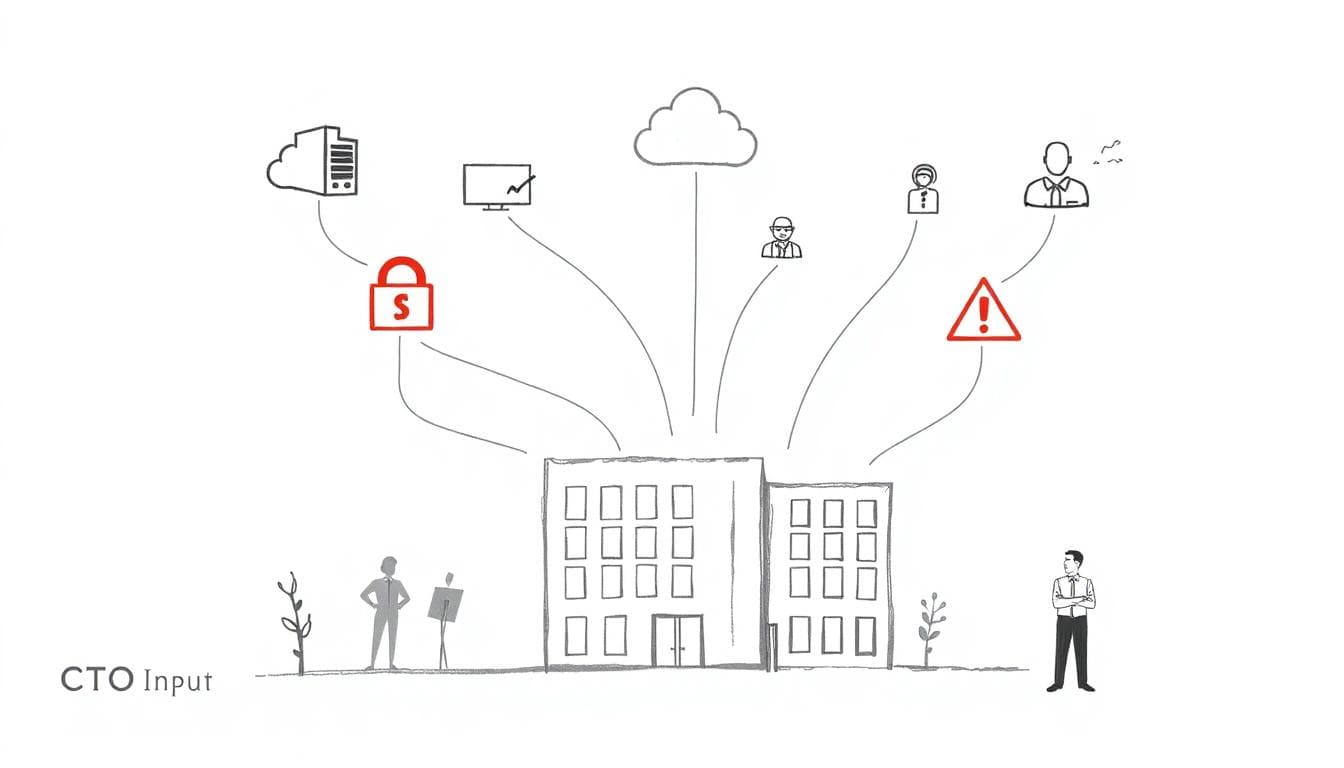
Illustration of a company connected to multiple technology vendors and hidden risk points trying to figure out third-party risk management. Image created with AI.
Third-party risk management is how you control the risk that comes from the vendors and partners your business depends on. It covers tools and services such as:
- SaaS platforms like CRM, ERP, and HR systems
- Payment processors and billing platforms
- Cloud providers and hosting
- Contract developers, AI vendors, and data processors
- Outsourced back office, payroll, and call centers
For a mid-market company, most critical processes now run on vendors. When they stumble, you stumble. When they lose data, you own the incident with your customers, regulators, and board.
Think about the core levers of your business:
- Revenue: If your CRM or payment gateway fails during a major campaign, you lose bookings you will never get back.
- Trust: If a marketing vendor leaks customer data, your brand takes the hit, not the vendor’s logo at the bottom of the page.
- Uptime: If your hosting provider goes down for hours, your team and customers sit in the dark.
- Valuation: Investors and buyers now ask hard questions about cyber risk and vendor oversight. Weak answers change the price.
As firms like Bitsight highlight in their overview of third-party risk management best practices, the vendor ecosystem has become one of the main drivers of cyber and operational risk. You do not have to copy their full framework, but you cannot afford to ignore the signal.
How vendors quietly shape your cyber risk and business resilience
Every key process in your company has a vendor shadow behind it.
- Sales teams live in CRM and quoting tools.
- Finance teams depend on payroll, billing, and banking platforms.
- Operations rely on logistics, scheduling, and inventory systems.
- HR and legal hold sensitive employee and contract data in third-party tools.
- Product and marketing teams plug in AI, analytics, and tracking services.
Now picture two short scenes.
Scenario 1: CRM outage during a quarter-end push
Your sales team is chasing a record quarter. On the last week, your CRM provider has a major outage. Reps lose access to accounts, quotes, and notes. Deals stall. Your forecast misses by 12 percent. The problem was not your internal team or process. It was one vendor, at the worst time.
Scenario 2: Payroll vendor breach
Your payroll provider stores Social Security numbers, bank details, and salary data for all employees. One day, they announce a breach. They are “investigating.” Your staff learns about it on social media. Now you must handle legal notices, identity protection, and a trust hit with your own people.
In both cases, your internal controls may have been strong. The weak link sat outside your walls. That is third-party risk in real life.
Key types of third-party risk to watch (beyond IT)
Third-party risk is not just a “security team” topic. It touches your full business model. These are the types of risk your board, lenders, and key customers care about.
1. Cybersecurity and data privacy risk
Can this vendor expose customer or employee data? Do they have access to internal systems? If they get hacked, whose name ends up in the headline or on the regulator’s letter? Your name.
2. Operational and uptime risk
Could this vendor stop you from serving customers or running payroll? What is their track record on outages and support? Boards now ask, “Where are our single points of failure?”
3. Financial and concentration risk
How dependent are you on this one provider? What happens if they raise prices 40 percent, or go out of business? Lenders and private equity backers care a lot about this hidden fragility.
4. Regulatory and contract risk
Do your vendors touch data or processes that fall under HIPAA, PCI, GLBA, GDPR, or other rules? If they break the rules, you still carry the regulatory exposure, plus costs and distraction.
5. Reputational risk
Will customers, partners, or the press expect you to have vetted this vendor? A weak vendor can make you look careless, even if they were the only one that failed.
A good third-party risk program gives senior leaders a clear, short list of where the real exposure sits, not a 500-row spreadsheet no one reads.
What Is Compliance Theater in Third-Party Risk Management?
Compliance theater is what happens when a company runs a security show to look safe, instead of doing the hard work to be safe.
Think of a teenager “cleaning” their room by shoving everything under the bed. At a glance, it looks fine. The mess is still there, just hidden from the parent. Many growing companies treat vendor risk the same way.
In third-party risk, compliance theater looks like this:
- Vendors get long questionnaires with 100 security questions, but no one reads the answers closely.
- Teams collect SOC 2 reports and ISO certificates and file them away, without checking if the scope matches your use case.
- Vendor lists live in giant spreadsheets the team updates once a year, right before the audit.
- “Reviews” happen in a rush when a customer or regulator asks, not as part of a steady process.
Security Magazine describes this problem well in their article on going beyond compliance theater. The core idea is simple. You can pass checks on paper, while real risk keeps growing in the background.
When you read that description, you may see your own company. If so, you are in good company. Many sharp teams fall into this trap.
Common signs your vendor risk program is just for show
If these patterns feel familiar, your program is likely more theater than protection:
- A huge, stale vendor spreadsheet: You have a long list of vendors no one trusts, with missing owners, wrong contacts, and no risk ratings. People avoid it.
- Endless questionnaires no one truly reviews: Vendors send back answers, often copy-pasted from their last customer, and your team just files them to satisfy an audit.
- Last-minute vendor reviews before big audits or deals: Risk reviews happen in a panic, right before a customer due diligence call or external audit. Everyone scrambles, no one feels confident.
- No follow-up on red flags: A vendor admits they do not encrypt data or lack incident response plans. The team notes it, but there is no clear next step or owner.
- SOC 2 and ISO as automatic hall passes: If a vendor has a certificate, they get a green light, even if the report is years old or does not match how you plan to use them.
- No clear owner for third-party risk: Security, IT, legal, procurement, and finance each own a tiny slice. No one has full accountability or authority to say “yes” or “no.”
Each of these patterns wastes time and hides risk. The paperwork stack grows. Your confidence does not.
Why smart teams fall into compliance theater
This is not a “dumb team” problem. It is a system problem.
Smart leaders drift into compliance theater for a few predictable reasons:
- Pressure to pass audits fast: When a major customer or regulator asks for proof, the safest short-term move is to collect documents and check boxes.
- Lack of senior security or risk leadership: Without a CISO or experienced risk leader, vendor reviews fall to whoever is available, not whoever is best equipped.
- Confusing regulations and vendor marketing noise: Every vendor claims they are secure and “compliant.” Regulations are long and dense. It feels safer to trust logos and badges.
- Fear of slowing down sales or onboarding: No one wants to block revenue. So the path of least resistance is to approve vendors as long as they look decent on paper.
- Rising spend without rising confidence: You spend more each year on tools, platforms, and consultants. Yet when the board asks, “Are we safer?” the honest answer is, “I am not sure.”
Compliance theater is a coping mechanism. The good news is that you can replace it with something better, without building a giant new department.
From Checklists to Real Protection: A Simple Third-Party Risk Playbook

A colorful infographic showing the tradeoffs between time, money, conversation, and mistakes in risk decisions during the third-party risk management process.
Photo by Monstera Production
Think of third-party risk as a funnel.
At the top, you have every vendor you pay. At the bottom, you have a small group that can truly hurt you. Your job as a CEO or COO is not to manage every vendor in depth. Your job is to make sure the right vendors get the right level of scrutiny.
Teams like SecurityScorecard highlight this tiered approach in their guide to trusted third-party risk management. You can adopt the same mindset without buying more software on day one.
Here is a simple 4-step playbook you can put in place over the next quarter.
Step 1: Know which vendors could actually hurt you
First, shrink the problem.
Start by pulling a list of all active vendors from finance. Then mark each one with three simple questions:
- Could this vendor stop or slow revenue if they fail?
- Do they touch sensitive customer, employee, or financial data?
- Could they create regulatory trouble if they slip up?
Any “yes” answer is a flag.
From there, group vendors into three tiers:
- Critical: A failure or breach would hit revenue, cash flow, or brand in a visible way.
- Important: A failure would be painful, but manageable. Workarounds exist.
- Low risk: Commodity services, no sensitive data, easy to replace.
For most mid-market companies, this exercise turns a 400-vendor list into 10 to 25 critical vendors. That is where you want your best thinking. The rest need basic hygiene, not board-level attention.
Step 2: Ask fewer, sharper questions that connect to real risk
Once you know who matters, simplify how you ask.
Throw away the 120-question generic forms, or at least stop sending them to everyone. For each tier, pick a short list of questions that map to business risk:
- Data handling: What data do you store or process for us? Where is it stored? How is it protected?
- Access control: Who can access our data? How is access granted, removed, and reviewed?
- Incident response: How will you detect, investigate, and report a breach that affects us? In what time frame?
- Uptime and continuity: What are your uptime targets? How do you handle major outages or disasters?
- Compliance basics: What independent reports (such as SOC 2, ISO 27001, PCI) cover your controls for the services we use?
Critical vendors should get more depth and proof. Important vendors get a lighter set. Low-risk vendors may just need a basic security and contract check.
Standards and reports like SOC 2 and ISO are useful inputs. They are not automatic approvals. Treat them as evidence to review, not finish lines. Ask, “Does this report actually cover the systems and data we care about?” If not, ask follow-up questions.
Step 3: Turn vendor answers into clear decisions and actions
Information without decisions gives you compliance theater. Decisions with follow-through give you protection.
For your critical and important vendors, set simple rules for what happens after review:
- Accept the risk: The vendor meets your bar. The risk is understood and aligned with your appetite. You move forward, maybe with a note for the board.
- Mitigate the risk: You agree to work with the vendor, but only if they add or change controls. For example, enabling multi-factor authentication, tightening admin access, or encrypting certain fields.
- Transfer the risk: You adjust contracts so that some risk shifts to the vendor. This is where security addendums, service-level agreements, and breach reporting clauses matter.
- Avoid the risk: For high-risk, low-control situations, you choose not to use the vendor, or you look for a safer alternative.
Turn this into a brief playbook that includes examples, such as:
- If a vendor refuses to add breach notification language, we treat that as a major red flag.
- If a payroll or HR vendor does not encrypt sensitive data at rest, they cannot be classified as critical without a clear mitigation plan.
- If a small analytics tool has access to limited data and offers quick controls, we may accept higher risk for speed, but we log the decision.
This is where you move from “we collected some documents” to “we changed how we work with vendors to reduce real risk.”
Step 4: Keep an eye on your critical vendors without drowning in work
You do not need a huge “continuous monitoring” project to manage third-party risk well. You need a light but steady rhythm.
For your critical vendors, aim for:
- Annual review: Revisit SOC reports, contracts, and key controls once a year, or after major changes in scope.
- Event-driven checks: When a vendor has a known breach, outage, or acquisition, run a quick impact check. Ask what changed for you.
- A simple dashboard: Keep a one-page view for leadership with your top 10 to 20 critical vendors, their tier, last review date, main risks, and owner.
Some companies also track public ratings or alerts from tools like SecurityScorecard or Bitsight. Their scores are not perfect, but they can be a useful early warning on big drift, like a sudden drop in a vendor’s security posture.
The key is to match the effort to the risk. A payroll vendor that holds every employee’s data deserves more of your time than a one-off design agency.
Align Third-Party Risk With Your Strategy, Budget, and Board Story
Third-party risk management should not be a side project that lives inside IT or compliance. It belongs inside your growth story.
When you right-size your program, something interesting happens. Deals close faster. Partners trust you more. Board conversations feel calmer and clearer.
Use vendor risk to support faster deals and stronger partnerships
Enterprise customers and serious partners now expect you to have a clear vendor risk process. They will send their own due diligence questions. If your team can answer with confidence, you gain an edge.
A focused third-party risk program helps you:
- Respond quickly to security questionnaires with consistent, accurate answers.
- Show a clean summary of your highest-risk vendors and how you oversee them.
- Prove that you have real governance, not just a stack of policies.
This is not theory. Large buyers have long memories. When they see a mid-market firm that treats vendor risk with discipline, they are more willing to sign bigger deals and renew at higher levels.
Give your board a simple, honest view of third-party risk
Your board does not want a technical lecture. They want to know: where are we exposed, what has improved, and what help do you need?
Structure your board story around a few points:
- Top critical vendors: Who are they, what do they support, and why are they on the list?
- Biggest vendor-related risks: For example, “We have heavy dependence on one cloud provider in region X” or “Our main payroll vendor is mid-maturity on incident response.”
- Progress this quarter: New controls in contracts, improved monitoring, or vendor changes that reduced concentration risk.
- Gaps and needed support: Where you need budget, vendor changes, or help backing a “no” on a risky vendor that looks convenient.
An honest, plain-language view of third-party risk builds trust. Boards are tired of glossy dashboards with shallow content. They want clarity and leadership.
Conclusion: Start Small, Aim for Real Protection
Third-Party Risk Management: From Compliance Theater to Real Protection is not about more forms. It is about focus, clarity, and leadership.
You do not need a complex program to start. You can:
- Identify your truly critical vendors.
- Ask sharper, shorter questions that tie to real risk.
- Turn answers into clear decisions, contract changes, and controls.
- Review a small set of vendors on a steady, predictable rhythm.
That path lowers risk, speeds up deals, and makes board conversations less stressful.
If you want expert help turning vendor risk from a distraction into a strength, visit https://www.ctoinput.com to see how fractional CTO, CIO, or CISO leadership can build a right-sized program that matches your growth plan. To keep learning about cyber, vendor, and technology risk without adding more noise, explore the articles and guidance on the CTO Input blog at https://blog.ctoinput.com.