

Tension between your CTO and the rest of the leadership team is draining.
Sales wants features, operations wants stability, finance wants lower spend. Your CTO keeps talking about risk, scale, and technical debt. At times, it feels like they are slowing the whole company down.
But sometimes “When Your CTO Is Right But Your Business Is Wrong” is exactly what is happening. The problem is not the person. The problem is misalignment.
Research in 2025 shows that about 70% of digital transformation projects still fail to hit their goals, often because business and IT are pulling in different directions, not because the technology itself is broken. You can see this in recent summaries of failure causes where weak alignment is a recurring theme, like in this overview of why 70% of digital transformation projects still fail in 2025.
This article shows you how to spot that pattern early, respond without blame, and turn that friction into a growth advantage.
What It Really Means When Your CTO Is Right But Your Business Is Wrong
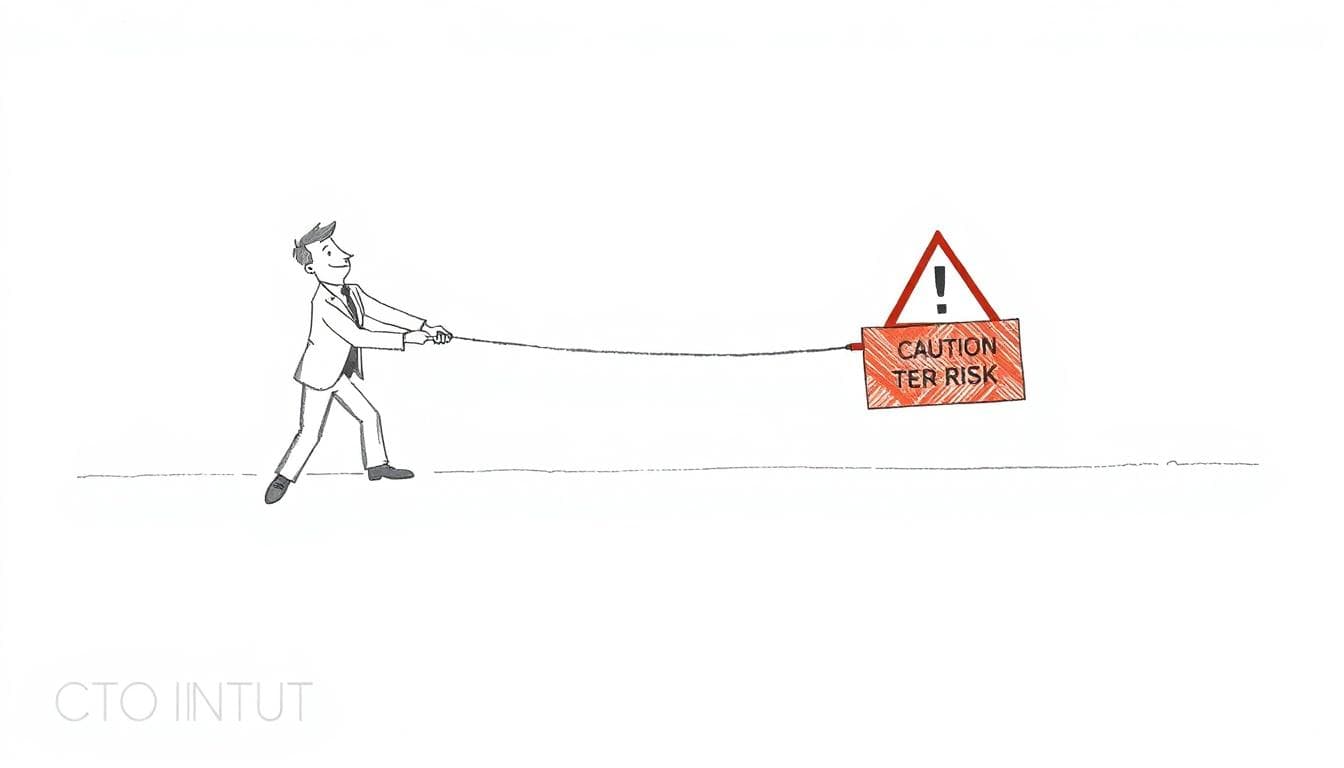
Caption: Business and technology pulling in opposite directions while risk grows in the gap. Image created with AI.
This phrase is not about your CTO being the smartest person in the room. It is about what they are looking at.
Your business leaders are paid to think about this quarter, key deals, hiring, cash, and the board. Your CTO is paid to think about systems, risk, and what will break if you keep adding weight without fixing the foundation.
They see:
- How many “quick fixes” you have stacked on top of each other
- Where security, privacy, or uptime are one incident away from a problem
- How today’s choices will affect cost, speed, and trust in 6 to 24 months
You see:
- Revenue targets
- Market windows
- Customer promises already on the table
Both views are valid. The conflict comes when the company treats long-term risk as “optional,” then expects short-term results as if those risks do not exist.
Take a simple example. A big client wants a new customer portal by quarter end. Sales promises a date. Marketing announces it. Your CTO says the integrations and security testing will take 6 more weeks.
You push ahead anyway. The portal launches on time, but:
- It crashes the first week
- A basic access bug exposes the wrong customer data
- Your team spends the next two months in crisis mode instead of building the next feature
That is what happens when the business is “wrong.” Not morally wrong, but wrong about what the system can safely do.
Studies show that around 70% of digital initiatives fail to meet their goals, and misalignment between business aims and IT capacity is one of the top reasons, as highlighted in these 50 statistics every technology leader should know in 2025. The tech is often fine. The expectations are not.
How Misalignment Between Business And Technology Shows Up Day To Day
You do not need a postmortem report to know you have a problem. You see it in daily behavior.
Here are common signs your CTO may be right and the business is off track:
- Scope changes but dates do not. Leadership keeps adding features without moving deadlines or budgets.
- Sales sells the future as if it already exists. Demos show “concept” features that have no team or plan behind them.
- Security warnings go into a parking lot. Issues that carry real risk get pushed to “after this launch” again and again.
- Legacy systems stay because “that is how we have always done it.” No one wants to touch the old platform that runs half your revenue.
- AI or automation projects start with a buzzword, not a problem. There is a pilot, but no clear owner, measure, or workflow.
- Your CTO looks tired in every exec meeting. Their job becomes blocking bad bets, not building smart ones.
If two or more of these feel familiar, the tension you feel is a signal, not just “tech being difficult.”
Common Situations Where Your CTO Is Right And The Business Is Taking The Wrong Bet
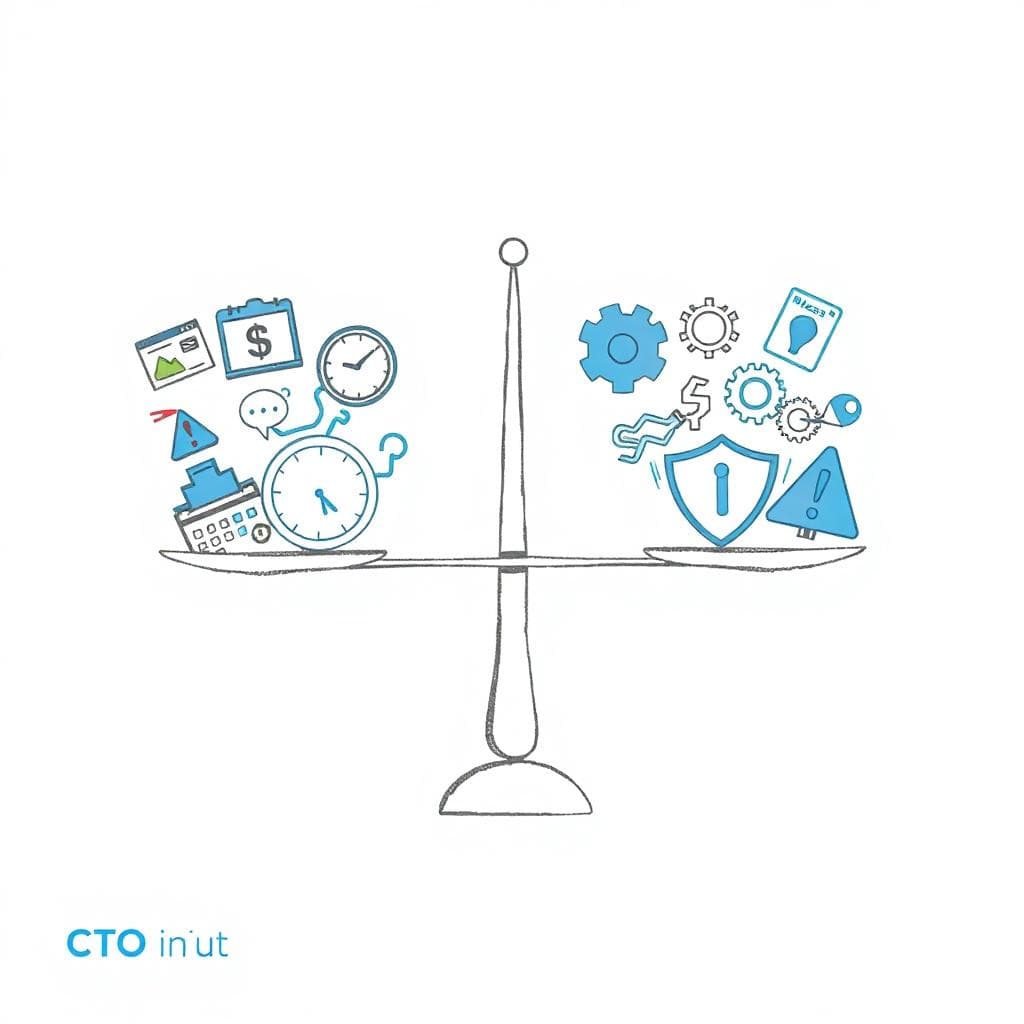
Caption: When speed and revenue outweigh risk and technical reality, failure risk spikes. Image created with AI.
Patterns repeat across companies and sectors. The details change, but the story is often the same.
Here are three of the most common.
Chasing Speed And Revenue While Ignoring Risk And Tech Debt
The logic: “If we move faster, we win more deals and beat the competition.”
The reality your CTO sees: “If we keep skipping design, testing, and security, the system will break at the worst time.”
So launches get rushed. Manual patches pile up. Core architecture stays fragile. Then the bill arrives as outages, angry customers, and rework that costs 2 to 5 times more than building it right the first time.
Many digital transformation failures start here. Companies run ahead of their own technical base, then spend the next year fixing what speed destroyed. Analysts who study transformation failures often call out misalignment as the secret killer of these initiatives, as outlined in this review of misalignment in digital transformation projects.
When your CTO says “We need two more sprints or we are betting the brand,” they are not blocking revenue. They are trying to protect it.
Treating Technology As A Cost Center Instead Of A Strategic Asset
The logic: “IT is too expensive. Cut tools, freeze hiring, and push vendors for discounts.”
The reality your CTO sees: “Random cuts will hit the very systems that keep us secure, compliant, and able to grow.”
So you delay key upgrades, keep fragile systems, and pick tools based on license price, not total cost of ownership. Your CTO pushes back on “just adding another SaaS” or “outsourcing that to a cheap vendor” because they know what sprawl does:
- More vendors, more risk
- More manual work, more errors
- More data copies, more compliance headaches
The right question is not “How do we make IT cheaper?” It is “Where does technology give us an unfair edge, and where are we wasting money?”
Your CTO is often right when they say no to random tools. They are trying to keep your data, focus, and security intact so growth is actually possible.
Starting AI And Automation Projects Without A Clear Business Problem
The logic: “We need AI or the board will think we are behind.”
The reality your CTO sees: “We are about to spend six figures and a year of time without a single clear outcome.”
Too many leaders jump into AI, dashboards, or bots before they answer three simple questions:
- What problem are we trying to solve?
- How will we know it worked?
- Who will own it day to day?
When your CTO pushes back on a vague AI idea, they are usually trying to stop a science project that burns time and capital. Even AI-focused advisors warn that you should start with the business problem, not the technology.
If your AI plan fits on one slide but your process map does not exist, your CTO is probably right.
How To Respond When Your CTO Is Right But Your Business Is Wrong

Caption: When business goals and technology reality share one roadmap, tension turns into momentum. Image created with AI.
You do not fix this by asking your CTO to “be more commercial” or by telling sales to “stop selling big ideas.” You fix it by changing how decisions get made.
Here are habits you can put in place in the next 30 to 90 days.
Start With A Shared Picture Of Success, Risk, And Tradeoffs
Sit down with your CTO and define success in plain language:
- Revenue and margin targets
- Customer outcomes you will protect at all costs
- Risk limits you will not cross (like downtime, security, compliance)
- Time frames that are real, not wishful
Then, before any big tech decision, ask one simple set of questions together:
- What do we gain if we do this?
- What do we risk?
- What do we delay or give up?
Write those tradeoffs down. When they are visible, your CTO is no longer the lone voice of caution. The whole team sees the bet for what it is.
Turn CTO Objections Into Options, Not Arguments
When your CTO says “no,” treat it as the start of a design session, not a fight.
Ask questions like:
- “If we keep the date, what do we cut to make this safe?”
- “If we ignore this security risk, what is the true worst case?”
- “What would a safe version of this launch look like?”
You are not trying to “win” the debate. You are trying to expose constraints so the team can pick from real options.
Very often, your CTO will give you a menu:
- Option A: Fastest but riskiest
- Option B: Balanced speed and safety
- Option C: Slower but far more stable
Your job is to pick the risk profile, not pretend it does not exist.
Use Outside Help When Trust Or Clarity Is Worn Down
Sometimes the relationship is bruised. The CTO feels unheard. The rest of the team feels blocked. Every topic turns into a replay of old arguments.
That is when a neutral technology leader can help.
A seasoned external CTO or CIO can:
- Translate your growth plan into a clear technology roadmap
- Turn vague “we are behind” complaints into specific gaps and options
- Give the board and investors a clear, independent view of risk and progress
An outside voice can sit on your side of the table, speak both business and tech, and reset the conversation around facts, not frustration.
If you feel stuck between “tech says no” and “the business must move,” this kind of short, focused engagement can save months of waste and a lot of political damage.
Conclusion: Listen To The Signal Behind The Conflict
When your CTO is right but your business is wrong, you are not dealing with bad people. You are dealing with misaligned bets.
The good news is simple. When you listen to that signal, reset expectations, and line up incentives, you cut waste, reduce risk, and often move faster with more confidence. You stop treating technology as a drag on growth and start treating it as the engine that makes growth repeatable.
Pick one current project and ask: “Are we pushing for business outcomes that our technology cannot safely deliver yet?” If the honest answer is yes, you have just found a chance to course-correct before it turns into another statistic in the 70% failure bucket.
If you want help turning this tension into a growth advantage, visit https://www.ctoinput.com to see how CTO Input supports CEOs and founders with fractional CTO, CIO, and CISO leadership tied directly to the growth plan. To keep sharpening how you align strategy, technology, and risk, explore more insights on the CTO Input blog at https://blog.ctoinput.com.