

You are about to sit across from a potential technology leader and you want to know how to interview a CTO. The stakes are high, and your notes are thin. The quiet question in your head is simple: What questions should I ask a potential CTO or technology advisor in an interview?
This is not a coding quiz. You are not trying to out-architect them. You are trying to see how they think about strategy, risk, money, people, and delivery.
You want to know if this person will help you grow, protect the balance sheet, and calm your board.
The right questions turn a vague “seems smart” gut feel into a clear decision you can defend to your investors and your team.
How to prepare before you ask a potential CTO or technology advisor any questions
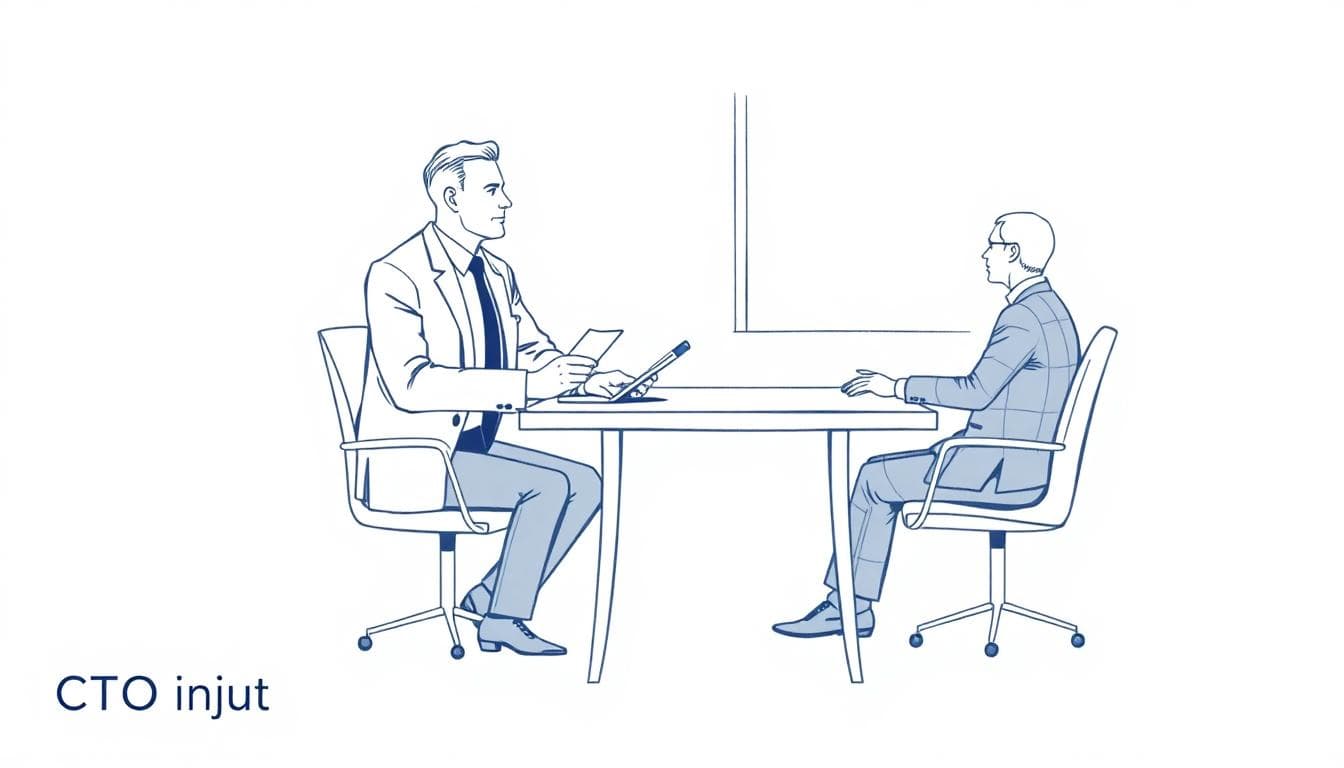
Interview between a CEO and a potential CTO, image created with AI.
If you walk into the interview unclear, you will walk out unclear. Preparation keeps the discussion tied to business outcomes, not tech buzzwords.
Your goal is to anchor the interview in revenue, margin, risk, and customer impact. That way, every answer either helps your strategy or exposes a gap.
Before you meet any candidate, write down where technology feels like a tax on the business: slow projects, surprise costs, outages, cyber worries, vendors who run the show. Those pain points shape better questions than any generic list.
You are not only hiring skills. You are hiring judgment. A prepared interview lets you see that judgment under pressure, in your context, not in some perfect textbook case.
Clarify what you really need from a CTO or technology advisor
Use a few simple prompts to sharpen your thinking before the interview:
- What must change in the next 12–24 months? For example, do you need cleaner data, fewer outages, faster product launches, or better board answers on cyber?
- Where does tech feel too expensive or too slow? Think about recurring vendor bills, never-ending projects, and manual work that should be automated.
- Where are the board, lenders, or regulators asking hard questions? Common topics in 2025 are AI use, data privacy, resilience, and vendor concentration.
- What would “success” look like with the right technology leader? Picture concrete outcomes: fewer incidents, simpler reports, a clear roadmap, lower run-rate spend.
Bring these notes into the meeting. They are your filter to judge if the candidate lives in theory, or in your reality.
Decide how you will judge their answers
You do not need a complex scoring model. A simple lens works well and keeps you objective when you compare finalists later.
Listen for three things:
- Clarity: Do they use plain language, or hide behind acronyms and tools?
- Alignment: Do they tie technology choices to revenue, margin, and risk, or only to “scale” and “innovation”?
- Ownership: Do they speak like they sit on your side of the table, owning outcomes with you?
Take short notes after each question. Circle or star answers that showed strong clarity, alignment, or ownership. At the end, you will see patterns instead of random impressions.
What questions should I ask a potential CTO or technology advisor in an interview?
This is where you turn your prep into targeted questions that reveal how they really work.
Current best practice in CTO hiring focuses on strategy, leadership, security, and measurable impact. Lists like the Adaface CTO interview questions guide show how often top companies anchor interviews in real outcomes, not tool trivia.
Use the themes below as your core script.
Questions that test strategic thinking and business alignment
1. “How would you connect our technology roadmap to our growth targets and margins?”
Good answers start with your strategy and unit economics. They talk about which products, channels, or customer segments matter most, then describe a roadmap that supports those priorities. Listen for simple metrics like revenue per customer, gross margin, churn, and operating cost.
2. “Tell me about a time you cut technology cost while improving reliability.”
Strong candidates describe trade offs and data. They might talk about pruning vendors, consolidating platforms, or simplifying architecture. The key is that reliability and customer experience got better, not worse.
3. “How do you decide what not to build?”
You want to hear about focus. Look for answers that mention customer value, time to impact, and opportunity cost, not just “cool tech.” They should describe saying no to features that do not move revenue, margin, or risk.
4. “Where do you think our biggest technology risks are, based on what you know so far?”
A sharp advisor will infer likely risks from your size and sector, then ask smart follow-up questions. Vague or generic risk lists are a warning sign.
For more strategy-focused prompts, the CJPI questions to ask a CTO provide useful benchmarks.
Questions that reveal how they lead teams and shape culture
1. “What do you do in your first 90 days with a new tech team?”
Look for a clear plan: listen first, meet key stakeholders, review current projects, assess talent, then set a small number of priorities. If they jump straight to a reorg or big tool changes, be careful.
2. “How do you handle conflict between product, sales, and engineering?”
Good answers sound like mediation, not politics. They talk about shared goals, clear decision rules, and data. Blaming “the business” or “the engineers” is a red flag.
3. “How do you keep engineers focused on customer outcomes, not just features?”
You want to hear about direct exposure to customers, clear success metrics, and simple stories that explain why the work matters.
4. “Tell me about a time you kept a strong engineer who was frustrated.”
This surfaces their coaching style. Strong leaders combine honesty, growth paths, and boundaries.
Questions about delivery, project health, and vendor management
1. “How do you bring a late or over-budget project back on track?”
Listen for structure: pause and replan, cut scope, reset milestones, and communicate clearly with sponsors. If they only talk about “pushing the team harder,” that is a problem.
2. “What few metrics do you watch to know if delivery is healthy?”
Healthy answers focus on a small set of signals: cycle time, defect rates, on-time delivery, and business outcomes. If they list a dozen vanity metrics, they may manage dashboards, not results.
3. “Tell me about a vendor relationship that you turned around.”
You want to hear about clearer contracts, stronger service levels, and direct executive-to-executive talks. Blaming the vendor without owning the relationship is a bad sign.
4. “How do you decide when to keep work in-house versus using a vendor or partner?”
Good answers weigh cost, speed, risk, and core IP. They should protect what makes your business unique.
External guides such as the TalentRise CTO interview questions echo this focus on real delivery and business results.
Questions that probe cybersecurity, risk, and compliance judgment
1. “If you joined here, what cyber or resilience risks would you look for in your first 60 days?”
Look for a practical checklist: access control, backups and recovery, vendor risk, key systems, and basic hygiene. Calm, methodical answers are good. Drama is not.
2. “How do you explain cyber and AI risk to a board so they can make decisions?”
Strong candidates talk about plain language, business impact, and options. They do not flood the room with threat names. They frame risk in money, downtime, reputation, and regulatory exposure.
3. “Tell me about a time you led through an outage or incident.”
You want to hear how they organized the response, communicated with customers and the board, did a blameless review, and reduced risk after the fact.
Questions about communication style and fit with the leadership team
1. “Teach me something complex from your world in three minutes, so I can repeat it to my board.”
This is a live test. If you feel smarter and calmer at the end, that is a great sign. If you feel confused or talked down to, trust that signal.
2. “What do you wish CEOs understood about technology decisions?”
Look for honest, balanced answers. The best people talk about trade offs in time, money, and risk, and how early involvement from leadership makes better choices.
3. “How do you react when an executive overrules your recommendation?”
A mature leader accepts that you own the final call, but they also say how they document risks, support the decision, and keep the relationship healthy.
Discussions on forums like this Reddit thread on questions to ask a CTO show how often communication and trust, not tools, decide long-term success.
How to use the answers to choose the right CTO or technology advisor
After a full interview, your notes may feel messy. The goal is to turn that noise into a clear decision.
Start by scanning each candidate through the same three-part lens: clarity, alignment, ownership. Who spoke most clearly? Who kept pulling tech back to revenue, margin, and risk? Who sounded like a peer on your side of the table?
Next, mark where they saw quick wins in the first 90 days, and where they sketched a 12–24 month view. You want both. Only quick wins means they may lack strategy. Only long-term plans with no near relief means your current pain will linger.
If you want more structure, you can compare your notes with external checklists such as the Talentrise interview questions for CTO candidates, but keep your own context front and center.
Spot red flags and green flags in their interview answers
Common red flags:
- Blaming past teams, vendors, or “the business” for every problem
- Speaking in heavy jargon without translating to money or risk
- Chasing shiny tools and trends without a clear use case
- Ignoring cost, compliance, or cyber risk in their stories
- Dismissing non-technical leaders as “not getting it”
Common green flags:
- Clear trade offs, with simple reasons for each choice
- Plain language that a board member would understand
- Shared ownership with the business, not “IT versus them”
- Focus on value and risk reduction in the first 90 days
- A calm tone, even when talking about incidents and failures
If you see more red than green, listen to that. You are not hiring a headline, you are hiring a partner.
Turn a good interview into a clear next step
If a candidate looks strong, turn the interview into a small working session.
Ask them to sketch a short, hypothetical roadmap for your company. Or walk them through a real project that is off track, or a recent outage, and ask how they would respond.
You are looking for calm, clarity, and a believable plan that connects technology, cost, and risk to your growth strategy. The right CTO or advisor should leave you thinking, “I can put this person in front of my board tomorrow.”
Conclusion
The question, “What questions should I ask a potential CTO or technology advisor in an interview?” is really about protection: of your business, your board relationships, and your next stage of growth. Thoughtful questions reveal whether a candidate can turn technology from a drag into a growth engine, while keeping risk and cost under control.
If you want practical help turning this into a real hiring or advisory decision, explore how CTO Input approaches fractional and advisory leadership at https://www.ctoinput.com, and continue learning from field-tested guides on the CTO Input blog at https://blog.ctoinput.com. The right technology partner should bring clarity, not noise, and help you lead with more confidence in every board meeting that comes next.