

Most mid-market technology reviews feel the same: 60 to 90 minutes of dense slides, status updates, and vendor jargon that leave you with the same questions you walked in with.
If you are a CEO, COO, or founder, you feel the cost of that. Rising tech spend with vague ROI. Cyber questions from the board you cannot answer cleanly. Projects that always seem “almost there” but never hit the date.
A strong quarterly technology review should be the opposite. It should give you straight answers on where money is going, which risks matter, and what must change before the next quarter. It should help you respond with confidence when boards, lenders, and investors ask hard questions.
This article shows you how to run a quarterly technology review that drives decisions, not just slides, and how to turn one meeting each quarter into a real control point for cost, risk, and growth.
What a Quarterly Technology Review Should Do for Your Business
A useful quarterly technology review is not an IT ceremony. It is a business control meeting.
At a minimum, it should help you answer three basic questions:
- Are we spending the right amount on technology and cybersecurity?
- Are our key systems and projects helping or slowing the growth plan?
- Are we carrying any risks that would worry a board, auditor, or key customer?
The point is not to become an expert in architectures or tools. The point is to connect technology, cost, and risk to revenue, margin, and trust.
Many companies borrow formats from Quarterly Business Review playbooks, like the CXO guide to QBR best practices or this QBR agenda overview. Those are helpful, but your internal technology review has a sharper job: protect cash, protect customers, and protect your reputation.
A good review replaces vague noise with a short set of clear decisions. It should help you cut dead projects, slow spend that is out of line, and double down where technology is truly a growth engine.
From status update to decision meeting
Treat the quarterly review like a budget and risk meeting that happens to talk about systems.
By the time you leave, you should have made decisions such as:
- Which projects to stop, pause, or speed up. For example, freeze the low impact HR portal redesign, and free up capacity for a delayed customer portal that affects revenue.
- Where to cut or increase spend. You might trim overlapping tools after a quick audit of licenses, then reassign that budget to overdue security work.
- Which risks to fix this quarter. That could be multi-factor authentication for remote access, or a recovery test for your main ERP system.
- Which vendors to challenge. Maybe a key SaaS provider has missed service levels three times. The outcome might be a renewal review or a formal improvement plan.
Picture a mid-market distributor with a small IT team and a tight budget. One decision meeting like this can unlock six figures of value. Stopping one unneeded integration project, renegotiating a mispriced contract, and closing one glaring cyber gap adds up fast.
If your quarterly meeting does not end with real trade offs, it was a status update, not a review.
Connect technology, cost, and risk to your growth plan
Every topic in the review should tie back to something your board already cares about:
- Revenue growth
- Margin and operating efficiency
- Customer experience and retention
- Risk, compliance, and resilience
For example:
- A CRM upgrade is not about features. It is about shorter sales cycles, higher close rates, and cleaner pipeline reporting for your investors.
- Cybersecurity work is not about frameworks. It is about loan covenants, vendor questionnaires, and your ability to keep shipping if someone clicks a bad link.
- A data project is not about dashboards. It is about faster pricing decisions, better credit control, or fewer write offs.
By the end of the meeting, you should be able to answer in plain language:
Are we overpaying, under investing, or simply misaligned on technology and cybersecurity?
If you suspect your entire governance approach is off, this Guide to Stopping Technology Chaos gives a useful CEO level frame for getting control back.
How to Prepare for a Quarterly Technology Review That Drives Decisions, Not Just Slides

Leaders reviewing a quarterly technology review before a decision. Photo by ThisIsEngineering
The most important work happens before the meeting. Preparation turns a slide show into a decision session.
Think of your prep in three moves.
Choose the right people and one clear owner
First, decide who is in the room. For most mid-market companies, the core group is:
- CEO or COO
- Finance leader
- Operations or key business unit lead
- Most senior technology or security owner you have
You can invite others for part of the meeting, but this group makes the calls.
Then assign one business leader, not IT, to own the agenda and outcome. Often that is the COO or CFO.
If IT or a vendor owns the meeting, it tends to drift toward updates and demos. When a business leader owns it, the frame shifts to spend, impact, and risk.
Build a one page view of your technology, spend, and risk
Next, replace the 40 page slide deck with a single page.
That page should have three short sections:
- Top 5 systems and what they cost. Name the system, the business purpose, the annual spend, and the exec owner.
- Top 3 to 5 active projects and their health. Show each project with a one line goal, budget, and a simple status: green, yellow, or red.
- Top 5 risks or issues. Focus on items that affect uptime, security, compliance, or key customers. Again, use green, yellow, or red.
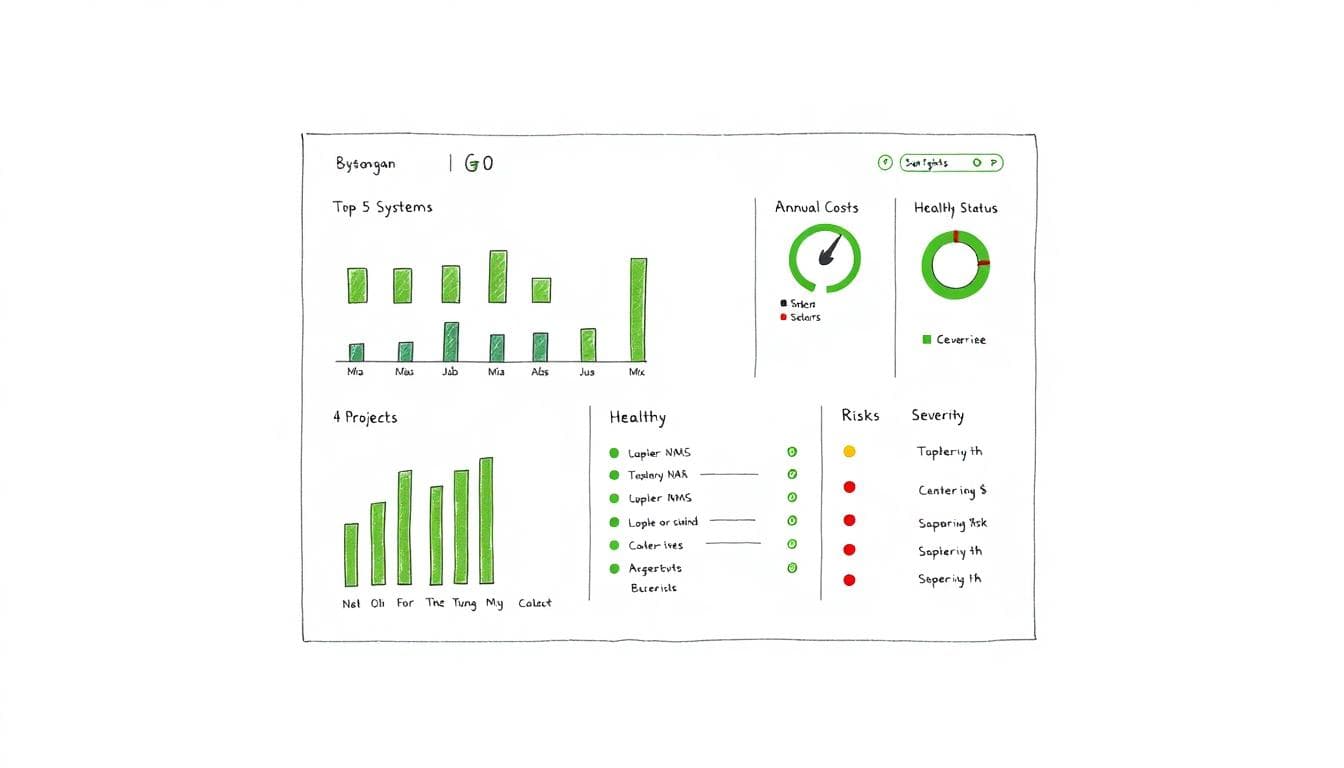
A one page dashboard showing systems, project status, and top risks in simple traffic light form. Image created with AI.
Traffic light labels help you spot where to focus in seconds. Green gets a nod, yellow gets questions, red gets decisions.
This does not need to be beautiful. It needs to be honest.
Pick 3 to 5 questions the meeting must answer
Finally, write 3 to 5 questions at the top of the agenda. These might be:
- Where are we wasting money on technology or vendors?
- What risks would worry our board if they saw the detail?
- What will slow down revenue next quarter if we do not fix it?
- Which projects no longer match our growth plan?
These questions become your filter. If a topic does not help answer them, you park it.
Many Managed Service Provider QBRs push for this kind of focus, as you can see in guides like the MSP Quarterly Business Review guide. You are doing the same thing, just for your own leadership team.
Running the Quarterly Technology Review in 60 Minutes
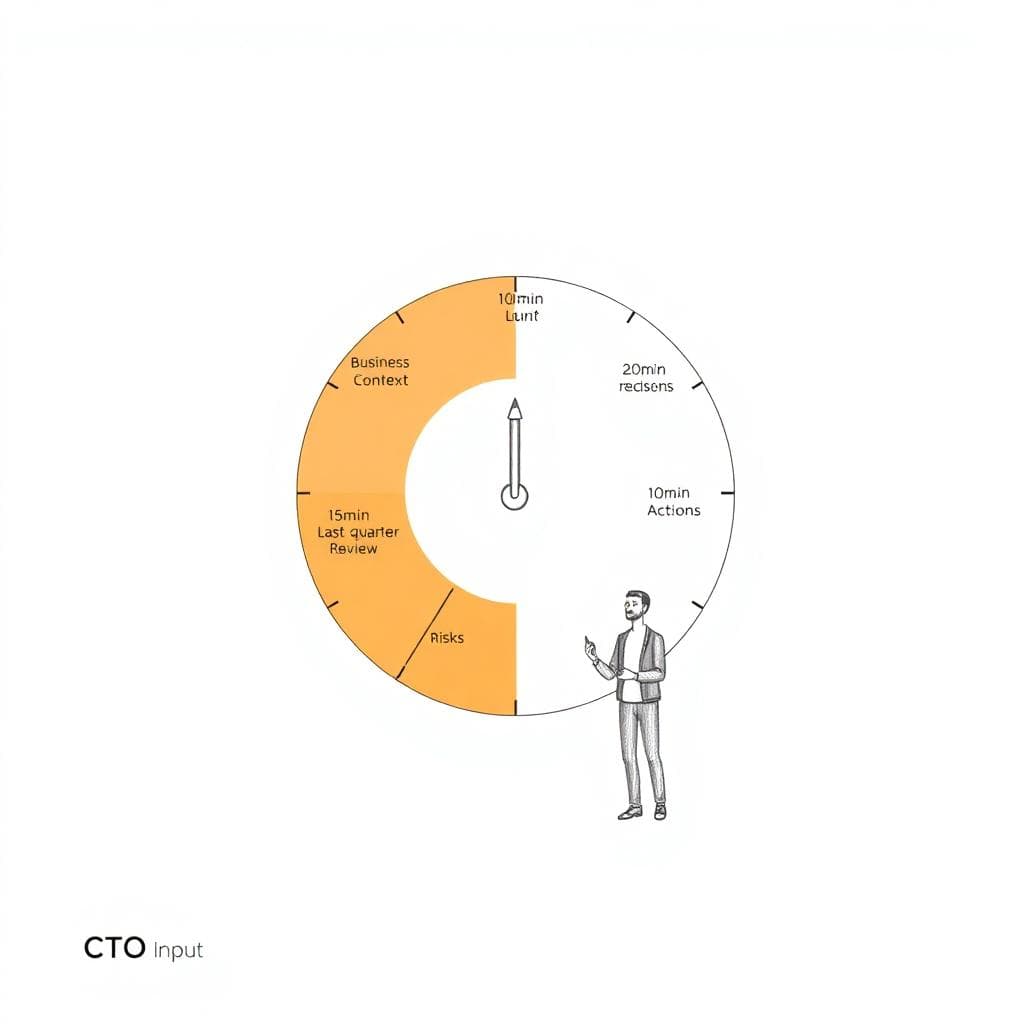
A 60 minute agenda visualized as time blocks for context, review, decisions, risk, and actions. Image created with AI.
You do not need a half day summit. You need one tight 60 minute meeting with a clear agenda.
Follow a simple, time boxed agenda
Here is a practical flow that works well:
- 10 minutes, business outcomes and context. Revenue, margins, major customer wins or losses, major operational changes.
- 15 minutes, last quarter in technology. Key wins, misses, surprises. No deep dives, just highlights.
- 20 minutes, decisions and trade offs. Use your one pager and target questions. Decide what to stop, start, speed up, or slow down.
- 10 minutes, risk and resilience. Top security issues, outages, vendor concerns, and any board or lender questions on the horizon.
- 5 minutes, owners and dates. Capture decisions, owners, and due dates in real time.
If you have gaps in leadership on the tech side, it helps to think beyond this quarter. The Future‑Ready Tech Leadership Guide offers a useful frame for how to build the leadership bench that can own these reviews with you.
Turn every topic into a clear decision with an owner and date
The hardest part is stopping the meeting from drifting into storytelling.
For each issue, force one of three outcomes:
- Decide now. For example, “We will cut 50 unused licenses this month and lock a new target spend for next year.”
- Ask for specific data and a deadline. For example, “IT and finance will bring back a vendor consolidation plan with three options by March 15.”
- Drop it. If a topic does not affect revenue, margin, customer trust, or real risk, it does not belong in this meeting.
Write decisions live where everyone can see them. A simple shared document is enough.
Strong decisions sound like this:
- “Move the warehouse Wi‑Fi upgrade ahead of the marketing website refresh. The outage risk is higher, and it puts orders at risk.”
- “Increase cybersecurity spend by 15 percent, but only after we cut overlapping tools and confirm the new plan with our lender.”
- “Pause the custom reporting project until we finish the CRM cleanup that feeds it.”
After the meeting, send a one page summary of decisions, owners, and due dates. That summary is your scorecard for the next quarterly review.
Conclusion
A strong quarterly technology review is short, sharp, and aimed at decisions, not slides. It connects your tech spend and cyber risk to the same growth, margin, and trust outcomes you report to your board.
If you choose the right people, prepare a simple one page view of systems, projects, and risks, and push every topic to a clear decision with an owner and date, your reviews will feel very different within one or two cycles.
If you want experienced help building this cadence, visit CTO Input to see how seasoned fractional CTO, CIO, or CISO leadership can sit on your side of the table. To keep learning, explore more executive level articles on the CTO Input blog and turn technology into a calm engine for growth instead of a constant source of anxiety.