

The SaaS tool renewal you just auto-approved is more than a line item. It’s an open door into your network, your data, and your customers' trust. Third-party vendor risk management is the discipline of ensuring those doors are managed with intention, not left open by default. This isn't about paperwork. It's about protecting your reputation and your ability to execute.
Your Vendor Contracts Are Quietly Costing You More Than Money
Most companies operate with a sprawling, invisible web of vendor dependencies held together by hope. Leadership sees a budget, but they don't see the coordination tax, the surprise risks, and the slow erosion of your ability to move fast. This isn't a tooling problem. It's an operating system failure, and it creates a constant, low-grade chaos that quietly drains your best people.

This isn't abstract. The pain is real and shows up in daily friction:
- Projects stall, waiting on security reviews for new tools nobody planned for.
- Your best people burn out on repetitive questionnaires for every audit and insurance renewal.
- A last-minute diligence request from a key partner triggers an all-hands fire drill, pulling focus from what matters.
When vendor oversight is scattered, every department makes decisions in a vacuum. Marketing, Finance, and Operations each sign contracts, weaving a complex web of risk that no single person understands or owns. You are not just buying software. You are inheriting the security posture of every company you do business with. The consequences are real. In 2024, a staggering 35.5% of all data breaches were traced back to third-party compromises. Your vendor choices are quietly dictating your company's resilience.
Restoring control starts with a simple acknowledgment: the chaos is a predictable operational failure, not a personal one. It’s not about blaming people or buying another dashboard. It's about installing a simple, reliable operating system for how you select, onboard, monitor, and offboard every vendor. A great place to start is by reviewing some foundational best practices for vendor management.
The goal is to shift from hopeful compliance to inspectable proof. This means creating clear ownership, setting firm guardrails for risk, and establishing a cadence that makes oversight routine, not heroic. This is how you restore control and get back to shipping what matters.
The Real Problem: Why Smart People and Good Tools Still Fail
You have a sharp team. You may even have a Governance, Risk, and Compliance (GRC) platform that promised a single source of truth. Yet the vendor mess persists, creating delays, rework, and surprise risk.
The problem isn't your people or your tools. The real issue is the absence of a simple, coherent operating system that defines ownership and cadence. Without it, smart people fail in ambiguous systems.

Think about how a new vendor is onboarded. The business unit wants a tool. Procurement negotiates terms. IT handles integration. Legal reviews the contract. So, who owns the risk for the next three years? When the answer is "everyone," it's really no one.
This fractured ownership creates predictable failures:
- Due diligence becomes a checkbox exercise. Teams rush security reviews to get a project moving, not to understand the blast radius.
- Decisions don't stick. A vendor is approved with security requirements, but with no owner to enforce them, the controls are never implemented.
- Offboarding is an afterthought. When a contract ends, the vendor's access lingers for months, leaving an unnecessary security hole.
Without a single owner for the entire vendor lifecycle, your policies are just expensive theater. They create the illusion of control while the real risk grows unchecked.
A Scenario: The Unapproved Analytics Tool
A marketing team at a fast-growing company is under pressure. They sign up for a new analytics tool with a corporate card, skipping the formal security review to move faster. They hit their numbers. Six months later, the analytics vendor suffers a massive data breach.
The leadership team is in crisis mode, asking basic questions:
- Who approved this vendor?
- What data did we give them?
- Is our customer information exposed?
- Who is coordinating the incident response?
The answers come slowly because ownership was never defined. Marketing saw a tool. IT and Security had no idea it was in their environment. This isn't a technical failure. It's an operational breakdown. The only way to stop these predictable surprises is to clarify ownership and define the process for every vendor relationship.
The Decision: Make Ownership Explicit
The most critical decision in third party vendor risk management is not which tool to buy. It is deciding how you will govern vendors as a system. This starts with one non-negotiable move: assigning a single owner.
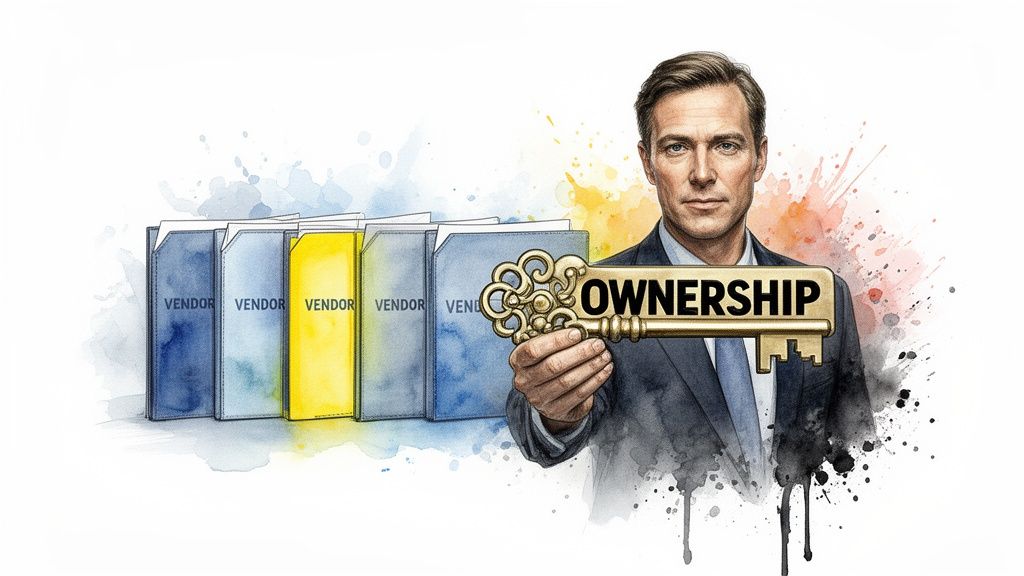
Vendor risk cannot be owned by a committee. One person must be accountable. Their mandate is clear: maintain the single source of truth for all vendors, define the risk tiers, and enforce the process from onboarding to offboarding. This is the only way to stop the chaos.
Translating Operations into Board-Ready Governance
This operational decision directly enables better oversight. The board's role is to define the organization's risk appetite with clear, non-negotiable guardrails.
For example, a board might establish these rules:
- "We will not partner with any vendor that processes customer PII without a current SOC 2 Type II report."
- "Any vendor with direct access to production systems must undergo a security assessment before onboarding."
With these clear rules, the program owner is no longer guessing at standards. They are executing a clear policy and providing the board with inspectable proof that it is being followed. Understanding what due diligence entails is crucial for meeting these standards. This structure replaces ambiguity with genuine accountability and defensible, delegated authority.
You can continue paying the heavy tax of ambiguity, or you can install a simple system with a clear owner. The pain you feel now is a direct result of fuzzy accountability. The moment you assign a single owner, you create a gravitational center. Decisions stick. Handoffs are clean. The system begins to work because someone is finally accountable for the outcome.
The Plan: A 30-Day Move to Restore Control
You don't need a year-long initiative to fix this. You can restore control and get a visible win in 30 days. The goal isn't perfection. It's to establish clarity and momentum where chaos currently reigns.
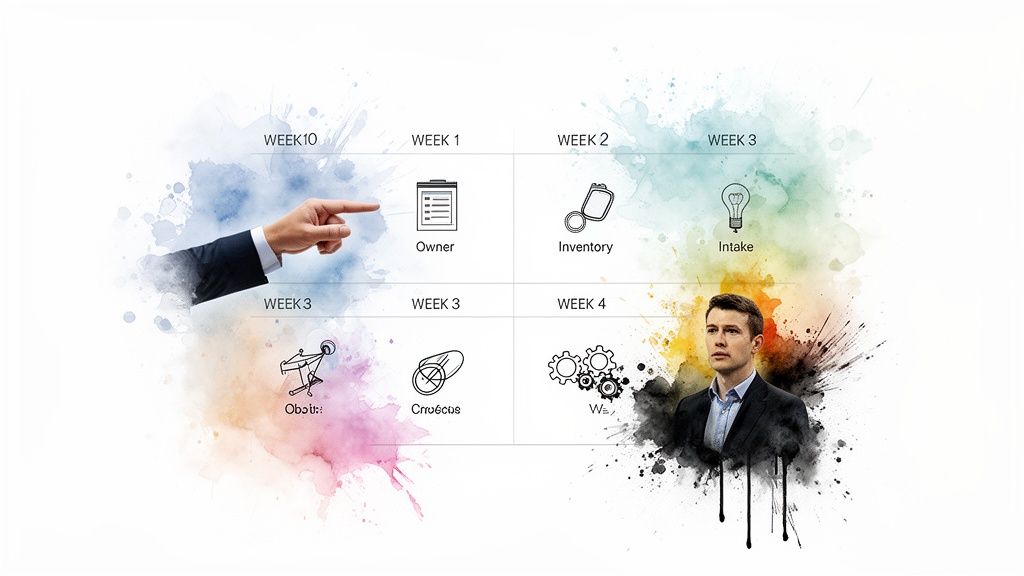
This plan builds a foundation for a sustainable third party vendor risk management program.
Week 1: Name the Owner and Build the Master List. One person is now accountable. Their first task is to create a single inventory of all vendors, pulled from accounts payable, contracts, and department heads. It must capture the business owner, data access, system access, and contract status for each. This is your baseline source of truth.
Week 2: Tier Your Risk and Define 'Done'. Map the current, messy onboarding process. Then, create simple risk tiers: High, Medium, and Low, based on data and system access. Define what a completed due diligence review looks like for each tier. This focuses your energy where it matters most.
Week 3: Remove One Blocker and Ship One Fix. The biggest win is often stopping the uncontrolled adoption of new tools. The fix: create a single, mandatory intake form for all new vendor requests. This one change forces a conversation before a contract is signed, routing every request to the program owner and stopping sprawl in its tracks. It is critical for lean teams. For instance, 73% of financial institutions operate with two or fewer full-time employees for vendor oversight, while managing over 300 vendors. You can find more insights on these resource challenges.
Week 4: Start the Weekly Cadence and Publish Proof. The program owner now has the inventory, risk tiers, and an intake process. The new weekly cadence is simple: review new vendor requests, track high-risk vendor assessments, and publish a one-page snapshot for leadership. This is your proof of progress.
This regular, predictable cadence transforms vendor risk from a series of reactive fire drills into a managed business function.
Proof: What Your Board and Insurers Will Accept
A policy document in a shared drive is not proof of control. To satisfy your board, auditors, and cyber insurers, you need a system that generates verifiable evidence of effective third party vendor risk management. This isn't about more questionnaires. It's about a handful of metrics that tell an honest story of risk reduction.
When a board member asks how you manage supply chain risk, a strong answer sounds like this: "We have a named owner and a weekly operating rhythm. Over the last 90 days, we reduced our unvetted vendors with system access by 40%. Here is the one-page proof." That response proves you have a system, not just good intentions.
Relying on vendor self-assessments alone is a known failure. Recent data shows that with 30% of breaches tied back to a vendor, only 4% of organizations feel confident their questionnaires reflect reality. Insurers see this disconnect, with a huge chunk of cyber claims now involving a vendor compromise, as shown in these third-party risk statistics on RecordedFuture.com.
Effective governance requires inspectable proof that your program is working.
Key Metrics for Board-Ready Reporting
Track these signals to provide inspectable proof. Progress here demonstrates control and reduces your blast radius.
| Metric | What It Measures | What 'Good' Looks Like |
|---|---|---|
| Total Number of Active Vendors | The size of your third-party attack surface. | A stable or downward trend, indicating control over vendor sprawl. |
| % of Vendors with Current Risk Assessment | The portion of your vendor base formally reviewed against your risk tiers. | Over 95% for high-risk vendors; over 80% for all vendors. |
| Average Time to Onboard a New Vendor | The efficiency of your due diligence process. | Under 10 business days for low-risk; under 30 days for high-risk. |
| Number of Offboarded Vendors (Quarterly) | The rate at which you terminate access for inactive contracts. | A consistent number showing the offboarding process is active. |
Proof is not a binder you assemble for an audit. It is the natural output of a calm, weekly operating rhythm. When the system works, the evidence generates itself. These numbers give you a clear signal of your organization's resilience, letting you make decisions based on data, not gut feelings. For a deeper dive, explore our approach to the vendor risk management assessment.
End the Chaos. Restore Control.
The way out of vendor chaos is not a new platform. It is a single decision: install a simple operating system built on clear ownership and a predictable cadence.
By focusing on a master inventory, risk tiers, and a weekly rhythm, you replace ambiguity with clarity. This is how you build a resilient organization that can move fast without tripping over unseen risks. It’s also how you slash the coordination tax and stop burning leadership time on fire drills.
A well-defined system for third party vendor risk management means every vendor relationship is intentional. This is not just about dodging breaches. It is about building an organization that is predictable, governable, and ready for what’s next. For more ideas on building a durable program, check out this comprehensive guide to third party risk management.
The most powerful move you can make is to shift the conversation from "Are we compliant?" to "Are we in control?" Control comes from a repeatable process with a clear owner. This also ensures that when a vendor fails, you are ready. A structured process is the difference between a contained incident and a full-blown crisis, as shown in a practical vendor incident response plan. It’s how you move from reactive panic to calm, methodical execution.
If you are ready to stop being blindsided by vendor issues, the first step is to clarify ownership. What is the one decision you can make this week to begin?
Your business deserves an operating system that turns chaos into clarity. CTO Input provides the fractional and interim CTO, CIO, and CISO leadership to install clear ownership, clean decisions, and reliable execution. If you are ready to move from fire drills to a governable system, book a clarity call with us.