

Hook: Chaos Costs Millions and Erodes Trust

Last quarter a finance leader learned that a third-party marketing plugin exposed customer data. The unexpected breach froze projects, drained budget, and shook the board’s confidence. The true cost wasn’t the plugin fee or the legal bill. It was the loss of control and trust.
The Real Problem: An Operating System Failure, Not A Technology Gap
Smart teams and expensive tools can still fail. This is not a tool problem. It is a system problem. When no one owns a security outcome and when no steady rhythm tracks progress, tasks slip through the cracks and risks hide in plain sight.
In the 2017 Equifax breach a critical patch sat uninstalled for 60 days. Everyone knew about the patch. No single person was accountable for installing it. That gap in ownership and review turned into a $4.4 billion loss.
This broken operating system shows up as:
- Decisions that make headlines but never go into production.
- Handoffs that close tickets but leave vulnerabilities live.
- Proof requests from your insurer answered with committees not names.
Without explicit decision rights and a weekly review cadence you will keep losing control.
The Decision: Appoint A Single Data Governance Owner And Set A Weekly Cadence
Leaders must choose who owns data security and how you will hold them to account. The decision is simple:
- Assign one executive (not a team) as Data Governance Owner.
- Define the one outcome they deliver in 30 days (not a broad mandate).
- Schedule a weekly 30-minute meeting for progress and blockers.
This clarity on owner, outcome, and cadence turns security from a hope into an inspectable system.
The Plan: A 30-Day Sprint To Restore Control
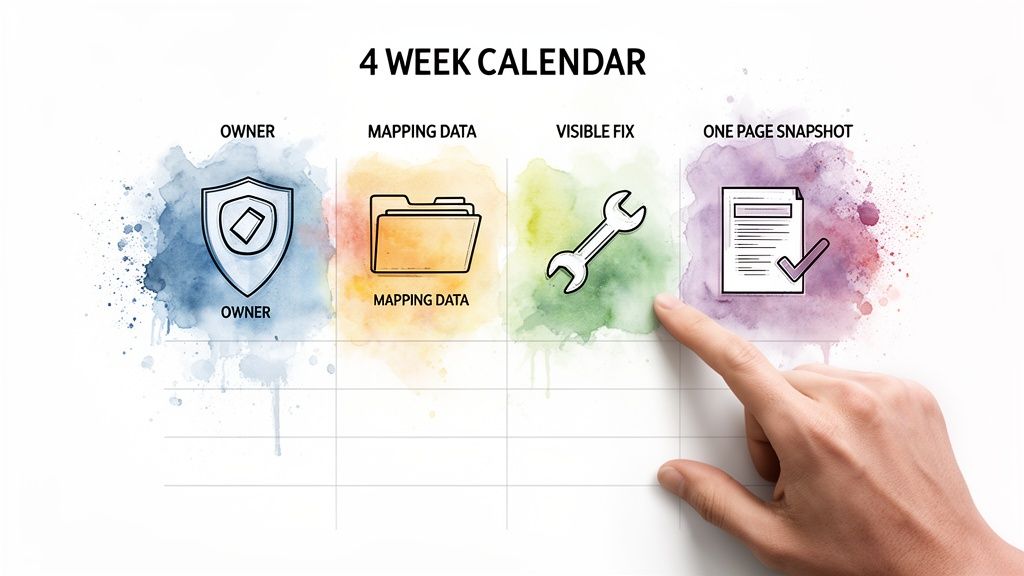
Week 1: Name The Owner And Identify Your Crown Jewels
Owner: CEO or COO names Data Governance Owner. Deadline: Friday. Outcome: A one-page map listing top 5 data assets, locations, and who has access. Proof: A signed document with owner name and asset list.
Week 2: Map Data Movement And Define Done
Owner: Data Governance Owner. Deadline: Friday. Outcome: A workflow diagram for one critical asset plus a checklist defining controls. Controls must specify who approves access, where multi-factor authentication applies, and how logs are reviewed. Proof: Diagram and checklist in one document.
Week 3: Ship One Visible Fix
Owner: Data Governance Owner and IT lead. Deadline: Friday. Outcome: One high-impact action that shrinks your blast radius. Options include revoking dormant privileged accounts or enforcing MFA on a key system. Proof: Before-and-after report showing reduction in accounts or 100 % MFA on the pilot.
Week 4: Lock In The Cadence And Publish Proof
Owner: Data Governance Owner. Deadline: Friday. Outcome: A standing weekly 30-minute meeting in the calendar and a one-page proof snapshot. Metrics: number of assets mapped, percent of MFA enforced, count of active privileged accounts, time to produce vendor inventory. Proof: The one-page dashboard sent to leadership.
Proof: Metrics That Matter To Your Board And Insurers
Your board and your insurer ask for proof not promises. Track these four signals:
- Mean Time to Detect and Contain (MTTD/MTTC). A stable, low number shows your incident response is real.
- MFA Enforcement Coverage. 100 % across all systems that touch critical data proves basic hygiene.
- Active Privileged Accounts. A weekly count trending down demonstrates disciplined access control.
- Time to Produce Vendor Inventory. Under one hour shows you can answer audit questions without a scramble.
Visualize these in a one-page snapshot with simple charts. This is the line of sight your board needs to govern.
Call to Action: Book A Clarity Call
If you are ready to stop losing control and start proving you are governed, the next step is clear. Book a clarity call today to diagnose your top bottlenecks and outline your first 30 days to a calm, fast, and inspectable security operating system.