

An incident response readiness assessment is not another report to file. It is a live-fire exercise that reveals the dangerous gap between the plan in your binder and what your team can actually do when a crisis hits. It is the only way to shift your organization from having a plan to possessing a provable capability to handle an attack under extreme pressure.
This is not a technical drill. It is a direct measure of your leadership's ability to protect trust, maintain operations, and make clean decisions when the business is on the line. The chaos that erupts when a plan fails is incredibly expensive. It burns out your best people, shatters customer trust, and exposes the company to regulatory and legal action.
The Real Problem: Smart People Get Stuck in Ambiguous Systems
You have the binder. It’s sitting on a shelf, labeled ‘Incident Response Plan.’ It ticked the boxes for auditors and cyber insurance. But what happens on a Friday night when a critical system goes dark? That binder becomes a paperweight.
The key contacts listed are out of date. The escalation paths are broken. The communication tools it mandates were replaced last quarter.
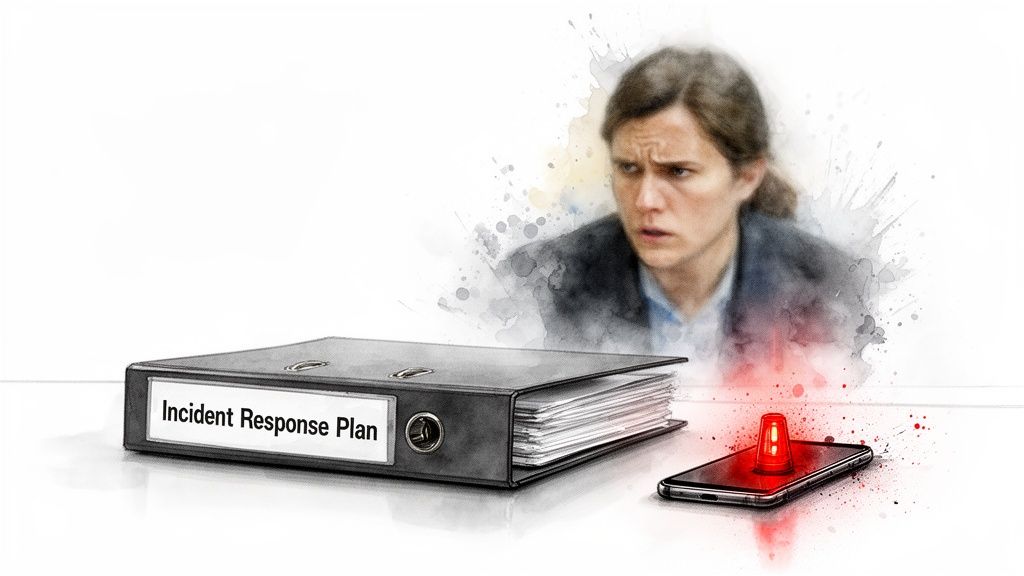
This is a common story. Smart teams fail in ambiguous systems. The problem is not your people or your tools. The problem is the operating system that guides their response. It lacks clear ownership, a predictable cadence, and simple decision rights.
Research from jumpcloud.com shows that while 55% of companies have a plan, a shocking 42% of those plans are not updated regularly. This creates a false sense of security that crumbles at the first sign of real trouble. The cost is measurable. Organizations without a tested, functional plan face an average breach lifecycle of 258 days. That is 69 extra days of exposure, operational chaos, and brand damage.
Relying on individual heroics is not a strategy. It is a glaring sign of systemic failure. An assessment forces you to answer the hard questions now, in a controlled environment, not during a real incident.
- Who has the final authority to shut down a revenue-generating system?
- How do you assemble the leadership team in the first 30 minutes, after hours?
- What is the precise handoff between the technical team and legal for evidence preservation?
Answering these questions is how you stop relying on hope and start building an inspectable, trustworthy system. It is how you restore control.
The Decision: Manage Readiness as an Operation, Not a Document
You have sharp people and good security tools. So why does every near-miss feel like a frantic scramble? It’s because the system that connects them is broken.
Most organizations are stuck in what I call a "formative" stage of readiness. Procedures are written down, but ownership is fuzzy, practice is inconsistent, and the entire process feels disconnected from business risk. This setup looks fine on paper but shatters under pressure.

This is the industry norm. A sobering 70% of companies fall into the bottom two readiness categories, according to the Cisco Cybersecurity Readiness Index. Seven out of ten organizations are reacting to fires instead of building a resilient, predictable response machine.
The single most critical decision you can make is to stop treating incident response as a compliance document and start managing it as a core operational function. This is a choice about ownership and cadence.
You must appoint a single, accountable owner for readiness. It cannot be a committee. A committee shares responsibility, which means no one is truly accountable. This owner’s job is to install an operating rhythm. They run regular tabletop exercises, maintain a backlog of gaps, assign owners and deadlines for fixes, and report progress to leadership.
For the board, this is the definition of defensible oversight. You establish clear, delegated authority and create a system for continuous verification. The entire conversation shifts from, "Do we have a plan?" to "Show us the proof that our plan works." This decision cuts through ambiguity and is the first step toward restoring control.
The Plan: A 30-Day Move to Provable Readiness
Chaos loves ambiguity. The fastest way to restore control is a simple, time-bound plan that forces clarity and builds momentum. This 30-day sprint is the first step toward creating a sustainable rhythm for your incident response readiness assessment. It replaces hope with a system.
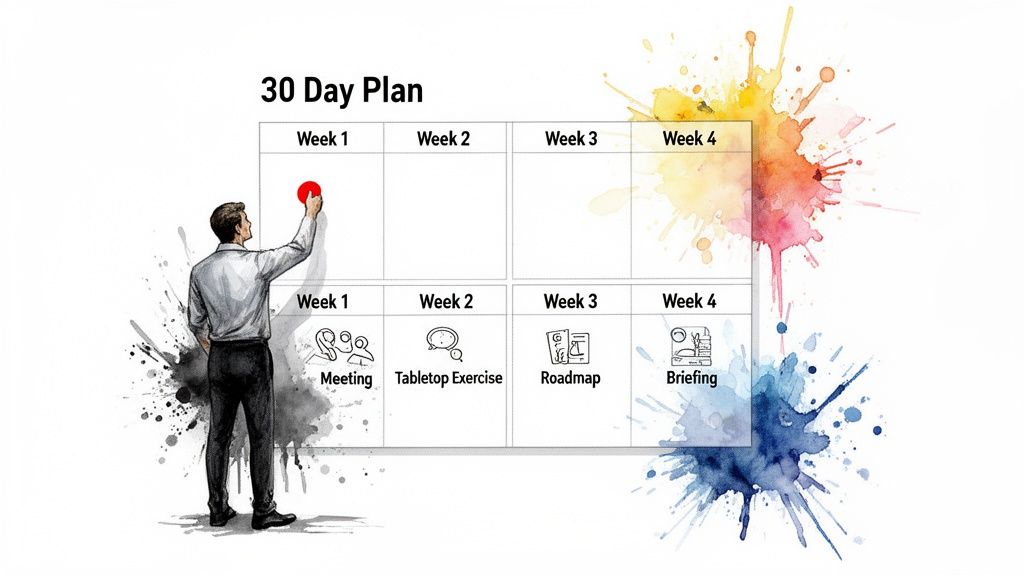
- Week 1. Name the Owner and Define the Outcome. Appoint a single person accountable for running the assessment. Their first job is to scope the test to one critical business service, like your primary revenue application or customer data platform. This makes the problem manageable and the results concrete.
- Week 2. Map the Handoffs and Define Done. The owner runs a tabletop exercise, a scenario-based walkthrough with the core response team. This is not a pass/fail exam. It is a diagnostic to find friction points. The exercise will quickly reveal gaps between what your plan says and what your team can do. Strong incident management best practices are essential here.
- Week 3. Remove One Blocker and Ship One Fix. The owner translates findings from the exercise into a prioritized list of gaps. This is not a 50-page report. It is a simple, actionable roadmap. For every gap, they assign an owner and a deadline. A finding without an owner is just a complaint. This step turns observations into accountable actions.
- Week 4. Start the Weekly Cadence and Publish a Proof Snapshot. The owner presents the findings and the remediation plan to leadership to get buy-in. With approval, they start a weekly or bi-weekly meeting to track progress on fixing the gaps. This turns readiness into a continuous operational function, not a one-off project.
This 30-day cycle lays the groundwork for a truly resilient operation. It is how you build a system you can prove is ready.
Proof: What a Board Accepts as Evidence
Your board, your executive team, and your cyber insurance provider no longer accept a dusty binder as evidence of readiness. They want inspectable proof that your organization can execute its plan under pressure.
A well-run readiness assessment delivers exactly that. It generates tangible evidence of due care and operational control. The goal is a simple, one-page dashboard any executive can grasp in under five minutes. You must speak the language of governance and business risk.
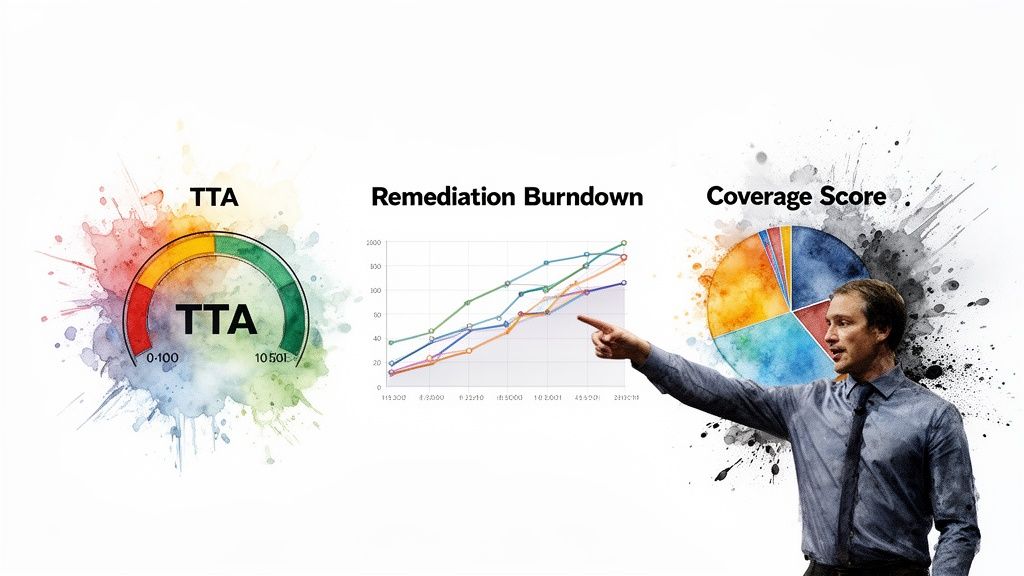
This evidence reframes the conversation. You stop answering the impossible question "Are we 100% secure?" and instead confidently state, "Here is the proof of our readiness, here are the gaps we're closing, and here is our progress over time."
To build this proof, track a few key metrics that tell a clear story.
Incident Readiness Metrics for Your Leadership Dashboard
| Metric | What It Measures | What 'Good' Looks Like |
|---|---|---|
| Time to Assemble (TTA) | The time it takes to get the core incident response team on a call after an incident is declared. | Under 15 minutes. This proves your on-call rotations and escalation paths are working. |
| Remediation Burndown | The rate at which you are closing gaps identified in tabletop exercises. | A steady downward trend. This shows you are systematically reducing risk, not just admiring the problem. |
| Coverage Score | The percentage of critical business services tested in a tabletop exercise in the last 12 months. | 100%. This demonstrates a serious commitment to readiness across all high-impact areas. |
These are your vital signs. Picture your next board meeting. You present a single slide with these three metrics. You can show that your Time to Assemble has dropped from 45 minutes to 12 minutes. You can display a chart proving 80% of critical findings from the last assessment have been fixed. You can confidently state that all Tier 1 services have been tested this year.
This is what defensible proof looks like. It is clear evidence of a calm, controlled, and continuously improving operation. It proves that leadership has established delegated authority and a system for verification. This is the kind of proof that builds confidence and satisfies insurers. You can learn more about framing this in our guide on how to explain cyber risk to your board.
Move from Hope to an Inspectable Operation
The gap between your documented plan and your actual capability is a hidden tax on your organization. It paralyzes decision-making and leaves your leadership exposed. Relying on an untested plan is not a strategy. It is hope.
The only way to fix this is with a structured incident response readiness assessment. This is how you replace hope with verifiable evidence, swap ambiguity for clear ownership, and turn chaotic fire drills into a calm, predictable operational rhythm. An inspectable operation doesn't promise perfection. It promises proof.
To create an operation you can inspect and trust, you need clear and documented incident management procedures. But more than that, you need two things: a single owner accountable for the outcome, and a regular cadence of testing and fixing.
Your current plan might check a box for an auditor, but will it hold up at 2 AM on a Saturday? The choice is simple: continue paying the tax of ambiguity and chaos, or invest in a straightforward system of ownership and cadence that restores control.
Are you ready to build an incident response capability you can prove is ready?
At CTO Input, we install the clear ownership and simple operating rhythms needed to make your incident response capability real and defensible. If you are ready to move from hope to proof, book a clarity call.