

Your board is tired. They are tired of slogging through dense, technical reports that leave them with more questions than answers. They see alarming headlines about cyber threats, turn to you for assurance, and ask a simple question: "Are we safe?" The cost of getting this wrong is your credibility and their confidence. A good board ready cybersecurity reporting template isn't about data. It's about delivering a clean decision.
The Real Problem: Why Smart Teams Produce Confusing Reports
Let’s be honest. The reports you send to the board are probably a 50-page slide deck overflowing with jargon, acronyms, and vanity metrics that do more to obscure reality than clarify it. Your team spends weeks pulling data, only to feel misunderstood. Your board leaves frustrated, still lacking the simple, confident answers they need to govern.

This isn’t a knock on your team. They’re smart, dedicated people. The problem is a broken operating system. When brilliant security professionals produce confusing reports, it’s because they lack a framework for translating technical details into business impact. They are stuck in a cycle of compliance theater, producing reports that look like governance but offer zero proof of control.
The fallout from this disconnect is significant:
- Lost Credibility: When reports are a tangled mess, leadership wonders if your security program is just as chaotic.
- Delayed Decisions: Without a clear picture of risk, the board can't make timely, informed decisions on budgets or priorities.
- Persistent Anxiety: A low-grade, constant anxiety permeates the leadership team. They worry an unseen risk is waiting to become a public disaster.
This pattern persists because most cybersecurity reports are built from the bottom up. They start with a mountain of raw data from dozens of tools and try to stitch it all together into a story. This is doomed to fail. A board doesn't need to know the number of blocked IP addresses. They need to understand the blast radius of a ransomware attack and see proof that your recovery plan works.
The pressure for this clarity is mounting. Weekly cyber-attack volumes now average 1,968 per organization globally, a staggering 70% rise since 2023. You can explore more cybersecurity trends and statistics to grasp the scope. Without a system to turn data into decisions, you're stuck in a reactive loop, forever explaining technical details instead of demonstrating control.
The Decision: From Compliance Theater to Inspectable Proof
The single biggest risk in cybersecurity isn't a hacker. It's the gap between what you think your security posture is and what it actually is. You have a choice: continue performing compliance theater, or install an operating system that produces inspectable proof.

I saw this firsthand at a mid-sized financial firm. Their reports were dense with attestations suggesting everything was locked down. During a cyber insurance renewal, an auditor asked for proof. The "tested" incident response plan was a three-year-old document. The "owner" for critical data backups had left six months prior. Dozens of ex-employees still had active accounts. They were compliant on paper, but not secure in reality. The leadership team was blindsided.
The most dangerous state for any organization is to be "compliant but not secure." It creates a false sense of safety that prevents meaningful action until it's too late. The goal is a resilient operation that produces a clean audit report as a natural byproduct.
The decision is to move from perceived safety to inspectable proof. For the Trust Governor on your board, this is the only language that resonates. They need evidence. Global surveys show that while 81% of security leaders feel confident in their compliance, penetration testing reveals 69% of critical flaws remain exposed. You can dig into these top cybersecurity statistics for more on this confidence gap.
Making this shift requires a governance decision to operate on three principles:
- A Single Owner: Every control needs one named individual accountable for its effectiveness.
- A Clear Cadence: Every control is tested on a predictable schedule.
- Verifiable Evidence: The output of every test must be tangible proof that can be inspected on demand.
This is the foundation of a real board ready cybersecurity reporting template. It’s not about more data. It's about delivering the right evidence that proves you are in control.
The Plan: Your 30-Day Move to a Defensible Report
Moving from reporting chaos to a calm, predictable rhythm doesn’t require a massive transformation. It requires a focused 30-day move to produce your first defensible, one-page cybersecurity summary.

Here is your 30-day plan to restore control.
-
Week 1: Name the Owner and Define the Outcome. Your first move is to name a single owner for the board-level report. This is not a committee. Their first task is to draft a one-paragraph narrative answering, "What do we want the board to know, feel, and do after reading this?" This becomes the commander's intent for the entire process.
-
Week 2: Map the Handoffs and Define Done. The owner works with technical leads to pick three to five Key Risk Indicators (KRIs) that support the narrative. For each KRI, identify the absolute "source of truth"—the system or log where the data lives. This step immediately uncovers data gaps. Our guide on a cybersecurity risk assessment template can help frame this. "Done" for this week is a list of validated metrics and their sources.
-
Week 3: Remove One Blocker and Ship One Fix. Build the first draft of the one-page executive summary. This is the heart of your new template. It must include the core narrative, simple charts for your KRIs, and a short list of top risks and mitigation initiatives. Circulate this draft to a small group of internal leaders (CEO, COO) for feedback. This is the fix: a V1 of the report that has been pressure-tested for clarity before it ever sees the board. This aligns with principles of understanding regulatory reporting.
-
Week 4: Start the Weekly Cadence and Publish a Proof Snapshot. Based on feedback, finalize the one-page template. The owner then establishes a simple, repeatable process for gathering the data. The 30-day move ends when you publish the first official one-page "proof snapshot" internally, signaling the new operating rhythm has begun.
This isn’t about buying new tools; it's a governance decision to restore control. Strategic ownership, like that from virtual CISO services, makes this possible without adding headcount.
Proof: What a Board-Ready Report Actually Contains
A good board report isn’t a data dump. It’s a clear, defensible story about risk. It provides the sharp, executive-level insights your board needs to meet its governance obligations. Each element is designed to answer a specific question a Trust Governor would ask.
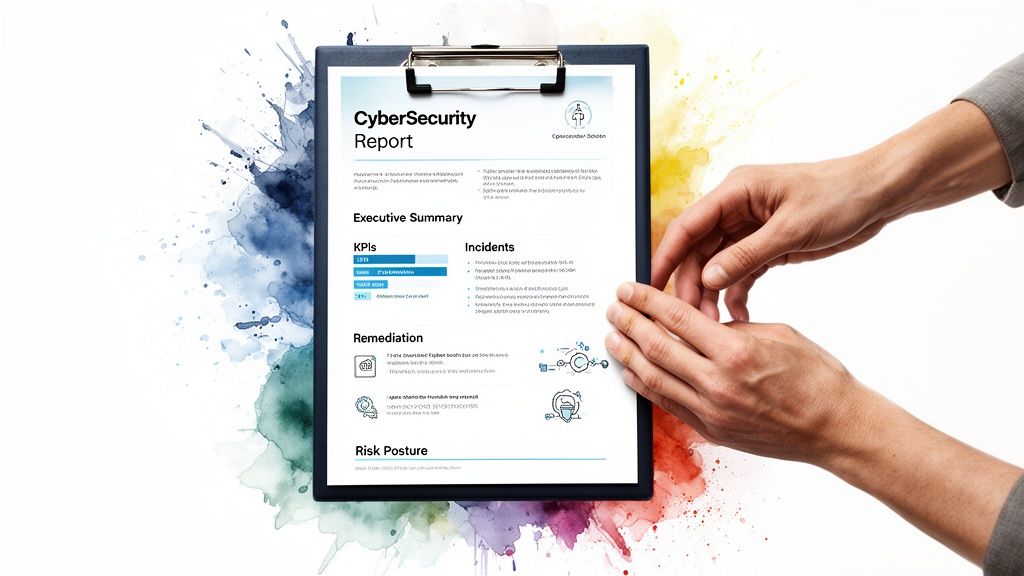
Your report should be built from these blocks:
1. The One-Page Executive Summary
This is the most important page. It must stand on its own. Start with a Red/Amber/Green assessment of your overall risk posture, then a single paragraph explaining why.
Example: "Our overall risk posture is Amber. While core systems remain secure, we are tracking a heightened risk from a sophisticated phishing campaign targeting finance. A project to deploy enhanced email security controls is underway, with a completion date of next month."
In seconds, you’ve shown the current state, top threat, and your plan.
2. Key Indicators That Reflect Reality
Your board cares about trends that show if the security program is getting stronger or weaker. Visualize no more than three to five metrics as trend lines over the last few quarters.
- Mean Time to Remediate Critical Vulnerabilities: How fast are you fixing the worst flaws? A downward trend is proof of operational maturity.
- Phishing Simulation Click Rate: What percentage of your team is falling for attacks? An upward trend in reporting shows awareness training is working.
- Number of Privileged Accounts: Tracking users with admin access is a direct measure of your blast radius. A flat or decreasing number shows control.
3. Risk and Initiative Tracking with Owners
The board needs a high-level summary of significant risks and proof you are fixing the root causes. Use a simple table with four columns: Risk/Initiative, Owner, Status (Red/Amber/Green), and Deadline. This format creates ownership and shifts the conversation from "What went wrong?" to "Who owns the fix, and are they on schedule?" Aligning this with understanding compliance and IT regulation is critical.
4. The Appendix with Auditable Evidence
Your one-page summary needs a link to an appendix. The board may never click it, but its existence builds trust. It proves every claim is backed by verifiable data, such as raw KPI data, incident after-action reports, or proof of successful backup recovery drills. For more on what to include, see our guide on what to expect in a cyber risk report from management.
This structure delivers a clear narrative for your board and the auditable proof your CISO and auditors demand. That’s how you build a reporting process that is both efficient and defensible.
Are you ready to stop the reporting fire drills and give your board the clarity they need to govern with confidence? CTO Input installs the calm, predictable operating systems that reduce risk and restore control.
Book a clarity call to map your first 30-day move toward defensible reporting. What is the one decision you could make this week to reduce reporting chaos?