

Your last board meeting felt off. You presented a deck full of cybersecurity metrics, but the room went quiet. Then came the question that hangs in the air after every one of these updates: “Are we actually secure?” The honest answer is you don’t really know, and the board senses it. This is the costly mess of misaligned security reporting. Your team is busy, your tools are expensive, but the chaos and the risk remain.

The truth is, your reporting is a fire drill. It’s a mad dash to pull numbers from a dozen different tools, all to build a report that feels more like a compliance exercise than a clear-eyed assessment of risk. The cost is immense: wasted leadership time, a false sense of security, and a board that lacks the confidence to govern effectively. This isn't a problem you can solve by buying another dashboard. It's time to restore control with a simple, reliable operating system.
The Real Problem: Your Reporting Is an Event, Not a System
You have smart people. You have good tools. So why does this keep happening? The problem isn't your team; it's the operating system they work in. You treat cyber reporting as a last minute event, not a predictable system. Without a defined board risk committee cyber reporting cadence, your team is trapped in a perpetual reaction cycle, scrambling to pull data just before every meeting.

This ad hoc approach creates a dangerous fog. Metrics are inconsistent because they're pulled under pressure. The story changes every quarter, making it impossible for directors to track progress against risk. Even worse, the absence of bad news is mistaken for good news. Your leadership is left with a fragmented picture, unable to connect the security team’s daily work to the board’s concerns about financial, operational, and reputational risk.
This failure has a name: a governance gap. Smart people fail in ambiguous systems. Policies fail without clear decision rights and enforcement. A recent DHR Global's analysis found only 2% of top companies have a dedicated board cybersecurity committee. Most fold it into the audit committee, where the language of finance often drowns out the nuances of risk. According to board practice findings from EY.com, this is the case for 81% of companies.
The core issue is that your reporting is an artifact produced for a meeting, not the natural output of a continuous operational system. It reflects a moment in time, not a trend. That is why you keep getting blindsided, and it's what we need to fix. For more on structuring these conversations, review these audit committee cybersecurity oversight questions.
The Decision: Make Ownership and Cadence Explicit
The only way to fix this is to stop treating reporting as a task and start running it like an operating system. This begins with one decision: you must clarify who owns the report and how often it will be predictably delivered. Forget the dashboard for a moment. This is about authority and rhythm.
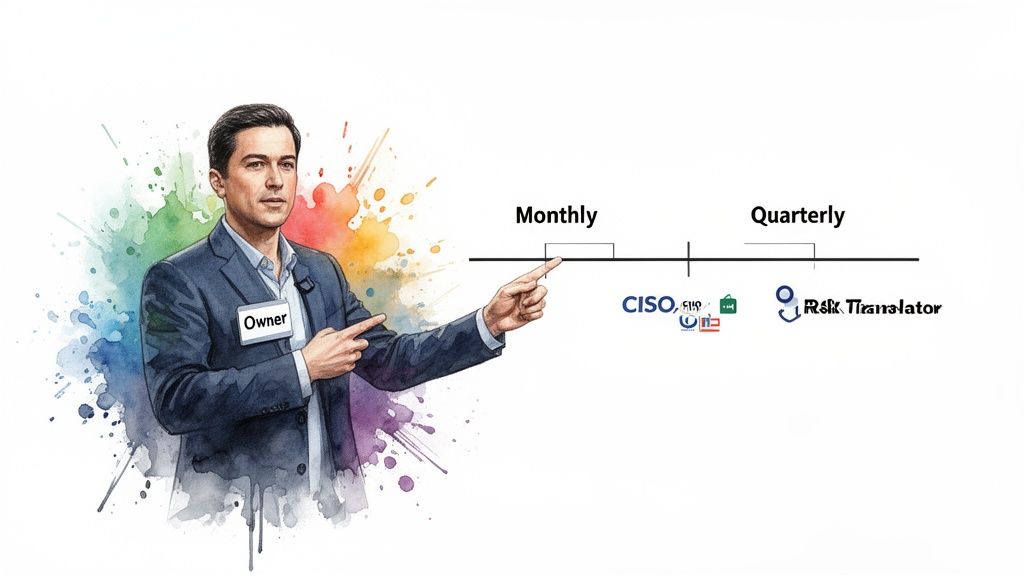
First, establish a formal board risk committee cyber reporting cadence. The rhythm that works is a quarterly deep dive for the board, supported by a more frequent monthly review with the internal executive team. This two track approach keeps directors strategically informed without bogging them down in operational details.
This simple decision forces you to assign a single owner. This cannot be a committee. It must be one person’s name. Whether it’s the CISO, CIO, or a dedicated Risk Translator, this individual is now accountable for delivering a report that translates technical details into business risk.
A predictable cadence does not mean you ignore emergencies. It means you define escalation triggers before a crisis. What events force immediate leadership attention?
- A confirmed data breach involving sensitive data.
- A ransomware attack that cripples critical operations.
- A major security failure at a key third party vendor.
Defining these triggers eliminates the “is this important enough to escalate?” debate that wastes precious time. Clarity on ownership, cadence, and escalation is the foundation of defensible governance. You can see how this structure is applied in our guide on what should a board expect to see in a cyber risk report from management. This is how you take back control.
The Plan: A 30-Day Move to a Defensible Reporting Cadence
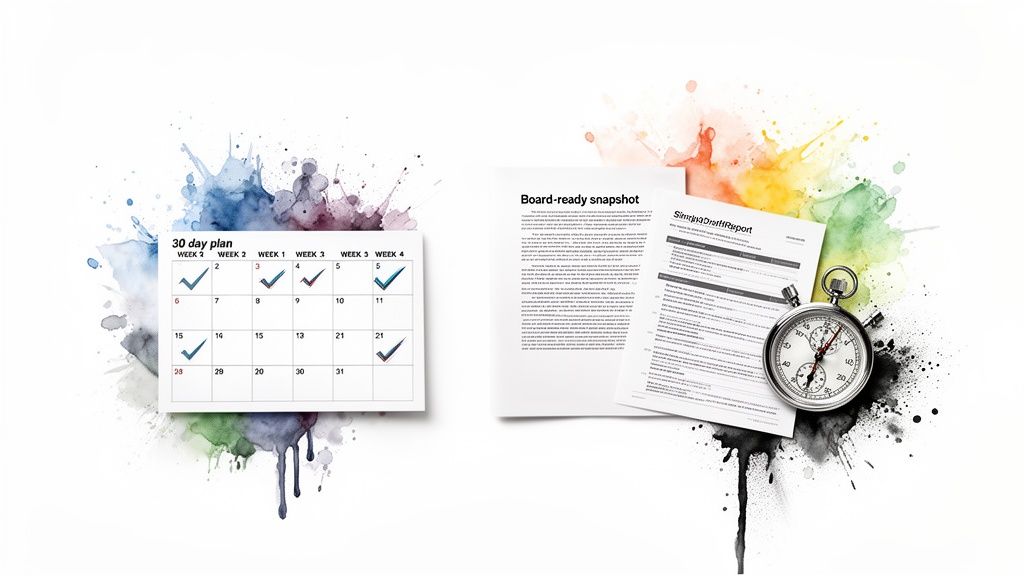
You can escape the cycle of ad hoc fire drills and install a predictable, professional rhythm. This 30 day plan is not about a complete overhaul. It’s about making immediate, tangible progress and building a system you can depend on. Each week builds on the last, systematically replacing chaos with clear ownership and inspectable proof.
-
Week 1: Name the Owner and Define the Outcome. Assign a single person, typically the CISO, who is accountable for board level cyber reporting. Give them a clear, outcome focused mission: “Produce a quarterly, board ready cyber risk snapshot that connects our security program to business risk.”
-
Week 2: Map the Handoffs and Define Done. The owner’s job is to identify the three to five metrics that truly signal risk reduction, not just activity. Think phishing simulation failure rates or time to patch critical vulnerabilities. Then, define what “done” looks like by sketching a one page dashboard that tells a story with that data.
-
Week 3: Remove One Blocker and Ship One Fix. Run a dry rehearsal. The owner presents the draft report to an internal executive group. This pressure test will immediately reveal blockers, like data that is impossible to pull or a narrative that doesn’t land with non technical leaders. Fix one of those issues this week.
-
Week 4: Start the Weekly Cadence and Publish the Proof. The owner launches a weekly internal meeting to review the core metrics. This meeting becomes the engine that feeds the quarterly board report. To close the loop, they publish a one page summary for the executive team. The system is now live.
This simple sequence, built around recurring task management, makes motion visible and reduces ambiguity fast.
Proof: What a Board Would Accept
How do you know the new system is working? The proof is not in a prettier slide deck. It is in the measurable signals that show you have restored control.
First, your team’s report assembly time should drop by 50% or more within two quarters. They are no longer hunting for data. They are pulling from a validated source of truth.
Second, the questions from the board will change. Anxious queries like “Are we secure?” will be replaced by strategic questions like, “Are our investments aligned with the top risks you’ve identified?” This means they are no longer lost. They are governing.
Here are three signals of real progress:
- Reduced Report Prep Time: The hours your team spends scrambling before a board meeting should decrease significantly.
- Trend-Based Conversations: The discussion shifts from one off data points to multi quarter trends in risk reduction.
- Fewer "Fire Drill" Escalations: The cadence surfaces issues early, reducing the number of urgent, unplanned meetings with leadership.
The ultimate proof is when a director can lay out the last four quarterly reports and see a clear, logical story of risk identified, investments made, and progress measured. This is what inspectable governance looks like. It’s what regulators expect, as highlighted in Deloitte's guide on cybersecurity board reporting. A clear, consistent cadence is the foundation for a resilient incident response procedures and every other aspect of a mature security program.
If you are tired of the coordination tax and surprise risks that come from a broken reporting system, it's time to restore control. CTO Input provides the executive-grade fractional and interim leadership to install a calm, reliable operating system for your technology and security. We don't drop reports; we build the process that produces them.
Ready to move from chaos to clarity? Book a call to discuss how we can help you build a defensible board risk committee cyber reporting cadence.