

If you find your teams constantly putting out fires, watching projects drag on, and blowing past budgets, the problem might not be your people. The chaos is likely coming from outside—from a sprawling, unmanaged web of vendors that now sets the pace for your entire company.
This isn't a minor headache. When your business moves at the speed of your slowest or riskiest vendor, it's a direct threat to growth, profitability, and board confidence.
Why Your Business Moves at the Speed of Your Vendors
Your company relies on dozens, maybe hundreds, of third-party partners. They handle everything from payroll and CRM to cloud infrastructure and security. Each one is a gear in your operational machine. When those gears are rusty, misaligned, or were the wrong choice from the start, the whole machine slows down.
Projects stall. Critical data gets trapped in silos. Teams invent clunky workarounds just to get through the day.
When you can't see the full web of dependencies, every new project is a gamble. A single vendor failure can trigger a chain reaction, causing service outages that anger customers or data breaches that shatter trust.

Shifting from Chaos to Control
The answer is not to sever ties with all vendors. It is to manage them with intention and discipline. This is where vendor due diligence transforms from a back-office chore into a core business function. It provides a framework to methodically vet third-party partners and neutralize risks before they can derail your business.
This is not about adding red tape. It is about gaining the visibility needed for sharp, strategic decisions. Done right, due diligence moves your organization from a reactive, firefighting mode to one of proactive control and predictable performance.
The market confirms this shift. The global vendor risk management market, valued at USD 12.5 billion in 2025, is projected to reach USD 45.3 billion by 2034. This is a clear signal that leaders recognize the high cost of unmanaged third-party risk. In manufacturing, which accounts for 17% of this market, one supplier's failure can halt an entire production line. For more details, see this vendor risk management market analysis.
The Business Case for Diligence
What are we actually protecting? Failing to properly vet vendors invites specific, damaging risks into your business. Understanding these categories is the first step toward building a defensible process.
- Operational Risk: The risk of a vendor's service failing, directly impacting your ability to do business. An outage in core software could paralyze your sales team.
- Cybersecurity Risk: A vendor's weak security creates a backdoor for attackers to access your network. The SolarWinds breach showed how one compromised partner can expose thousands of customers.
- Financial Risk: The vendor is on shaky financial ground. If they go out of business, you could lose access to critical services and data permanently.
- Compliance Risk: Your vendor does not comply with regulations like GDPR or HIPAA. Regulators will not care that it was your partner’s mistake; the fines and legal fallout will be your company's problem.
Effective vendor due diligence is not about eliminating risk entirely. It is about making informed decisions to accept, mitigate, or transfer risk in alignment with your business goals. It's the difference between navigating with a map and hoping you do not hit an iceberg.
How Vendor Sprawl Happens and Why Leaders Miss It
Vendor chaos does not happen overnight. It is a slow creep of small, seemingly harmless decisions that accumulate over time. No one sets out to build a complex and brittle system. It just grows, one quick fix and one new app at a time, until the entire business is slowed by its own weight.
This process, or vendor sprawl, usually begins during periods of rapid growth. A department needs a tool for an urgent problem and signs up. The finance team finds a better way to manage expenses and onboards a new service. Each decision makes sense in isolation.

The result is an accidental infrastructure, a patchwork of disconnected systems held together by manual workarounds. This is the root cause of the operational drag many leaders feel but cannot precisely identify.
The Problem of Tactical Focus
If this is so common, why do more leaders not see it coming? It usually comes down to focus. Most IT management is necessarily tactical, focused on keeping the lights on. This ground-level view rarely connects a single vendor choice to the company's strategic risk.
This creates serious blind spots:
- No Central Ownership: When each department manages its own vendors, no single person sees the whole picture. Without a central owner for vendors due diligence, no one tracks cumulative costs, security gaps, or data silos.
- Hidden Dependencies: Leaders often do not realize how much the business relies on a single vendor until it fails. A small marketing tool might hold the only copy of a critical customer list, creating a single point of failure that goes unnoticed until a crisis.
- Invisible Contractual Risks: Without a systematic review, contracts auto-renew with unfavorable terms, data ownership clauses are overlooked, and exit plans are left vague. These issues remain buried until a switch is needed or a dispute arises, at which point they become expensive problems.
Vendor sprawl is the result of prioritizing short-term fixes over long-term strategy. It's what happens when no one is empowered to ask, "How does this tool fit into our larger operational and security framework?"
The Rising Stakes of Negligence
Ignoring vendor sprawl has become an increasingly costly mistake. The market for formal due diligence services is growing as companies deal with vendor failures, from data breaches to regulatory fines. The market value, which hit USD 15.2 billion in 2023, is projected to nearly double to USD 28.9 billion by 2032. This highlights the pressure on every business to manage third-party risk. You can learn more about the growth drivers of the due diligence market in recent analysis.
Leaders miss the creep of vendor sprawl because it looks like progress. Each new tool feels like a win. But without a disciplined approach to vendors due diligence, those small wins add up to a major strategic liability.
A Practical Framework for Vendor Due Diligence
Vendor due diligence can quickly become a bureaucratic nightmare. When a process creates more friction than it prevents, it leads to analysis paralysis. The key is not to create a mountain of paperwork, but to build a practical framework that focuses on what actually matters.
This approach turns vendor due diligence from a dreaded task into a high-impact business discipline.
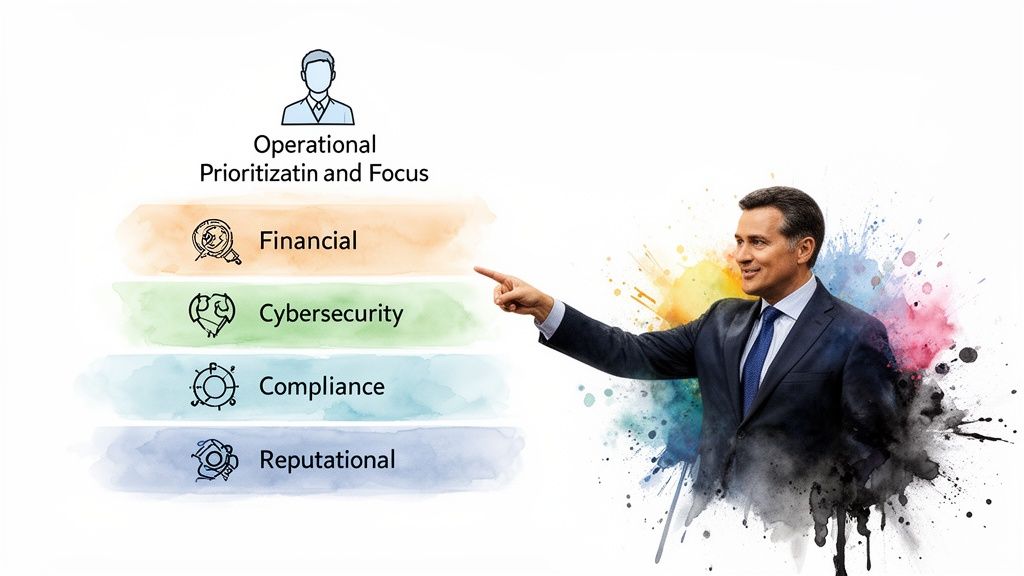
The goal is to apply the right amount of scrutiny to the right vendors. Your office supply provider does not carry the same risk as your core cloud platform. A smart framework prevents your team from drowning in checklists for low-risk vendors while ensuring you protect the business from genuine threats.
Start with a Tiered Approach
First, create a full inventory of every vendor. Then, sort them into tiers based on their criticality to your daily operations. This simple act focuses your energy where it counts.
Tier 1: Critical Vendors These are partners your business cannot function without. If they go down, you face immediate and significant disruption. Think cloud providers, core SaaS platforms, or any vendor with deep access to sensitive data. These partners demand rigorous diligence.
Tier 2: Important Vendors These partners are integral, but their failure would be disruptive, not catastrophic. Workarounds exist, or a temporary outage would be manageable. This tier often includes marketing automation tools or project management software. Diligence should be thorough but less intensive than for Tier 1.
Tier 3: Non-Critical Vendors These are low-risk, easily replaceable partners like office catering or non-essential software. A simple, lightweight review is sufficient.
This tiered system ensures your team's time and attention are spent on the relationships that pose the greatest risk. For a deeper breakdown, this guide to due diligence for vendors offers a great overview of scoping risk for third-party suppliers.
Focus on the Five Key Risk Domains
Once vendors are tiered, you can focus on the five core areas where things are most likely to go wrong. Instead of a generic questionnaire, ask sharp, business-focused questions that get to the heart of the matter. You need to understand how a partner operates and where their weaknesses could become your problems.
A mature vendor due diligence process moves beyond asking, "Are you compliant?" to asking, "Can you prove you are resilient?" The first question gets a simple yes or no. The second demands evidence.
This shift in questioning is crucial. You are not just checking boxes; you are pressure-testing a potential partnership. This structured approach also strengthens your overall security posture, a topic covered in our guide to third-party vendor risk management.
The table below breaks down these core risk domains and the essential questions leaders should ask.
Key Vendor Risk Domains and Core Questions
| Risk Domain | What It Is | Core Question for Leadership |
|---|---|---|
| Operational | The vendor’s ability to reliably deliver their service or product. | Can this vendor consistently meet our needs for quality and uptime, especially as we scale? |
| Financial | The vendor's economic stability and business health. | Is this company financially sound, or are we risking our operations on a partner that might go under? |
| Cybersecurity | The vendor’s security posture and data protection practices. | How do they protect their systems and our data, and can they prove it with evidence like a SOC 2 report? |
| Compliance | The vendor’s adherence to laws and regulations relevant to your industry. | Does this partner comply with our industry's specific regulations (e.g., GDPR, HIPAA), and what's our exposure if they don't? |
| Reputational | The vendor’s public perception and ethical standing. | Is this vendor tied to any negative press or unethical behavior that could damage our own brand by association? |
By looking at each potential partnership through these five lenses, you gain a clearer, more holistic picture of the risk you’re taking on.
This combination of a tiered model and a focus on these five risk domains creates an efficient framework for vendor due diligence. It cuts through the noise and empowers you to make clear, confident decisions that protect your business.
The Vendor Due Diligence Checklist That Matters
A framework provides a map, but a checklist gets you moving. To turn vendor due diligence into a repeatable process, you need a set of sharp, insightful questions.
Unfortunately, most generic templates create "compliance theater," a flurry of activity with zero real insight. This checklist is different. It is built around questions that force vendors to show evidence, not just give hollow assurances.
Stop asking, "Are you financially stable?" and start asking, "Can you provide your audited financial statements for the past three years?" The first question gets a "yes." The second demands proof. That shift is the heart of effective vendor due diligence.
Financial Viability
A vendor’s financial instability can quickly become your operational crisis. If they go under, you could lose your service, your data, or both. Confirm they have the financial strength to deliver on their promises.
Look for hard evidence of:
- Profitability and Cash Flow: Request financial statements. Look for consistent profitability and healthy cash flow. A company burning through cash without a clear path to profit is a red flag.
- Customer Concentration: Ask what percentage of their revenue comes from their top three customers. If a single client accounts for 50% or more of their business, the vendor is on shaky ground. Losing that one contract could put them out of business.
- Insurance Coverage: Verify they hold general liability, professional liability (errors and omissions), and cybersecurity insurance. Ask for the certificate of insurance.
Operational Capacity and Resilience
This is about their ability to do the work, day in and day out, especially under pressure. Understand their processes, dependencies, and emergency plans.
You’re not just buying a service; you are inheriting their operational weaknesses. A vendor’s lack of a business continuity plan means that when disaster strikes them, it strikes you, too.
Key questions to ask:
- Key Personnel Dependency: Who are the critical people on their technical and operational teams? What is the plan if one of them leaves? A heavy dependency on one or two individuals is a serious risk.
- Disaster Recovery and Business Continuity: Ask to see their business continuity and disaster recovery (BC/DR) plans. What are their Recovery Time Objectives (RTO) and Recovery Point Objectives (RPO)? Have they tested these plans in the last year?
- Subcontractor Dependencies (Fourth-Party Risk): Find out who their critical vendors are. Your risk extends down their entire supply chain.
Cybersecurity and Data Protection
In a world of constant vendor breaches, this area is non-negotiable. A vendor with sloppy security is a direct threat to your network and data. For a deeper dive, our AI vendor due diligence checklist provides questions tailored for technology partners.
Your questions must demand solid proof of security controls:
- Security Audits and Certifications: Can they show you a recent, clean third-party security audit, like a SOC 2 Type II report or an ISO 27001 certification? These reports verify security claims.
- Data Handling and Encryption: How will they handle your data? Is it encrypted at rest and in transit? Who has access, and how is that access controlled and logged?
- Incident Response Plan: Ask to review their incident response plan. How do they define an "incident"? Who gets notified and how? A vague or non-existent plan is a massive warning sign.
Creating a thorough checklist takes time, but the process is valuable. Specialized examples, like this detailed vendor due diligence checklist for ITAD & E-Waste Partners, can be helpful.
By using targeted questions, you stop making decisions based on hope and start making them based on verifiable facts.
Controlling the Full Vendor Lifecycle
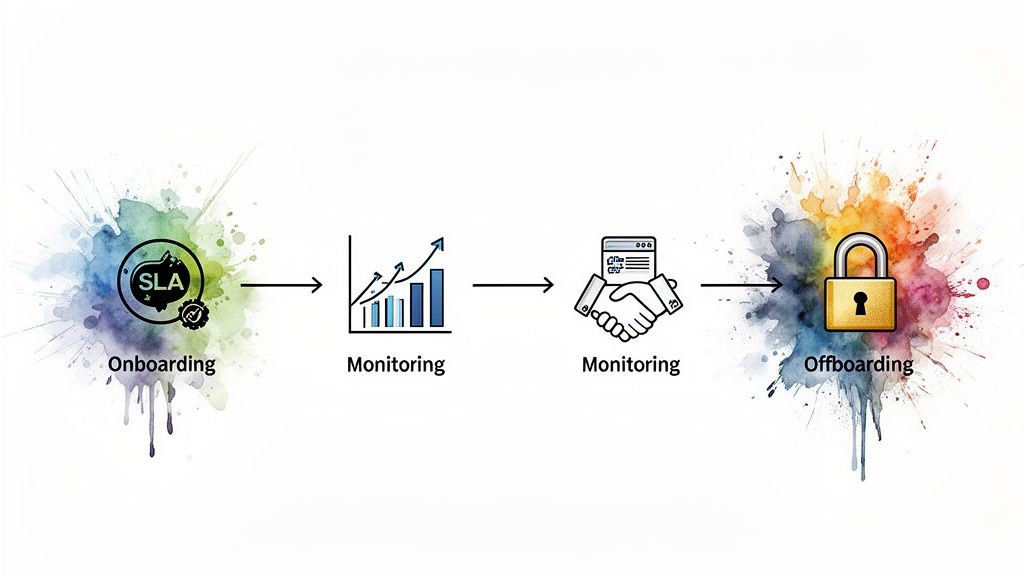
True vendors due diligence is not a one-time gate. It is a continuous discipline that protects your business from onboarding to offboarding. Treating it as a single event is like installing a smoke detector but never checking the batteries.
A vendor who was solid last year might face financial trouble or a security breach this year. Without a system to manage the entire lifecycle, you are blind to risks that appear long after the contract is signed.
Embedding controls across the entire vendor journey—onboarding, monitoring, and offboarding—is non-negotiable. It is how you maintain control and build the governance needed to prevent data leaks, service disruptions, and other surprises.
Onboarding With Intention
Effective vendor management starts with a deliberate onboarding process. This is your best chance to set clear expectations and establish the rules for the relationship.
A strong onboarding process includes:
- Executing a Strong Service Level Agreement (SLA): Your SLA must define performance metrics, uptime guarantees, support response times, and penalties for failure. This document holds a vendor accountable.
- Assigning a Clear Internal Owner: Every vendor relationship needs a designated internal owner responsible for managing the partnership, tracking performance, and acting as the main contact. Without clear ownership, accountability vanishes.
Continuous Monitoring: The Rhythmic Review
Once a vendor is onboarded, the real work of vendors due diligence begins. This means shifting from a one-time check to a continuous review process. The goal is to spot risks before they become crises.
Schedule periodic check-ins—quarterly for high-risk vendors, annually for others—to review three key areas:
- Performance: Are they consistently meeting the SLA?
- Risk Posture: Have there been any significant changes to their financial health, security posture, or key personnel?
- Strategic Alignment: Does this partnership still make sense for our business?
The vendor risk management market is projected to jump from USD 15.08 billion in 2026 to USD 26.44 billion by 2031, showing how critical this oversight is. With some reports estimating that 80% of data breaches trace back to third parties, inconsistent practices create chaos. You can learn more about the trends driving the vendor risk management market to understand growing compliance pressures.
Offboarding Securely
Offboarding is the most frequently botched phase. When a contract ends, you cannot just walk away. A sloppy process leaves backdoors open to your data and systems.
A clean offboarding is not just about ending a contract. It is a critical security process that ensures the vendor relationship is completely severed, leaving no lingering access or data behind.
A secure offboarding must be systematic. Your process should confirm all user access is revoked, company data is securely returned or destroyed, and all final invoices are settled. Our vendor offboarding checklist provides a step-by-step guide to closing these security gaps.
What Better Vendor Management Looks Like
When you get vendors due diligence right, the rhythm of the business changes. The constant feeling of lurching from one crisis to the next is replaced by quiet confidence. It is the difference between a company bogged down by surprises and one that executes with precision.
Problems will still pop up. The difference is that you see them coming and have a playbook to respond. Your tech stack starts working for you, not against you.
From Unpredictability to Confidence
The tenor of leadership meetings changes. Imagine being asked about vendor risk and having crisp, evidence-based answers. You can speak with authority about your risk posture because you have a defensible process. You are demonstrating control.
This confidence empowers your teams. With clear guardrails, they can build, create, and innovate without fear of tripping a wire and bringing down a critical system.
Success in vendor management feels like quiet competence. Decisions stick, projects finish on time, and the chronic stress of unpredictability fades into the background.
A Strategic and Managed Portfolio
Over time, your accidental collection of vendors begins to look more like a thoughtfully curated portfolio. You have a complete picture of who you partner with, why you chose them, and the specific risk they introduce. This delivers measurable benefits.
- Improved Resilience: Your business becomes less fragile. By identifying single points of failure, you can build in redundancies for critical partners.
- Enhanced Speed: With reliable partners and ironclad SLAs, projects flow better. Work gets done on schedule, without the endless finger-pointing.
- Stronger Control: You regain control over your technology roadmap and budget. Decisions become proactive, not forced by the latest vendor-induced emergency.
A robust vendors due diligence program is the bedrock of a calmer, faster, and more resilient organization. It is the system that connects asking tough questions upfront to the tangible value of predictable execution.
Frequently Asked Questions About Vendor Due Diligence
Even with a solid framework, leaders often have practical questions when putting a vendor due diligence process into action. Here are straight answers to common concerns.
How Often Should We Perform Due Diligence on Our Vendors?
Think of due diligence as a health plan. For any new vendor, a deep dive is mandatory before signing a contract. After that, the frequency of check-ups should match the vendor's risk level.
- High-Risk and Strategic Vendors: These partners demand a full, comprehensive diligence review annually. Their access to sensitive data or their core role in your operations requires it.
- Lower-Risk Vendors: For vendors in smaller roles, a review every 18 to 24 months is generally safe.
This is separate from day-to-day monitoring. You should always track performance against SLAs and watch for public red flags for all vendors.
What Is the Biggest Mistake Companies Make with Vendor Diligence?
The single biggest mistake is treating vendor due diligence like a check-the-box chore for a junior administrator. This misses the strategic value of the exercise and reduces a critical risk management function to paperwork.
When leadership delegates the task but not the strategy, they sacrifice the very insights that are meant to protect the business. The goal isn't just to be compliant; it’s to gain clarity and control.
Effective due diligence is a leadership function. It requires seasoned judgment to weigh complex risks and make smart trade-offs aligned with the company's goals.
We’re a Small Company. Can We Afford to Do This?
Let's reframe that. Can you afford not to? The cost of one catastrophic vendor failure—a data breach, a service outage, a massive fine—will always be more than the cost of doing your homework.
The 2013 Target data breach started with credentials stolen from an HVAC vendor. It is a painful lesson in how a seemingly minor partner can cause astronomical damage.
The secret is a scaled approach, not boiling the ocean.
- Focus your most rigorous diligence on your small handful of critical, high-risk vendors.
- Use a much lighter, streamlined process for everyone else.
This approach channels your resources where they matter most, making the process both affordable and effective.
Where Do We Start if Our Vendor List Is a Mess?
If your vendor list is an untamed wilderness, do not try to tackle it all at once. First, get organized and figure out who you are working with.
- Create a Master List: Work with finance, IT, and department heads to build a single inventory of every third-party you pay.
- Group by Function: Sort them into logical categories based on what they do (e.g., marketing, operations, finance, IT).
- Identify the Critical Few: Go down the list and ask one question: "If this vendor vanished tomorrow, how badly would it hurt?" This will quickly surface your most essential partners.
Start your first formal vendor due diligence cycle with just this small group of high-risk vendors. It is the most direct path to reducing your biggest risks and will build the momentum needed to bring the rest of your vendor ecosystem into order.
If you're tired of paying the coordination tax and want to move from vendor chaos to predictable execution, CTO Input can help. We provide the executive-grade leadership to install a calm operating rhythm and make your technology a reliable engine for growth.
A Clarity Call can help you see what is happening and what to do next. Book a call at https://www.ctoinput.com.