
If you have ever felt the air go still in the boardroom after a simple question like, "How secure are our most critical vendors?" you know the feeling. That moment of hesitation is more than just an awkward silence. It’s a signal that your approach to third-party risk is breaking.
This is not an IT problem. It is a failure of business governance that can hit your bottom line, slow growth, and erode the board's confidence in leadership. When the answers about vendor risk feel weak, it is usually because the underlying process is weak.
Your Board Is Asking Tougher Questions About Vendor Risk

I have seen it happen time and again. A member of the risk committee leans forward and asks a pointed question about a key software partner. The management team shuffles papers, and the answer that eventually comes out is vague, full of jargon, and missing the one thing the board actually needs: assurance.
This is not a theoretical exercise. The constant drumbeat of news about vendor-related breaches means directors now connect the dots between a supplier's security failure and a direct hit to the company's own balance sheet. They expect crisp, evidence-backed answers.
The Shift From IT Task to Board-Level Concern
For a long time, vendor security was a checkbox on a procurement form or a task handed off to the IT department. Not anymore. It is now a fixture on the agenda for directors and the C-suite.
What changed? The fallout from third-party failures has simply gotten too big to ignore. A security event at one of your suppliers can cascade into operational shutdowns, massive regulatory fines, and a brand reputation crisis that takes years to repair.
The data paints a stark picture. Breaches originating with third parties have exploded, becoming a dominant threat that boards cannot afford to overlook. In a recent analysis, third-party vendors were implicated in 30% of all breaches, a figure that doubled from the previous year. For those in financial services, the exposure is even more pronounced, with some 73% of cyber incidents tracing back to a vendor. These are not just statistics. They are material risks that demand board-level attention.
The board is not just asking for a status update. They are stress-testing the resilience of the entire business.
What the Board Is Really Asking
When a director asks about vendor risk, they are actually asking a bundle of much deeper questions all at once. What they truly want to know is:
- Do we know who we depend on? Can you produce a risk-prioritized list of the partners whose failure would bring our business to its knees?
- Is our process defensible? Are you following a consistent, repeatable system for vetting and monitoring these partners?
- Where is the proof? Can you show us tangible evidence of due diligence, ongoing monitoring, and risk mitigation?
Answering these questions well means graduating from reactive, technical jargon to strategic, business-focused dialogue. Our guide on setting a board risk committee cyber reporting cadence offers a framework for this.
Ultimately, your goal is to build a system that produces calm, consistent, and defensible answers. This is how you transform board meetings from tense interrogations into productive, strategic conversations about building a more resilient business.
Why Current Vendor Reporting Often Fails

When third-party risk reporting to the board falls flat, it is almost never for a lack of trying. The real culprit is not the effort. It is the outdated toolkit.
Many organizations still run their vendor risk programs on static, point-in-time assessments like annual security questionnaires. This data, painstakingly collected in sprawling spreadsheets, is already obsolete the moment it’s typed in. A vendor’s security posture can shift dramatically overnight, but the report on your desk still shows them with a passing grade from last quarter.
This approach creates a dangerous false sense of security. It hands leaders a snapshot that might have been accurate months ago but offers zero insight into the real-time threats your organization faces today.
The Breakdown of "Spreadsheet Risk Management"
A spreadsheet-driven vendor management program is a manual, error-prone system that simply cannot keep up. As your vendor list grows, those spreadsheets become impossible to manage, version control goes out the window, and critical risks inevitably fall through the cracks.
When your reporting feels weak, it is usually a symptom of a broken third-party risk management process that needs immediate attention. This is not just an administrative headache. It has real, tangible consequences for the business.
- It Hides the Real Risk: A "green" status from a six-month-old assessment is meaningless when a new, critical vulnerability was discovered last week. Spreadsheets cannot track the dynamic nature of cyber threats.
- It Grinds Business to a Halt: A slow, manual vetting process for a new vendor can stall momentum and even kill a project. Business wants to move at lightning speed, but risk management is stuck in the slow lane.
- It Fails Under Pressure: Trying to explain a "system" of spreadsheets and email threads during an audit or regulatory exam will not hold up as a defensible system of record.
This static reporting model is completely out of sync with what boards now expect. Directors are under immense pressure and need to see current, reliable data, not ancient history.
Despite this, a huge reporting gap remains. Research shows that while 73% of organizations feel pressure to get their TPRM programs in order, only 40% are actually delivering regular reports. For those that do, more than half (53%) are still relying on spot checks instead of continuous monitoring. This leaves the board in the dark between reporting cycles.
A vendor's risk profile is a moving target. Reporting on it with a static document is like trying to navigate a highway by looking at a map printed last year.
The Real Cost of Stale Data
At its core, the problem is simple: failed reporting presents old news as current information. This stale data, a classic lagging indicator, leads directly to poor decisions at the highest level of the company.
The board might greenlight a major strategic initiative based on a false sense of security, unknowingly exposing the business to significant financial, operational, or reputational harm.
Truly effective third-party risk reporting to the board is not about building a bigger spreadsheet. It is about a fundamental shift from a periodic, compliance-driven chore to a continuous, risk-focused discipline. This requires a system that delivers a live view of your entire vendor ecosystem, giving your leadership the clarity they need to govern effectively.
How to Build a Board-Ready Reporting Framework
If your vendor risk reporting feels like a chaotic fire drill every quarter, you are not alone. Moving from reactive updates to strategic, board-level conversations is entirely possible. It just requires a deliberate framework.
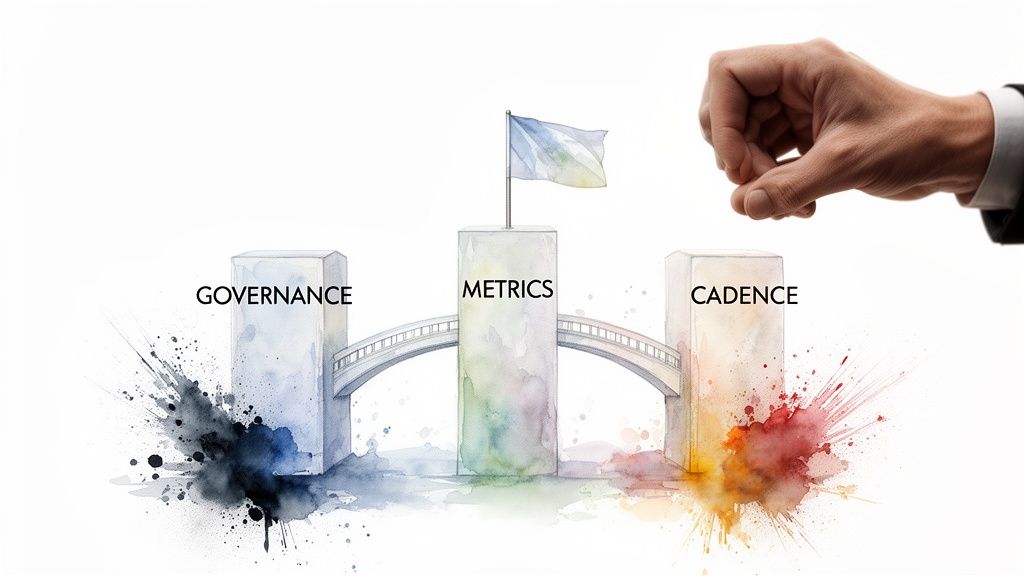
An effective system for third-party risk reporting to the board stands on three pillars: solid governance, metrics that speak the board's language, and a predictable reporting cadence. Get these right, and you will replace last-minute scrambles with a system that produces consistent, defensible insights and builds confidence with leadership.
Pillar 1: Establish Clear Governance
If your most critical cloud provider has a major security breach, who in your organization is on the hook to manage the fallout? If you cannot name that person in under five seconds, your governance structure is broken.
The first step is assigning undeniable ownership. Every critical vendor relationship needs a designated internal business owner, someone accountable for the relationship’s value and its risks. This is not just an IT or security task. It is a core business function.
With ownership defined, the next piece is creating clear escalation paths. You need to answer a few key questions ahead of time:
- What specific event triggers an alert?
- Who gets notified and in what order?
- Which decisions can be made at the operational level, and what requires a sign-off from the risk committee or the CEO?
Documenting these rules of engagement removes the guesswork. It ensures that when a major risk appears, it is elevated predictably, not just based on who happened to see the email first.
A strong reporting framework starts with accountability. If nobody owns vendor risk, then everybody owns it, which means it will be managed through heroics and luck. That is not a strategy the board can rely on.
Pillar 2: Focus on Business-Centric Metrics
Board members do not care about the number of vulnerabilities you found in a vendor's environment. They care about enterprise risk, financial impact, operational downtime, and regulatory fines.
Your job is to translate technical findings into tangible business consequences. Instead of reporting that a vendor has 15 high-severity vulnerabilities, explain that the vendor processes 100% of your customer payments and a breach could halt revenue and trigger GDPR penalties.
Key Metrics for Board-Level Third-Party Risk Reporting
| Metric Category | What to Measure | Why It Matters to the Board |
|---|---|---|
| Concentration Risk | Percentage of critical business functions dependent on a single vendor. | Highlights over-reliance and single points of failure that could cripple operations. |
| Risk Posture & Trends | The number and percentage of vendors rated "high-risk" over time. | Shows whether the overall risk profile is improving or degrading. It’s about momentum. |
| Remediation Velocity | The average time it takes to close high-priority risks with critical vendors. | Measures the effectiveness and responsiveness of the risk management program. |
| Risk by Business Unit | A breakdown of third-party risk exposure by department or product line. | Pinpoints where risk is concentrated within the business, helping to allocate resources. |
| Fourth-Party Exposure | The number of critical vendors that rely on their own high-risk "fourth-party" suppliers. | Reveals hidden dependencies and supply chain risks that are one step removed but still impactful. |
This kind of reporting changes the conversation from a technical audit to a strategic discussion about business resilience. For a deeper dive, our board-ready cybersecurity reporting template has more concrete examples.
Of course, great reporting relies on a solid foundation. You first need to build a robust 3rd party risk management program to generate these insights.
Pillar 3: Set a Predictable Cadence and Format
Consistency is your best friend. The board should never be surprised by your reports. They should know when to expect updates and what the format will look like. This predictability builds trust and makes the information easier to digest.
A two-tiered cadence works best for most organizations:
- Quarterly Board Summary: This is your high-level, strategic overview for the entire board. It should be concise and visual, focusing on major risk themes, trends, and the overall health of your vendor ecosystem.
- Monthly Committee Deep Dive: This is a more granular update for a dedicated committee, like Audit or Risk. Here, you can get into the details on specific high-risk vendors, review remediation plans, and discuss emerging threats.
By tailoring the format and depth to the audience, you give each group exactly what it needs to fulfill its duties without drowning anyone in unnecessary detail.
What Actually Goes Into Your Board Report?
When you present third-party risk to the board, you are telling a story. Your job is to give them a strategic view of your vendor ecosystem, not drown them in technical details. They need to understand where the real risks are and what you are doing about them.
The best reports are lean, visual, and always tied back to the business. They skip the jargon and translate complex risk data into a clear narrative about control and resilience. This is what effective third-party risk reporting to the board looks like in the real world.
A Risk-Ranked Inventory of Critical Vendors
First, the board needs to know who matters most. You have to show them, at a glance, which vendors are essential to keeping the lights on. This is not a laundry list of all 500 vendors you use. It is a tight, curated look at the top 15-25 partners whose failure would cause significant disruption.
For each of these critical vendors, a simple scorecard works wonders. It is a visual snapshot that summarizes their risk profile in a way anyone can immediately grasp.
Example Vendor Scorecard: "PayPro Inc."
- Service Provided: Customer Payment Processing
- Business Impact: Critical (Processes 100% of revenue)
- Overall Risk: High (Red)
- Key Risk Driver: Their security posture has recently degraded; we have identified known vulnerabilities in their platform.
- Remediation Status: In progress. We have weekly check-ins with their team and a mitigation plan is in place with a 60-day resolution target.
This format instantly tells the board what the vendor does, why they are critical, what the specific problem is, and what is being done to fix it. No ambiguity.
The Consolidated Risk Heatmap
After highlighting the key individual players, you need to show the entire landscape. The most powerful tool for this is a consolidated risk heatmap. It gives you a one-page summary of your risk exposure across the entire vendor ecosystem, plotted on two simple axes: Business Impact and Risk Likelihood.
This visual allows directors to spot outliers and risk clusters in seconds. Is one business unit leaning too heavily on a handful of insecure partners? A heatmap makes these patterns jump off the page. It naturally focuses the conversation on the red and orange squares, exactly where board-level attention belongs.
Board members are not there to audit individual vendors. They are there to govern enterprise risk. A heatmap elevates the conversation from, "Is this one vendor secure?" to "Is our overall reliance on third parties being managed effectively?"
This kind of reporting is fast becoming table stakes. Regulators are raising the bar, demanding continuous visibility and standardized metrics. The days of annual spot-checks are over.
Trend Analysis of Key Risk Indicators
A snapshot in time is useful, but the trend line tells the true story. Is your overall risk posture improving or getting worse? Your report must include a few simple charts showing trends over the last few quarters for a handful of vital indicators.
I recommend tracking at least these three metrics:
- Percentage of Critical Vendors by Risk Tier: Use a stacked bar chart to show the proportion of critical vendors rated as High, Medium, and Low risk. The goal is to show the red bar shrinking over time.
- Remediation Velocity: Track the average number of days it takes your team to close a high-priority risk finding with a vendor. A downward trend proves your program is gaining traction.
- Emerging Threats Summary: Briefly list 2-3 new third-party threats relevant to your industry and state your readiness.
Presenting these trends proves you are running a dynamic program, not just going through a static checklist. It shows you are actively managing risk, not just reporting on it. You can learn more about the broader strategy in our guide to third-party vendor risk management. This is how you transform the report from a status update into evidence of a healthy governance system.
What Success Looks Like: Calm Control Over Vendor Risk

When you get your third-party risk reporting to the board right, you change the conversation in the boardroom. The goal is not to pretend you have eliminated all risk. The real win is replacing anxious, reactive questioning with calm, productive strategy sessions built on data everyone trusts.
Success is having defensible control. It is the confidence you feel when you can answer any question about vendor exposure, not because you are scrambling for an answer, but because you have a system that provides it on demand.
From Fire Drill to Routine Exercise
Think about the all-too-common fire drill: a surprise audit request or a sudden due diligence demand that consumes entire teams for weeks. Mature vendor risk governance makes that a thing of the past. When you have a clear, continuous view of your vendor ecosystem, surprises become the exception, not the rule.
This is what changes on the ground:
- Faster, Safer Onboarding: Your business teams can bring on new vendors without hitting a wall of bureaucracy. The assessment process becomes so standardized that it stops being a source of friction and starts enabling growth.
- Proactive Risk Mitigation: Instead of reading about a vendor's security breach on the news, your system flags their degrading performance in near-real-time. This gives you lead time to demand a fix or activate your backup plan before there is a real problem.
- Simplified Audits and Diligence: An auditor asks for proof of your vendor oversight. Instead of a frantic scramble, you simply export the data from a mature, inspectable program.
This is the shift from a culture of hope to one of genuine control. It is proof that your risk management program is a vital, active part of your daily operations.
The ultimate outcome of strong vendor risk reporting is not just a better slide deck. It is the operational resilience that allows the business to innovate and seize opportunities without taking on unmanaged risk.
A New Level of Board Confidence
When your reporting achieves this level of clarity and predictability, the entire dynamic with the board transforms. They stop interrogating the data and start debating the strategic choices it presents.
This clarity delivers a real, bottom-line impact. The board now has a defensible basis for their oversight duties, which is critical in today's environment of heightened regulatory scrutiny. This confidence empowers them to greenlight more ambitious initiatives because they trust that the underlying risks are being actively managed.
Ultimately, this calm control is the real prize. It is the ability to move faster, operate with more resilience, and build a business that is built to last.
Getting Your Board Reporting Right: A Practical Framework
Even with a perfect playbook, building out your third-party risk reporting for the board is where the real challenges appear. It is easy to get stuck on the practical details of translating complex, technical risk into a conversation that resonates in the boardroom.
Here is a simple framework for answering the most common questions.
1. Identify Your "Crown Jewel" Vendors First
Faced with a sprawling, undocumented list of vendors, do not try to assess every single one. That approach is a guaranteed recipe for analysis paralysis.
Instead, start by finding your "crown jewels." Ask your executive team a simple question: "Which partner's failure would halt our operations, force us to report a data breach, or cause an immediate, catastrophic financial loss?"
That question will instantly shrink your focus to a manageable list of 10-20 critical relationships. Pour your energy into this group first. Build a repeatable assessment and reporting process for them. Once that system is humming, you can methodically expand it. The goal is progress, not perfection.
2. Translate Technical Details into Business Impact
There is a critical distinction between IT vendor management and board-level risk reporting.
- IT Vendor Management is tactical. It answers the question, "Is the vendor delivering the service we are paying for?"
- Board-Level Risk Reporting is strategic. It answers a more important question: "How does our dependence on this partner impact our company's value, resilience, and regulatory standing?"
Your job is to bridge that gap. Always convert technical findings into business context.
Do not say this:
"Vendor X failed their recent scan and has 15 critical vulnerabilities, including CVE-2023-4567."
Instead, say this:
"Our primary payment processor, which handles 100% of our online revenue, currently presents a high-risk security posture. This creates a direct threat of a data breach that could halt operations. We have invoked the risk mitigation clause in their contract, and their CISO has committed to a 30-day remediation plan."
IT vendor management asks, "Is it working?" Board-level reporting asks, "What happens to us if it breaks?" They are not the same question.
3. Separate Your Monitoring Cadence from Your Reporting Cadence
A quarterly update for the full board is a great rhythm. It keeps the conversation focused on strategic trends.
However, do not confuse your reporting cadence with your monitoring cadence. Your visibility into vendor risk cannot be a once-a-quarter activity. For your most critical vendors, monitoring has to be a constant, near-real-time process.
Think about it in three distinct layers:
- Continuous Monitoring (Daily/Weekly): Your operational teams keep a constant watch on high-risk vendors and handle remediation as issues arise.
- Committee Updates (Monthly): A dedicated Risk or Audit Committee gets a more detailed, tactical update on specific problems and progress.
- Full Board Report (Quarterly): The board receives a concise, strategic summary of key trends and critical issues that demand their attention.
This layered approach ensures management is handling the day-to-day while the board can provide effective governance without getting lost in the weeds.
If the gap between what your board expects and what your team can deliver on vendor risk is getting wider, it is a problem that only gets more expensive and dangerous over time. CTO Input provides executive-grade technology leadership to install a calm, board-defensible system for managing risk. We help you move fast without taking on unmanaged threats.
If you are ready to restore control, book a Clarity Call. We can help you map out your next steps.