

SEO Title: Your IT Cost Optimization Plan That Works
Meta Description: A practical IT cost optimization plan for CEOs and COOs who want clear ownership, better visibility, and sustainable savings instead of one-off budget cuts.
Slug: /it-cost-optimization-plan
Your IT budget feels wrong when nobody can explain it in plain English.
The spend keeps rising. The vendor list keeps growing. Cloud invoices arrive with just enough detail to confuse everyone. The board asks whether technology is creating advantage or just overhead, and the room gets vague.
That is usually not a tooling problem first. It is an ownership problem.
A real IT cost optimization plan is not a round of arbitrary cuts. It is a management system. It makes technology spend legible, assigns decision rights, and creates a repeatable rhythm so costs stop surprising leadership. When that system is missing, every budget review turns into archaeology.
When Technology Spend Feels More Like a Tax Than an Investment
A familiar scene plays out in a lot of companies.
The CEO looks at a budget line that has expanded across software, cloud, contractors, managed services, security tools, and “miscellaneous platforms.” The COO asks which of these systems are critical. Finance asks who approved a renewal. IT says several tools are embedded in workflows. Nobody can clearly say which spend drives growth, which spend protects the business, and which spend is just leftover complexity from past decisions.
That is when technology starts to feel like a tax.
Not because every tool is bad. Not because your team is careless. It happens because the business outgrew an informal operating model. Decisions got made in pockets. Vendors got added faster than they were reviewed. Systems stayed in place because replacing them felt risky. Then leadership inherited a cost base that nobody fully owns.
Why the usual cost cuts fail
The standard response is blunt. Freeze purchases. Cut projects. Ask every department to trim spend.
That approach creates motion, not control.
Only 11% of organizations sustain cost savings for three consecutive years, according to Gartner as cited in Info-Tech research, largely because they make short-term cuts without fixing the governance problems that caused the overspend in the first place (source). That number should get every CEO’s attention. Most cost programs fail because they attack symptoms and leave the operating mess intact.
If your savings disappear after one budget cycle, you did not optimize cost. You delayed it.
What leadership is missing
Most leaders do not need a more technical dashboard. They need a clearer answer to three basic questions:
- What are we paying for
- Who owns each decision
- What business outcome does this spend support
That is the difference between chaos and control.
If you work in a regulated or board-watched environment, this is why the idea of predictable IT costs matters so much. Predictability is not just nice for budgeting. It is evidence that the business is governed.
If your current reporting feels expensive and unconvincing, this earlier piece on why tech spend feels high and ROI feels low will sound familiar: https://blog.ctoinput.com/why-your-tech-spend-feels-high-and-your-technology-roi-return-on-investment-for-ceos-feels-low/
Make the Invisible Visible by Mapping Your True IT Environment
The first job is not cost cutting. It is making reality visible.
Most companies think they have an IT inventory because they have a software list from procurement, a spreadsheet from finance, and some cloud billing reports. That is not a map. That is a pile of partial evidence.
A usable map shows three things together:
- Systems you rely on
- Vendors you pay
- Owners who are accountable for value, risk, and cost
Without the third one, the first two are not enough.

Start with business services, not tools
Do not begin by asking IT for a master list of applications.
Start with business functions. Revenue operations. Finance. Customer service. Operations. Security. Compliance. Product delivery. Then ask which systems each function depends on to do its work. That reverses the usual problem. You stop cataloging software in a vacuum and start understanding which spend supports which business capability.
A simple map should capture:
| Layer | What to record | Why it matters |
|---|---|---|
| Business service | The function or workflow the system supports | Ties spend to outcomes |
| System | The application, platform, infrastructure, or outsourced service | Shows what exists |
| Vendor | The company being paid | Reveals overlap and contract exposure |
| Owner | The executive or manager accountable for use and value | Prevents orphaned decisions |
| Technical steward | The person or team maintaining it | Clarifies operating responsibility |
| Renewal and commitment | Contract timing and commercial model | Prevents surprise renewals |
| Risk notes | Data sensitivity, access concerns, operational dependency | Connects cost to control |
Fuzzy ownership is where waste hides
This is the part most cost optimization content misses.
Existing cost optimization content focuses heavily on technical levers but often misses the root cause of waste: fuzzy ownership. That gap leads to rework, delays, and heroics. Restoring a legible reality by mapping ownership first can lead to 20-30% sustained savings by reducing coordination tax and fire drills, as summarized in the source material tied to Info-Tech’s levers (Moveworks).
That rings true in practice.
When nobody owns a platform, five bad things happen at once:
- Renewals drift through by default
- Licenses pile up because nobody audits usage
- Teams buy overlap because they cannot get decisions
- Incidents take longer because responsibility is unclear
- Projects stall while people argue about who can approve changes
None of that shows up neatly on a technical architecture diagram. All of it shows up in your cost base.
The fastest way to reduce waste is often to name an owner before you touch a tool.
How to build the map without turning it into a six-month project
Keep it ugly and useful.
You do not need a big transformation office to start. A spreadsheet is fine. A shared workspace is fine. The point is not elegance. The point is one source of truth that leaders can review.
Use this sequence:
- Pull finance records first. Start with every recurring technology payment, including software, cloud, contractors, telecom, managed services, and security tools.
- Match each payment to a business function. If nobody can place it, flag it immediately.
- Name one accountable owner. Not a committee. One person.
- Record the technical steward separately. Accountability and administration are not the same thing.
- Mark contracts with upcoming renewals or usage uncertainty. Those often become the first savings opportunities.
- Note critical dependencies. If removing a system would break payroll, customer support, or compliance reporting, write that down.
A proper stack review helps here. If you need a practical starting point, this guide on how to audit your tech stack is useful: https://blog.ctoinput.com/how-to-audit-your-tech-stack/
What a good map gives leadership
Once the map exists, budget conversations get better fast.
You can see where vendor sprawl is creeping in. You can spot systems that serve the same workflow. You can identify spend with no accountable owner. You can challenge renewals based on business value instead of habit. This means you stop managing technology through folklore.
That is the primary first milestone in any IT cost optimization plan. Not a savings target. A shared version of reality.
Identify High-Impact Levers for Cost and Risk Reduction
Once you can see the environment, the next question gets easier.
Where is the waste that matters enough to fix now?
Do not chase every line item. Go after the categories that affect margin, execution speed, and risk. In most organizations, the biggest gains come from a small set of repeat offenders.
Cloud overspend is usually a management failure
Cloud is now one of the biggest drivers of technology spend. Gartner projects worldwide IT spending will reach $6.15 trillion in 2026, a 10.8% increase from 2025, driven largely by AI infrastructure and cloud services, according to CloudZero’s analysis of the trend (CloudZero). The same source notes that enterprises often waste 21–50% of cloud budgets due to poor management, and that commitment-based pricing such as AWS Reserved Instances or Savings Plans can deliver 30–60% savings for predictable workloads if they are managed dynamically.
The CEO takeaway is simple. Cloud is not expensive because cloud exists. Cloud gets expensive when nobody owns usage discipline.
A few examples:
- Production workloads run larger than they need to.
- Test environments stay on when nobody uses them.
- Teams launch services faster than they retire them.
- Reserved capacity gets bought without a living plan to match actual usage.
This is why FinOps matters. Not as jargon. As operating discipline.
SaaS sprawl creates double cost and weak control
Software duplication rarely looks dramatic one purchase at a time.
One team buys project management software because another system feels slow. Marketing adds a reporting tool because the BI team cannot prioritize their request. HR adopts a niche workflow app to avoid waiting on IT. Each decision sounds reasonable in isolation.
Together, they create a mess:
| Pattern | Business consequence |
|---|---|
| Duplicate tools | You pay twice for the same outcome |
| Low license utilization | You fund shelfware |
| Fragmented data | Reporting gets slower and less reliable |
| Too many vendors | Security review and legal review become heavier |
| Department-level buying | Enterprise advantage diminishes |
Here, application rationalization earns its keep. If you want a practical framework, this article on application portfolio rationalization is a solid companion: https://blog.ctoinput.com/application-portfolio-rationalization/
Procurement is not admin work
A lot of leaders underestimate how much value sits in procurement discipline.
The right way to buy technology is not “get three quotes and pick one.” It is understanding usage, contract timing, overlap, decision rights, and influence across the whole vendor base. That is why better procurement mechanics matter. If your finance or operations team needs a plain-English overview, this piece on mastering purchasing and procurement is worth reviewing.
Renegotiation works best when you know:
- What the business uses
- Which teams depend on the product
- Whether another paid tool already covers the same need
- How much risk a switch would create
- When you have real influence in the contract cycle
Without that groundwork, most vendor negotiations are theater.
Never renegotiate from a position of internal confusion. Vendors can smell that immediately.
Shadow IT is both cost waste and board risk
Unauthorized tools are not just a nuisance. They are unmanaged spend, unmanaged data flow, and unmanaged accountability.
When teams buy tools on cards, use unsanctioned AI services, or move data into side systems, the company loses three things at once: visibility, influence, and control. That is why shadow IT should sit inside your IT cost optimization plan, not off to the side as a separate compliance annoyance.
The right response is not pure elimination. Some shadow tools exist because the official path is too slow. In those cases, leadership should decide whether to shut them down, replace them, or formalize them properly.
Workforce and service model waste is real too
Not all waste lives in tools.
Some lives in the way people spend time. Expensive staff doing low-value manual admin. Highly capable leaders pulled into vendor wrangling because nobody owns contracts. Internal teams carrying support for legacy systems that should have been retired years ago.
If your best people are acting as glue between broken ownership boundaries, you are paying for dysfunction twice. Once in labor. Again in delay.
A good IT cost optimization plan focuses on the levers that improve both cost and operating control. Those are the ones worth board attention.
Build Your Execution Roadmap to Prioritize Action
Most companies do not fail because they cannot find waste.
They fail because they find too much of it at once.
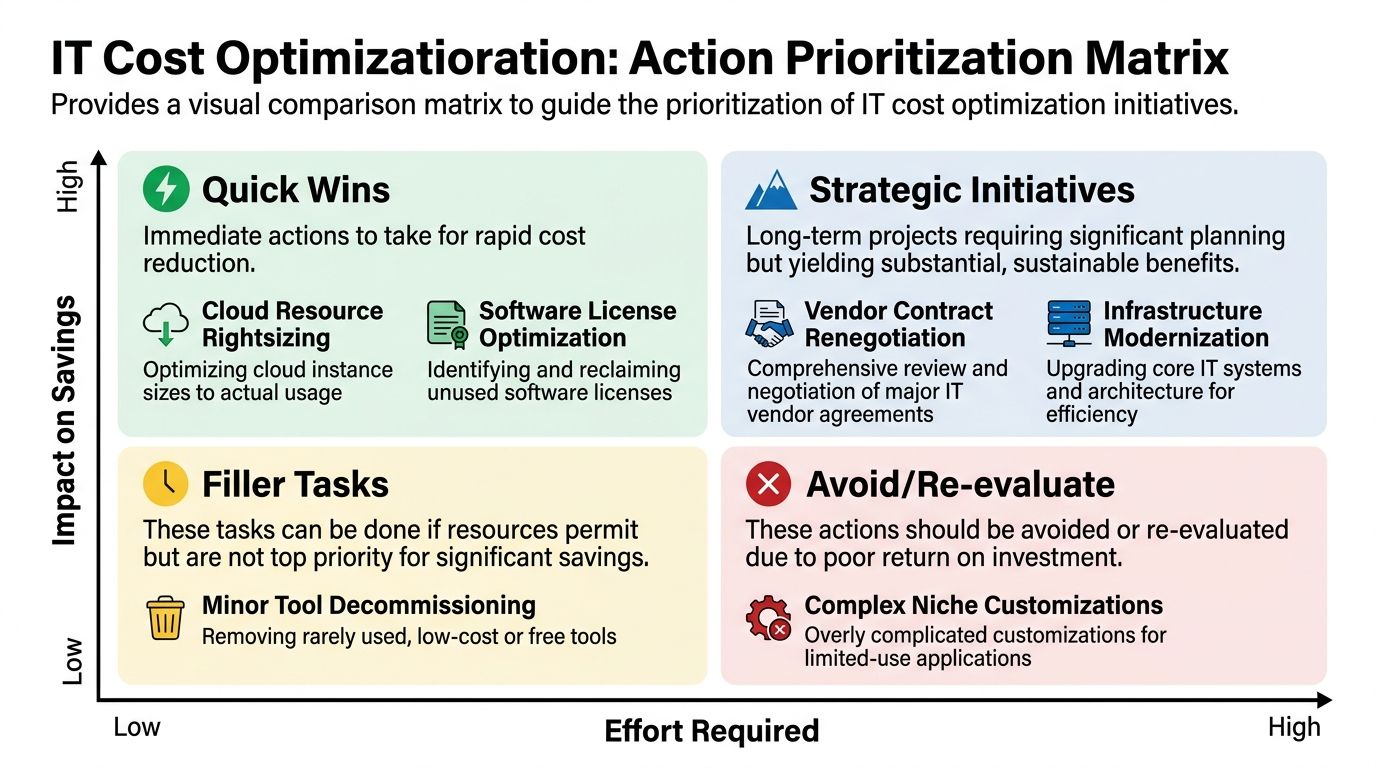
The answer is not a giant transformation deck. It is a prioritization method that forces trade-offs. I prefer a simple impact and effort matrix because executives can understand it quickly, defend it to the board, and use it to sequence action without endless debate.
Use four buckets and be ruthless
Every identified initiative should land in one of four buckets:
| Category | What belongs there | What to do |
|---|---|---|
| Quick wins | High impact, low effort | Start immediately |
| Strategic initiatives | High impact, high effort | Plan, fund, and govern tightly |
| Filler tasks | Low impact, low effort | Do only if they support bigger moves |
| Avoid or re-evaluate | Low impact, high effort | Kill or defer |
That sounds basic. It works because it stops leadership from treating every issue as equally urgent.
What usually counts as a quick win
Quick wins are not glamorous. That is why they are valuable.
These often include canceling unused licenses, shutting down idle environments, consolidating duplicate low-risk tools, fixing access levels, or cleaning up old vendor agreements that nobody needs anymore. They build momentum because they show the business that optimization can produce relief without disrupting operations.
For organizations under scrutiny, shadow IT discovery is a strong quick win. DigitalOcean’s summary notes that for organizations heading into diligence or board review, auditing expenses, monitoring networks, and then formalizing high-value shadow tools can reduce risk by 15-25% while cutting redundancies (DigitalOcean). That matters because it turns a messy problem into an inspectable one.
What deserves strategic treatment
Some savings opportunities are too important to rush.
Think of core vendor renegotiation across major platforms. Data center consolidation. Reworking cloud commitment strategy. Replacing a brittle legacy system that causes manual work across departments. Tightening security architecture so you can retire overlapping tools safely.
These moves affect operations, contracts, and often customer experience. Handle them like business initiatives, not side quests for IT.
Use a decision lens like this:
- Financial upside. Is the savings material enough to matter?
- Risk reduction. Does it improve resilience, security, or auditability?
- Execution drag. Does it remove friction that slows teams down?
- Dependency load. Will it simplify the environment or create more coordination?
- Time to value. How quickly will leadership see relief?
A roadmap with no quick wins loses credibility. A roadmap with only quick wins changes nothing structural. You need both.
Sequence matters more than enthusiasm
Many cost programs go wrong here. Leaders authorize ten initiatives at once. The team spreads thin. Owners are unclear. Savings get projected, not realized.
A better pattern is:
- Pick a small number of quick wins
- Select a few structural initiatives with clear owners
- Tie each initiative to business value
- Set review points before the work starts
If you cannot say who owns the outcome, how success will be judged, and what could block delivery, the initiative is not ready.
Keep one visible roadmap, not five private lists
A real execution roadmap should fit on one page.
That page should show the initiative, owner, expected outcome, dependencies, decision date, and current status. It should be readable by the CEO, CFO, and operations leadership. If your roadmap only makes sense to infrastructure specialists, it is not doing its job.
This is also the point where outside leadership support can be useful. Some organizations use internal finance and IT leaders for this. Others bring in fractional leadership to map owners, run prioritization, and hold the operating rhythm. CTO Input does that kind of executive-level work across technology and security when a business needs clarity without hiring a full-time executive too early.
A roadmap should reduce debate, not generate new categories of confusion.
Install a Governance Rhythm to Make Savings Stick
A cost program becomes real when it shows up on the calendar.
Without a governance rhythm, every optimization effort drifts back to old habits. Renewals auto-approve. Exceptions pile up. Teams start buying around the process. The budget grows again, but nobody can explain why.
That is why the last step in an IT cost optimization plan is not another analysis pass. It is an operating rhythm.

Tie cost governance to risk governance
This is essential now.
The average cost of a data breach has climbed to $4.88 million, according to IBM’s 2024 Cost of a Data Breach Report summarized in IBM’s IT cost optimization framework article, which also highlights KPMG’s three-step approach of gaining transparency, prioritizing initiatives, and establishing Lean IT governance (IBM).
That matters because uncontrolled spend and uncontrolled risk often come from the same source: poor visibility and weak ownership.
A company that cannot explain why it pays for certain tools usually cannot explain who is accountable for the data inside them either.
Build a simple executive rhythm
You do not need a giant committee structure. You need a few recurring motions that people respect.
A workable rhythm usually includes:
| Cadence | Participants | Purpose |
|---|---|---|
| Weekly | IT lead, finance partner, key owners | Resolve blockers, review exceptions, assign actions |
| Monthly | CEO or COO, finance, technology leadership | Review spend, value, risk, and roadmap movement |
| Quarterly | Executive team or board committee | Confirm strategic direction, major contracts, and control posture |
The weekly meeting is operational. Short. Decisive. It exists to stop drift.
The monthly meeting is where leadership asks harder questions. What changed. Which costs moved. Which initiatives delivered. Which risks remain unresolved.
The quarterly review is for governance. It should show that decisions are being made on purpose, not by default.
Track a small set of KPIs that executives can understand
Many teams sabotage this by tracking too much.
Pick a handful of measures that connect spend to business outcomes and operating control. Depending on the business, that may include cloud spend relative to revenue, license utilization, average cost per active IT seat, maverick spend, or IT as a share of operating expenses. Keep the list short enough that an executive can see movement quickly.
The point is not metric theater. The point is decision support.
Use each KPI to trigger a management question:
- Cloud spend moved. Was that planned growth, poor discipline, or both?
- License utilization dropped. Why are we renewing unused software?
- Maverick spend appeared. Which team bypassed process, and why?
- Security tool overlap surfaced. Can we consolidate without weakening protection?
If a KPI does not trigger a decision, it is clutter.
Make reporting board-defensible
Boards do not need every invoice. They need confidence that the company is governed.
A board-ready view of IT cost optimization should answer:
- Where the major spend categories are
- Who owns them
- What actions are underway
- What risks are being reduced
- What decisions need executive or board approval
Many companies still overcomplicate things here. They produce dense technical reports, but they do not produce evidence of control.
Good governance reports are plain. They show ownership, movement, exceptions, and decisions.
Use policy to support behavior, not replace it
Rules alone do not fix cost chaos.
You can publish procurement rules, approval thresholds, and access policies all day. If decision rights are fuzzy and the operating cadence is weak, people will still route around the system.
A strong rhythm fixes that. People know who approves what. They know when issues will be reviewed. They know exceptions will be seen. That reduces both waste and drama.
This is when savings stop being a one-time event and start becoming a habit.
Your First 180 Days From Chaos to Control
Leaders often delay this work because it sounds larger than it is.
It is substantial, but it is manageable when the sequence is right. The first six months should produce two outcomes at the same time: immediate relief and a stronger operating model.
The first 180-day execution plan
| Phase | Key Activities | Primary Outcome |
|---|---|---|
| First 30 Days | Gather finance records, map systems and vendors, assign owners, identify renewals, flag obvious duplication and unmanaged spend | Visibility |
| First 90 Days | Execute selected quick wins, clean up unused licenses, review shadow IT, renegotiate low-complexity contracts, establish weekly and monthly review cadence | Early savings and control |
| First 180 Days | Launch structural initiatives, formalize decision rights, improve board reporting, align cost tracking with risk tracking, embed governance rhythm | Sustainable optimization |
First 30 days with no drama
Your only real job in the first month is clarity.
Do not open with a broad mandate to “reduce spend.” Open with a mandate to understand the IT environment. Build the system, vendor, and owner map. Identify which tools lack clear accountability. Surface renewals that could trap you into another year of avoidable cost.
This phase also exposes where politics will show up. You will see which systems nobody wants to own, which vendors have become untouchable by habit, and which departments have been solving problems outside normal channels.
That is useful. It is not noise.
First 90 days with visible wins
By this point, the business should feel movement.
A few licenses should be retired. A few duplicate tools should be consolidated. One or two ugly vendor conversations should already be underway. Shadow IT should be surfaced and triaged. Weekly review cadence should be active. Monthly reporting should exist in plain English.
The point is not to post a victory number on a slide. The point is to prove that leadership can now see, decide, and act.
First 180 days with structural change
By month six, your organization should be running differently.
Ownership should be explicit. Decision rights should be clearer. Board and executive reporting should show real control. Larger initiatives should be in motion with named owners and visible milestones. Technology spend should start behaving like part of the operating system, not a separate weather pattern.
What success looks like is boring in the best way.
Fewer surprises. Fewer emergency approvals. Better renewal decisions. Better answers in board meetings. Less dependence on one overworked person who “just knows how it all fits together.”
That is what a working IT cost optimization plan delivers. Not just lower spend. Better control.
If your technology budget still feels like a black box, CTO Input helps make the current reality legible, assign clear ownership, and install the operating rhythm that turns cost control into a repeatable system. A clarity call is a practical next step if you want to surface the biggest cost leaks, governance gaps, and first moves without turning this into another long internal fire drill.