

Technology strategy consulting matters when growth starts feeling harder than it should.
You add people, tools, and vendors, but work still stalls. Leaders spend too much time chasing status. Teams build workarounds because systems do not line up. Cyber and compliance questions get sharper, but answers stay fuzzy. The business is moving, but it does not feel controlled.
That is usually not a talent problem. It is an operating problem. Technology strategy consulting is useful when leadership needs technology to support growth, risk control, and decision quality, not just keep the lights on.
When Technology Is The Source of Chaos Not Growth
A familiar pattern shows up right after a business reaches a new level of complexity.
Sales are up. Headcount is up. Customer expectations are up. But the operating system underneath the business still looks like a smaller company. Decisions live in side conversations. One vendor owns too much context. One internal person knows how everything work. Projects slip because nobody can name the primary blocker.

That creates what I call the coordination tax. You pay for it in missed handoffs, repeated meetings, weak reporting, and expensive delays that nobody budgets for.
What chaos looks like in practice
A CEO thinks a system replacement is on track. The COO thinks operations signed off. The IT lead thinks the vendor still owes a critical fix. Finance sees invoices coming in, but cannot explain what business result they are buying. The board asks about cyber exposure. Everyone has fragments. Nobody has a clean answer.
This is why so many plans fail after the kickoff meeting. Research indicates that 85% of organizations lack a, executable technology strategy, leading to wasted spend, competitive threats, and operational chaos like project delays and team burnout (GadellNet on executable technology strategy).
The problem is rarely the absence of ideas. Most companies already have ideas. They have roadmaps, vendor decks, budget lines, and a backlog full of good intentions.
The deeper cause leaders often miss
A significant break is usually operational:
- Ownership is fuzzy: Important decisions cross departments, but nobody has final accountability.
- Handoffs leak: Sales, operations, finance, and IT each think the next team has it.
- Vendor logic takes over: Your roadmap starts following what providers sell, not what the business needs.
- Reporting lacks teeth: Meetings produce updates, not decisions.
When technology becomes a source of chaos, the fix is not more activity. The fix is making work legible, assigning owners, and creating a cadence that forces decisions to stick.
That is why this is a leadership issue, not a help desk issue. If your business is paying the coordination tax every week, you do not need more heroic effort. You need a better operating system around technology.
What Technology Strategy Consulting Really Means
Most leaders hear “technology strategy consulting” and picture one of three things. An outsourced IT team. A software vendor with a sales quota. Or a consulting firm that delivers a thick deck and leaves your team to sort it out.
That is not the work.
Technology strategy consulting is the discipline of aligning technology decisions with business outcomes, then installing the operating rhythm that makes those decisions executable. It sits above tickets and below pure theory. It is where leadership gets a usable view of reality, a practical path forward, and a structure for execution.
What it is not
It helps to clear away the lookalikes first.
| What leaders buy | What they get |
|---|---|
| IT support | Day-to-day issue handling, device management, user support |
| Vendor advisory | Advice shaped by a product or platform sale |
| Strategy deck consulting | Analysis and recommendations with weak follow-through |
| Technology strategy consulting | Business alignment, decision clarity, ownership, roadmap, governance |
A managed service provider can keep systems running. A software company can implement its tool. Both can be useful. Neither automatically creates leadership clarity.
What good consulting does
A strong advisor usually does three things.
Make the current reality legible
Before anyone talks roadmap, someone needs to map what exists. That means systems, vendors, contracts, costs, key workflows, risk exposure, and decision rights.
If you cannot explain which tools matter, who owns them, what they cost, and where the business depends on them, you do not have a strategy. You have accumulated technology.
For a deeper look at that foundation, this guide on technology strategy is useful because it centers decisions on business value, not tool sprawl.
Install a calm operating rhythm
This is the part most firms skip.
An effective strategy needs named owners, regular decision forums, clear escalation paths, and reporting that a board or executive team can use. Without that rhythm, every issue turns into a custom negotiation.
Build a roadmap that reduces risk and supports growth
The roadmap matters, but only after the business can see clearly and decide consistently. Good roadmaps sequence work. They do not try to fix everything at once. They tie projects to outcomes like growth capacity, cleaner reporting, lower operational drag, and stronger risk control.
If a consultant cannot explain how decisions will get made weekly after the roadmap is approved, they are selling planning, not strategy.
The point is simple. Technology strategy consulting is not about sounding smart in a workshop. It is about helping leadership regain control over a system that has become too important to run informally.
Signs Your Business Needs Technology Strategy Consulting
Most companies wait too long to get strategic help.
They wait until an audit is close, a board gets impatient, an acquisition process starts, or a critical system fails at the wrong time. By then, leadership is buying under pressure.
The better move is to recognize the pattern early. The demand for this work is growing for a reason. The strategy consulting market is projected to grow by USD 121.2 billion from 2024 to 2028, at a CAGR of 23.3%, driven by customer digital experience demand and AI-led transformation (Technavio market outlook via PR Newswire).
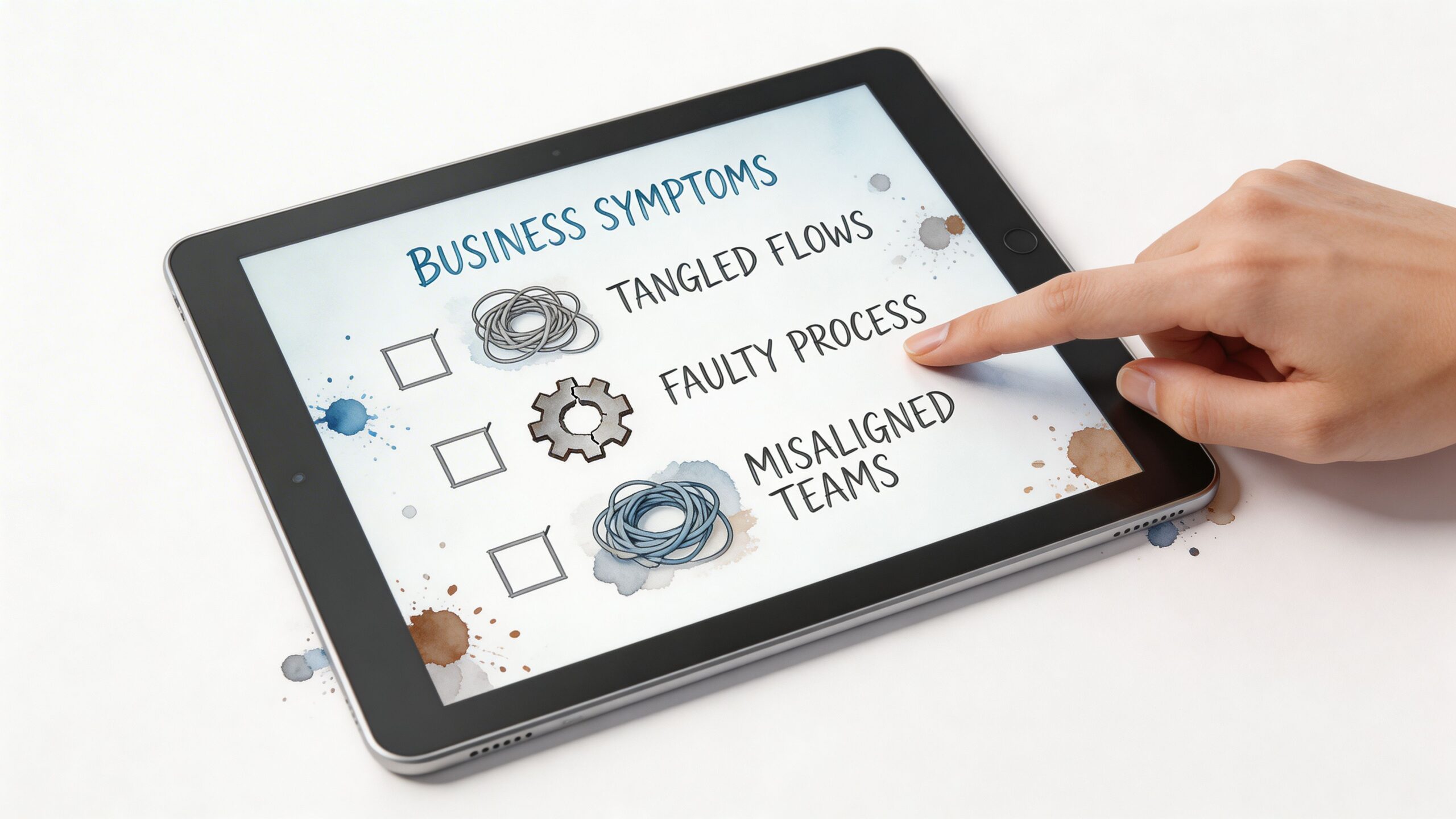
The executive checklist
If several of these are true, you likely need technology strategy consulting now, not later.
- Spend keeps rising but value is hard to explain: You approve renewals, projects, and outside help, but nobody can tie the spend to speed, margin, risk reduction, or customer outcomes.
- Important initiatives keep getting delayed by “tech issues”: That phrase usually hides a bigger issue. Unclear dependencies, weak ownership, or architecture nobody has fully mapped.
- The board is asking harder questions about cyber or resilience: If answers depend on one person translating technical detail in real time, governance is weak.
- One heroic employee holds too much context: When one admin, engineer, or vendor knows how things work, you have concentration risk.
- Vendor recommendations shape your priorities: If your roadmap comes from account managers more than business leadership, strategy has drifted.
- You are heading into diligence, audit, or insurer scrutiny: Weak documentation, murky ownership, and scattered controls get expensive fast.
What these signs mean
These are not random annoyances. They point to a business that has outgrown informal technology leadership.
A company can survive a surprising amount of mess when it is smaller. Growth changes that. More customers, more locations, more regulations, more integrations, and more people all increase the cost of ambiguity.
That is where an experienced CTO consultant can help leadership move from reactive decisions to a controlled system. Not by adding noise, but by making priorities visible and enforceable.
A useful rule is simple. If technology now affects growth, board confidence, financial visibility, or risk posture, it needs executive-level structure.
The right time to act is before the next public miss, failed rollout, or ugly diligence request. Waiting does not make the work smaller. It usually makes it more expensive and more political.
How To Engage a Strategic Technology Partner
Not every situation needs the same kind of help.
Some companies need a defined piece of work. Some need regular executive guidance. Others need someone embedded enough to lead change, manage risk, and create traction across teams.
The mistake is choosing based on title alone. Choose based on the depth of the operating problem.
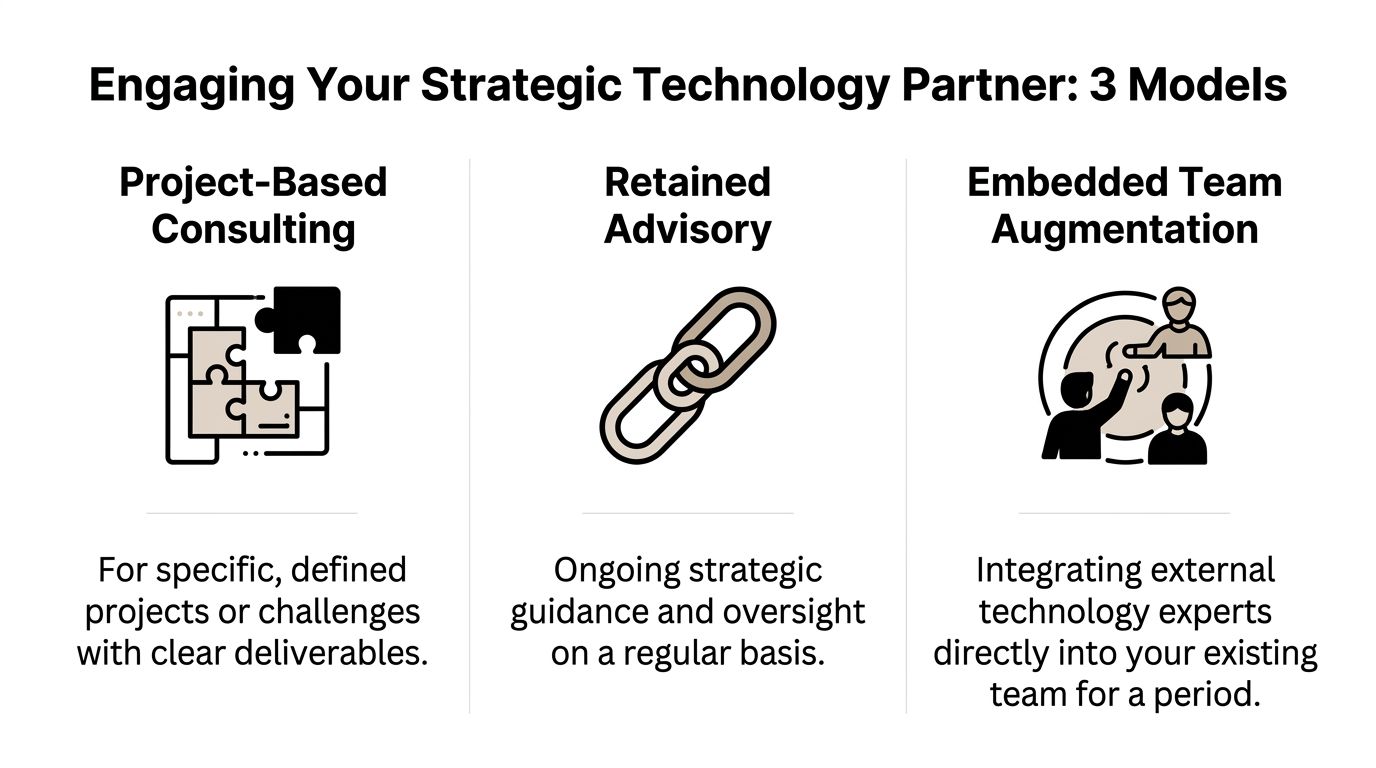
Three common models
Project-based consulting
This works when the scope is specific and the output is clear.
Examples include a system selection, a pre-diligence review, a vendor reset, or a targeted security assessment. You need an answer, a recommendation, and a plan for a bounded issue.
This model is efficient when leadership already has enough internal control to carry execution after the project ends.
Advisory retainer
This fits companies that have capable operators but need regular strategic guidance.
The advisor serves as a sounding board for investments, staffing choices, vendor decisions, sequencing, and risk tradeoffs. The work is less hands-on than embedded leadership, but stronger than occasional consulting.
It is often a good fit when a CEO or COO wants better decision quality without changing the org chart immediately.
Fractional or interim leadership
This is the right move when the business needs strategy and execution leadership at the same time.
You are not just asking for advice. You need someone to install cadence, create reporting, work across departments, manage vendors, and drive the first operational changes. That is especially relevant in sectors where full-time executive hires are hard to justify. Fractional executive leadership is increasingly important for underserved sectors like non-profits and high-trust service organizations because it provides ongoing governance and risk translation without the cost of a full-time hire (RTS Labs on consulting and fractional leadership).
How to choose the right model
| Your situation | Best fit |
|---|---|
| You need a decision on a narrow issue | Project-based |
| You need executive judgment on a recurring basis | Advisory retainer |
| You need strategy, ownership, and execution structure | Fractional or interim leadership |
Some businesses also need capacity in specialized areas while leadership gets sorted. In those cases, targeted options like AI staff augmentation can help fill delivery gaps, but only after someone defines priorities and decision rights. Extra hands do not solve a leadership vacuum.
A practical roadmap also matters. This piece on a technology roadmap is useful if you are trying to judge whether your next move should be sequencing work, changing governance, or adding execution support.
One factual option in this market is CTO Input, which provides fractional and interim CTO, CIO, and CISO leadership focused on clarifying ownership, risk, and execution.
Your First 30 Days From Chaos to Control
The first month should produce relief, not just diagnosis.
If an advisor spends weeks gathering information without creating visible control, leaders lose confidence and teams keep defaulting to old habits. Good technology strategy consulting creates clarity fast.
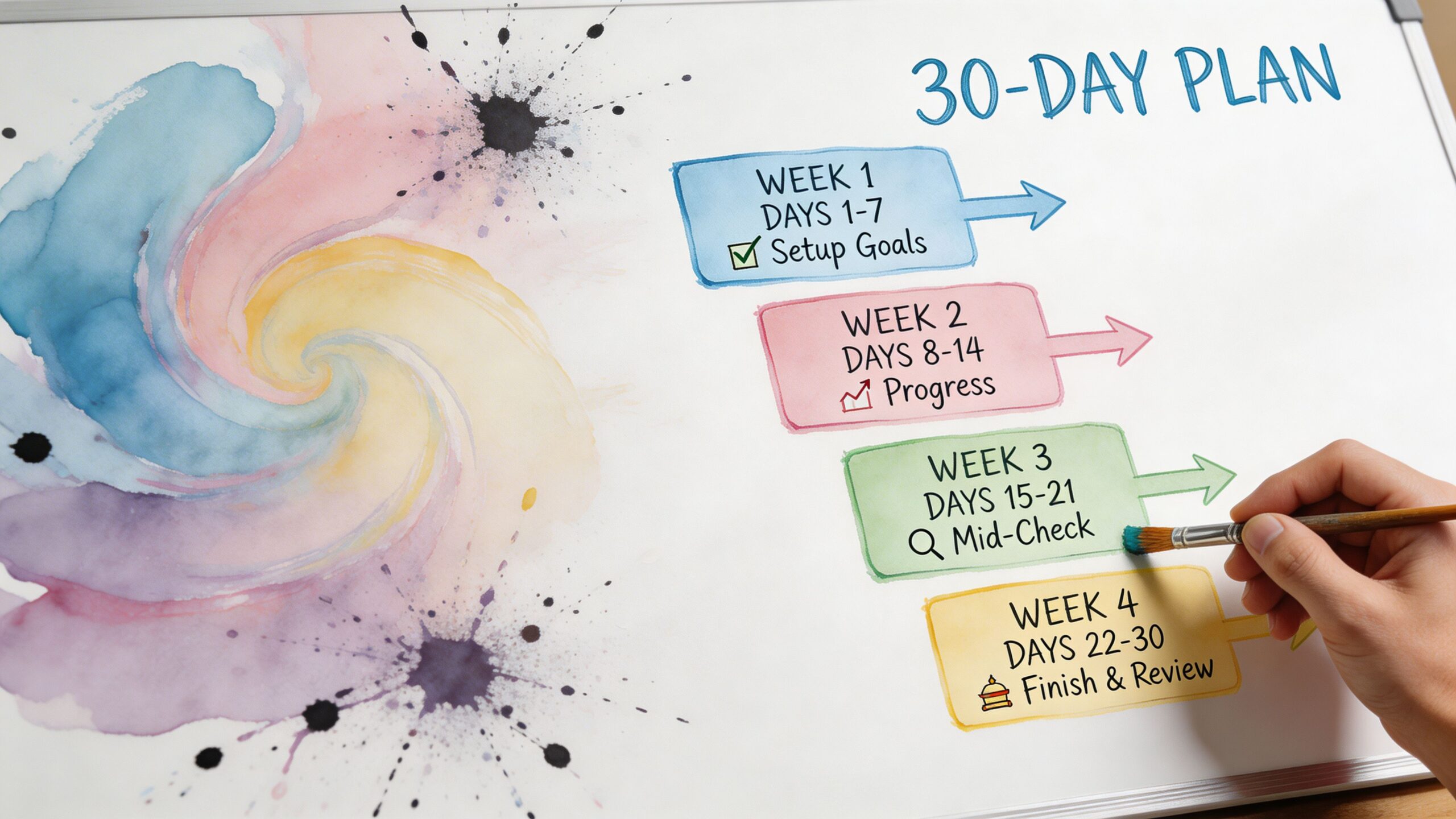
Week 1 gets the facts on the table
The first week is about legibility.
An advisor should interview the people who carry the business risk and the operational burden. That usually includes the CEO or executive director, COO, finance leader, senior IT lead, operations owners, and anyone responsible for compliance or customer delivery.
The output is not a pile of notes. It is a working map of:
- Core systems: Which platforms run revenue, finance, operations, customer service, and reporting
- Key vendors: Who owns what, where contracts sit, and where dependency is too high
- Decision rights: Who can approve, who can recommend, and where decisions stall
- Pain concentration: Which workflows create the most delays, confusion, or exposure
A strong advisor also looks for where reality differs from the org chart. Those gaps matter more than titles.
Week 2 identifies the bottlenecks and trust risks
By the second week, patterns should be visible.
Not every problem deserves the same urgency. A useful first pass usually isolates two categories.
Operational bottlenecks
These are the few issues that slow everything else down. They often include broken handoffs between teams, duplicate systems, unclear ownership for shared platforms, or reporting that depends on manual stitching.
Trust risks
These are the problems that could embarrass leadership, weaken board confidence, or create insurer, audit, or diligence trouble. They often involve access control, poor documentation, concentration risk, or sensitive data living in too many places.
At this stage, the advisor should be able to tell leadership something plain: these are the few problems creating most of the drag, and these are the ones that could create a public or financial problem if ignored.
The first 30 days are not for trying to solve everything. They are for proving that the business can see clearly enough to make disciplined choices.
Week 3 installs the operating rhythm
Here, the work starts to feel different.
Instead of endless updates, the company gets a repeatable cadence. Weekly review meetings become decision meetings. Owners are named. Escalation paths are clarified. Open items stop floating.
A practical operating rhythm often includes:
- A weekly leadership cadence: Focused on blockers, decisions, and risks
- A simple action register: Owner, due date, decision needed, status
- A vendor review loop: So providers are managed against business outcomes, not just invoices
- A board-ready summary: A concise view of progress, exposure, and next actions
This is also where the advisor proposes early wins. Not flashy wins. Useful wins.
Examples might include simplifying a bloated vendor relationship, clarifying ownership for a critical system, or fixing a reporting dependency that has been wasting executive time every week.
Week 4 ships the first visible improvements
By the end of the month, something should be better in the world.
That might be a risk reduction move, a cleaner workflow, a simplified vendor handoff, or a tighter reporting process. The point is not to finish the whole transformation. The point is to show that the business can move from vague concern to controlled action.
A good first month also leaves behind a few durable assets.
| Asset | Why it matters |
|---|---|
| Current-state map | Leadership can finally see systems, vendors, and dependencies |
| Named owners | Work stops hiding in shared accountability |
| Weekly cadence | Decisions happen on schedule instead of by emergency |
| Priority list | The business knows what to fix first and why |
| Executive reporting view | Boards and senior leaders get cleaner oversight |
The best early result is emotional as much as operational. Meetings get shorter. Status hunts fade. Team tension drops because the rules are clearer.
That is the point of strategy. Not more documents. Better control.
A Checklist for Choosing the Right Consultant
Hiring the wrong advisor can leave you with a prettier version of the same mess.
You do not need the smartest person in the room. You need someone who can help leadership make cleaner decisions, get work unstuck, and leave behind a system your team can run.
Questions worth asking in the first meeting
Use these questions to separate operators from report writers.
- How do you make decisions stick: Listen for ownership, cadence, escalation, and follow-through. Be cautious if the answer stays at the level of frameworks.
- What does your weekly operating rhythm look like: A strong advisor should describe meetings, artifacts, owners, and reporting with specificity.
- How do you handle a weak vendor: You want someone who can reset scope, accountability, and expectations, not just complain about partner performance.
- What will leadership see by the end of the first month: The answer should include visible clarity and at least a few practical changes.
- How do you report to a board or executive team: Ask for the structure, not confidential examples. You want concise business reporting, not technical noise.
- How do you transition ownership back to us: If they cannot explain the handoff, they may be building dependency.
Red flags that should change your mind
Some warning signs are obvious once you know to look for.
| Red flag | Why it matters |
|---|---|
| They lead with tools | Tool opinions are not a strategy |
| They cannot explain governance clearly | Complexity often hides weak execution thinking |
| They avoid ownership questions | That usually means the plan will float |
| They talk only to IT | Your problem is cross-functional, so the work must be too |
| They promise transformation without tradeoffs | Serious advisors know sequencing matters |
Ask one blunt question. “What will you do when my team agrees in the meeting and then nothing changes the next week?” The answer tells you whether they understand the core job.
The right consultant does not become the hero at the center of every problem. They build internal clarity so your team can operate with less noise and less dependence over time.
What Success Looks Like Calmer Faster Operations
Success is not a new platform announcement.
Success is when leadership no longer has to guess. You can ask who owns a decision, what the current risk is, what is blocked, and what happens next, and get a clear answer quickly.
The operational feel of a healthier business
The strongest signal is calm.
Projects still hit obstacles, but they do not disappear into ambiguity. Vendors still need managing, but they no longer shape strategy by default. Boards still ask hard questions, but the answers are structured and credible.
In a healthier operating model:
- Decisions stick: They are assigned, tracked, and revisited on schedule.
- Budgets tie to outcomes: Leaders can explain why spend exists and what result it supports.
- Risk becomes discussable: Security and compliance stop living as abstract fear or paperwork.
- Teams move with more confidence: Clear guardrails reduce hesitation and rework.
Where the ROI shows up
The most important return is business alignment. The true ROI of technology strategy consulting comes from linking IT decisions directly to business outcomes. In one nonprofit example, seamless data flows enabled real-time financial reporting, increased transparency, and generated 15% growth in fundraising revenue within the first year (Corsica Technologies on IT strategy consulting ROI).
That example matters because it shows the point clearly. Better technology leadership is not about cleaner diagrams. It is about better execution, faster reporting, stronger trust, and improved financial outcomes.
You feel it in ordinary moments. A leadership meeting ends with decisions instead of drift. A board packet is easier to prepare. A key employee can take vacation without the business holding its breath.
That is what leaders are buying. Not technical elegance. A system they can inspect and rely on.
Common Pitfalls That Keep Technology Disconnected
A lot of leaders are skeptical about consultants for good reason.
They have seen polished strategy work that changed nothing. They have paid for security activity that produced paperwork, not control. They have watched vendors turn a business problem into a product conversation.
Those instincts are healthy. There are predictable ways this work goes wrong.
Strategy on a shelf
This is the classic failure mode.
The consultant interviews everyone, writes a clean report, presents a roadmap, and leaves. No owner is named. No weekly cadence is installed. No budget tradeoffs are made. The strategy becomes a reference document that nobody can operationalize.
The fix is simple, though not easy. Every major recommendation needs an owner, a decision path, and a review cadence. If none of that exists, the strategy is still theoretical.
Vendor-driven roadmaps
Many businesses think they have a technology plan when they have a stack of vendor suggestions.
That shifts power away from leadership. Providers naturally frame priorities through their products, renewals, and implementation models. Sometimes that aligns with the business. Often it does not.
A strategic advisor should restore business-first sequencing. That means asking what the company is trying to protect, improve, or simplify before discussing tools.
Compliance theater
This is one of the most expensive traps because it feels responsible while changing very little.
Policies get written. Training gets completed. Audit folders look fuller. But daily operations do not improve. Sensitive information still moves into places nobody monitors. Access remains broad. Ownership remains murky.
A critical risk here is letting sensitive data spread into unmonitored systems. Effective technology strategy consulting addresses that by designing data architecture and governance controls that contain data and support compliance requirements such as HIPAA and GDPR, turning policy into operational reality (First San Francisco Partners on data strategy and governance).
What prevents these failures
Three disciplines prevent most of the disconnect.
- Named ownership: Shared concern is not the same as accountability.
- Operating cadence: Risk, progress, and decisions need a regular forum.
- Inspectable controls: Leaders need evidence that operating behavior changed, not just documentation.
The point is not perfection. It is making sure strategy changes how the business runs.
Your Next Step Toward Clarity and Control
If this feels familiar, the good news is that the problem is solvable.
You do not need more noise. You need clearer ownership, a steady cadence, and a short list of priorities tied to business outcomes. That is what turns technology from a recurring source of friction into a reliable execution system.
If data confusion is part of the problem, this practical piece on data analytics strategy is a useful companion because reporting quality often exposes the same ownership and governance gaps.
The right next move is a focused conversation that surfaces the few bottlenecks and trust risks that matter most.
If technology is slowing growth, weakening visibility, or making board questions harder to answer, a CTO Input Clarity Call is a practical next step. In one conversation, you can surface the top bottlenecks, identify the main trust risks, and outline what the first 30 days of restoring control should look like.