

You’re in the leadership meeting. Revenue, delivery, hiring, and margin are on the agenda. Then technology hijacks the room.
A system issue delayed invoicing. Reporting doesn’t match across teams. A vendor renewal appeared with no owner. Security wants one thing, operations wants another, and nobody can explain which work matters most to the business this quarter. So the conversation shifts from strategy to cleanup.
That’s the problem. Not that technology is complicated. It’s that the business can’t reliably use technology to execute.
A business-aligned technology strategy fixes that. Not by producing a prettier roadmap. By making ownership clear, decisions inspectable, and progress visible enough that leaders can move without guessing.
When Technology Feels More Like a Tax Than an Asset
Most leaders don’t ask for a business-aligned technology strategy because they love planning. They ask for it because technology has started acting like a tax on growth.
You see it in ordinary moments. A sales initiative slips because data lives in three places. Finance can’t trust a report without manual cleanup. A customer issue takes too long to resolve because one team owns the app, another owns the vendor, and nobody owns the outcome. The business keeps paying, but control gets weaker.
That’s why this problem gets missed. It rarely shows up as one dramatic failure. It shows up as drag.
Everything is urgent, nothing finishes.
If that line feels familiar, you’re not dealing with a bad sprint or a noisy month. You’re dealing with misalignment between business priorities and technology decisions.
The frustrating part is that this isn’t unusual. Info-Tech Research Group found that 74.6% of organizations report having an ineffective IT strategy process, and 23.6% of CXOs feel their business goals remain unsupported by IT according to the PMC summary of that research. That’s the same pattern many executive teams live every week. Money goes in. Friction comes out.
What this looks like in the room
Leaders usually describe the symptoms in business terms, not technical ones:
- Plans keep slipping: Important work gets started, interrupted, re-scoped, and carried forward.
- Reporting takes too much effort: Teams build spreadsheets around system gaps because the underlying flow of information isn’t trusted.
- Vendors shape the roadmap: Renewals, product pitches, and one-off fixes evolve into strategy.
- Risk feels vague: The board asks reasonable questions, but answers are slow, partial, or overly technical.
That’s why I don’t treat this as an IT problem first. It’s an operating model problem.
If you’re trying to decide where AI belongs in that operating model, Prometheus Agency's AI strategy insights are useful because they keep the discussion tied to business intent rather than tool excitement.
Why leaders feel stuck
Many teams are working hard. That isn’t the issue.
The issue is that effort without decision clarity creates more motion than progress. People compensate with heroics, side channels, and personal trust. That works for a while. Then scale, scrutiny, or turnover exposes the gaps.
A strategy worth having should reduce noise, not document it.
First Make the Current Reality Legible
Before you change anything, make the current system visible enough to inspect.
Most organizations skip this step. They jump straight to solutions. New platform. New hire. New vendor. New transformation plan. That usually adds another layer on top of confusion that already exists.
Start with a map. Not a giant architecture diagram nobody reads. A working map of how the business gets important work done, which systems support that work, who can make decisions, and where the handoffs break.

Start with business flows, not systems
Ask four plain questions.
What work is the business trying to do?
Think in terms like quote-to-cash, hire-to-onboard, incident-to-resolution, intake-to-service delivery, or lead-to-renewal.Which systems and vendors touch that work?
Name the CRM, ERP, ticketing platform, file storage, HR system, security tool, outsourced provider, and any spreadsheet that has become “temporary infrastructure.”Where does the process break or slow down?
Look for manual re-entry, conflicting numbers, approval bottlenecks, recurring exceptions, and places where one person always has to rescue the process.Who decides?
Not the org chart version. The practical version. Who approves spend, chooses vendors, accepts risk, changes process, and can force a priority decision when teams disagree?
Build a simple map of the chaos
You do not need a months-long assessment to do this well. You need disciplined interviews and one consistent format.
A useful working map usually includes:
- Critical business process: The outcome the business needs, such as billing, service delivery, customer support, or compliance evidence.
- Supporting systems: The named applications, reports, integrations, and manual workarounds involved.
- Decision rights: Who can approve, escalate, stop, or change the process.
- Failure points: Where delays, duplicate work, surprises, or risk show up.
- Business consequence: What the breakdown costs in speed, confidence, customer experience, or control.
Practical rule: If a process depends on memory, goodwill, or one heroic employee, it is not under control.
Focus on the few issues creating most of the friction
You’re not trying to document the entire estate in perfect detail. You’re trying to identify the handful of issues causing most of the operational drag.
That often means finding patterns like these:
- Shadow ownership: A vendor “belongs” to whoever complained loudest last time.
- Fragmented data: Teams report from different tools and reconcile by hand.
- Broken intake: New requests arrive through email, chat, meetings, and hallway conversations, then bypass prioritization.
- Security bolted on late: The risk review happens after the purchase decision, not before it.
For risk visibility, some leaders use tools like GoSafe's cyber risk assessment platform to support a broader view of exposure across the business. That can help, but don’t confuse tooling with clarity. The map still matters first.
What you should have by the end of this step
By the end of this exercise, leadership should be able to answer three questions crisply:
| Question | What a useful answer sounds like |
|---|---|
| Where is the business losing time? | “Order handoff between sales and operations breaks because data is re-entered and approvals are unclear.” |
| Where is risk concentrated? | “Third-party access and exception handling are poorly owned, so accountability is weak.” |
| Which issues matter now? | “We’re fixing reporting trust, vendor sprawl, and intake discipline before we touch bigger platform decisions.” |
That’s when the problem starts to shrink. Once the current reality is legible, you can stop arguing from anecdotes and start operating from facts.
Define Clear Ownership and Govern Decisions
Most technology chaos is not caused by a lack of effort. It’s caused by fuzzy ownership.
When nobody clearly owns a decision, the work doesn’t stop. It just moves sideways. Teams discuss, escalate, revisit, and workaround. That’s why organizations can spend heavily on technology and still feel unmanaged.

According to Datamagic’s summary of alignment research, communication gaps and cultural barriers are top inhibitors to strategic alignment, and a key cause is the lack of clear ownership and C-suite commitment. The same source notes that misaligned firms suffer from stalled initiatives and three times higher project failure rates.
That’s why governance matters. Not because executives need more meetings. Because decisions need somewhere to live.
Having IT is not the same as having technology leadership
An IT department can keep systems running and still leave the business exposed.
You need someone, or a small set of clearly assigned leaders, to own decisions across core domains:
- business application priorities
- vendor selection and renewal
- cybersecurity exceptions
- architecture and integration direction
- project trade-offs
- technology budget logic
- reporting on risk and progress
Without that, the organization falls into a familiar trap. Operations assumes IT owns the process. IT assumes the business owns the requirements. Finance assumes someone vetted the spend. Security assumes exceptions were approved. Then an issue surfaces and everyone is surprised.
Use a simple executive RACI
Don’t overengineer this. A light RACI is enough if you use it.
For each major decision, define:
- Responsible: Who does the work and prepares the recommendation
- Accountable: Who makes the final call
- Consulted: Who must give input before the decision sticks
- Informed: Who needs to know after the fact
The key distinction is between doing and deciding. Many teams blur that line and pay for it later.
Where to apply decision rights first
Start with a short list of decision categories that drive recurring friction.
| Decision area | Accountable owner | Why it matters |
|---|---|---|
| New vendor approval | Business or executive owner with technology and security input | Stops ad hoc purchases and duplicate tools |
| Major project priority | Executive sponsor | Prevents every request from becoming urgent |
| Security exception | Named risk owner | Makes risk acceptance explicit |
| Core system change | Technology leader with business owner input | Protects operational stability |
| Reporting definition | Business owner for the metric | Stops endless reconciliation arguments |
A decision is not governed because people discussed it. It is governed when a named owner can explain who decided, why, and what happens next.
Governance should be boring
That’s a compliment.
Good governance is not dramatic. It removes ambiguity before it turns into escalation. It should answer ordinary questions quickly:
- Who approves this vendor?
- Who can accept this risk?
- Who decides whether this project continues?
- Who owns the business metric this system affects?
- Who explains the status to the executive team?
If those answers change depending on who is asked, governance is weak.
For a deeper look at practical ownership models, this guide on how to structure technology ownership is worth reading.
What to put in the governance layer
Keep it compact. Most organizations need only a few working pieces:
- An executive sponsor group: Small, cross-functional, and able to make trade-offs.
- Decision logs: Short records of major calls, especially on spend, scope, risk, and vendor choices.
- Escalation rules: Clear thresholds for when an issue moves up.
- Review cadence: A standing rhythm so decisions don’t wait for a crisis.
- Exception handling: A way to say yes, no, or not now without burying the issue.
A business-aligned technology strategy is realized. Strategy is not aspiration. It is the structure that makes decisions hold.
Install a 90-Day Operating Rhythm for Quick Wins
A strategy document doesn’t restore confidence. A visible operating rhythm does.
The first proof that alignment is improving is simple. Work starts finishing. Risk starts shrinking. Leaders stop chasing updates because the system produces them.
Info-Tech’s guidance on building a business-aligned IT strategy makes this point clearly in its strategy methodology. In the first 30 days, ship tangible risk reductions or simplification wins. Then establish a weekly operating rhythm with clear deadlines and progress tracking so strategy becomes an ongoing process, not a document people ignore.
That’s the right model. Keep it tight. Make it inspectable.
The first 30 days should create relief
Don’t begin with the largest program. Begin with the moves that reduce friction fast and prove that leadership is serious.
Good early wins usually look like this:
- Consolidate obvious vendor overlap: Remove duplicate tools, overlapping subscriptions, or unmanaged shadow systems.
- Fix one reporting gap: Choose a business-critical metric that currently requires too much manual repair and assign one owner to define the number.
- Stabilize intake: Create one path for new requests so priorities stop getting bypassed.
- Clean up access or exceptions: Close loose ends that create recurring security or audit discomfort.
These aren’t cosmetic. They build trust because people can feel the difference in daily work.
Days 31 through 90 should install discipline
Once the first wins land, don’t switch back into reactive mode. Doing so allows you to install the rhythm that keeps the organization from sliding into chaos again.
Use a weekly cadence with a short agenda:
- Review top priorities and whether they remain aligned to business goals.
- Check deadlines, blockers, owner actions, and key risks.
- Decide what changed since last week and what that means for sequence.
- Triage new requests through the same decision lens, not through politics.
That meeting should be brief, operational, and owned. Not a theater performance.
If you need executive air cover to install that cadence, executive technology leadership is often the missing ingredient, especially in organizations that have plenty of technical activity but no reliable decision structure.
Sample 90-Day Technology Alignment Sprint
| Timeframe | Focus | Key Actions | Success Metric |
|---|---|---|---|
| Days 1 to 30 | Reduce noise and visible risk | Map top friction points, assign owners, remove one source of duplicate spend, fix one reporting weakness | Leadership can name top priorities, owners, and immediate risks without debate |
| Days 31 to 60 | Install governance and cadence | Launch weekly review, create decision log, define intake path, document escalation rules | New requests follow one path and decisions stop getting remade |
| Days 61 to 90 | Prove traction | Track progress on priority work, close known exceptions, tighten vendor oversight, report status in business terms | Work completion becomes more predictable and executive updates get shorter |
What the dashboard should show each week
A weekly dashboard does not need to be pretty. It needs to be credible.
Track a short set of items:
- Priority initiative status: On track, at risk, blocked
- Named owner: One person, not a committee
- Decision needed: If leadership action is required, say so plainly
- Business effect: What outcome this work supports
- Risk note: What happens if the item slips or changes
Keep the intake gate firm
Many plans often falter here.
New requests will arrive. A customer issue, board question, contract opportunity, insurer concern, leadership idea, urgent vendor pitch. If everything goes straight into active work, your operating rhythm becomes ceremonial.
Use three simple categories:
- Do now: Directly tied to current business priorities or material risk
- Queue next: Valid, but not important enough to disrupt active work
- Decline or defer: Not aligned, not mature, or not worth current capacity
Operating principle: Every new request should displace something, wait, or be rejected. It should never enter the system as a free extra.
Extend the cadence to 180 days without pretending the roadmap is fixed
By day 90, you should not lock in a grand multi-year fantasy. You should have enough control to set a realistic 180-day direction.
That next horizon usually includes:
- retiring fragile workarounds
- reducing dependency on key-person knowledge
- tightening core vendor management
- improving business reporting trust
- sequencing larger platform or integration decisions
- clarifying where security controls need operational backing
This is also where a service like CTO Input can fit as one option among others. Its stated model is executive-grade fractional or interim technology and security leadership that maps current reality, installs operating rhythm, and leads early risk-reduction work. That’s useful if your team has capable operators but lacks decision structure at the leadership layer.
The point isn’t to admire the plan. The point is to create a rhythm where priorities survive contact with reality.
What to Do When Alignment Breaks Under Pressure
Most advice about alignment assumes stable conditions. The ultimate test comes when pressure hits.
Budget tightens. A customer issue escalates. Security flags an exposure. A board member wants acceleration on a digital initiative. Suddenly the neat roadmap collides with reality, and leadership starts asking the hard question that should have been built into the strategy from the start.
What do we stop?
KPMG’s guidance on strategic IT and business alignment is useful here because it acknowledges the part many frameworks avoid. Under scarcity, legacy tech debt may consume 60% to 80% of capacity, and leaders still have to choose between growth work and risk-reduction work. That is where a defensible decision framework matters.
Alignment is not agreement with every request
If your version of alignment means saying yes to every business unit, you do not have alignment. You have unmanaged demand.
Real alignment means the organization can make hard trade-offs without losing credibility. Leadership can explain why a project moved, why a security fix went first, or why a vendor purchase is waiting. The explanation should sound deliberate, not apologetic.
Use a three-lens trade-off test
When pressure rises, evaluate work through three lenses.
Business outcome
Ask whether the work directly supports a current business objective. Revenue protection, customer delivery, reporting integrity, contractual obligation, regulatory readiness. If the answer is vague, the work should wait.
Risk exposure
Some work does not create growth, but failing to do it creates unacceptable downside. Security, resilience, compliance, core infrastructure stability. Leaders need to say that plainly instead of pretending every item has the same type of value.
Execution reality
Even worthy work can fail if the organization lacks capacity, ownership, or sequencing. Many plans become fiction under these circumstances. If a team cannot absorb the work cleanly, defer it instead of pretending urgency changes capacity.
When priorities shift every week, the strategy is not failing. The decision system is.
Make deprioritization explicit
When something moves out of active work, record four things:
- What was deprioritized
- Why the decision was made
- What condition would bring it back
- What risk the organization is accepting in the meantime
That discipline matters. It lets leaders explain trade-offs to the board, to business unit heads, and to their own teams without signaling confusion.
Protect the roadmap without becoming rigid
A business-aligned technology strategy should bend. It should not collapse.
That means keeping a protected core. A small set of priorities that only move for a defined reason, such as material risk, legal requirement, major customer impact, or executive decision tied to enterprise goals. Everything else can be re-sequenced around that core.
Without that protected core, the organization drifts back to noise. Work gets reshuffled by volume, not value.
How to Measure and Report Progress to the Board
Boards do not need a tour of your tools. They need evidence that leadership has control.
That means reporting on technology in business terms. Not server uptime, ticket counts, or architecture diagrams unless those directly answer a business question. The board wants to know whether the organization is reducing risk, improving execution, and using technology spend to support real outcomes.
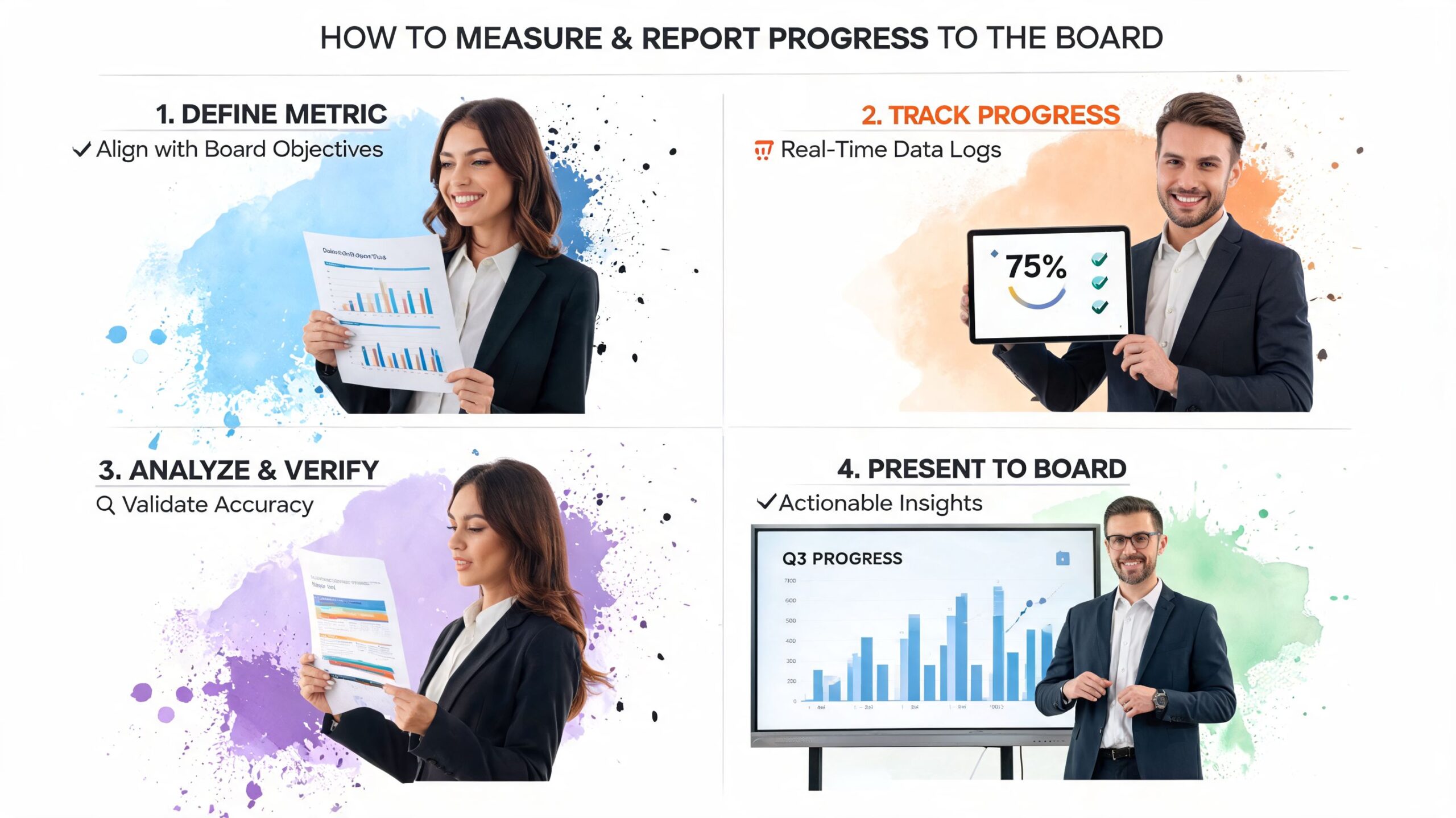
According to Deloitte, organizations with strong business-aligned IT strategies are 20% more profitable and achieve revenue growth up to 35% faster than competitors, as cited in Datcom’s discussion of aligning technologies with business goals. That’s why reporting should connect technology work to outcomes like customer retention, project timelines, and compliance pass rates.
Report outcomes, not activity
A board update should help non-technical leaders answer five questions:
- Are we more in control than last quarter?
- Are the top risks understood and being reduced?
- Is spend supporting business priorities?
- Are major dependencies and delays visible early?
- Can leadership explain what changed and why?
That is enough. If you can answer those clearly, confidence rises.
A practical board dashboard
Use a concise dashboard with a small number of business-facing measures.
| Area | What to report |
|---|---|
| Strategic progress | Status of top initiatives tied to business goals |
| Risk reduction | Material risks closed, mitigated, or awaiting decision |
| Delivery confidence | Whether key work is on track, at risk, or blocked |
| Spend logic | How current spend supports priority outcomes |
| Decision needs | What leadership or board attention is required |
Good metrics have business meaning
The best board-level metrics usually sit one level above technical operations.
Examples include:
- Customer retention support: Whether key systems or process fixes are helping service quality or account continuity
- Project timelines: Whether critical delivery work is becoming more predictable
- Compliance pass rates: Whether controls and evidence are improving in a way the board can trust
- Reduction in manual workarounds: Whether operational friction is decreasing
- Time to resolve critical issues: Whether the organization is becoming more resilient under pressure
If you want a sharper framing for this, your board doesn’t care about uptime, they care about dollars is the right mindset.
Board rule: If a metric doesn’t help a director judge control, risk, or business value, it probably doesn’t belong on the board page.
Pair each metric with a short narrative
Numbers alone are not enough. Add one sentence of interpretation.
For example:
- The initiative is on track and reducing manual reconciliation in finance.
- The security control is delayed because ownership was unclear. That has now been assigned.
- The vendor consolidation work is slowing because contract terms need executive review.
That sentence is where leadership proves command. It shows not only what changed, but whether the organization understands why.
From Chaos to a Calm, Fast Organization
A good business-aligned technology strategy does not make the organization slower. It removes the friction that was already slowing it down.
The visible change is straightforward. Fewer surprises. Shorter status hunts. Cleaner reports. Better vendor control. Less dependence on one person to hold the whole thing together.
The deeper change is more important. Technology stops being a collection of projects and becomes part of the company’s execution system.
What the better version looks like
In a calmer organization, leaders can answer basic operating questions without confusion.
- Who owns this decision?
- What are we doing now, and what are we not doing?
- Which risks are accepted, and by whom?
- What changed this week?
- How does this work support the business?
That clarity changes behavior. Teams stop escalating everything. Security becomes a set of guardrails instead of a late-stage blocker. Boards get cleaner answers. Operators get room to fix root causes instead of living inside interruptions.
What usually changes first
The first improvements are rarely glamorous.
A messy vendor estate gets tighter. One critical report becomes trustworthy. A backlog gets triaged against business goals instead of internal politics. A weekly review starts producing decisions instead of updates. People notice because work stops leaking at the edges.
Calm is not the absence of pressure. It is the presence of control.
That’s the point. You are not trying to build a perfect plan. You are building a system that can take pressure without turning every week into improvisation.
If your organization is living the opposite pattern, the next step is not another broad transformation deck. It is a clear read on where the chaos is coming from, who should own what, and what the first 30 days of control restoration should look like.
If technology is slowing growth, weakening reporting, or making risk harder to explain, a conversation with CTO Input is a practical next step. A Clarity Call can surface the main bottlenecks, the trust risks behind them, and the first moves that would restore control.