

You can be hiring, selling, and shipping, and still feel the business getting heavier. That is often the first sign that technology decisions are slowing growth. The problem is not lack of effort. It is that ownership, reporting, and decision rights are too fuzzy to support speed. These technology decisions growth issues undermine long-term business outcomes and hinder the ability to hit aggressive revenue goals.
The warning signs rarely arrive with a siren. They show up as delays, workarounds, and the same questions coming back again and again. Once that pattern sets in, technology stops acting like support. It starts acting like drag.
Key takeaways
- If decisions keep reopening, you probably have a breakdown in the operating model, not a tool problem.
- If spend keeps rising but speed does not, your stack may be absorbing money without producing enough value.
- If risk lives in spreadsheets and side conversations, you do not have enough visibility at the top.
If every hard decision needs another meeting, you do not have a process issue. You have a control issue.
When projects keep dragging, the clock is telling you something
A feature gets pushed twice. A migration of legacy systems slips again due to technical debt. A simple fix needs three approvals. That is not operational friction. It is decision latency, and it eats momentum.
You see the same pattern in a lot of scaling startups. The team is busy, but the work is not moving cleanly. For a blunt take on how leadership can slow a company down, see how leaders slow companies down. The point is not that people are failing. The point is that the balance of product and technology decision paths is too long.

If the same project keeps reopening, the team is not confused about work. It is confused about authority. Someone should know what gets decided, who owns the call, and when the call is final.
That matters because delay is not just delay. It changes how your team behaves. People stop moving with confidence. They wait. They hedge. They protect themselves with extra meetings and more status updates.
Spend rises without better results
A growing it budget can be a healthy sign. It can also mean you are paying for confusion. If tools are added as a strategic investment to patch process gaps but fail to deliver roi or measurable impact, the stack starts to bloat fast.
This is where founders get misled. The dashboard says spend is up, the team says progress is happening, and the business still feels slower. That gap is the real story. If you want a cleaner way to judge the picture, a metrics that matter one-page dashboard is more useful than a pile of reports nobody trusts.
If you have a board, investors, or partners (who care about earnings per share) asking for a stronger story, the board and funder reporting readiness checklist is a solid reality check. Clean reporting is not about looking polished. It is about showing where the money is going and what that spending is buying.
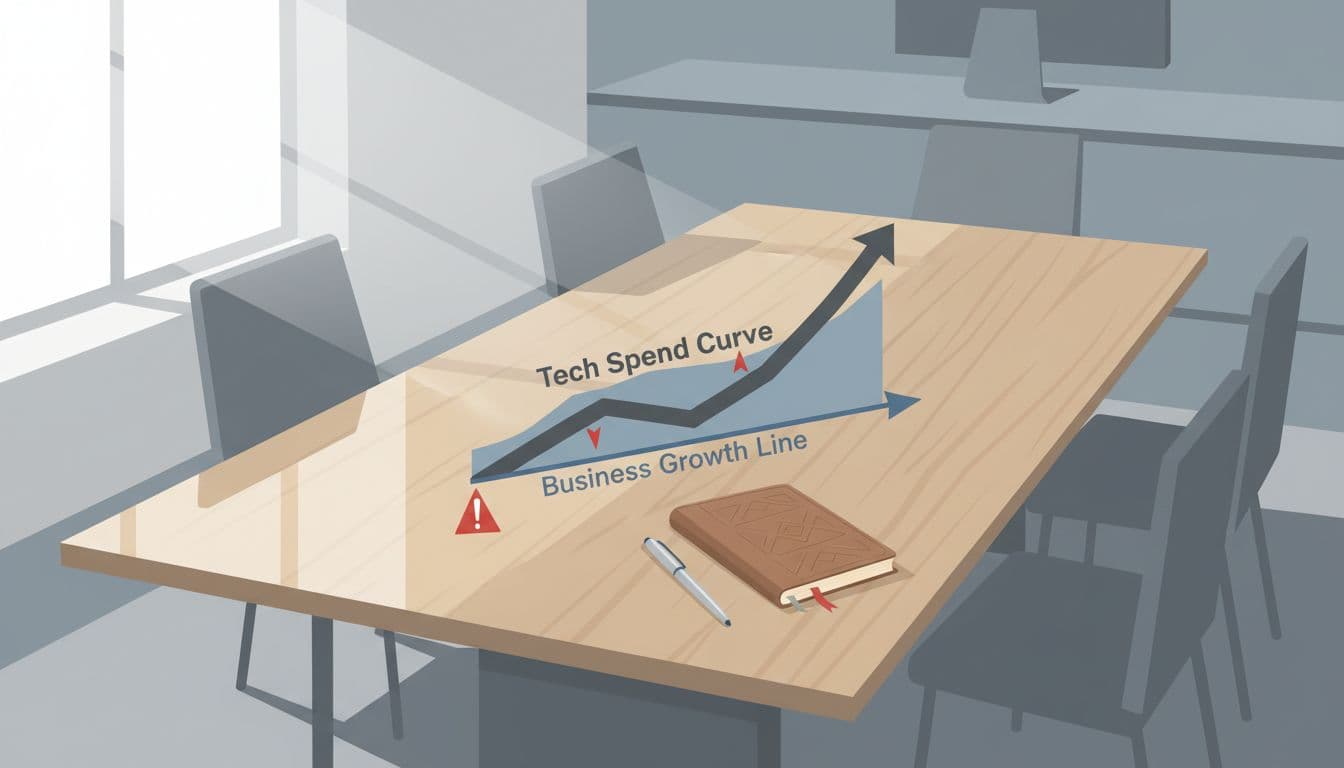
When spend rises and output stays flat, you should ask a simple question. What problem did this new tool solve, and what problem did it create? If that question is hard to answer, the stack may be carrying more complexity than value.
That is usually where growth starts to feel expensive. Not because technology is too important, but because it is not being run with enough discipline.
Hidden risk can slow you down before it shows up
Some of the worst drag does not show up in the P&L right away. It hides in vendor dependence, poor access control that exposes cybersecurity risks, and knowledge trapped in one person’s head.
If a former employee can still reach a system, or a vendor holds more control than your team does, you do not have real oversight. You have a problem waiting for a bad day. The vendor access and offboarding checklist helps you get a cleaner grip on that risk.
This is also where founder bottlenecks show up. When too many decisions route back to you, the company slows even if revenue is still rising. That pattern is laid out well in why founders become the bottleneck in their own company. The issue is not that you are involved. It signals a need for stronger technical judgment and a shift in tech leadership style. The business cannot move without you.

When risk is hidden, you spend more time reacting than leading. You cannot fix what you cannot see, and you cannot scale what still depends on a failure in decision architecture and heroics.
What to watch in your own company
If you want a quick read on whether technology decisions are slowing growth, look for these patterns that often signal a stalled digital transformation.
| What you notice | What it usually means | What to ask next |
|---|---|---|
| Projects keep getting reopened | Ownership is unclear | Who has the final call? |
| Reporting changes every meeting | Data maturity is lacking | Which number is stable? |
| New tools keep getting added | Process gaps are being patched, disrupting the customer journey | What is this replacing? |
| One person knows too much | Risk is concentrated | What breaks if they are out? |
When you see two or more of these at once, the issue is bigger than a single project. You need a decision framework to clarify decision rights, improve reporting, and define ownership for actionable insight.
FAQ
How do you know it is a technology problem and not a people problem?
If capable people keep hitting the same wall, the problem is usually structure. It may be weak ownership, weak reporting, or too many decisions routed through the wrong people. Tech leadership must ensure system stability, or good teams can still get stuck in a bad operating model.
Can growth slow even when revenue is still rising?
Yes. Revenue can go up while speed, margin, and confidence go down. That is the dangerous part, because the business still looks healthy from a distance while the day-to-day load keeps getting worse.
How do artificial intelligence and hybrid work add decision complexity?
Artificial intelligence and hybrid work introduce new layers of decision complexity that can slow growth by complicating technology choices and operational alignment.
Conclusion
You do not need to assume the business is broken. You need to notice when technology decisions have started to add friction instead of removing it. Once the same delays, costs, and ownership gaps keep showing up, the pattern is plain.
To build a competitive advantage and increase enterprise value, start with the basics: decision rights, reporting, and vendor control. Success requires stakeholder alignment across product and technology, while automation and artificial intelligence can improve overall business outcomes. Those three usually tell you where growth is getting stuck.
If you want a clearer read on the situation, a clarity call can help you sort signal from noise.