
If you’re asking how much a fractional CISO costs, the honest answer is: it depends on the job you need done. Pricing usually shifts with scope, risk level, time commitment, and how much executive support you want around reporting, vendor oversight, and incident readiness.
That’s why the cheapest option is not always the best fit. If you need board reporting, help after a cyber scare, or someone to steady the room when ownership is fuzzy, a low hourly rate can end up costing more later.
The point isn’t to buy security theater. It’s to budget for the level of leadership your business actually needs.
Key takeaways: Fractional CISO pricing is shaped by risk, scope, and support level. Hourly work fits short bursts. Retainers fit ongoing oversight. Project fees fit defined deliverables. If your risk is already high, budget for more than advice. Budget for follow-through.
The main pricing models you are likely to see
Most fractional CISO pricing falls into four buckets. The structure matters as much as the number on the proposal. It affects predictability, flexibility, and how much leadership attention the work will take.
| Pricing model | Best for | What it gives you | Watch out for |
|---|---|---|---|
| Hourly consulting | Short assessments, quick advice, one-off meetings | Flexibility and low commitment | Costs can be hard to predict |
| Monthly retainer | Ongoing executive support | Regular cadence and steadier leadership | Scope creep if roles are unclear |
| Project fee | Defined deliverables | Clear price for a clear outcome | Surprises if the scope is vague |
| Hybrid model | Ongoing oversight plus specific projects | Balanced support and better control | Needs good boundaries up front |
If you need an outside set of eyes for a narrow issue, hourly can work. If you need someone in the room every month, a retainer usually makes more sense. If you know the finish line, project pricing is easier to budget.
If you’re dealing with broader leadership strain, not just a security task, a model closer to executive technology leadership is often a better fit than a narrow advisory engagement.
Hourly rates work for narrow, short-term needs
Hourly billing makes sense when you need a focused assessment, a quick review of policy gaps, or a single advisory session before a decision. It’s useful when you want expert input without a long commitment.
The upside is simple. You pay for time used, and you can stop when the issue is resolved.
The downside is less pleasant. Hourly work can become expensive if the problem turns out to be larger than expected. It also makes budgeting harder because the total can move fast.
Monthly retainers are best when you need steady leadership
Retainers are the most common fit when you need ongoing executive support. That usually means regular reporting, risk oversight, vendor review, board prep, and guidance for the team over time.
This is the model that fits best when security is no longer a side task. You need someone who can keep an eye on the whole picture, not just one problem at a time.
A retainer also gives you something leadership teams often need more than anything else, predictability. You know the monthly cost, and you know who owns the follow-through.
Project fees can help when the scope is clear
Project pricing works well when the work has a defined start and finish. Think security policy cleanup, board reporting setup, a risk assessment, or incident response planning.
The advantage is clean budgeting. You know what you’re paying for, and you can often compare options more easily.
The catch is scope. If the project starts small but keeps growing, the fee stops being helpful. That’s why good project work needs clear deliverables, clear timing, and a clear decision on what is out of scope.
What drives the cost up or down
Two fractional CISOs can quote very different prices and both can be right. The number usually reflects the amount of work, the level of risk, and how much leadership support the situation needs.

Your industry matters first. Healthcare, finance, retail, and other regulated or high-risk environments tend to need deeper documentation, tighter controls, and more careful reporting. That takes time.
Your board expectations matter too. If the board wants clear answers on exposure, progress, and tradeoffs, the work is broader than a basic security check. It has to be legible to people who are not living in the weeds every day.
Your risk level and industry shape the workload
A company with low exposure and a narrow scope will usually need less time than a company that handles sensitive data, has regulatory pressure, or is in the middle of diligence. The more visible the risk, the more work it takes to manage it well.
That’s not about fear. It’s about reality. A business with compliance obligations or customer trust on the line needs a deeper operating rhythm.
The amount of hands-on support changes the fee
Some fractional CISOs stay in an advisory lane. They review, advise, and help you think. Others are much more hands-on. They join weekly meetings, write or clean up policies, coach internal leaders, prepare board updates, and help handle urgent issues.
That difference matters. Advisory-only work costs less, but it won’t solve a leadership gap by itself. Hands-on support costs more, but it can also prevent confusion, delays, and rework.
Your current security maturity affects how much work is needed
If you already have a clear security program, the job is lighter. If your tools are scattered, policies are outdated, and no one can say who owns what, the work gets bigger fast.
You’re not just paying for expertise. You’re paying for cleanup, structure, and decision support.
A stronger security leader can also help you avoid spending in the wrong places. That’s where executive-level oversight matters more than another tool purchase or one more dashboard.
How to budget for fractional CISO support without guessing
Budgeting gets easier when you stop shopping for a rate and start framing the actual problem. If you don’t define the problem first, every quote will feel random.

Start with the question your leadership team is trying to answer. Is it, “Are we board-ready?” Is it, “Do we have a real security program?” Or is it, “Why does risk keep showing up after every major decision?” That question shapes the budget.
Then separate must-have work from nice-to-have work. You may need discovery first, then recurring oversight, then a few project bursts. Don’t cram everything into one bucket.
If the first conversation is only about cost, you’ll miss the bigger issue. The real question is whether you need advice, oversight, or active executive leadership.
Start with the problem you are trying to solve
Maybe your issue is weak reporting. Maybe it’s vendor sprawl. Maybe the board wants better answers. Maybe you need help after an audit or incident. Name the problem plainly.
Once you do that, pricing conversations get better. You can compare proposals against the same need instead of comparing random hours.
Set aside room for ongoing oversight, not just one-time help
A lot of teams budget for the first assessment and forget the follow-through. That’s usually where the real work lives.
Recurring oversight often includes board reporting, policy updates, vendor reviews, risk tracking, and making sure the team keeps moving after the first set of recommendations lands. If you only budget for the diagnosis, you may never get the fix.
For leadership teams that need clearer reporting and tighter ownership, build a board-ready technology risk view before the next board meeting or audit cycle.
Plan for urgent work if your risk is already high
If you’re dealing with a cyber event, acquisition pressure, a failed audit, or a leadership transition, the work will be more intense than normal. Urgent situations usually need faster response and more hands-on time.
That means your budget needs some room for escalation. If the business is already under pressure, don’t plan for the calm version of the work.
When a fractional CISO is cheaper than a full-time hire
A fractional CISO often costs less than a full-time hire, but the real comparison is bigger than salary. You’re comparing salary, benefits, bonus, recruiting time, onboarding, and the risk of hiring the wrong level too early.
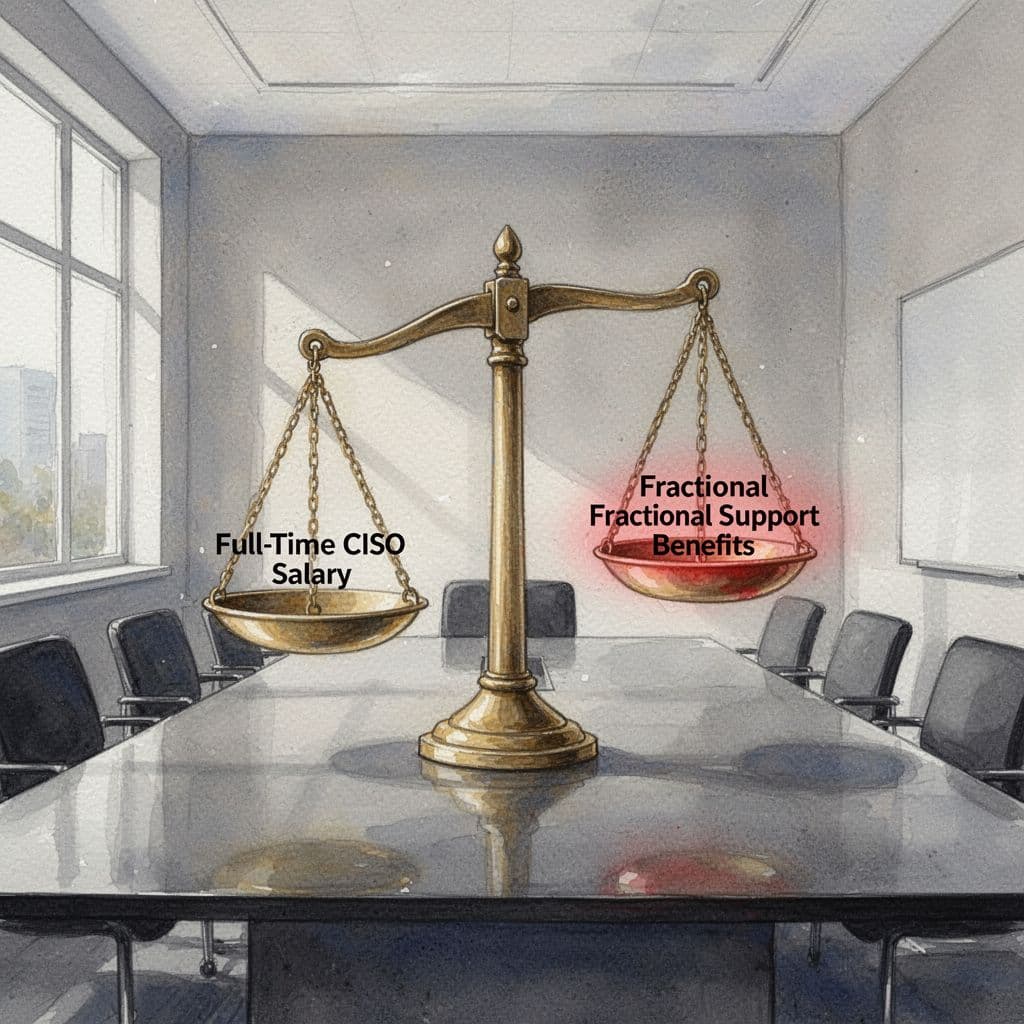
A full-time CISO can make sense when your risk profile is large, your team is mature, and security is a permanent executive function. But if you need senior leadership now and you’re not ready for a full-time seat, fractional support is often the cleaner move.
That’s especially true when the bigger issue is a leadership gap, not just a security gap. In that case, the business needs someone who can bring order quickly and help you decide what comes next.
Compare salary, benefits, and hiring delay against fractional support
A full-time hire is never just compensation. You also carry recruiting costs, onboarding time, and the chance that the role lands at the wrong altitude for where your business is right now.
Fractional support gives you executive-level help without locking into a permanent payroll decision too early. That can be the smarter move when the problem is urgent, but the long-term structure is still unclear.
Think about the cost of risk, not just the invoice
A lower monthly fee can still be expensive if it leaves you exposed. Weak security decisions can lead to downtime, rework, legal trouble, lost trust, or a board that no longer believes the current plan is working.
You don’t need dramatic language to see the point. Poor visibility costs money. Slow decisions cost money. Unclear ownership costs money.
Fractional support can bridge a leadership gap quickly
If you need someone to stabilize the situation while you decide whether a permanent hire makes sense, fractional support can buy you time without buying confusion.
It gives you a clearer picture of what you actually need, not just what sounds good on paper.
Questions to ask before you sign an agreement
Before you agree to a fractional CISO arrangement, get clear on scope. That one step protects your budget better than almost anything else.
Ask these questions:
- What is included in the fee, and what costs extra?
- How often will we meet?
- How quickly do you respond to urgent issues?
- What deliverables will we receive?
- Will you help with board reporting?
- Will you review vendors, policies, and incident readiness?
The answer should be plain. If it isn’t, keep asking.
Ask what is included and what costs extra
Watch for extra meetings, urgent calls, travel, project work, and incident support. Those can all change the total cost fast.
A clear scope keeps the budget honest. It also keeps the relationship cleaner once the work starts.
Make sure the role fits your real needs
Some companies need a strategic advisor. Others need a hands-on executive who can step in, make decisions, and help the team move.
Price matters, but fit matters more. The wrong level of support is still the wrong support, even if the rate looks good.
Conclusion
The real answer to how much a fractional CISO costs is tied to the problem you need solved. If you need a few hours of advice, your budget should look different than it would for ongoing oversight, board reporting, or urgent risk work.
The best budget is the one that matches your risk, your goals, and the level of leadership your team needs right now. If you start with scope and priorities, you’ll make a cleaner decision and avoid paying for the wrong kind of help.
If you want a clearer read on what support makes sense, start with one focused conversation and get the facts on the table.