
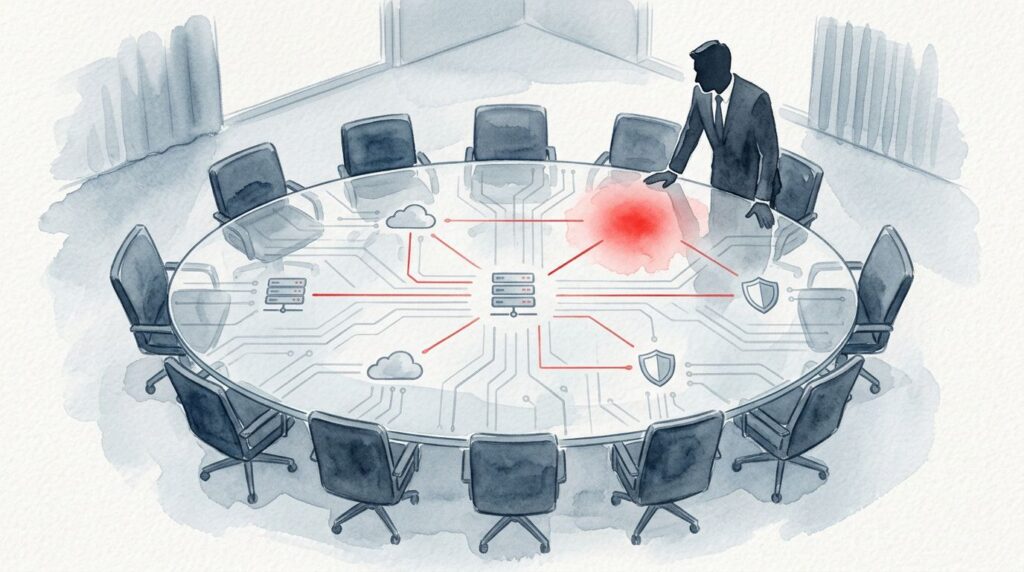
Technology risk gets hard to see when everyone is busy and no one owns the whole picture. You end up with dashboards, vendor updates, and board slides, but still no clear answer to one simple question: what could actually hurt the business this quarter?
That is where technology risk visibility matters. You do not need more noise. You need a cleaner read on what is exposed, who owns it, and what would break if something fails.
Key takeaways for busy CEOs
- Visibility is a leadership problem first. If ownership is fuzzy, the risk stays fuzzy.
- Boards need business impact, not technical clutter. Clear reporting beats long reporting.
- A fractional CTO or interim CTO can close the gap fast. You do not always need a full-time hire to get control.
If you cannot explain the risk in plain English, you do not have visibility yet.
Why technology risk disappears inside growing companies
The problem usually starts with success. Growth adds tools, vendors, exceptions, and workarounds. Before long, your team is managing tool sprawl, shadow IT, and technical debt while still trying to move fast.
That is how risk gets buried. It hides inside vendor contracts, access gaps, weak reporting, and systems no one really owns. It also shows up in the places leaders hate most, such as cyber exposure, data quality, and project drift.
You can see the same pattern in the market. CEOs are paying more attention to AI governance, ransomware readiness, and third-party risk management because those issues are no longer isolated IT concerns. They are business issues. For a broader board-level view, Deloitte’s guidance on the technology risk landscape is a useful reminder that boards need to see resilience, recovery, and risk appetite together.
That lines up with 2026 board priorities around tech resilience, where visibility into vendors, critical systems, and dependencies is now central.
Build a risk picture the board can use
Board-level visibility should answer a few plain questions. What matters most right now? Who owns it? What breaks if it fails? What are you willing to accept?
That is the core of technology governance for CEOs and technology governance for boards. It is also the difference between a useful risk view and a stack of reports nobody trusts.
A simple board-ready structure helps. It can live in a board-ready risk summary, a board cybersecurity reporting pack, or a one-page view tied to a 12-month technology roadmap.

| What the board asks | What the report should show |
|---|---|
| What changed? | The top risks that moved since last month |
| Who owns it? | A named business owner, not a vague department |
| What is exposed? | Systems, vendors, data, and customer impact |
| What is the tradeoff? | Cost, delay, compliance, or resilience impact |
Board-ready reporting should stay short and sharp. Board technology reporting, board-ready technology reporting, and cyber risk reporting to the board should not sound like an engineering log. They should sound like leadership knows where the risk sits and what to do next.
That is also where cyber risk appetite matters. If you have never said how much downtime, data loss, or vendor exposure is acceptable, every decision turns into a negotiation.
The real issue is often a technology leadership gap
If no one owns the strategy, the tools will not fix it. That is where executive technology leadership and fractional technology leadership matter.
You may need a fractional CTO, interim CTO, outsourced CTO, virtual CTO, or part-time CTO. In some cases, the right fit is a fractional CIO, fractional CISO, virtual CISO, or interim CISO. The label matters less than the outcome. You need someone who can connect business goals, risk, delivery, and ownership.
If you are still asking how to hire a CTO, pause first and ask whether you need technology leadership before hiring. Many mid-market teams do not need a full-time executive yet. They need better direction now. If that sounds familiar, fractional CTO services may fit the moment better than a long search cycle.
You can also start by reading when to hire a fractional CTO. That question is often cleaner than the one about job titles.
What better control actually looks like
Better visibility is not about one giant platform. It is about a tighter operating rhythm. That includes a systems inventory, a decision rights map, and reporting leaders can trust.
It also means better third-party risk management, vendor risk management, vendor due diligence, and vendor management. If a vendor is carrying a critical workflow, you need to know that before a renewal, outage, or offboarding event forces the issue. The same goes for a vendor incident response plan.
On the cyber side, your baseline should cover cybersecurity oversight, technology risk oversight, technology risk management, technology risk management framework, business continuity planning, disaster recovery planning, incident response readiness, and access control best practices. If you are heading into a cyber insurance renewal or a fresh cybersecurity risk assessment, these questions matter even more.
You should also keep an eye on spend. Technology spend optimization, technology ROI, tech spending ROI, IT cost optimization, and IT cost reduction should show up in the same conversation as cost-per-outcome reporting. If a tool does not support growth, control, or customer trust, it probably deserves a hard look.
If you want a sharper starting point, Get an Executive Technology Clarity Check. It is useful when technology decisions feel scattered, risky, or too dependent on the wrong people.
Conclusion
You do not get better visibility by asking for more dashboards. You get it by narrowing the questions, naming owners, and making risk visible in business terms.
That means clearer technology strategy, a real business-aligned technology strategy, and reporting that shows what matters now. It also means knowing when a technology leader for growing companies needs to step in before the next problem gets expensive.
When technology risk is visible, you can lead with less guessing and more control. That is the point.
FAQ
What is the fastest way to improve technology risk visibility?
Start with a systems inventory, a vendor list, and named owners. Then build a short board-ready view that shows exposure, impact, and next decisions.
Do you need a full-time CTO to get better visibility?
Not always. Many companies are better served by a fractional CTO or interim CTO services first, especially during growth, transition, or rising risk.
What should board reporting include?
Keep it focused on risk appetite, top exposures, ownership, progress, and tradeoffs. If it reads like an operations log, it is too detailed.