

If you're sitting in a board meeting looking at a polished transformation deck and still can't tell who owns the outcome, what risks matter, or how value will be measured, your instincts are right. The problem usually isn't the technology. It's that the board is being asked to approve spend without installing a system of oversight.
That's why board advisor digital transformation work matters. Not as a ceremonial layer of expertise, but as a governance function. The board doesn't need to learn cloud architecture, data pipelines, or AI tooling. It needs to make execution inspectable.
Most boards are still too passive here. They approve the ambition, accept vague milestones, and hope management will sort it out. Then the updates drift into activity theatre. More vendors. More pilots. More jargon. Less clarity.
What changes outcomes is simple to say and harder to enforce. A board advisor should help the board define decision rights, demand evidence, and tie technology work to risk reduction and business value.
Why Digital Transformation Fails at the Board Level
The familiar scene is this. Management asks for a large budget. The slides are clean. The language sounds modern. AI, automation, customer experience, platform, data, operating model. Yet the answers to basic board questions are still weak.
What exactly are we fixing?
Who decides when scope changes?
What are we stopping to fund this?
How will we know, in plain business terms, whether this is working?
That discomfort is healthy. Boards should trust it.

The failure is usually governance, not code
Digital transformation has a brutal track record. The failure rate ranges from 70% to 95%, with waste estimated at up to $2.3 trillion in 2024 from poorly managed programs, according to the Advisory Board Centre's analysis of digital transformation advisory boards.
Boards hear that and often conclude the work is inherently unpredictable. I don't buy that. Difficult, yes. Uncertain, yes. But the bigger pattern is governance failure dressed up as technology complexity.
A transformation becomes dangerous when the board approves three things without demanding three others.
- It approves funding without requiring clear value measures.
- It approves strategy without setting decision rights.
- It approves urgency without defining risk controls.
That's the black box. Once that box exists, management reporting becomes a recital of milestones rather than proof of control.
Practical rule: If the board can't see how decisions are made, it can't honestly say it's overseeing the transformation.
Why boards get drawn into the wrong conversation
Many boards still let the discussion drift toward tools. Which platform. Which integrator. Which vendor promise. Which dashboard. Those are management questions until they become risk, control, concentration, or capital allocation questions.
The board's real concern is narrower and more serious.
Is the business solving a material problem?
Is there an accountable executive structure?
Are we creating a new dependency we don't understand?
Are people adopting the change?
That's where a good board advisor digital transformation approach earns its keep. It keeps the board focused on governance, not gadgetry.
A lot of general best-practice commentary misses this distinction, though some useful insights from AssistGPT Hub on digital transformation best practices can help sharpen the conversation around execution discipline. Still, best practice is not enough. Boards need an oversight system.
Approval is not oversight
I've seen boards mistake budget approval for stewardship. It isn't. Approval is a moment. Oversight is a rhythm.
If the board only sees the work at funding time and after a miss, it's already late. By then, the shape of failure is familiar. Scope has spread. Vendors have multiplied. Owners are fuzzy. The business case has been diluted into language like "strategic enablement" and "future readiness."
That is exactly why so many digital roadmaps stall once early energy fades. The pattern is explored well in this analysis of why most digital roadmaps fail in year two and how to protect yours. Year two problems rarely begin in year two. They begin at approval, when governance is too light.
The board's job is to make execution legible
A board advisor should reframe the board's role from passive approver to architect of oversight. Not operator. Not project manager. Architect.
That means the board should insist on:
- A defined business mandate tied to specific operational or commercial outcomes
- A named decision structure for spend, scope, risk, and sequencing
- A small set of trusted measures that show value, risk, and adoption
- A predictable reporting cadence that surfaces exceptions early
- Evidence of management control rather than confidence alone
When a board says yes to transformation, it should also say yes to the governance system that will keep the work honest.
Without that, the board isn't supervising a transformation. It's financing a story.
The Three Jobs of Board-Level Digital Oversight
Boards don't need a longer checklist. They need a clearer division of labor. In practice, board-level oversight in transformation comes down to three jobs. If those jobs are done well, management has room to execute and the board has real visibility. If they're done poorly, everyone ends up arguing over status reports.
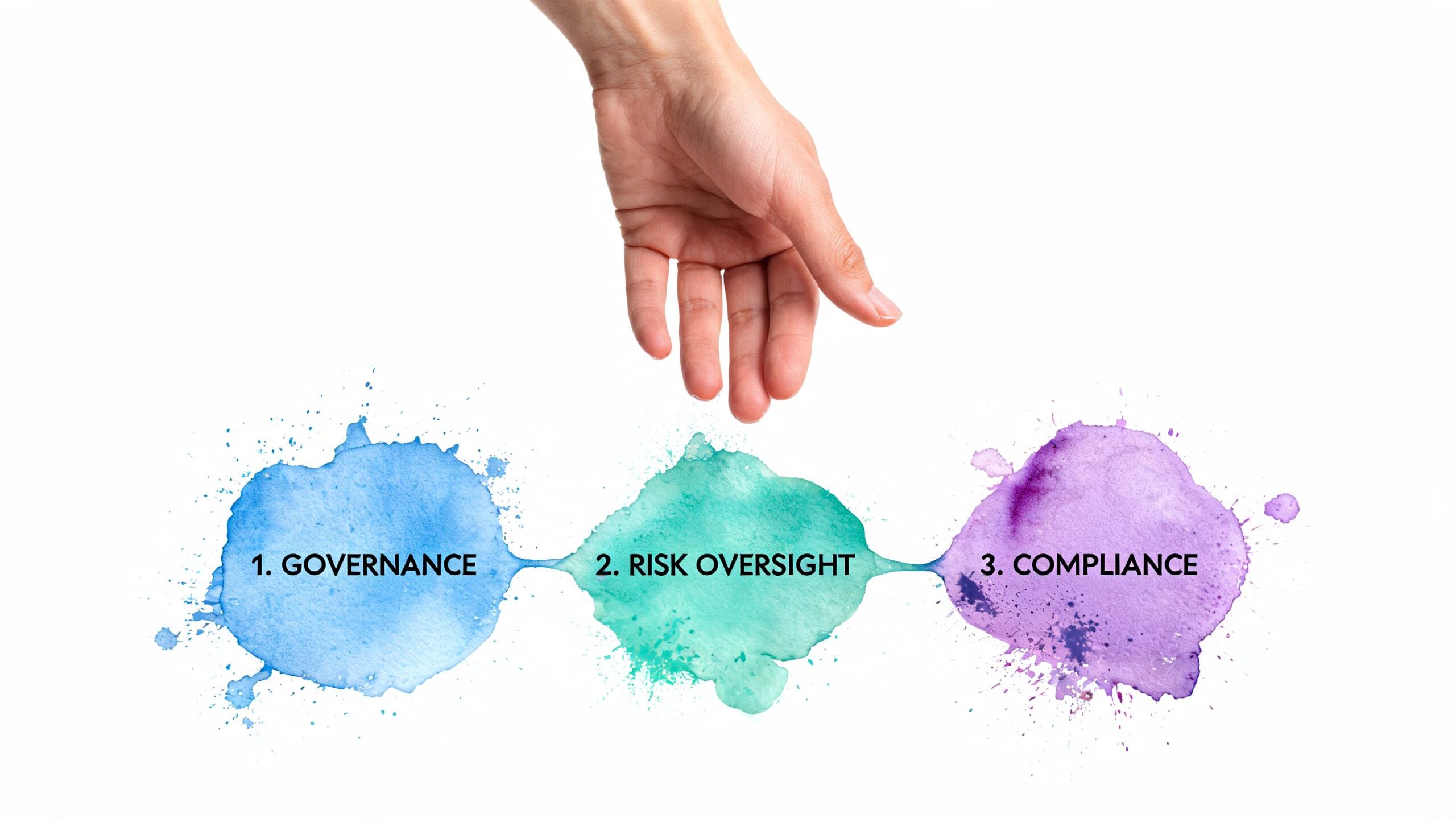
Job one is to assess maturity and set the mandate
Most transformation programs start too high up the stack. The board hears about target architecture, AI ambition, digital customer journeys, and platform modernization before anyone has shown whether the data, process ownership, and operating cadence are fit for purpose.
That sequencing is reckless. Data from The Executive Outlook on why digital transformation projects fail before they start says 73% of digital initiatives fail to deliver expected ROI because they skip foundational steps.
The board's first job is to stop that.
Before approving major spend, insist on a maturity view that covers four plain questions:
- Data. Can management explain where critical data sits, who owns it, and whether it can be trusted?
- Process. Are the core workflows stable enough to digitize, or are we automating confusion?
- Ownership. Is there one accountable executive, not a committee of partial owners?
- Execution rhythm. Does management have a working cadence for decisions, escalation, and adoption?
The output here shouldn't be a glossy roadmap. It should be a blunt mandate. What business problem is being solved, what constraints matter, and what conditions must be true before scaling the next layer of spend.
A weak mandate sounds like this: modernize the business.
A usable mandate sounds like this: reduce service friction, tighten reporting integrity, and simplify the operating model in the functions creating the most drag.
Job two is to govern decisions and risk
Once the mandate is set, the board's second job begins. It must make sure management is operating inside a disciplined decision system.
Many transformations often go astray. Leaders assume the team will sort out trade-offs as they go. They don't. Not cleanly. In the absence of decision rights, vendors shape direction, strong personalities override sequence, and urgent local needs hijack enterprise priorities.
The board should demand clarity on a few decision classes:
| Decision class | Board concern | Evidence the board should require |
|---|---|---|
| Strategic scope | Is the initiative still solving the approved business problem? | A current scope statement with explicit inclusions and exclusions |
| Capital allocation | Are we funding the highest-value and highest-control moves first? | Sequencing logic tied to business and risk outcomes |
| Risk acceptance | Which risks are being tolerated, by whom, and for how long? | Named owners, review dates, and mitigation plans |
| Vendor dependence | Is one supplier quietly controlling the roadmap? | Contract visibility, exit options, and internal capability coverage |
The point isn't to centralize every choice at board level. It's to make sure the important choices aren't happening by accident.
A transformation without explicit decision rights doesn't stay strategic for long. It becomes political.
Job three is to measure value and enforce accountability
The third job is where boards often get misled. Management reports activity because activity is easy to count. Workstreams launched. Sprints completed. Licenses deployed. Workshops held. Those aren't outcomes. They're motion.
The board should ask for metrics that answer three different questions.
First, are we reducing material business friction?
Second, are we controlling risk as complexity changes?
Third, are people using the new way of working?
A sound board advisor digital transformation model pushes reporting away from technology vanity metrics and toward operational proof. That means management should be able to connect a change in technology or process to something leadership cares about: profitability, control, speed, customer experience, or resilience.
A few examples of better board questions:
- Value. What business result improved, and how do we know the transformation contributed?
- Forecast discipline. Are benefits and timelines holding, or are we normalizing drift?
- Accountability. Which executive owns each major benefit, risk, and dependency?
- Adoption. Where is behavior changing, and where is it being resisted?
What the board should produce
The board's output is not technical guidance. It is governance clarity.
That usually means producing or demanding these five artifacts:
- A transformation mandate written in business language
- A maturity assessment grounded in current operational reality
- A decision-rights map for scope, spend, risk, and vendors
- A board reporting pack focused on value, adoption, and exposure
- An accountability model with named executive owners
If those aren't in place, the board isn't overseeing a transformation. It's sponsoring an aspiration.
Establishing Your Governance Rhythm and Key Questions
A board doesn't need more updates. It needs a rhythm that produces signal. That's the difference between watching a program and governing it.
Most reporting packs are built for management. They describe activity. Board reporting should do something else. It should tell directors whether control is improving, risk is moving, and value is becoming more or less credible.
Management reporting is not board reporting
Management needs detail. The board needs judgment.
That distinction matters because many boards get buried in the wrong material. They receive dense project plans, technical status notes, vendor timelines, and delivery commentary, then still can't answer basic oversight questions.
A useful board pack should surface only what belongs at board level:
- Decision exceptions that need escalation
- Risk shifts that affect the enterprise
- Value movements against the approved case
- Adoption signals that show whether the change is taking hold
- Dependency issues involving vendors, data, or key people
As Kons Law's corporate governance insights remind leaders in a broader governance context, good governance isn't just authority on paper. It's a structure for decision-making, accountability, and oversight. The same logic applies here.
If a board pack tells you what happened but not whether you're in control, it's the wrong pack.
Set decision rights before the pressure rises
Decision rights shouldn't be invented mid-crisis. By then, people reach for hierarchy, habit, or whoever shouts loudest.
The board should require a simple decision map that sorts matters into three buckets.
Reserved to the board
These include material changes in investment level, significant scope changes, major risk acceptance, and concentration risk that could affect resilience, reputation, or diligence.
Delegated to executive leadership
These are operating choices about sequence, staffing, vendor execution, process redesign, and implementation detail, provided they stay within the approved guardrails.
Escalated by exception
These are issues that management can handle until specific thresholds are crossed. Examples include delivery slippage that threatens strategic timing, adoption weakness in a critical function, or a vendor dependency that narrows exit options.
Many boards benefit from a cleaner reporting standard such as the one outlined in this guide to board technology reporting. The principle is simple. Directors need reporting that clarifies ownership and exposure, not more operational noise.
Ask about people, not just platforms
A large share of transformation failure sits with adoption, resistance, and weak change handling. As MeltingSpot's review of why digital transformation projects fail notes, 70% to 95% of failures are rooted in human factors like resistance to change and poor adoption, and 70% of enterprises have no visibility into technology adoption.
That should change the board's line of questioning.
Don't just ask whether the system is live. Ask whether the intended users changed behavior.
Don't just ask whether training happened. Ask where usage is lagging and what management is doing about it.
Don't just ask whether communications went out. Ask whether leaders across functions can explain the "why" in the same language.
The checklist that keeps oversight honest
A practical board advisor digital transformation rhythm often relies on a short checklist reviewed consistently rather than a sprawling pack reviewed occasionally.
| Governance Area | Key Question for the Board | Desired State / Evidence |
|---|---|---|
| Mandate clarity | Is the transformation tied to a specific business problem and a limited set of outcomes? | A concise business mandate approved by the board |
| Executive ownership | Is one executive clearly accountable for delivery across functions? | Named owner with authority across business and technology teams |
| Decision rights | Do we know which decisions belong to the board, management, and exception escalation? | A current decision-rights map used in governance meetings |
| Data governance | Can management explain ownership, quality expectations, and critical dependencies? | Defined owners, known issues, and remediation priorities |
| Vendor control | Are suppliers supporting the roadmap rather than shaping it? | Contract visibility, capability coverage, and exit considerations |
| Adoption visibility | Can we see whether people are using the new process or tool as intended? | Consistent adoption measures and action plans where usage lags |
| Value tracking | Are we measuring business outcomes instead of implementation activity? | Reporting tied to operating results, control improvement, or customer impact |
| Risk controls | Are major risks named, owned, and reviewed on a cadence? | A board-facing dashboard with current exposure and mitigation status |
Build a calm cadence
The cadence itself should feel dull in the best sense. Predictable. Short. Evidence-based.
A sensible rhythm usually includes:
- A regular committee review focused on risk, value, and decisions
- Clear exception triggers that force early escalation
- Named owners for every material risk and dependency
- A standing review of adoption so the board can see whether behavior is changing
- A periodic challenge of the business case rather than treating the original case as sacred
Boards don't need to run the program. They need to make sure management cannot hide inside it.
When this rhythm is installed, board conversations improve quickly. Less decoding. Fewer surprise requests. More direct trade-off decisions.
Your 30-90-12-Month Action Plan
Boards often know the current oversight is thin. What they lack is a clean starting sequence. That's where a board advisor digital transformation playbook should be practical, not conceptual.
Start by making the current reality legible. Then install the operating system for oversight. Then keep using it long enough to shape capital allocation and executive accountability.
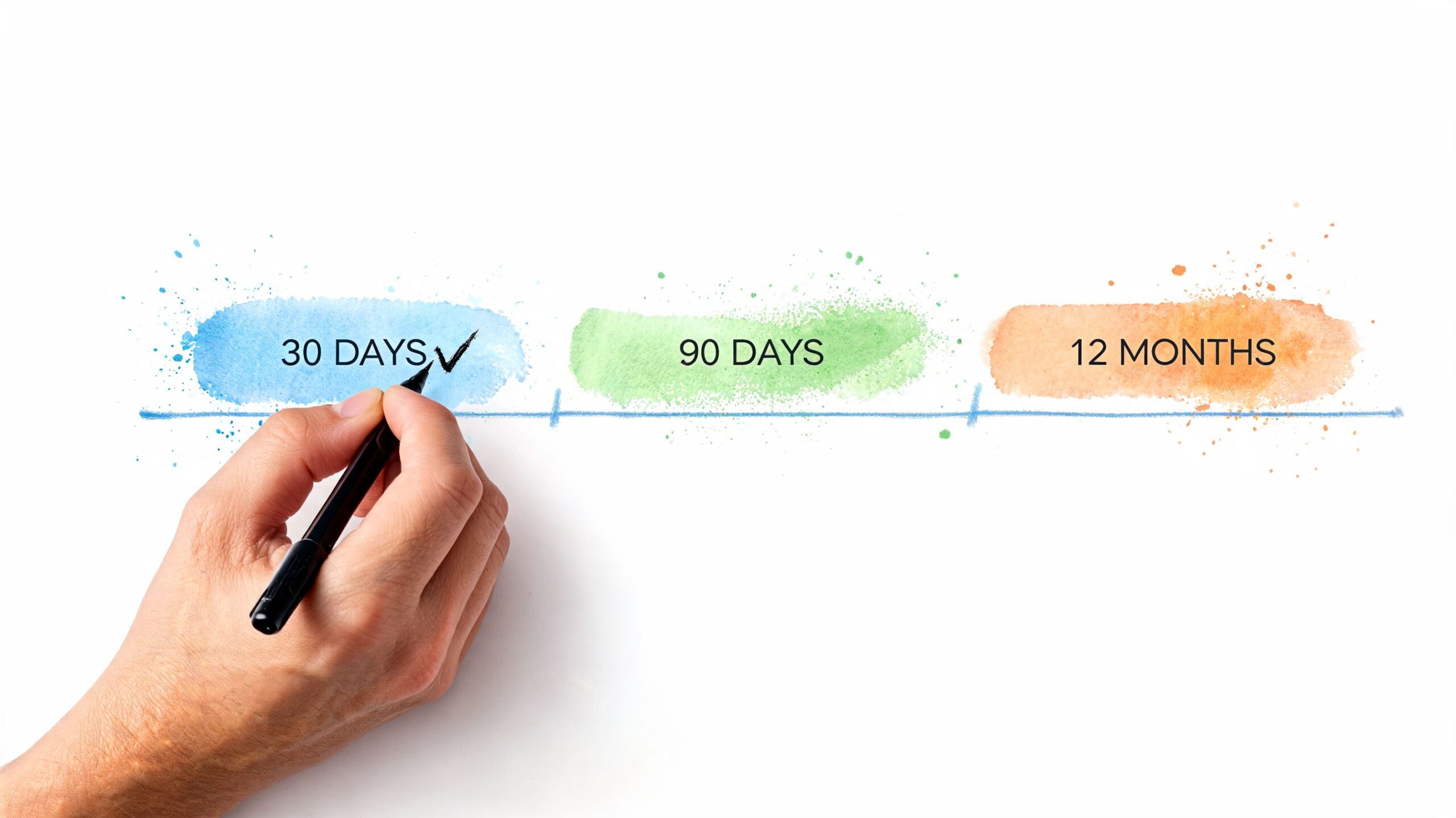
In the first 30 days, get the truth on one page
The first month is not for redesign. It's for visibility.
Ask management for a reality map. Not a strategy deck. A current-state map of active initiatives, committed spend, major vendors, known risks, unresolved dependencies, and named decision owners. If management can't produce that cleanly, you've already found a governance problem.
Require a short briefing on these points:
- Current portfolio of transformation-related work
- Business rationale for each active initiative
- Ownership gaps where accountability is shared or unclear
- Risk concentrations around data, vendors, key staff, or compliance exposure
- Reporting weaknesses where the board is receiving activity instead of evidence
At this stage, don't ask for optimism. Ask for legibility.
Board move: Freeze new transformation labels until the board can see what is already in flight, who owns it, and how value is meant to appear.
In the first 90 days, install the system
Once the baseline is clear, use the next quarter to put governance in place. This is the moment to define the board's operating rhythm, not wait for another budget cycle.
That means:
- Approve the business mandate for the transformation in plain language.
- Set decision rights for scope, spend, risk acceptance, and vendor commitments.
- Define the board pack so it reports value, control, adoption, and exceptions.
- Name the executive owner with genuine cross-functional authority.
- Prioritize early moves that reduce risk or simplify delivery before layering in more complexity.
This is also the right time to challenge the sequence of work. If management is trying to scale advanced tooling on top of poor data, brittle processes, or fuzzy ownership, stop it. Fix the base first.
For boards that need a better structure for that conversation, a board-ready tech roadmap is a useful model. It forces technology ambition to pass through governance discipline before it gets funded as strategy.
Over 12 months, move from supervision to stewardship
Digital transformation is a top priority for 87% of senior executives, and the global market is projected to exceed $1 trillion by 2025, according to Boardroom Advisors on digital advisory boards. That scale alone should end the idea that boards can treat this as a one-off approval exercise.
Over the first year, the board should use its new visibility to do three things well.
First, make sharper trade-offs. Once the board can see which initiatives are producing value and which are producing noise, capital allocation improves.
Second, challenge drift. Every transformation attracts add-ons, pet requests, and vendor-led expansions. The board should be willing to narrow scope to protect outcomes.
Third, improve confidence across the full board. Committee work should feed a simple board-level narrative: what problem is being solved, what value is emerging, where the risks sit, and what decisions are next.
A well-run first year doesn't look dramatic. It looks calmer. Fewer surprises. Better questions. Tighter ownership. More credible reporting.
What Better Looks Like and the Red Flags to Watch For
Well-governed transformation feels different in the boardroom. The discussion is cleaner. Directors aren't trying to decode technical language or infer risk from polished slides. They can see the shape of the work, the logic of the decisions, and the evidence behind management's claims.
That's what better looks like. Not perfection. Control.
The signs you're in a better place
When governance is working, board discussions become more strategic because the basic oversight questions have already been answered. The board knows who owns the work. It knows where the risks are. It can test trade-offs without descending into operational noise.
You also see a change in management behavior.
- Leaders explain the work in business terms rather than technical abstraction.
- Risks are surfaced early instead of buried until they become awkward.
- Value reporting improves because measures are tied to business outcomes, not implementation effort.
- Vendor conversations become firmer because the company knows its own priorities and dependencies.
Better governance doesn't make transformation easy. It makes it inspectable.
The red flags that should concern any board
The warning signs are usually visible before the project is visibly in trouble. Boards miss them because the language still sounds confident.
Watch for these patterns:
Activity without outcome
The update is full of launches, workshops, and milestones, but thin on business value, control improvement, or adoption.Shared accountability
Several executives are "supporting" the program, but none clearly owns the result.Vendor-shaped strategy
The roadmap starts to look suspiciously like the supplier's product strategy rather than the company's operating priorities.Changing story
The rationale keeps shifting. Cost reduction becomes growth. Growth becomes resilience. Resilience becomes innovation. That usually means the original mandate wasn't disciplined enough.Weak adoption visibility
Management can say the tool was deployed but can't show whether teams are using it properly or where resistance sits.Board packs that grow as clarity shrinks
More pages. More dashboards. Less certainty.
The simplest test
Ask one direct question of the executive owner and one of the board chair.
Can you explain, in plain language, what this transformation is meant to change, how progress is judged, and what risk most concerns you right now?
If either answer wanders, governance needs work.
From Board-Level Anxiety to Board-Level Confidence
The board does not need to become technical to govern digital transformation well. It needs to become disciplined. That means treating transformation as a matter of oversight architecture, not just strategic enthusiasm.
The shift is straightforward. Stop acting as a funding gate. Start acting as the body that installs decision rights, reporting standards, risk controls, and value accountability.
That is the core function of board advisor digital transformation work. It turns a vague, high-cost, high-anxiety initiative into something the board can inspect with confidence. Not because the risk disappears, but because the organization can finally show how decisions are made, how problems surface, and how value is expected to appear.
If the current program still feels like a black box, don't ask for better slides. Ask for a better governance system.
If your board is getting vague answers on technology spend, risk, or transformation progress, a conversation with CTO Input can help clarify what is happening, where ownership is weak, and what a board-defensible oversight model should look like.