

A quarterly business review should answer one simple question fast, is technology helping the business, or quietly taxing it?
If you walk out of the meeting with a pile of updates and no decisions, you wasted the hour. You do not need more vendor talk. You need clearer visibility into spend, risk, ownership, and the next set of CEO technology decisions.
That matters even more when growth is moving fast, the board is asking harder questions, or you are dealing with a technology leadership gap. A quarterly business review ensures strategic alignment between the board’s expectations and the actual technology roadmap. This is where a real business-aligned technology strategy starts to show up in the room.
Key takeaways for your quarterly business review
If you only keep four things in view, keep these:
- The review is a check on key performance indicators for technology, not a status parade.
- Spend, roadmap, and risk belong in the same conversation.
- Boards need board-ready reporting, not data-driven decisions.
- If nobody owns the next decision, you have a leadership problem, not a reporting problem.
Start with the business questions that matter
You should start with what changed for the business objectives, not what changed in the stack. Did technology speed up sales, slow down delivery, reduce friction, or create new workarounds? Those are the questions that matter.
A good quarterly technology review also checks whether your technology priorities for growing companies still match reality. The quarterly business review is the primary vehicle for assessing product adoption of new systems. That means looking at founder-led technology decisions, COO technology strategy, and the broader technology decisions for growth. If the company is still running on informal habits, the meeting should say that out loud.
This is also where executive technology leadership matters. Without it, the review becomes a report. With executive participation, the review becomes a management habit.
If you want a useful benchmark for the meeting shape, what to expect from a quarterly IT review agenda is a decent starting point. Your version should go further, because you are not reviewing tickets. You are checking whether the business can move with confidence.
Use a short agenda the room can prepare for
A strong quarterly business review, functioning as an executive business review for the tech stack, has a simple shape. Keep it short enough that people prepare, then use the same structure every quarter. That is how a quarterly technology review turns into a technology operating rhythm instead of another calendar invite.
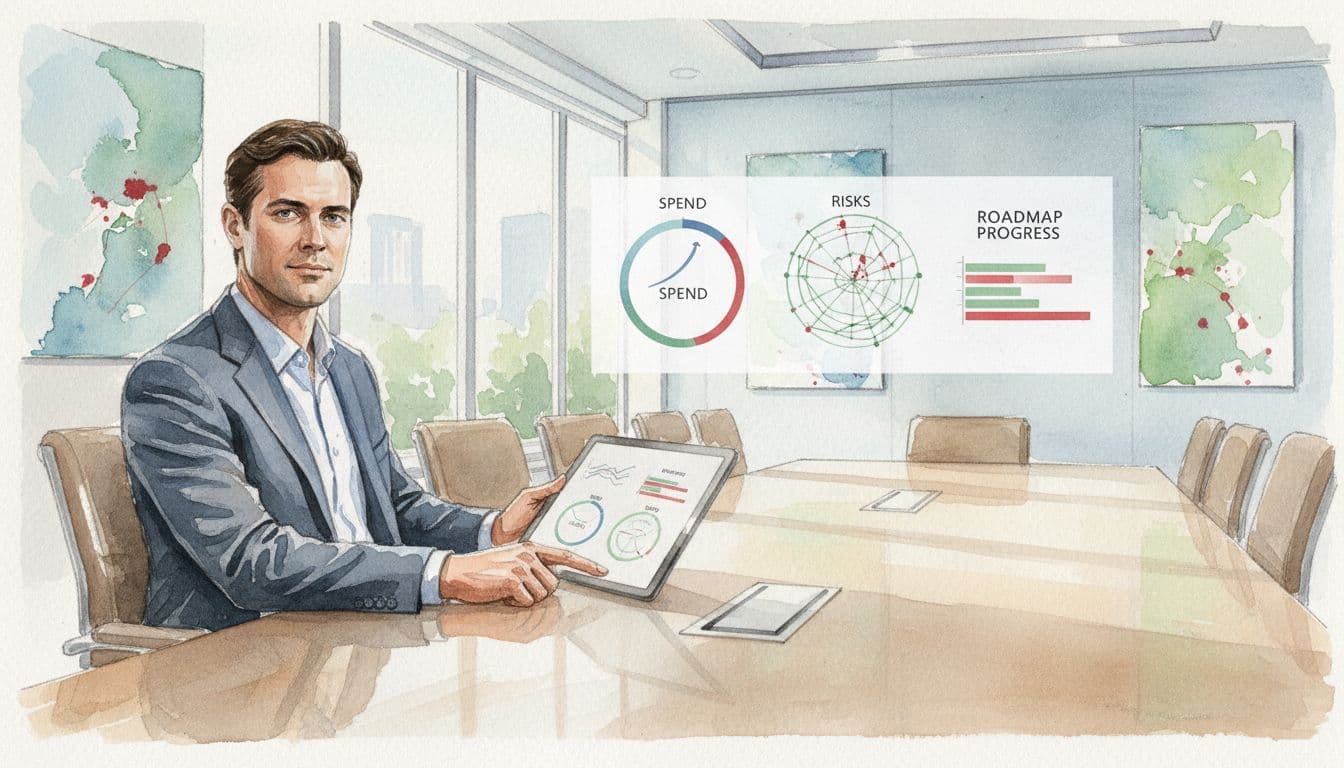
| Topic | What you need to hear | Typical owner |
|---|---|---|
| Business outcomes | What improved, what slipped, what blocked revenue or service | CEO or COO |
| Spend | Where money went, what changed, and what no longer earns its keep | CFO, technology leader, managed IT services |
| Risk | Cyber, vendor, data, continuity, and access issues | CTO, CISO, or ops leader |
| Roadmap | What changes in the next 90 days and why | CEO and tech lead |
If a row has no owner, it should not stay on the list.
The best meetings feel like executive technology leadership, not a support review. They are about decisions, not drama. They also force decision rights to the surface, which is where many companies discover that nobody really owns the call. The meeting should end with clear action items to ensure ownership.
Review roadmap, spend, and risk together
This is where the meeting earns its keep. Your roadmap should be a one-page technology strategy at minimum, then a future roadmap with a clear 90-day technology plan inside it. If your team cannot translate the work into a simple technology roadmap template, the plan is too vague.
That same quarterly business review should test whether your business-aligned technology strategy still matches the business, including key metrics like customer health score. A quarterly business review that aligns IT strategy with business growth does not chase activity for its own sake. It connects spend to outcomes and return on investment.
That means board technology reporting, board-ready technology reporting, and board-ready reporting in your quarterly business review. It also means a board-ready tech roadmap, not a slide deck that nobody trusts. If the board wants a clean view, give them one. If the board needs a board-ready risk summary with cybersecurity measures, put that in the packet too.
The same quarterly business review conversation should cover board cybersecurity reporting, cyber risk reporting to the board, cyber risk appetite, cybersecurity oversight, technology risk oversight, and a practical technology risk management framework.
Then look at third-party risk management, third-party risk reporting, vendor risk management, vendor management, vendor due diligence, and vendor offboarding. If a vendor can break your month, your review needs a vendor incident response plan too.
Do not skip performance management software consolidation, shadow IT, technical debt, technical debt management, and technology debt. Add application portfolio rationalization, software platform evaluation, technology vendor selection, technology due diligence, technical due diligence, cybersecurity due diligence, acquisition readiness, and post-merger technology integration when they apply.
If ai-powered tools are in the mix, do not let it drift. You need AI governance, AI adoption strategy, AI transformation strategy, responsible AI, AI acceptable use policy, AI vendor due diligence, and an AI opportunity assessment. The same is true for systems inventory, data governance framework, data strategy, data quality, data privacy, and information governance.
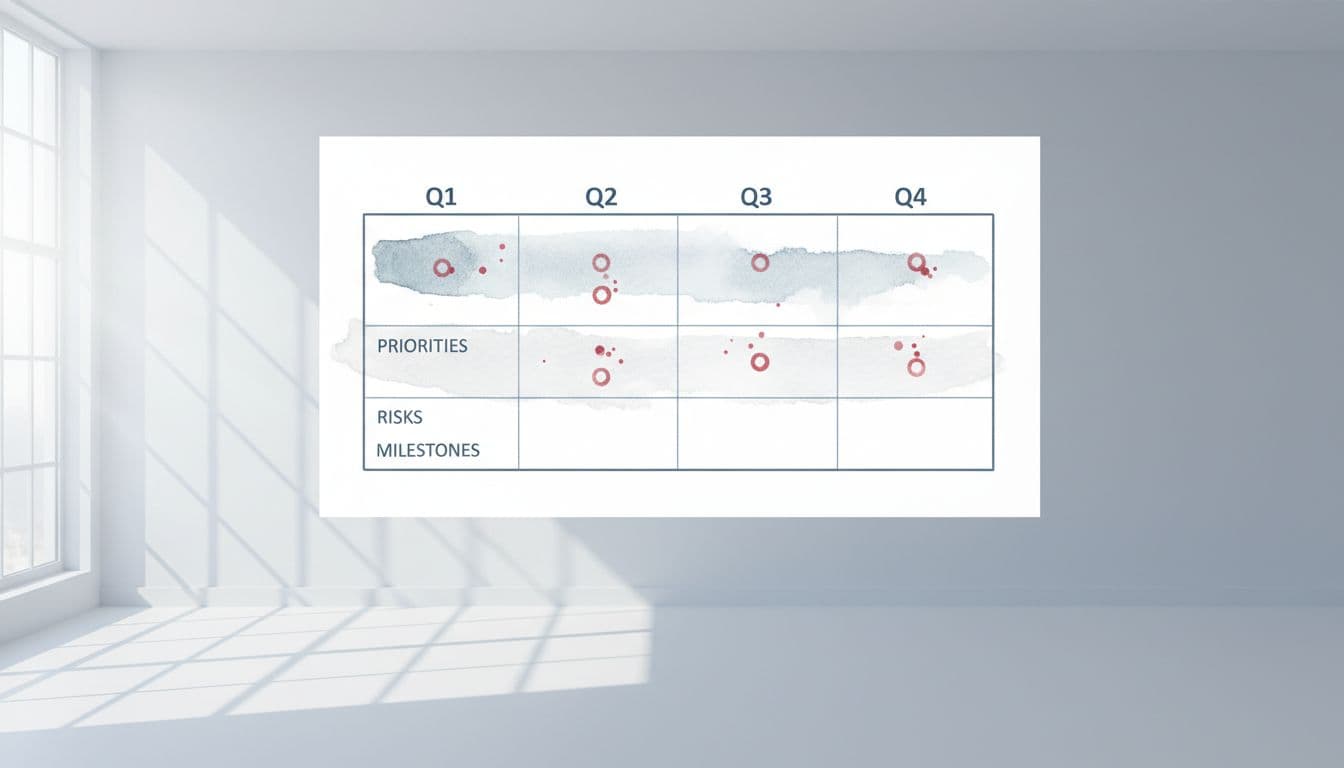
None of that is abstract. It is what keeps a business steady when pressure rises.
Turn the meeting into decisions and ownership
Talking is cheap when nobody writes down the decision. Unlike a typical quarterly performance review, end your quarterly business review with action items: who owns it, what changes by next quarter, and what gets dropped.
If the meeting turns into a status dump, you are not running a review. You are hosting theater.
This is the part leaders often skip. They like the discussion, but they avoid the cut line. Yet that is where technology spend optimization, technology ROI, tech spending ROI, IT cost optimization, and IT cost reduction show up. Automation of reporting can improve return on investment, deliver better technology dashboards, and reduce waste from work that no one would reapprove if they had to fund it again. You also get cost-per-outcome reporting.
That is also where technology strategy consulting can help, if the work is tied to decisions and not just presentations. Strategic technology planning should change what gets funded, paused, retired, or redesigned.
Use the meeting to separate noise from signal. What matters now? What can wait? What should stop? The cut line discussion produces action items you can track with performance management software. If you do not ask those questions, the business will keep paying for stale priorities.
When the review exposes a technology leadership gap
Sometimes the review exposes the real issue. You do not have a tooling problem. You have a technology leadership gap.
That is where the right model matters. Some companies need fractional CTO services to elevate their quarterly business review. Some need interim CTO services because the seat is open or the situation is urgent. In bigger risk-heavy moments, a fractional CIO or virtual CIO, with a focus on relationship building between the virtual CIO and the CEO, fractional CISO, virtual CISO, or interim CISO may be part of the answer too. The point is not the title. The point is executive technology leadership that can make decisions stick.
If you are still sorting out when to hire a fractional CTO, the answer usually shows up in the review itself. You need help when the business has outgrown informal habits, when reporting is weak, when the roadmap is unclear, or when the board wants better visibility. That is also when fractional CTO vs full-time CTO becomes a real choice, and when fractional CTO vs IT consultant stops being a theoretical debate.
This is technology leadership before hiring, not after the damage is done. It is also where technology leadership for mid-market companies, mid-market technology leadership, growth-stage technology leadership, and scaling technology leadership all start to look the same, especially since scaling QBRs is a common challenge for mid-market companies. You need someone who can connect business priorities, delivery reality, risk, and spend.
If you need help separating the signal from the noise, Get an Executive Technology Clarity Check before the next quarter goes by the same way.
Conclusion
Your quarterly technology review should leave you calmer, not busier. If it does not change ownership, sharpen the roadmap, and expose risk in plain English, it missed the point.
The best quarterly business reviews make technology easier to govern. They turn noise into decisions, deliver actionable insights that lead to immediate improvements in customer retention and operational efficiency, and give you a cleaner view of what matters before the next quarter starts.
FAQ
How long should a quarterly technology review last?
Most CEO-level quarterly performance reviews work best in 60 to 90 minutes. Long enough to cover the real issues, short enough that people come prepared.
Who should attend?
You usually want the CEO, COO, CFO, technology leader, customer success manager (if technology impacts the onboarding process), and anyone who owns major business risk or delivery. If the board needs visibility, give them the summary, not the full meeting noise.
What should you review every quarter?
Focus on business outcomes, roadmap progress, spend, vendor risk (including service level agreements and renewal cycles), cyber risk, data quality, and the decisions that need to happen next. If you run AI in the business, include AI governance and AI use cases too.
What if you do not have a CTO?
That is often the point where fractional CTO services or interim CTO services make more sense than waiting for a full-time hire. If the review keeps uncovering the same gap, the business needs executive technology leadership now, not later.