

You can spend a lot on technology and still not move the business forward. That is the trap many leadership teams fall into. The budget looks busy. The company still feels stuck.
The real question is not whether you spend enough. It is whether the spend creates growth, control, and clearer decisions. If you can’t tell whether the money is building capability or just patching holes, the budget is speaking louder than the strategy.
Start with the budget itself.
Key takeaways
- Growth spend changes what the business can do. It improves speed, customer experience, visibility, or risk.
- Maintenance spend keeps the current stack alive. That is normal, but it should not swallow the whole conversation.
- If ownership, reporting, and decision rights are fuzzy, the issue may be a technology leadership gap, not a spending problem.
The fastest test: does this spend create movement or just uptime?
In plain terms, a maintenance budget is the money it takes to keep the current stack running, from labor and licenses to fixes and replacements, as Tractian’s definition of maintenance budget puts it. Growth spend is different. It funds new capacity, cleaner execution, and better business outcomes.
That distinction matters because a budget can contain both. The problem starts when maintenance takes over and nobody notices.
| Signal | Growth-supporting budget | Keep-the-lights-on budget |
|---|---|---|
| Core question | What outcome does this create? | What breakage does this prevent? |
| Reporting | Cost-per-outcome reporting, board-ready reporting | Spend by line item, little context |
| Vendor role | Vendors fit a plan | Vendors start to define the plan |
| Decision pattern | Clear ownership and decision rights | More handoffs, more noise, more delay |
| Business result | Faster execution, better customer experience, stronger ROI | Uptime, patches, and more requests for money |
A budget that supports tech budget growth should make the business easier to run. A budget that only keeps things alive should feel temporary, not permanent.
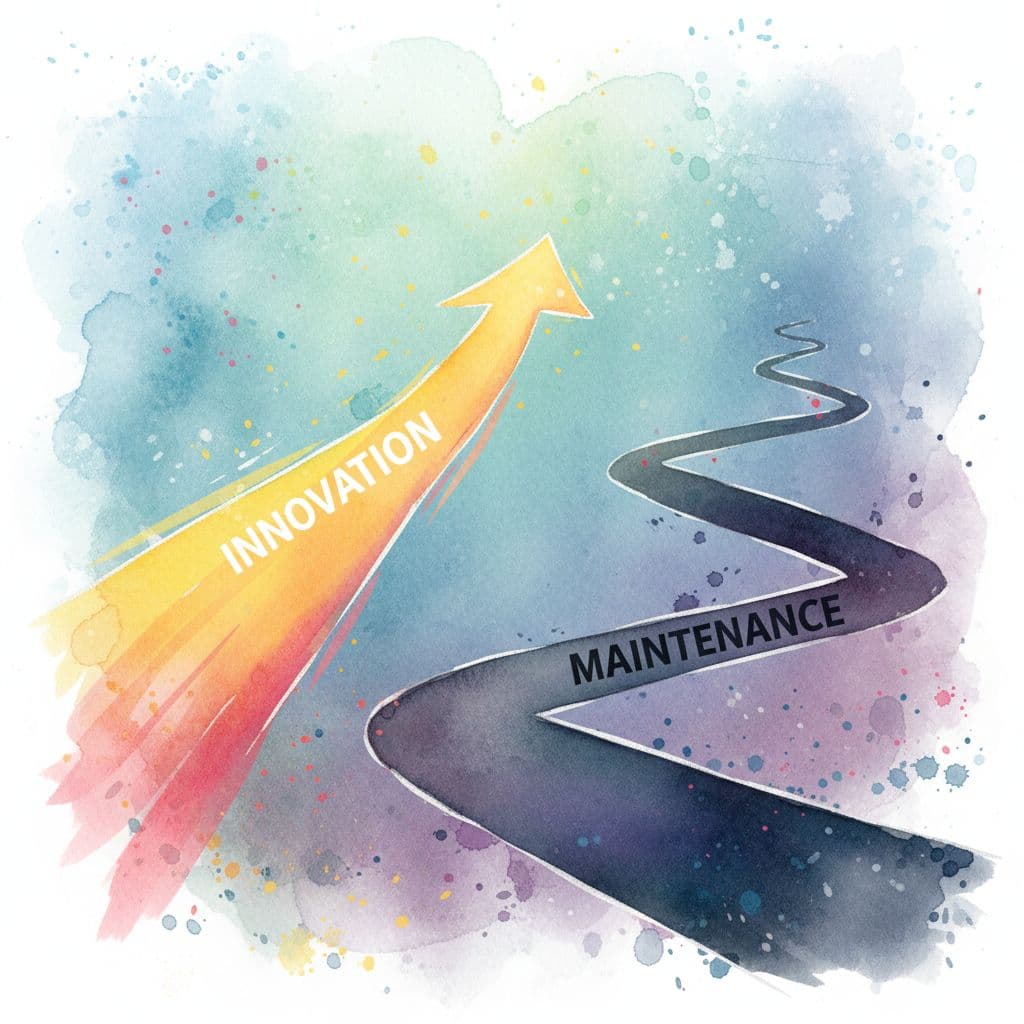
If the image feels blunt, good. That is the point. Growth budgets move. Maintenance budgets hold the line. You need to know which one you are funding before the next dollar goes out the door.
Look at outcomes, not line items
Most budgets get judged by habit. New licenses appear. Old tools stay. Contractors get renewed because no one wants to own the cleanup. Before long, you have tool sprawl, shadow IT, and technical debt sitting in the same pile as real growth work.
That is why you need cost-per-outcome reporting, not just technology dashboards. If a line item cannot be tied to revenue, risk reduction, customer trust, or operating speed, it is probably a support cost, not a growth investment.
If you can’t explain the value in business language, you probably don’t have a strategy. You have a ledger.
This is where technology spend optimization and tech spending ROI stop being finance exercises and start being leadership work. You are not just trying to cut IT cost reduction or IT cost optimization. You are trying to see what each dollar buys.
Look hard at application portfolio rationalization, software platform evaluation, and technology vendor selection. If a tool cannot survive technical due diligence, it should not be in next year’s plan. If a platform only exists because nobody wants to deal with the migration, you are paying for avoidance.
The same rule applies to AI. If AI spend is growing, you need AI governance, an AI adoption strategy, AI transformation strategy, responsible AI guardrails, an AI acceptable use policy, AI vendor due diligence, and an AI opportunity assessment. Otherwise, the budget becomes a pile of experiments with no owner.
When the budget is hiding a leadership gap
A maintenance-heavy budget often points to a deeper problem. The issue may not be cost. It may be weak technology leadership.
Maybe the company has founder-led technology decisions that worked when the business was smaller. Maybe the team needs a real technology leader for growing companies, but not a full-time hire yet. Maybe vendors are driving the roadmap because nobody inside has enough executive authority to say no.
That is where a fractional CTO, interim CTO, outsourced CTO, virtual CTO, or part-time CTO can change the shape of the conversation. These are not labels. They are different ways to close a technology leadership gap without overhiring too early.
If you need steady leadership, fractional CTO services can help you build a clearer operating picture. If the situation is urgent, fractional and interim CTO services are built for stabilization, decision support, and better control.
The same goes for cyber and data. If the real issue is governance, risk, or reporting, the answer may sit closer to a fractional CIO, fractional CISO, virtual CISO, or interim CISO. The title matters less than the result. You need someone who can turn ambiguity into decisions.
That is especially true for mid-market technology leadership, growth-stage technology leadership, and scaling technology leadership. At that stage, CEO technology decisions and COO technology strategy cannot live in side conversations anymore. They need executive technology leadership with a real cadence.
What a growth-supporting tech budget actually looks like
A growth budget is not random spend with a hopeful label. It is built on business-aligned technology strategy and strategic technology planning. It has an IT strategy and roadmap, not just a wish list.
At minimum, you should be able to point to a one-page technology strategy and a 12-month technology roadmap. If you need a template, fine. If you need a cleaner plan, better. The point is that leadership can see what is changing, why it matters, and who owns each decision.
That is also where technology governance comes in. Technology governance for CEOs and technology governance for boards should answer simple questions. What gets funded now? What waits? What risk are you carrying? What decisions need board attention?
Good board technology reporting does not bury people in detail. It gives board-ready technology reporting, board-ready reporting, and a board-ready tech roadmap that show the tradeoffs in plain language. If cyber is part of the picture, board cybersecurity reporting and cyber risk reporting to the board should be tied to a clear cyber risk appetite.
The same logic applies to technology risk oversight and technology risk management. A real technology risk management framework includes third-party risk management, third-party risk reporting, vendor risk management, vendor management, vendor due diligence, vendor offboarding, and a vendor incident response plan. If those pieces are missing, you do not have control. You have exposure.
Do not ignore the basics either. Business continuity planning, disaster recovery planning, incident response readiness, ransomware readiness, an executive incident response checklist, cyber insurance renewal, cybersecurity risk assessment, IT security assessment, access control best practices, data governance framework, data strategy, data quality, data privacy, information governance, and a clean systems inventory all belong in the budget conversation.
That is how technology becomes business-aligned technology strategy instead of a pile of disconnected expenses.
A simple 90-day reset
If your budget feels muddy, start small and get specific.
- Build a systems inventory. List every major platform, owner, vendor, and annual cost. Separate run, change, and risk. You will see tool sprawl and duplicate spend fast.
- Tie each major expense to an outcome. Use cost-per-outcome reporting. Ask what improves if you keep it, what breaks if you cut it, and who owns the result. That question clears out a lot of noise.
- Write a practical roadmap. Keep it to a 90-day technology plan and a 12-month technology roadmap. Include decisions, owners, dates, and what leadership needs to review. If you are facing acquisition readiness, technology due diligence, cybersecurity due diligence, or post-merger technology integration, get those items into the plan early.
If you want help separating signal from noise, Get an Executive Technology Clarity Check.
FAQs
How do you know your tech budget is mostly maintenance?
If most of the spend goes to keeping old tools alive, covering workarounds, and renewing vendor contracts without a clear business outcome, the budget is maintenance-heavy. That is not always bad. It becomes a problem when growth never gets a real slice.
When should you hire a fractional CTO?
When you need executive technology leadership before hiring a CTO full-time. That is usually the point when business technology strategy matters more than tactical execution, but the company is not ready for a permanent seat. It is also the right move when you are deciding how to hire a CTO or comparing fractional CTO vs full-time CTO.
What if the issue is cyber risk, not budget size?
Then you need clearer cybersecurity oversight, not just more spend. A better board-ready risk summary, stronger board cybersecurity reporting, and tighter technology risk oversight usually matter more than another tool.
Conclusion
A tech budget does not tell you much by itself. You have to read what it is funding, what it is avoiding, and who owns the decisions behind it. That is where growth becomes visible, or where it gets buried under maintenance.
If the budget only keeps the lights on, you are paying for survival. If it supports clear ownership, better reporting, and a roadmap leaders can trust, you are funding growth. That difference is worth knowing before the next budget cycle locks it in.