

Technology usually starts breaking in plain sight long before anyone names the problem.
Projects slip. Basic requests take too long. The monthly technology bill gets bigger, but leadership still can't get a straight answer on what is stable, what is risky, and what is improving. Then the board starts asking sharper questions about security, resilience, vendors, and reporting. The answers sound vague because the system behind them is vague.
That isn't unusual. It's what happens when a business outgrows informal technology management and keeps operating on memory, heroics, and tribal knowledge.
An IT maturity model matters because it gives leadership a way to make that mess visible. It turns gut feel into a working diagnosis. More importantly, it gives you a basis for action. Not a prettier scorecard. A plan with ownership, deadlines, and evidence.
Your Technology Feels Chaotic Because It Probably Is
If your leadership team spends too much time hunting for status, clarifying ownership, or chasing vendors for basic answers, your technology function is not under control.
You may have capable people. You may have decent tools. You may even have a hardworking IT manager or service provider. But if every important issue still depends on escalation, urgency, and personal intervention, the operating system is weak.
What low maturity looks like in practice
You see the same patterns over and over:
- Projects drift: delivery dates move, scope changes without notice, and nobody can explain what is blocked in business terms.
- Risk hides in normal work: access reviews, backups, vendor dependencies, and data handling all sound "probably fine" until someone asks for proof.
- Spend feels opaque: budgets exist, but they don't clearly connect to outcomes, risk reduction, or business priorities.
- Simple work becomes slow: onboarding, reporting changes, application fixes, and approvals take too many handoffs.
This is why so many leadership teams feel like they're paying a coordination tax every week. The problem isn't just technical complexity. It's weak control. If that sounds familiar, the pattern in the hidden cost of tech chaos will probably feel uncomfortably familiar.
Practical rule: If work only moves when a senior leader chases it, you don't have reliable execution. You have managed urgency.
The real gap leaders are feeling
Most CEOs and COOs don't wake up asking for a maturity assessment. They want three things: clear ownership, predictable delivery, and fewer unpleasant surprises.
That gap between what leadership needs and what technology delivers is the issue. An IT maturity model is useful because it gives you a way to inspect that gap across governance, process, roles, and execution discipline. It helps leadership stop arguing about symptoms and start naming the actual operating problem.
The point isn't to prove your team is bad. The point is to stop running an important business function like a black box.
What an IT Maturity Model Actually Measures
An IT maturity model is not a fancy inventory of servers, software, or tickets. It is a way to judge how well technology operates as a business system.
The underlying idea comes from broader process-maturity work like CMMI, which helped turn IT from a purely technical function into a measurable operating discipline tied to strategy, risk, and efficiency, as summarized in this overview of IT governance maturity models.

Think of it like a team, not a toolset
A youth sports team can have good athletes and still lose because roles are unclear, practice is inconsistent, and nobody tracks performance. Technology works the same way. Good software doesn't create a mature function. Operating discipline does.
Most modern models use five stages or close variations:
| Stage | What it feels like |
|---|---|
| Initial | Work is reactive. People rely on heroics. Meetings focus on today's fire. |
| Developing | Some processes exist, but they are inconsistent. Progress depends on who is involved. |
| Defined | Core processes are documented and repeatable. Ownership is clearer. Fewer surprises. |
| Managed | Leaders use metrics, reviews, and controls to steer performance. Delivery becomes more predictable. |
| Optimizing | The organization improves intentionally. Teams refine process, governance, and tools based on evidence. |
What leaders should actually look for
Don't ask whether the team has a roadmap. Ask whether the roadmap drives decisions.
Don't ask whether there is a security policy. Ask whether someone can show who owns each major control, what is overdue, and what evidence exists.
Don't ask whether the service desk is busy. Ask whether recurring issues are being reduced or just processed.
A useful IT maturity model measures practical capability across areas like:
- Governance and decision rights: who decides, who approves, who is accountable
- Process discipline: how work gets prioritized, executed, reviewed, and closed
- People and roles: whether responsibility is explicit or implied
- Technology and tooling: whether systems support the business or force workarounds
- Metrics and oversight: whether leadership can inspect performance without a scavenger hunt
If you're trying to understand how service management tooling fits into this picture, it can help to explore Haloitsm as one example of how organizations structure operational workflows. The tool isn't the model, but it can expose whether your process is real or just verbal.
A mature technology function doesn't mean everything is perfect. It means leaders can see what is happening, who owns it, and whether risk is actually going down.
How to Assess Your Current IT Maturity
Most companies don't need a more advanced framework. They need an honest read on current reality.
An IT maturity assessment should feel more like a forensic review than a survey. If the process only asks people how they feel, you'll get politics, optimism, and defensive storytelling. You need evidence.
Start with artifacts, not opinions
Review what already exists:
- Planning artifacts: project plans, priorities, roadmaps, change logs
- Control evidence: incident records, access reviews, backup reports, vendor contracts
- Financial artifacts: budgets, invoices, renewal schedules, software lists
- Operating records: escalation paths, weekly status updates, service metrics, decision logs
Then talk to the people who live with the system. Interview executives, team leads, frontline operators, and vendors where necessary. Ask the same practical questions in each conversation: what is owned, what is late, what creates rework, and what nobody can prove.
If you want a strong starting point for gathering the underlying evidence, use a disciplined process like the one in this guide to auditing your tech stack.
Build a heatmap, not a vanity score
One score for the entire technology function is almost useless. Most organizations are mature in some areas and shaky in others. A heatmap is better because it shows where leadership should focus first.
Here is a simple example.
Sample IT Maturity Heatmap
| Capability Area | Current Maturity | What leadership should ask |
|---|---|---|
| Cybersecurity | Developing | Are key controls owned, reviewed, and evidenced? |
| Infrastructure & Operations | Defined | Are outages and recurring issues reducing over time? |
| Business Applications (ERP/CRM) | Developing | Who owns data quality, changes, and process fit? |
| Data & Analytics | Initial | Can leaders trust the numbers used for decisions? |
| Vendor Management | Initial | Who owns renewals, accountability, and performance reviews? |
That kind of view is actionable. It shows where chaos is concentrated.
Don't chase the top score
A lot of leaders get distracted by the idea of becoming "optimized." That's not the near-term goal for most businesses. According to Gartner's data governance maturity model, fewer than 5% of organizations reach the top "Optimized" stage, while most cluster in the middle at about 30% Reactive and about 40% Proactive, as summarized in Atlan's breakdown of Gartner's model.
That should calm people down. The point is not perfection. The point is steady improvement with a shared baseline.
What matters most: use the assessment to identify weak control points, not to produce a trophy slide.
Why a Clear Lens Matters More Than a Specific Framework
Leaders often waste time asking which framework is "best." COBIT. CMMI. Something industry-specific. That debate usually goes nowhere.
What matters is whether the model helps you make better decisions about control, execution, and risk in your context.
Why context beats purity
Recent reviews of healthcare IT and digital maturity models show the field has become fragmented and domain-specific. They also show that higher maturity is not always directly correlated with value. The better takeaway is to improve governance and behavior in the context you operate in, not to chase a higher abstract score, as discussed in this review of healthcare IT maturity models.
That lesson applies far beyond healthcare. A regulated services firm, a multi-site operator, and a SaaS company should not use the exact same lens with the exact same weighting.
Use five practical dimensions
You don't need a perfect model. You need a consistent one.
Assess the business through these dimensions:
Strategy and governance
Is technology tied to business priorities, or is the roadmap mostly inherited and reactive?People and roles
Are responsibilities named, or do work and risk sit between departments?Process and execution
Does work flow through a repeatable cadence, or does everything become a special case?Technology and tools
Do systems support clean operations, or do teams rely on spreadsheets, side channels, and manual fixes?Data and metrics
Can leadership inspect performance and risk with confidence, or are numbers debated every month?
A clear lens helps you compare areas consistently. It also keeps the conversation grounded in business consequences instead of framework trivia.
Translating Your Assessment into a 30-90-180-Day Plan
Here, most maturity work falls apart.
Leaders get a score. They get a heatmap. They get a few polished slides. Then nothing changes because nobody translated the diagnosis into named work, accountable owners, and a review cadence.
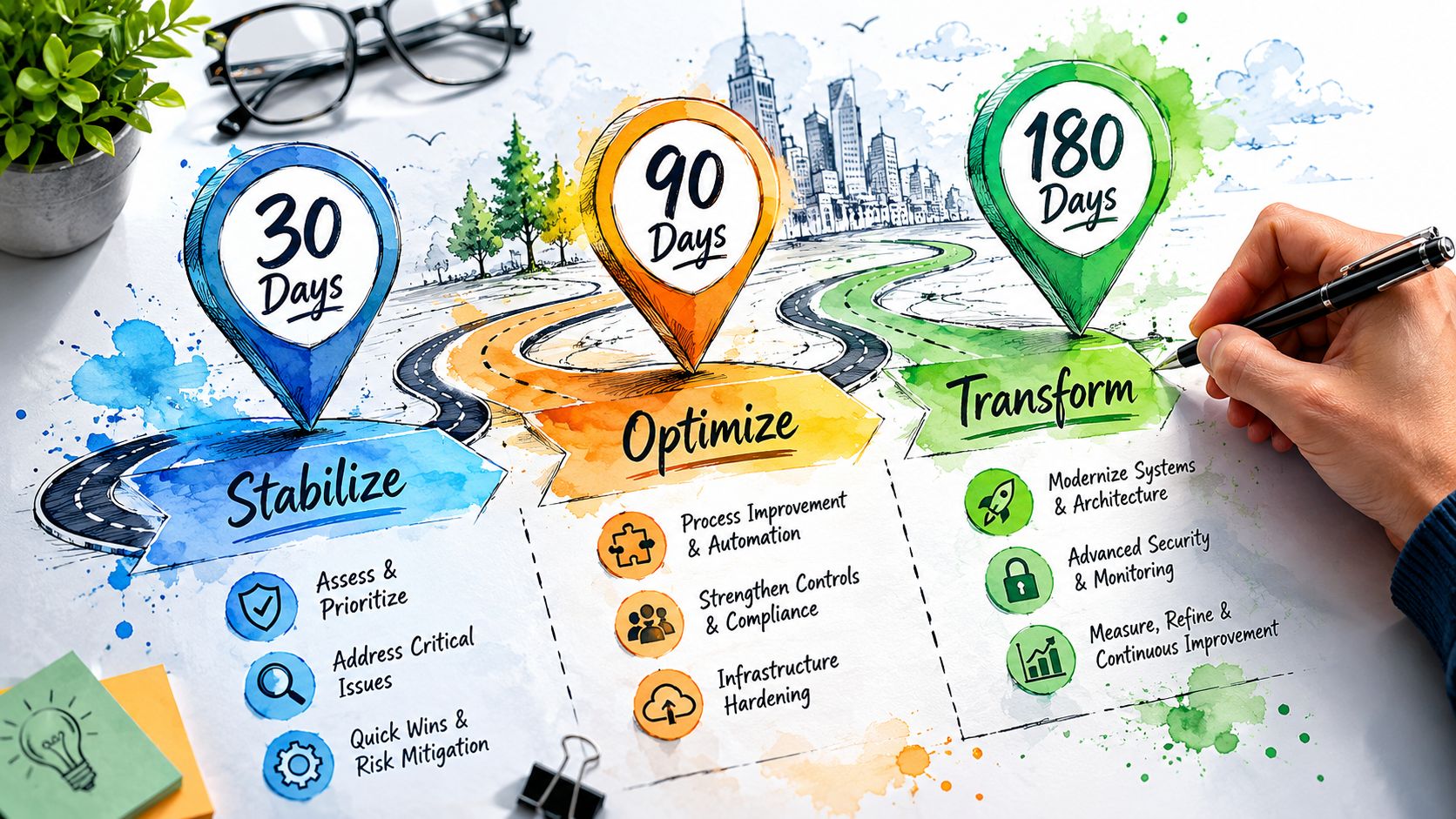
A review of digital health maturity models made this gap explicit. Many models describe stages but don't specify the operational accountability required to progress. The missing piece is moving from a diagnostic score to a governed execution cadence with named owners, deadlines, and evidence, as noted in this analysis of maturity models and their practical limits.
First 30 days
The first month is triage. You are not "transforming IT." You are making the current reality visible and reducing immediate exposure.
Focus on:
- Name owners: every major risk, system, and active initiative needs one accountable owner
- Stabilize obvious gaps: unresolved access issues, unsupported systems, unknown vendors, broken escalations
- Create one operating view: active projects, top risks, key vendors, and open decisions in one place
- Set a weekly cadence: a short review meeting with decisions, blockers, and due dates
The output should be simple: a baseline heatmap, a top-risk list, and a working action register.
Next 90 days
At this point, discipline starts replacing improvisation.
You should expect to:
- Install governance: define who approves spend, changes, priorities, and exceptions
- Fix recurring process failures: onboarding, offboarding, vendor review, incident escalation, change control
- Clean up portfolio noise: pause low-value work, clarify priorities, remove zombie projects
- Require evidence: if something is reported as complete, there should be proof attached
If your team struggles to structure execution across distributed teams, examples of async workflow implementation plans can help leadership think more clearly about sequencing, ownership, and follow-through.
The board doesn't need more reassurance. It needs evidence that the organization knows what is broken, who owns the fix, and whether progress is real.
Then 180 days
By this point, you should be moving from stabilization into durable improvement.
That usually includes:
Reducing structural friction
Consolidate overlapping tools, simplify vendor sprawl, and fix approval paths that slow the business.Addressing legacy constraints
Identify systems, contracts, and workarounds that create repeated risk or delay.Aligning investment with business goals
Tie major technology work to growth, compliance, resilience, reporting, or customer experience.Creating inspectable reporting
Move from status storytelling to evidence-backed reporting leadership can trust.
The plan should fit on a page. If it takes a deck to understand, the execution model is still too fuzzy.
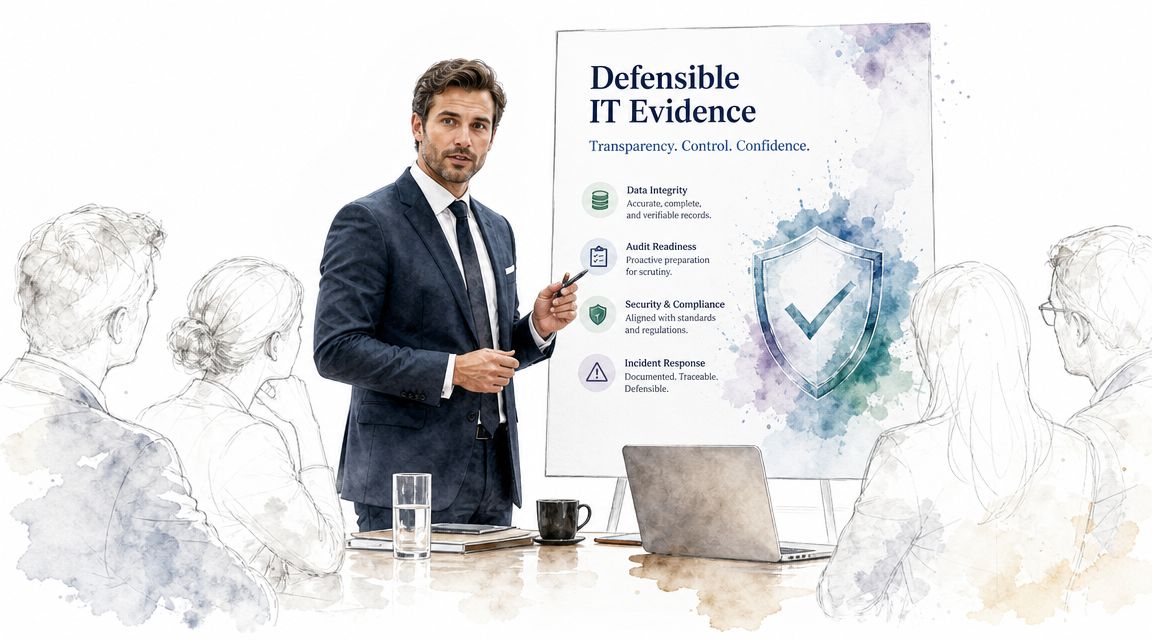
What Defensible Evidence Looks Like for the Board
Boards don't need a lecture on architecture. They need confidence that technology is governed, risks are visible, and management isn't guessing.
A good maturity process produces an evidence package that leadership can defend. Not because the organization is perfect, but because it can show baseline, plan, ownership, and progress.
What should be in the board packet
At minimum, leadership should be able to present:
| Evidence item | Why it matters |
|---|---|
| Maturity heatmap | Shows the baseline by capability area |
| 30-90-180-day roadmap | Proves management has a sequenced plan |
| Named owners list | Makes accountability explicit |
| Progress updates | Shows what moved, what slipped, and why |
| Risk decisions log | Documents accepted, mitigated, or escalated issues |
This changes the board conversation. Instead of asking, "Is IT doing okay?" directors can ask, "Are the agreed risk reductions and control improvements on track?"
If you're refining the reporting layer itself, this board-ready cybersecurity reporting template is a useful reference for how to present risk in a way leaders can effectively govern.
Where boards get misled
The process usually fails when leadership makes one of these mistakes:
- Delegating without inspection: management assumes the IT leader or MSP has things covered, but never asks for evidence tied to plan and ownership.
- Treating maturity as a one-time audit: the assessment gets filed away instead of becoming the basis for weekly and monthly oversight.
- Accepting tool activity as proof: dashboards, tickets, and software purchases are mistaken for risk reduction.
- Allowing vague ownership: everyone is "involved," so nobody is accountable.
A board should not have to rely on confidence alone. It should be able to inspect progress against an approved plan.
When that standard is in place, auditors, insurers, investors, and diligence teams usually get a clearer story too. More important, management gets a better operating discipline instead of a recurring reporting scramble.
Common Pitfalls When Using an IT Maturity Model
An IT maturity model is useful. It is not magic. The model won't fix a chaotic department if leadership treats it like theater.
The most common ways this goes wrong
Turning it into a technical exercise
If the assessment lives only inside IT, it misses the business pain. Maturity has to be judged through delivery, control, reporting, and decision quality.Obsessing over the score
A higher stage is not the objective. Better control, cleaner execution, and fewer surprises are the objective.Skipping ownership
If every issue gets assigned to a team instead of a person, slippage is guaranteed.Underfunding the fix
Leaders often approve the assessment and then hesitate on the remediation work. Diagnosis without action just creates a more articulate form of drift.Failing to revisit the model
This should become part of the operating rhythm. If you assess once and never return to it, maturity work becomes shelfware.
The standard to hold
Use the model to answer four blunt questions:
- What is weak?
- Who owns the fix?
- What happens in the next 30, 90, and 180 days?
- What evidence will prove we improved?
If you can't answer those, the maturity exercise was paperwork.
If your technology function feels expensive, slow, or hard to trust, CTO Input helps leadership turn that chaos into a visible plan with owners, deadlines, and board-defensible evidence. A clarity call can help you identify the biggest control gaps and the first moves to restore calm, predictable execution.