

Every Chief Technology Officer can look solid right up until rapid growth starts asking harder questions. When the technical stack expands and business demands shift, the ability to help your CTO scale becomes the deciding factor in long-term success. The board will soon want cleaner answers, and your team will need more than just technical control to succeed.
You are not trying to judge whether your technical leader is smart. You are trying to determine whether they can manage increasing complexity without turning the company into a mess. Looking at high-growth environments like Scale AI offers a helpful benchmark, as these organizations prove that leadership must evolve alongside infrastructure. That is the real test.
Key takeaways for busy CEOs
- A CTO who can scale successfully translates high-level business goals into a functional technology strategy, whether that involves implementing complex enterprise AI solutions or driving product innovation.
- You should observe stronger ownership, cleaner reporting, and fewer technical surprises as the company expands, particularly regarding the deployment of machine learning models and infrastructure.
- If tool sprawl, technical debt, vendor dependence, or security risks keep rising, the role may have outgrown the person, or the person may have outgrown the requirements of the position.
When growth starts exposing the limits
Growth does not fail all at once. It fails in small places first. A dashboard becomes difficult to trust, projects take longer, one vendor starts steering technical decisions, and finance sees tech spend rise faster than confidence.
That is usually the point where you stop asking whether your CTO is busy and start asking whether they are effective at scale. A CTO who can keep the lights on is useful, but a CTO who can shape the business around clear priorities is different. Evolution is necessary at every stage. For instance, consider how industry leaders like Arun C Murthy navigated the transition from the early days of Hadoop and big data to the complex demands of modern AI infrastructure. His career trajectory demonstrates how technical experience must evolve to meet shifting business landscapes.
A useful outside lens is SaaStr’s warning signs for a CTO who isn’t scaling. The pattern is familiar: speed drops, coordination becomes messy, and the job duties stop matching the stage of the company.
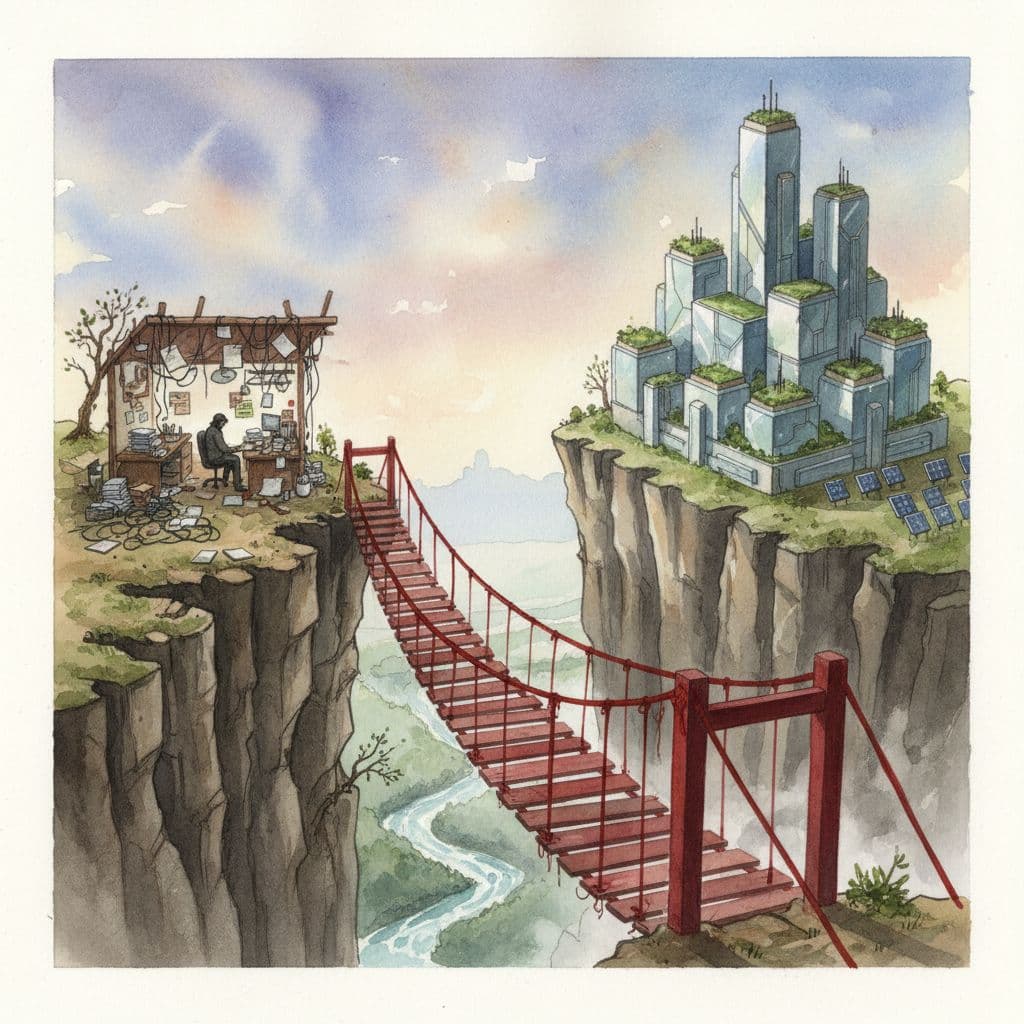
The issue is not effort. Your team may be working hard, but the real question is whether the CTO can make that effort add up to something the business can actually use.
For many companies, that is the moment to ask when to hire a fractional CTO. If you are not ready for a full time executive seat, you still need a clear answer to your scaling challenges.
What a CTO who can scale actually does
A scale-ready CTO does more than keep systems running. They turn business priorities into a business-aligned technology strategy, then into a roadmap people can follow. This involves building a 12-month technology roadmap that clearly outlines priorities, including the integration of generative AI, the deployment of large language models, and the orchestration of internal AI agents to drive operational efficiency.
If you need that level of direction without a full-time hire, Fractional CTO services can be the right fit. You get executive technology leadership without pretending the company needs a permanent seat before it does.
A strong CTO also creates technology governance. That means establishing decision rights, board-ready technology reporting, and clear ownership. It means technology risk oversight is visible and that board cybersecurity reporting is delivered in business language rather than technical fog. When addressing risk, a capable leader implements safety guardrails to ensure trustworthy AI practices across the organization.
You should also see control around vendor management, third-party risk management, and technology spend optimization. If the company cannot explain the ROI of its tech spending, the budget is likely masking inefficiencies.
On the risk side, the work is broader than simple security tickets. A capable CTO keeps business continuity planning, disaster recovery, incident response, and ransomware readiness in view. If your team is moving fast on new technology, they should also press for AI governance, an AI acceptable use policy, and rigorous AI vendor due diligence.
Good CTOs also prioritize data governance, data quality, data privacy, and information governance. They understand that high-quality data annotation and clean, well-structured training data are the foundations of reliable systems, as poor data quality makes every strategic decision built upon it inherently weaker.
The signs they are managing the stack, not the company
You can usually see the gap in a few places.
| What you see | What it means |
|---|---|
| They explain activity, not outcomes | The work is moving, but the business is not getting clearer results |
| They can’t name the business owner for major systems | Ownership is fuzzy, so accountability is fuzzy |
| Tool sprawl and shadow IT keep growing | The environment is getting harder to govern |
| Technical debt keeps piling up | The future is being borrowed against |
| Board-ready reporting is thin or late | Leadership does not have a clean view of risk or execution |
| Vendors are steering the roadmap | The company is reacting instead of deciding |
A CTO who can scale can tell you which systems stay, which go, and why. They can handle application portfolio rationalization, software platform evaluation, and technology vendor selection without turning every choice into a fresh debate. This includes guiding complex initiatives like model evaluation for data pipelines or implementing reinforcement learning architectures, ensuring these technical choices align with corporate goals.
They should also be able to speak clearly about technical due diligence, cybersecurity due diligence, acquisition readiness, and post-merger technology integration if the business is heading toward a transaction. If they cannot provide a clear perspective on how their tech strategy impacts the company valuation, the next owner or buyer will spot the gap fast.
For a cleaner read on fit, choosing between a fractional and full-time tech leader is often more useful than debating titles.
The questions that tell you the truth
Ask these in plain language.
- If your CTO left next month, would you lose a person or the operating picture?
- Can they defend the roadmap and tradeoffs in front of the board?
- Are they reducing tool sprawl, shadow IT, and technical debt, or are they blindly adding complexity like unnecessary RAG implementations and unoptimized vector databases?
- Can they tie technology spend to technology ROI without hiding behind activity?
- Can they explain cyber risk appetite, third-party risk reporting, and vendor offboarding without drifting into jargon?
If your CTO can only explain the system, not the business consequence, they may be running technology, not scaling it.
The same test applies to technology governance for CEOs and technology governance for boards. You do not need perfect technical detail. You need a leader who can turn complexity into decisions you can stand behind. As organizations push for human-level performance in their automated systems, the gap between technical output and actual business value often widens. If that picture feels fuzzy, Get an Executive Technology Clarity Check. Sometimes the fastest way forward is a direct look at where the gaps actually are.
Which leadership model fits the moment
Not every company needs the same answer. The job has to match the pressure.
| Model | Best fit | Watch for |
|---|---|---|
| Fractional CTO, part-time CTO, or virtual CTO | You need steady executive direction, but not a full-time seat | The role still has to cover real priorities, not just advice |
| Interim CTO | You have a gap, a transition, or a high-stakes problem that needs control now | Speed matters more than a long search |
| Full-time CTO | Technology is central to daily execution and constant leadership presence | You need someone embedded in the business |
| Outsourced CTO | You need outside executive judgment without adding headcount | Make sure the work is strategic, not just tactical |
If you are comparing fractional CTO versus full-time leadership, use the workload and decision cadence as your guide. When the business needs daily presence, a part-time model will strain. When the business needs judgment, structure, and clearer ownership, fractional CTO services can be the better bridge.
Consider how top-tier organizations handle this executive synergy. For instance, the partnership between Alexandr Wang and Vijay Karunamurthy illustrates how a founder and Chief Technology Officer must align to drive vision. As a company scales, the introduction of a chief product officer can also shift the CTO focus toward deeper engineering rigor. In high-stakes environments, such as companies managing complex Department of Defense contracts, the need for consistent executive oversight often dictates whether a fractional or full-time appointment is necessary to maintain mission-critical performance.
The same thinking applies to a fractional CIO, fractional CISO, virtual CISO, or interim CISO. The title matters less than the amount of executive attention the business actually needs.
Conclusion
You are not looking for a CTO who can talk well about technology. You are looking for one who can successfully facilitate cto scale without adding unnecessary noise to the organization. When your technology department operates like a well-tuned data-centric engine, it provides the transparency and speed required to support rapid business expansion.
If your technical lead can connect strategy, roadmap, governance, risk, and reporting in a way your team can actually use, they are driving the company forward. If they cannot, the business will keep paying for it in operational drag, product delays, and weak visibility. Navigating this transition is essentially Humanity’s Last Exam for technical leadership; it requires moving beyond the code to master the complexities of the company itself.
The cleanest test is simple. Ask whether your CTO is making the company easier to lead. If the answer is no, you have your signal that it is time for a change.
FAQ
How do I know if my CTO has outgrown the role?
Look for repeated drift. If projects slip, reporting gets thin, vendors gain influence, and leaders still do not have clear answers, the role may no longer fit the stage of the business. In high-complexity industries like the development of autonomous vehicles, the gap between managing code and managing strategy becomes very apparent. If your lead cannot bridge that gap, they may be out of their depth.
Is a fractional CTO enough, or do I need a full-time hire?
If you need executive judgment, clearer ownership, and better technology direction, a fractional CTO can be enough for a season. If the company needs daily leadership, deep people management, and constant presence, a full-time Chief Technology Officer is the better fit. Executive-level decision making is critical when your team is navigating complex technical problems, such as integrating RLHF into your machine learning pipelines, as this requires both strategic vision and deep technical oversight.
What should I do first if I am not sure?
Start with a technology audit, a board-ready risk summary, or a 90-day technology plan. You do not need to solve everything at once. You need a clear view of what matters most now.