
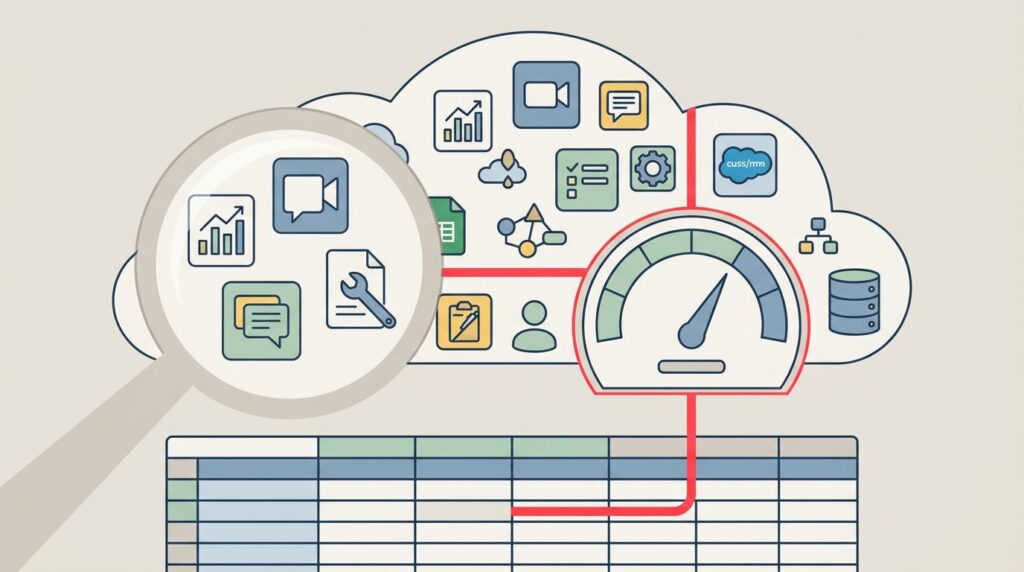
You can feel SaaS sprawl before the budget sheet actually reflects it. A few extra tools quickly turn into duplicate licenses, fuzzy ownership, and reports that nobody trusts. Without proper visibility into your software ecosystem, these unmanaged costs balloon until the stack looks normal on paper but remains expensive in practice. Conducting a comprehensive SaaS sprawl audit provides the clarity you need to address these inefficiencies before you approve another year of unnecessary spending.
Key takeaways before you lock next year’s spend
- Start with a full inventory rather than a simple license count.
- Tie every application to a specific business outcome, a dedicated owner, and a clear risk level.
- Remove redundant applications to streamline your stack before asking teams to absorb further budget cuts.
- Prioritize license optimization to reclaim budget by identifying and eliminating unused licenses.
- Establish board-ready reporting regarding spend, risk, and strategic decisions to improve overall operational efficiency.
Start with a full inventory, not a budget line
If you do not know every app, admin, integration, and backup owner, you are guessing. That is not a review. That is a hope.
A real pass starts with a systems discovery process, then moves into application portfolio rationalization, shadow IT, technical debt, and software platform evaluation. Creating a comprehensive app inventory is essential to move beyond the line items finance can see. You need total visibility into what lives in procurement, what lives on employee credit cards, and what lives in the gray zone between IT and the business. Using a SaaS management platform can provide the necessary visibility to uncover unmanaged apps and hidden shadow IT risks that often escape manual tracking.
This is also where executive technology oversight and proper IT oversight matter. SaaS sprawl is not just a software problem. It is a leadership problem, because blurry ownership always turns into weak control.
For a practical security lens, Josys’ SaaS security audit guide is a useful starting point, and HubiFi’s SaaS audit essentials gives you a clean view of security, compliance, and cost. If you want a second checklist to compare against, Ardas’ SaaS security audit checklist is straightforward about permissions and exposure.
If you cannot name the owner, the backup owner, and the business outcome, the tool is already expensive.
Use the first pass to answer six things clearly:
- Coverage and owners, including every system, admin, integration, and backup owner.
- Spend and value, including technology spend optimization, technology ROI, IT cost optimization, and cost-per-outcome reporting.
- Risk, including third-party risk management, vendor risk management, cyber risk appetite, and board cybersecurity reporting.
- Data, including data strategy, data quality, data privacy, and information governance.
- Automation and AI, including AI governance, AI adoption strategy, AI acceptable use policy, and AI vendor due diligence.
- Change and exit, including vendor offboarding, technical debt management, and post-merger technology integration.
Trace every app to an outcome you can defend
Budget season gets messy when a tool stays in the stack because nobody wants to challenge it. That is how SaaS spend becomes background noise instead of a business decision.
Each app should connect to a real outcome, such as faster sales cycles, lower manual work, better customer experience, cleaner reporting, or reduced risk. If a tool does none of that, it is likely adding to your financial waste. This is where technology dashboards and ROI numbers should shift from vanity metrics to decisions you can defend.
A useful way to think about it is simple. If the app does not move margin, speed, or risk, it has to justify its seat. Achieving true visibility into redundant applications is the heart of effective license optimization and long-term tech spending ROI work. It is not about being cheap. It is about spending with intent.
If your stack is already bloated, start with Find What Technology Is Costing Your Growth. That kind of review should produce a cleaner one-page technology strategy, not a deck full of excuses. It should also point you toward a 12-month technology roadmap that shows what stays, what gets merged, and what gets retired.
The goal is not to make the budget smaller for sport. The goal is to make every dollar easier to explain.
Check the risk hiding inside the stack
SaaS sprawl is where hidden risk likes to live. One team buys a tool, another team adds a plug-in, and suddenly you are contending with shadow AI. Before long, nobody remembers who approved access, where the data flows, or what happens if a vendor suffers a data breach.
That is why your audit must include cybersecurity oversight and technology risk management. You need a simple technology risk management framework that defines what is acceptable, what is not, and what requires board attention. If you have a board, the output should be board-ready reporting, rather than a disorganized pile of screenshots.
You also need to look at the vendor layer. Vendor management, third-party risk management, and vendor due diligence belong in the same conversation. If a tool touches customer, employee, or finance data, it should also undergo rigorous security reviews to ensure it meets your standards for access control and compliance. This is where you should confirm your vendor incident response plan, business continuity planning, and disaster recovery planning are up to date. Evaluating these tools also helps you answer the difficult questions that arise during cyber insurance renewal or ransomware readiness assessments.
If your stack touches sensitive data, your review should also cover your data governance framework, data strategy, and data privacy. A tool can look harmless until it becomes an unauthorized tool that increases your attack surface or complicates a breach response.
For the board layer, Build a Board-Ready Technology Risk View before you ask for another round of spend. When the board can clearly see the risk, the tradeoffs regarding your software stack become much easier to navigate.
Decide what stays, what gets merged, and what gets cut
Once you have a complete inventory, a clear view of spend, and a handle on risk, the real decision work starts. This is where application portfolio rationalization becomes practical instead of theoretical. You are not trying to win a software popularity contest. You are trying to clear the clutter that is draining attention and budget.
To reduce SaaS sprawl effectively, use three simple tests:
- Keep it if it maps to a core business outcome and has a clear owner.
- Merge it if you find redundant applications that serve the same purpose. This is the perfect time for vendor consolidation to streamline your stack.
- Cut it if no one can defend the spend, the security risk, or the actual adoption rates.
Leveraging a SaaS management platform provides the visibility needed to identify unused licenses and prioritize license optimization. Without this insight, you are just guessing which tools provide value.
That is also where vendor offboarding matters. If you decide to kill a tool, you need a clean exit. Data export, access removal, contract timing, and internal communication all need a place in the plan. Otherwise, the cleanup process simply creates new administrative problems.
A solid review should end in a technology audit or technology assessment with a short list of actionable decisions, not a vague wish list. If you want the clearest next step, Get an Executive Technology Clarity Check. A good check should produce a usable 90-day technology plan, not another committee project.
This is the moment to be honest about your current state of shadow IT, technology debt, and technical debt management. Every extra tool looks small until you multiply it by the true costs of licenses, admins, training, support, and reporting.
Pick the right leader for the cleanup
A SaaS sprawl audit usually reveals a bigger issue than a high software count. It uncovers a technology leadership gap. Someone must take ownership of the cleanup, the decision rights, and the long-term follow-through. Effective IT oversight is the only way to curb shadow IT and ensure that your software stack aligns with actual business objectives.
If you lack internal bandwidth, the right answer may be fractional CTO services rather than a rushed full-time hire. In other cases, interim CTO services make more sense. If your challenges are vendor-heavy rather than strategy-heavy, an outsourced CTO, virtual CTO, or part-time CTO may be enough to restore control and drive visibility across your subscriptions. For broader finance or data work, a fractional CIO may be the better fit. If the biggest issue is security and risk, a fractional CISO, virtual CISO, or interim CISO can provide the necessary governance.
At this stage, executive technology leadership stops being an abstract label and starts solving real problems. You need a technology leader for growing companies who can handle growth-stage technology leadership, scaling technology leadership, and technology leadership for mid-market companies without turning the audit into performance theater. A skilled leader will also prioritize employee training to ensure your team understands the tools they have and why compliance matters.
If you are still deciding how to hire a CTO, or whether you even need a full-time leader yet, budget season is the wrong time to guess. It is also where the choice between a fractional CTO vs full-time CTO and a fractional CTO vs IT consultant becomes a critical business question. An IT consultant can fix a specific technical slice, but a CTO owns the entire operating picture.
If the issue is really leadership rather than just excess licenses, Talk Through Your Technology Leadership Gap is the cleaner move.
Build next year’s budget from a cleaned-up view
Once you have successfully addressed your SaaS sprawl, you can finally build a budget that makes sense. That budget should reflect technology governance for CEOs and technology governance for boards rather than serving as a static list of renewals. It should include board technology reporting, board-ready technology reporting, and a board-ready risk summary that clearly outlines what changed, what matters now, and what requires a decision.
This process is the ideal time to establish a formal software purchasing policy and set clear governance policies for the upcoming year. Your budget should point toward a real technology operating rhythm that prioritizes centralized procurement to eliminate data silos and drive better operational efficiency. This rhythm relies on a decision rights map, clearer stakeholder alignment, and a business-aligned technology strategy that connects directly to the goals the company is trying to execute. If you need a cleaner path forward, technology strategy consulting, strategic technology planning, and an IT strategy and roadmap can help you turn your SaaS spend into a growth asset.
You do not need a giant deck to achieve this. You need a usable technology roadmap, a sensible board-ready tech roadmap, and a one-page technology strategy that leaders can hold in their hands. That is what keeps next year from becoming a repeat of the inefficiencies seen this year.
If acquisition readiness is on the horizon, use Prepare Technology for Diligence or Transition. Technology due diligence, technical due diligence, cybersecurity due diligence, and an acquisition due diligence checklist are much easier when the stack is already cleaned up. The same is true for CTO transition plan work and post-merger technology integration.
Conclusion
Budget season is not the time to pretend SaaS sprawl will sort itself out. It is the time to identify the overlap, the risk, and the financial waste before they harden into next year’s baseline.
When you know what each tool does, who owns it, and what it costs the business, your budget gets sharper fast. That is the real value of conducting a comprehensive SaaS sprawl audit. It gives you the transparency and control your leadership team actually needs to make better informed investment decisions for the coming year.
FAQs
What should you include in a SaaS sprawl audit?
Your audit should begin with a comprehensive discovery process to build an accurate app inventory. Include system owners, contract terms, usage data, vendor risk, access controls, and data flows. During this discovery phase, pay close attention to unmanaged apps that have surfaced outside of official procurement. If a tool involves AI, sensitive data, or cyber exposure, incorporate those technical checks as well to ensure your business outcomes remain defensible.
How often should you review SaaS sprawl?
At a minimum, review your stack before budget season. However, you should also revisit your list after a major hiring wave, a reorganization, a security incident, a vendor change, or any acquisition activity. To keep things under control between audits, you should establish a clear software purchasing policy and ongoing governance policies to prevent long-term bloat.
How can we prevent shadow IT and unauthorized tools?
The most effective technical defense against shadow IT is implementing Single Sign-On. By requiring Single Sign-On for all corporate applications, you gain visibility into unauthorized tools and can revoke access instantly. Complement these technical measures with regular employee training to ensure staff understands the security risks associated with purchasing tools outside of approved channels.
Who should own the audit?
The CEO or COO should own the outcome, with finance, IT, and security teams actively involved. If you do not have strong executive technology leadership, bring in the right outside help early so the review does not turn into another unproductive spreadsheet exercise.