
Growth usually does not stall because your team stopped trying. It stalls because the work has nowhere clean to land. The result is familiar: more meetings, more tools, more dashboards, and less confidence.
When technology gets in the way, the problem is rarely the software itself. It is usually ownership, reporting, spend, vendors, data, or decisions that never got named in plain English.
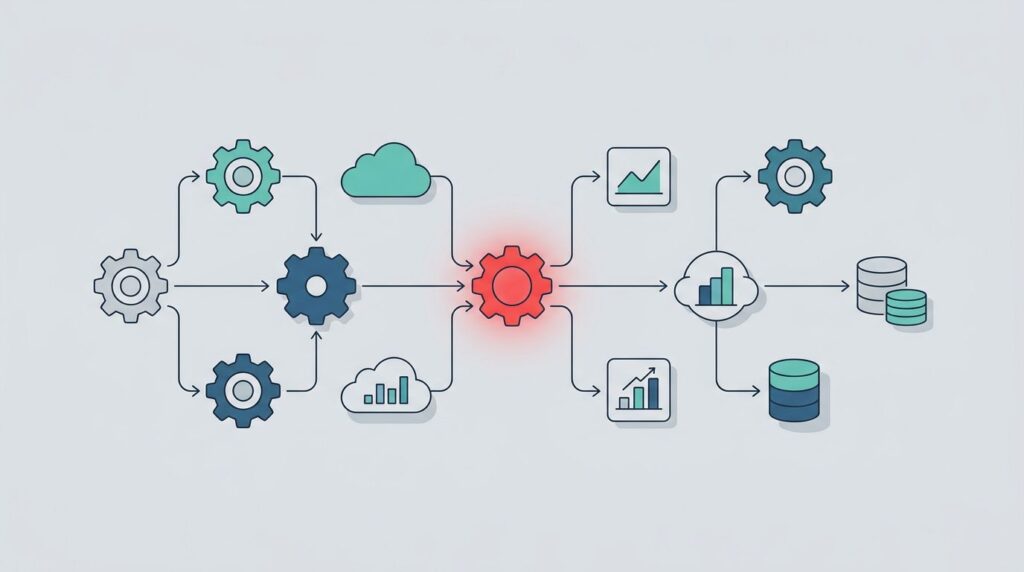
A technology bottleneck map gives you a better way to see these technology bottlenecks. It helps you spot where growth is getting stuck before you spend another quarter arguing about symptoms.
Key takeaways
- The bottleneck is often not purely technical. It is usually a leadership, reporting, or governance problem exacerbated by outdated systems.
- The fastest way to find it is to map ownership, spend, vendors, data, risk, and decisions side by side.
- Once you can name the real constraint, you can build a shorter, cleaner 90-day plan.
If you cannot name the owner, you do not have a roadmap. You have a wish list.
Start by mapping the drag, not the symptoms
If revenue is slowing, projects are late, and the board keeps asking for cleaner answers regarding your IT infrastructure, do not start by asking which tool is broken. Start by asking where work keeps getting trapped. That might be a missing owner, a vendor with too much control, or a dashboard nobody trusts.
A technology strategy as an execution system helps because it shows the business result, the owner, and the next decision in one place. A good outside read on the same problem is when technology becomes a growth constraint. Both point to the same truth. If you cannot trace the drag to a business outcome, you are still guessing.

The fastest way to clear the fog is to stop treating every problem as separate. Weak reporting, legacy systems, too many approvals, and a messy vendor stack often belong to the same story.
The six places growth usually gets stuck
Most companies find the problem in one of six places. The table below gives you a fast way to sort the noise.
| Bottleneck zone | What it looks like | What to check first |
|---|---|---|
| Leadership and ownership | Founder-led technology decisions, CEO technology decisions, COO technology strategy, fuzzy escalation, weak board-ready reporting | Decision rights map, technology operating rhythm, who owns the outcome, talent bottleneck |
| Spend and portfolio | Technology spend optimization is unclear, tech spending ROI is weak, tool sprawl, shadow IT, technical debt, too many platforms | Application portfolio rationalization, software platform evaluation, IT cost optimization, cloud computing, data centers |
| Vendors and third parties | Vendor management is reactive, vendor risk management is loose, third-party risk reporting is thin | Third-party risk management, vendor due diligence, vendor offboarding, contract ownership |
| Cyber and resilience | Cyber risk appetite is vague, board cybersecurity reporting is thin, risk is hard to explain | Technology risk oversight, technology risk management framework, business continuity planning |
| Data and AI | Data quality is poor, data privacy rules are muddy, AI tools appear without guardrails | Data governance framework, data strategy, AI governance, AI acceptable use policy, AI infrastructure, frontier technologies, process automation |
| Deals and change | Acquisition readiness is weak, systems are hard to trust, integration is messy | Technology due diligence, cybersecurity due diligence, CTO transition plan, post-merger technology integration |
The point is not to solve all six at once. It is to see which one is actually dragging the business today.
A technology audit that reveals hidden bottlenecks usually pays for itself by killing the wrong assumptions early. That is why many leaders start with a technology health check, a technology assessment, or a technology audit before they write a one-page technology strategy or a 12-month technology roadmap.
If you like templates, use a technology roadmap template as a starting point. Just do not stop there. A useful output becomes a board-ready tech roadmap, a board-ready risk summary, and board-ready technology reporting that leaders can trust.
What to fix first when the map gets honest
Once you see the drag, do not rush to buy a new platform. Start with the decision hiding underneath. If ownership is fuzzy, fix the decision rights map. If the issue is tool sprawl or hidden hardware constraints, trim the stack and get shadow IT under control. If the problem is data, clean up the data governance framework, information governance, and systems inventory.
This is where technology governance consulting helps, because the real work is not just policy. It is escalation, reporting, and the right operating rhythm paired with effective software orchestration. You want board technology reporting and board-ready technology reporting that tell the truth, not a prettier version of the mess.
For most growing companies, the next deliverable should be simple. One page. Three priorities. Clear owners. A 90-day technology plan that rolls into strategic technology planning, business-aligned technology strategy, and a practical technology roadmap. Good technology strategy consulting turns that into business technology strategy and system co-optimization, not a slide deck nobody uses.
If spend is the complaint, do not start with a broad budget cut. Start with cost-per-outcome reporting. Tie technology dashboards to business results, including costs tied to your data centers, then compare tech spend optimization against actual technology ROI and tech spending ROI. That is where IT cost optimization and IT cost reduction become real.
If cyber is part of the drag, the same logic applies. Board cybersecurity reporting, cyber risk reporting to the board, and a clear cyber risk appetite statement are better than vague reassurance. Add access control best practices, cybersecurity oversight, cybersecurity risk assessment, and IT security assessment where they belong, then decide whether the business needs stronger technology risk oversight or a better technology risk management framework.
When the answer is executive leadership, not another project
Some problems are bigger than a project. If no one owns the whole picture, you have a technology leadership gap rather than just a shortage of technical talent or missing tools. That is when a fractional CTO, interim CTO, outsourced CTO, virtual CTO, or part-time CTO makes sense. The same logic applies when the need sits with a fractional CIO, a fractional CISO, a virtual CISO, or an interim CISO.
You are not buying a title. You are buying executive technology leadership, fractional technology leadership, and a calmer operating picture. Executive technology leadership brings the roadmap, the reporting, and the decision structure into the same room. This is critical for mid-market technology leadership, growth-stage technology leadership, and scaling technology leadership, where the business has outgrown informal habits but is not ready for a full-time hire. These leaders ensure you have the right compute power to support your infrastructure while aligning your technical strategy with your broader business goals.
This is also where technology leadership before hiring matters. A lot of companies ask how to hire a CTO before they ask whether they need one yet. Sometimes the answer is a full-time leader. Sometimes it is the right fractional CTO services, interim CTO services, or a fractional CTO vs full-time CTO comparison. Sometimes it is a fractional CTO vs IT consultant question with a clear answer. If the issue is judgment, ownership, and board-facing clarity, the title matters less than the structure.
The same test applies to AI governance, AI adoption strategy, AI transformation strategy, responsible AI, AI acceptable use policy, AI vendor due diligence, and AI opportunity assessment. It applies to vendor management, vendor due diligence, vendor incident response plans, and third-party risk management. It even applies to technology due diligence, technical due diligence, cybersecurity due diligence, acquisition readiness, and the acquisition due diligence checklist. If the stakes are high, the work needs executive ownership.
FAQs
How do you know whether the bottleneck is technical or leadership-related?
Start with the business outcome. If projects are delayed because no one can make a clean decision, the issue is leadership. If systems are failing because architecture or technical debt is buried, the issue is technical. Most companies have both, which is why a technology audit or technology assessment helps more than debate does.
When should you hire a fractional CTO?
You should look at when to hire a fractional CTO when the business needs stronger ownership, but not yet a full-time executive seat. That often happens when growth is moving faster than founder-led technology decisions, or when technology priorities for growing companies have become too important to leave informal. A good rule is simple. If the problem is executive judgment, not more hands, fractional CTO services are worth a serious look.
How do hardware-level constraints impact modern scaling?
Scaling strategies often hit physical limits before they hit software limits. As you optimize for throughput in large scale distributed computing, you must account for hardware factors like GPU performance and memory bandwidth. If you fail to address thermal management or neglect the necessity of liquid cooling, you will inevitably throttle your systems. Advanced infrastructure also relies on optical networking to move data at speed, while the adoption of high bandwidth memory helps prevent latency bottlenecks. Ultimately, your long-term infrastructure health depends on prioritizing energy efficiency alongside your software architecture.
What should the first deliverable be?
Keep it small. A one-page technology strategy, a 90-day technology plan, and a 12-month technology roadmap are enough to start. If the company needs more structure, add board-ready technology reporting, a board-ready risk summary, and a clear technology operating rhythm. That gives you a better base than a thick document no one opens again.
Conclusion
Growth rarely gets stuck in one dramatic place. It gets stuck in a chain of small failures, weak ownership, fuzzy reporting, too many tools, and decisions that never got named. That is why the technology bottleneck map matters.
Once you can see where the drag is happening, you can stop treating every symptom like a separate fire. You can choose the real fix, set cleaner priorities, and move with more confidence.
You do not need more noise. You need to identify the next real constraint to drive meaningful progress in your digital transformation and ensure your organization continues to evolve effectively.