
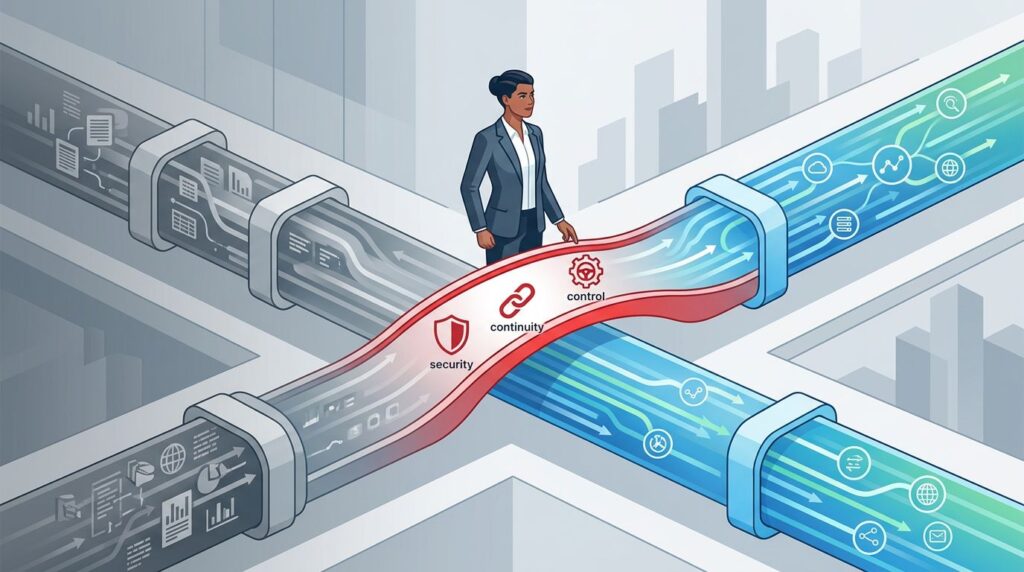
A bad vendor rarely fails all at once. More often, your costs climb, workarounds multiply, reporting gets weaker, and nobody can give you a straight answer on risk.
That is why technology vendor replacement is not a procurement exercise. It is a leadership decision about control, continuity, and trust. If you handle it late, the business pays twice, once for the weak vendor and again for a rushed exit.
The goal is not drama. The goal is a cleaner decision, a safer transition, and a business that keeps moving without suffering from avoidable business disruption.
Key Takeaways
- Replace a vendor when trust breaks in execution, visibility, security, or economics, rather than simply because the relationship feels irritating.
- A clean exit requires clear ownership, a firm timeline, strict data and access controls, and a transition plan that protects operational stability and business continuity.
- Most failed vendor exits trace back to weak governance, fuzzy decision rights, and a lack of rigorous lifecycle management that leaves the team unprepared for necessary transitions.
- If nobody on your side can effectively own the roadmap, risk, and tradeoffs, you may be facing a technology leadership gap rather than just a vendor problem.
The signs you are past frustration and into replacement territory
Not every weak vendor needs to be fired. Some need tighter scope, stronger service level agreements, or better internal ownership. Effective IT vendor management ensures that you aren’t just tolerating mediocrity, but there is a point where more patience becomes expensive.
You are usually there when the vendor has become part of the drag. Delivery slips. Manual work grows. Your team starts building side processes to survive the system. Finance sees spend rising, but the business does not see better outcomes.
The deeper warning sign is loss of decision confidence. Leadership keeps hearing different stories from the vendor, internal team, and operators. Reporting exists, but it does not help you act.
Using a standardized scorecard helps you evaluate these situations objectively:
| What you see | What it usually means | Likely call |
|---|---|---|
| Missed deadlines, but clear ownership and fixable scope issues | A management problem | Repair first |
| Rising cost, overlapping tools, duplicate licenses | Weak vendor management and tool sprawl | Rationalize and reset |
| Poor security posture, weak incident handling, unclear data rights | A third-party risk problem | Replace or isolate |
| No one trusts reporting, priorities, or roadmap claims | A leadership and governance problem | Replace vendor and tighten ownership |
A vendor should be on the table for replacement when it is creating business drag in four places.
First, performance. The vendor misses commitments, hides behind tickets, or needs heroic effort from your staff.
Second, economics. The spend no longer matches value. That is where technology spend optimization, technology ROI, return on investment, tech spending ROI, IT cost optimization, IT cost reduction, and cost-per-outcome reporting matter. If you cannot explain what the money is buying, the problem is real.
Third, risk. Weak security, unclear backup practices, shallow support, and vague incident roles are not side issues. They are vendor risk management issues.
Fourth, control. If the vendor influences your roadmap more than your leadership team does, you have let them inside your operating model.
That is the point where a vendor decision becomes a business decision.
What to test before you pull the plug
Before you replace anyone, get the facts straight. A lot of vendor exits start with a fair complaint and end with the wrong answer because the real issue was internal.
Start with a sober technology assessment. In some cases, you need a technology audit, a technology health check, or a board-ready risk summary before you choose a path. If the environment is messy, build a short 90-day technology plan first.
Ask five plain questions.
Can the current vendor improve within your time frame?
Are your own requirements and technical requirements clear?
Is the business paying for a bad vendor, or for years of weak technology strategy?
Will replacing the vendor reduce drag, or only move it?
Who will own the transition once the contract clock starts?
This is where software platform evaluation, application portfolio rationalization, and a cleaner vendor selection process matter. You are not shopping for features. You are judging fit, switching cost, data exposure, and operating risk during your vendor evaluation.
A good review also looks at technical debt, technical debt management, and broader technology debt. Sometimes the vendor is weak. Sometimes your architecture, custom integrations, or old workflows make any vendor look bad.
If you are dealing with duplicate tools, informal purchases, and disconnected data, read up on managing technology vendor risk and tool ownership. Effective IT vendor management is essential because tool sprawl and shadow IT can make a replacement look easy on paper and ugly in practice.
The same goes for strategy. If vendor choices keep outrunning leadership judgment, you need establishing governance for technology vendor decisions. A real technology strategy is not a slide deck. It is decision structure.
That means a business technology strategy, a business-aligned technology strategy, and strategic technology planning that connect spend, risk, and execution. It should show up in your IT strategy and roadmap, your technology roadmap, and your 12-month technology roadmap. It can be simple. A one-page technology strategy and a practical technology roadmap template often do more good than a fat deck nobody uses.
If you cannot explain why the vendor stays or goes in plain business language, you are not ready to make the call.
Weak governance is why vendor exits go sideways
Most vendor exits do not fail because the replacement tool is bad. They fail because ownership is blurry.
One team negotiates. Another team migrates. Finance tracks cost. Legal reviews terms and handles vendor contract management. Operations absorbs the disruption. Nobody owns the whole outcome.
That is a technology governance problem.

You need a systems inventory, a robust asset management process, a decision rights map, and a technology operating rhythm before the exit starts. That is the bare minimum. Without it, small migration issues turn into board issues.
Technology governance for CEOs is about clear authority, budget guardrails for hardware procurement, and business outcomes. Technology governance for boards is different. The board owns oversight, not daily execution. It should expect board technology reporting, board-ready reporting, and a board-ready tech roadmap that show what is changing, who owns it, and what risk moves with it.
If cyber exposure is part of the picture, add board cybersecurity reporting, cyber risk reporting to the board, a clear cyber risk appetite, and stronger cybersecurity oversight. The same structure supports technology risk oversight, technology risk management, and a working technology risk management framework.
Third-party risk management and third-party risk reporting belong here too. So do vendor due diligence and vendor offboarding. If your exit plan does not name those items, it is not complete.
This is also where stakeholder alignment matters. Founder-led technology decisions often worked when the company was smaller. They usually break under scale. CEO technology decisions need better inputs. COO technology strategy needs clearer tradeoffs. Technology priorities for growing companies cannot sit inside vendor sales calls.
If that sounds familiar, you may not need more effort. You may need executive technology oversight.
The exit plan that protects operations
A clean replacement has one job: keep the business running while control moves from the old vendor to the new one. A well-executed strategy is essential to preventing business disruption during this shift.
Prioritize continuity and downtime prevention
Begin with business continuity planning and disaster recovery planning. If the current vendor failed tomorrow, what would stop first? Consider billing, payroll, customer support, manufacturing, donor operations, scheduling, identity, and data feeds. You must identify these critical processes before you select a replacement. As part of your transition management plan, review your incident response readiness, ransomware readiness, and executive incident response checklist. If the vendor touches critical data or identity, the migration should align with your cyber insurance renewal, cybersecurity risk assessment, and IT security assessment.
A vendor incident response plan is not optional for critical systems. You need named contacts, escalation paths, breach notification terms, backup expectations, and a tested fallback to ensure seamless downtime prevention.
Lock down data, access, and contractual rights
Bad exits get uglier when data rights are fuzzy.
Confirm what data you own, what format you can export, how long the export takes, and what fees apply. Check retention, deletion, archives, and API access. Review access control best practices before anyone changes roles or permissions. This is also the ideal time to tighten your data governance framework, data strategy, data quality, data privacy, and information governance. If the vendor is the only party who understands your data model, you must prioritize knowledge transfer to ensure your team gains the necessary insight to maintain control.
Make sure the contract supports the real exit. Look for termination terms, transition support, subcontractors, source data access, admin credentials, and obligations after notice. A lot of leaders learn too late that the legal agreement did not match the operating reality.
Run the transition in parallel when the stakes are high
The safest path is often a phased move. Stand up the replacement, test key workflows, reconcile reports, and compare outputs. Cut over by function, team, or region if that lowers risk.
Utilizing parallel operations costs more in the short term, but it often saves far more than a rushed cutover. Use technology dashboards that track readiness, defects, open risks, budget, and adoption. Keep the reporting simple because leadership needs signal, not noise.
If the vendor touches finance, customer data, or identity, build explicit hold points. Do not cut over until the numbers reconcile, the backups are tested, and the handoffs are clear. This is where a CTO transition plan helps, even if no CTO is leaving. The same discipline applies; name the owner, name the milestones, and name the stop-go decisions.
When a vendor problem is really a technology leadership gap
Sometimes the vendor is weak. Sometimes the larger issue is that nobody on your side owns the tradeoffs.
That is a technology leadership gap.
A technology leader for growing companies should connect the roadmap, vendor decisions, architecture, spend, and risk. Without that, vendors fill the vacuum. Priorities drift, reporting turns noisy, and the board gets updates without clarity. Ultimately, a strong leader is needed to ensure every technology solution aligns with your broader business goals.
This is where executive technology leadership matters. A fractional CTO, part-time CTO, virtual CTO, outsourced CTO, or broader fractional CTO services can provide consistent ownership without the full-time overhead. That is often the right model for mid-market technology leadership, growth-stage technology leadership, and scaling technology leadership. In some cases, Managed IT services can also provide the necessary operational support to bridge these gaps.
An interim CTO or interim CTO services fit a different moment. Use that model when the seat is open, trust is damaged, or the business needs someone to steady the room fast.
If the issue runs beyond engineering into systems, ERP, data, and operating design, a fractional CIO may be the better answer. If cyber pressure is loudest, a fractional CISO, virtual CISO, or interim CISO may make more sense.
This is not about titles for their own sake. It is about ownership. A good leader brings technology strategy for CEOs, technology strategy for COOs, and technology decisions for growth into one practical view.
If you are stuck in technology leadership before hiring, asking how to hire a CTO, or weighing when to hire a fractional CTO, start with the role the business needs now. The real comparison is often fractional CTO versus full-time CTO, or fractional CTO versus an IT consultant. One gives ongoing ownership. The other usually gives advice or a project.
For many companies, technology leadership for mid-market companies starts before a permanent hire. That is why technology strategy consulting can be useful, but only if it ends in clearer decisions and stronger follow-through.
Special cases that raise the stakes
Some vendor exits carry more heat than others.
If the vendor is part of an acquisition, integration, or leadership change, put technology due diligence, technical due diligence, acquisition readiness, cybersecurity due diligence, and an acquisition due diligence checklist into the plan early. Weak vendor ownership gets exposed fast in these scenarios. Whether you are working with a Value-Added Reseller to manage licenses or coordinating a complex technical transition, weak post-merger technology integration remains a primary failure point.
AI-related vendors need extra care. A cheap pilot can create lasting risk if no one owns AI governance, AI adoption strategy, AI transformation strategy, responsible AI, or an AI acceptable use policy. Before replacing or adding an AI tool, run AI vendor due diligence and an AI opportunity assessment. You should also consider a formal Request for Proposal to compare how different vendors handle data provenance, storage, model training, and critical decision-making boundaries.
The same logic applies to cyber-heavy platforms. Identity tools, endpoint tools, cloud monitoring, and backup vendors cannot be judged on price alone. Your board will want a board-ready risk summary that connects security posture to business consequences.
If the vendor exit feels scattered, risky, or too dependent on the wrong people, a technology clarity call or decision clarity call can save time. The first goal is not a grand plan. It is to assess organizational readiness and establish a clear view of what is happening, what matters now, and what can wait.
Conclusion
You should not replace a technology vendor simply because the relationship feels annoying. You replace one when performance, economics, risk, or control have degraded to the point where the business is paying for the resulting ambiguity.
The safest exits begin much earlier than most leaders realize. They start with facts, clear ownership, and reporting that leadership can trust. This foundational approach is what prevents a vendor change from escalating into a disruptive operations problem.
If you can clearly identify the risk, the designated owner, the implementation timeline, and your fallback options, you are already well on your way to making a clean, defensible decision.
FAQs
How long should a technology vendor replacement take?
It depends on the system, the integrations, and the data involved. A small switch may take weeks, while a core platform change can take months. The timeline often depends on your current level of asset management, as cataloging hardware and software inventory is essential to a smooth transition. What matters more than the specific timeline is whether you have a real transition owner, a tested cutover, and business continuity planning in place.
Should you ever keep the old vendor and only tighten management?
Yes, sometimes that is the right call. If the core problem is weak scope control, poor internal ownership, or loose IT vendor management, a reset may work. However, if trust is broken in security, data handling, or execution, replacement is usually the cleaner path.
Who should own the exit if you do not have a CTO?
Someone still needs executive ownership. That may be a COO with the right support, a fractional CTO, an interim CTO, or another senior leader who can own the roadmap, risk, and vendor decisions. What you cannot afford is a vacuum.