
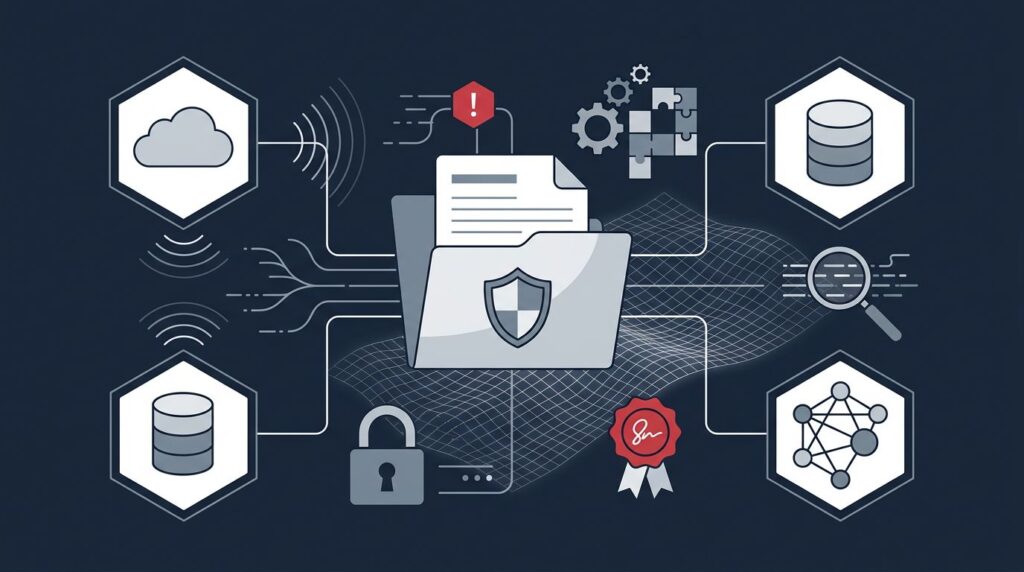
An AI vendor can touch customer records, employee data, confidential plans, and intellectual property before leadership fully sees the exposure. The risk is not only a bad output. It is third-party risk that leaves you unable to explain where data went, who accessed it, or what happens when the contract ends.
Your ai vendor contract checklist should be part of your operating controls, not a legal document filed away after signature. For CEOs, COOs, CFOs, general counsel, and boards, the contract is one part of data security, risk management, and vendor governance. Technology oversight and advisory can help when ownership and reporting are still unclear.
The eight clauses below give you a practical way to review the agreement before speed becomes exposure.
Key takeaways for your AI vendor contract checklist
Use this ai vendor contract checklist to look for clear answers, not broad vendor promises.
- Your data use must be defined, limited, and tied to the service you bought, ensuring strict data privacy standards are met.
- Shared model training, resale, profiling, and affiliate sharing should require written approval.
- Security duties need evidence, named standards, and clear incident responsibilities to verify ongoing vendor compliance.
- Breach notice should cover suspected incidents, not only confirmed breaches, to support an effective incident response.
- Your company needs clear rights to its data, outputs, exports, and exit support.
- Audit rights, change notices, and board-ready reporting should be built into the relationship.
The agreement should match your data sensitivity, industry obligations, business purpose, and the cost of failure. A customer support assistant is not the same as an AI tool screening job applicants or analyzing patient records containing protected health information, which often requires a business associate agreement and careful attention to regulatory compliance.
Legal review matters. It is not enough on its own. If nobody can explain the vendor’s technical controls, model dependencies, decision rights, and exit path, you do not yet have control.
AI Vendor Contracts: the 8 clauses that protect your data and your board
No single clause will protect you. The contract needs to work as a whole. It should make four things plain: who owns the data, what the vendor may do with it, what evidence they must provide, and what happens if the relationship fails.
A strong ai vendor contract checklist also keeps the AI use case tied to an approved business outcome. Do not approve a tool because a team wants to experiment. Approve it because you can name the problem, the owner, the expected value, and the risk you are willing to accept.

### 1. Data ownership and permitted use
The contract should state that you own your intellectual property, prompts, inputs, records, documents, personal data, and other customer information. It should also say that the vendor processes that data only to provide the agreed service. Contractual terms must clearly protect data privacy, especially when handling sensitive inputs like protected health information.
Watch for broad wording such as “to improve our services.” That phrase may permit use that you would never approve in a board meeting.
Require written approval before the vendor uses data for secondary purposes, profiling, resale, or sharing with affiliates. Data minimization belongs here too. The vendor should receive only what it needs.
Using data to answer a customer service question is different from using it to train a shared model. Treat those as separate decisions.
2. Model training, retention, and deletion controls
Ask direct questions. Will the vendor use your training data for fine-tuning, testing, analytics, or human review? Does that answer change by product tier, geography, or model?
The agreement should name retention periods, backup retention, deletion methods, and deletion timelines. It should cover audit logs, cached copies, subprocessors, and derived data where practical.
The practical question is simple: can the vendor prove deletion when you leave? A statement on a marketing page is not a binding obligation.
Keep an approved inventory of AI tools. Without one, teams can create data exposure through separate contracts, free accounts, and unreviewed trials.
A vendor cannot be accountable for a data boundary that nobody wrote down.
3. Security, privacy, and compliance duties
“Industry-standard security” is not a useful commitment. Your contract should name the controls that matter for data security, such as encryption standards, identity management, access controls, secure development practices, vulnerability management, employee access restrictions, and data location. Vendor compliance requires robust security certifications like SOC 2 reports.
It should also name applicable privacy laws, industry rules, and your own internal requirements. If you handle protected health information, a business associate agreement must be in place. Clear service level agreements help enforce regulatory compliance and data privacy standards.
Ask for current evidence. That may include an independent security assessment, a penetration test summary, or a completed control questionnaire. A logo page is not evidence.
4. Breach notice and incident response
A useful incident clause requires notice without unreasonable delay and sets a firm deadline. It should require the vendor to provide known facts, named contacts, containment steps, and continuing updates during incident response.
Do not limit notice to confirmed breaches. You need to know about suspected unauthorized access, prompt leakage, compromised accounts, service outages, model abuse, and unauthorized subcontractor access while there is still time to act.
The clause should also require cooperation with investigation, evidence preservation, customer communications, and legal or regulatory duties. Risk management requires knowing who decides, who communicates, and what escalation threshold applies before the first call comes in.
5. Accuracy, bias, explainability, and human control
AI systems make errors. A contract cannot remove that risk, but it can reduce avoidable surprises.
Require the vendor to disclose known limitations, material performance changes, testing methods, and intended use boundaries. For high-impact decisions, such as employee screening, credit-related analysis, or patient care involving protected health information, require clinical validation, bias mitigation, operational guardrails, and a defined way to challenge harmful outputs. Service level agreements should tie these safeguards to strict performance standards, while ongoing monitoring helps detect model drift.
Your agreement should also state when you may pause or disable the system. Keep records of important decisions and the information used to make them.
Someone in your business must own the outcome. The vendor owns its service. You still own the decision to use it.
6. Subcontractors, foundation models, and supply chain risk
Your AI vendor may depend on cloud providers, model developers, data processors, hosting firms, and other subprocessors. Third-party risk management is vital when dealing with complex artificial intelligence technologies and supply chains you cannot easily see.
Require a current subprocessor list, advance notice of material changes, and contract duties that flow down to every provider handling your data. You should have the right to object or exit if a material change raises risk beyond your approved threshold.
Ask where the foundation model is hosted, who controls it, and whether the vendor can replace it without approval. A model swap can change performance standards, data handling, pricing, and legal exposure, especially regarding how training data is managed.
7. Audit rights, evidence, and change notification
Audit rights do not need to mean unlimited onsite access. They should give you practical access to the evidence you need, including security reports, policy summaries, control questionnaires, compliance certifications, penetration test summaries, and targeted reviews after an incident. Performing careful due diligence helps verify ongoing vendor compliance.
Require notice of material changes to the model, data use, security controls, ownership, or service terms. A change that affects how customer data is processed, or that introduces unexpected model drift, should not arrive as a buried product update. Security certifications and operational metrics should be reviewed regularly.
Evidence should reach the right internal owner. It should also be clear enough for the responsible board committee to understand the exposure and the decision required.
If your team needs executive help turning scattered vendor evidence into decisions, fractional CTO leadership can provide the ownership and reporting discipline that internal teams often lack.
8. Liability, indemnity, insurance, and exit rights
Liability and indemnification caps deserve careful review when a vendor handles sensitive data or supports a critical process. Ask whether the cap covers privacy violations, security incidents, intellectual property claims involving training data, vendor negligence, and regulatory compliance penalties where permitted. Contractual terms must clearly define responsibility for third-party claims.
Review who defends claims tied to training data or generated outputs. If a vendor claims it has rights to use its model or data sources, make sure the contract places responsibility where it belongs.
Exit rights matter just as much to prevent vendor lock-in. Require usable data export, transition support, deletion certificates, continued access during a dispute, and reasonable help moving to another provider.
A tool that cannot be exited is not only a technology choice. It is a business dependency.
Turn contract clauses into board-level oversight
A signed agreement is only the start. Put each approved vendor in an AI vendor register. Include the business owner, use case, data types, model dependencies, risk rating, renewal date, contract exceptions, required evidence, exit readiness, business associate agreement status, and protected health information scope.
The board does not need technical noise. It needs a short view of critical vendors, sensitive-data exposure, unresolved exceptions, open incidents, concentration risk, upcoming renewals, and spend tied to business outcomes.

### Who should review the agreement before you sign?
Legal, security, privacy, finance, operations, and the business owner should each review the agreement to ensure strong data security. Each sees a different problem.
One accountable executive must resolve conflicts and approve exceptions. Internal technical teams and outside vendors can provide useful input. They should not be the only people deciding whether a contract protects the business.
Common mistakes that create avoidable exposure
Speed is useful. Blind speed is expensive. Stop the signature until someone resolves these red flags and fixes gaps in your risk management:
- Click-through terms accepted without review
- Open-ended retention or vague training rights
- No named model provider or subprocessor list
- Weak notice language for suspected incidents
- Missing or vague service level agreements
- No workable export, deletion, or transition commitment
- Assumptions that AI output is automatically accurate or owned
Download the ai vendor contract checklist, document any exceptions, and assign an owner before renewal dates disappear into a procurement calendar.
Use the checklist, then make the decision your board can defend
Classify the data. Name the AI use case. Review the eight clauses. Document exceptions. Assign ownership. Set review dates. Report material risks to the board.
The goal is not to avoid every AI vendor. It is to use AI with clear boundaries, evidence, accountability, and an exit plan. Your contract only works when your operating controls match what it promises. Prioritizing robust data security, maintaining strict data privacy, and executing a business associate agreement where required ensures complete regulatory compliance.
Quick FAQ
Can an AI vendor train on our data? Only if your contract clearly permits it. Do not accept vague service-improvement language as approval.
What should the breach notice deadline be? Set a deadline that fits your risk and legal duties. Require prompt notice of suspected incidents.
Who owns AI-generated work? State it in the contract. Ownership can depend on the service, inputs, and applicable law.
Do small vendors need the same clauses? The risk may be different, but the core questions still apply, especially when evaluating service level agreements and verifying that any necessary business associate agreement is properly executed for sensitive records.
When should the board review an AI contract? Review material agreements when they involve sensitive data, critical operations, major spend, or a meaningful risk exception.
If the decisions still feel scattered, Get an Executive Technology Clarity Check and book a focused vendor review before the next contract creates a problem you have to explain later.