
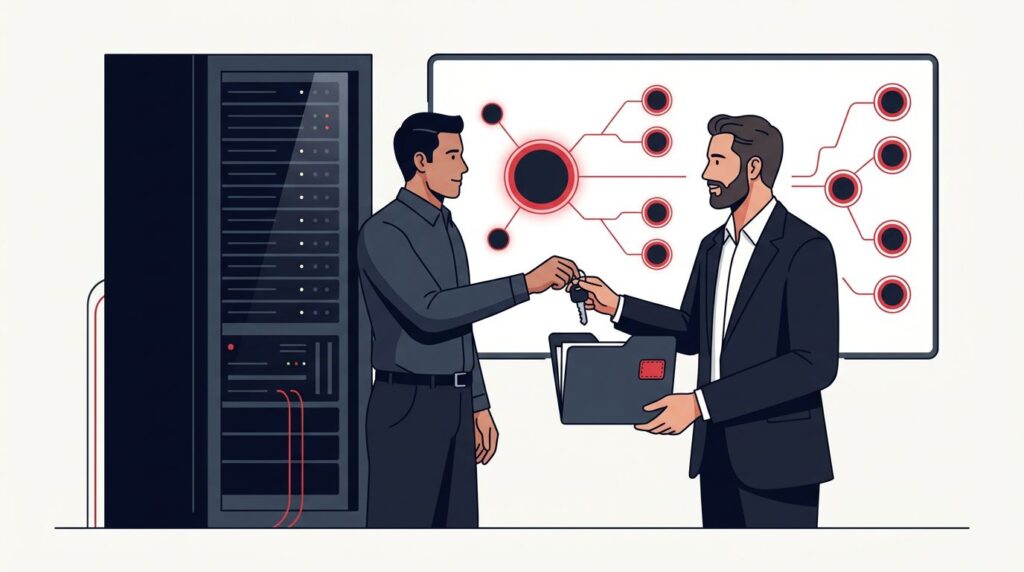
The resignation email lands, and suddenly one person is taking the company’s operating memory with them. They know the systems, vendors, admin accounts, exceptions, workarounds, and risks nobody thought to document. The role transition can expose gaps in access, knowledge, and decision ownership.
That’s why IT succession planning is a business continuity issue, not an HR exercise. If your only IT person leaves, you need control of access, knowledge, decisions, and risk before the gap turns into an outage or an expensive hiring mistake.
Key takeaways
- Your only IT person may be the sole owner of critical roles, creating a single point of failure even when systems appear stable.
- The first response should secure access, name an interim decision owner, and create a clear operating picture.
- Knowledge transfer must produce usable documentation, backup owners, and tested recovery steps.
- A fractional CTO or interim CTO can provide executive ownership while you decide what the permanent role should be.
- A succession planning process should produce the right succession plan. It should build bench strength through internal talent and internal mobility, using workforce intelligence to evaluate coverage.
The real risk is not the resignation
Your only IT person rarely owns only IT.
They may manage cloud administration, employee access, backups, cybersecurity vendors, software renewals, network equipment, customer integrations, and the relationships that keep everything moving. They may also hold critical knowledge about fragile systems, undocumented dependencies, where passwords are stored, and which “temporary” fixes have been in place for years.
After the resignation, a role transition can expose operational gaps that were hidden while one person handled everything.
When that person leaves, the risk is not limited to an empty seat. You may lose the ability to answer basic leadership questions:
- Which systems are business-critical?
- Who can restore access if an administrator is unavailable?
- Which vendors can make changes to your environment?
- When do key licenses, certificates, and contracts renew?
- What has been deferred because the team was too busy?
- Which risks does the board need to see now?

A single point of failure can exist in a person, process, vendor, or system. The practical problem is the same. One missing piece can block a safe decision when critical knowledge remains with one person.
A practical guide to avoiding single-point-of-failure situations makes an important distinction: a team may continue operating while system knowledge remains trapped with one individual. That is the condition you need to address before the departure, not after it, with deliberate knowledge transfer and succession planning.
What to do in the first 72 hours
During the first 72 hours, succession planning means stabilizing the business, not redesigning the entire technology environment. Your immediate goal is to prevent avoidable damage.
- Secure access without creating new risk. Confirm ownership of administrator accounts, password vaults, cloud platforms, domain registrations, backups, certificates, service accounts, and security tools. Review MFA and recovery methods. Document critical knowledge about undocumented recovery procedures and privileged access. Do not rely on a departing employee’s personal email or phone for access recovery.
- Name one interim decision owner. The CEO or COO should activate the succession plan and appoint an interim decision owner. That person can approve priorities, spending, access changes, and vendor decisions. They don’t need to perform every technical task, but they do need authority to act and escalate risk.
- Build a short operating picture. Create a systems inventory, vendor list, renewal calendar, open project list, incident history, and risk summary. Identify what is running, what is failing, and what only one person knows. Record critical knowledge about vendor dependencies and missing operational details.
- Protect the handoff. If the relationship is sound, schedule structured knowledge transfer sessions before the departure date. Treat this role transition as a documented process, not an informal conversation, and turn each session into usable runbooks. Have the interim owner validate the knowledge transfer by following the runbooks before the employee leaves. If the departure is hostile or sudden, preserve logs, review privileged access, and involve legal or security support before making changes.
If you discover suspicious activity, treat the departure as a possible security event until the facts are clear, even during a role transition. Strong succession planning ensures your incident response readiness does not depend on the person who just left.
Critical roles anchor succession planning
A succession plan should not begin with a list of job titles. It should begin with the work the business cannot afford to lose.
Rank critical roles by business impact, rarity of skill, recovery time, and backup availability. For example, a payroll system administrator may create more immediate risk than a developer who owns a lower-priority internal application.
Your critical role coverage improves when every high-impact responsibility has:
- A named primary owner.
- A named backup owner who can access and apply critical knowledge.
- Current documentation.
- A tested recovery or escalation path.
- A clear approval threshold.
- An external contact who can help if internal capacity is limited.
Knowledge transfer also needs a defined standard. “They showed me once” is not a handoff.
An effective knowledge transfer includes system diagrams, account ownership, recurring tasks, vendor contacts, known failure points, escalation paths, judgment calls, and undocumented dependencies. It should preserve critical knowledge about why systems work as they do, not just how to access them.
A succession planning discussion from Addison Group describes the same core concern: key relationships, judgment, and unwritten rules can leave with an employee. Documentation must capture more than passwords. It must show how the environment is actually operated.
Talent management can help identify internal talent, but technical readiness needs evidence. A practical succession planning process connects a leadership pipeline to actual operating needs. Start by defining the skills gap for each backup assignment, then set a readiness score based on observed performance.
Review internal mobility records alongside availability, interest, and relevant system experience. High-potential employees may need career pathing, targeted upskilling programs, or supervised ownership before entering the talent pool. That sequence makes a succession strategy practical rather than aspirational.
Use talent management to support development decisions, but let technical leaders authorize production access. The 9-box method supports calibration by comparing performance and future potential. A second 9-box method review can organize discussion, but it cannot prove production-system readiness.
The talent review workflow for succession planning
- Criteria: Open each talent review by defining the backup assignment, operating risk, and experience required for a safe role transition.
- Evidence: Use the evidence step in each talent review to compare certifications, project history, system experience, and manager observations.
- Calibration: During calibration, a talent review should distinguish potential from proven judgment, availability, and willingness to own a backup responsibility.
- Cadence: Set a quarterly talent review cadence, with an immediate review after a resignation, major system change, or failed recovery test.
- Documentation and candidate validation: Record the decision in the talent review, then validate the candidate’s access, judgment, and ability to follow escalation paths under pressure.
- Development actions: Use development actions from the talent review to assign shadowing, supervised work, and internal mobility assignments. A mentoring program can reinforce leadership development and employee retention.
- Follow-up: At follow-up, use the talent review to update the backup owner and close remaining evidence gaps.
AI-driven workforce intelligence can surface candidates across teams through skills mapping. Workforce intelligence tools can compare experience, certifications, project history, and career interests faster than manual review. Predictive analytics may reveal a talent pool for emerging needs, but it cannot confirm judgment or availability. That workforce intelligence should inform the shortlist, not appoint anyone. Leaders must verify willingness and the ability to operate under pressure.
Track simple measures over time. Useful metrics include the percentage of high-impact responsibilities with qualified backups, successor readiness, the number of systems with current documentation, time to restore access, and internal mobility. These measures show whether bench strength is improving or whether the company remains dependent on individual heroics. They also support workforce planning.
Use the results to update succession planning before the next departure.
Choose the right bridge after the departure
You may need a new employee. You may need outside support first. Those are different decisions.
A fractional CTO fits when you need continuing executive technology leadership, but the business does not yet justify a full-time hire. Fractional CTO services can cover technology strategy, roadmap ownership, vendor management, technical debt decisions, executive reporting, and team direction. Succession planning may require this bridge before you commit to a permanent hire.
An interim CTO fits a different moment. Interim CTO services are usually appropriate when the leadership seat is vacant, trust has broken down, a major initiative is in trouble, or the business needs immediate stabilization. The interim leader owns the role transition while you decide whether to hire permanently.
A part-time CTO, virtual CTO, or outsourced CTO may provide a similar structure when the work is strategic and the operating cadence is clear. If the pressure extends across enterprise systems, data, operations, and process design, a fractional CIO may be a better fit.
When cybersecurity is the immediate concern, you may need a fractional CISO, virtual CISO, or interim CISO. That leader can focus on cyber risk appetite, access control, incident response readiness, vendor risk, and board cybersecurity reporting.
The important comparison is not only fractional CTO versus full-time CTO. It is also fractional CTO versus IT consultant. A consultant may deliver a defined assessment or recommendation. An executive technology leader stays close enough to own decisions, tradeoffs, follow-through, and the operating picture.
If you are unsure which model fits, start with when to hire a fractional CTO. The decision should support succession planning and the longer-term operating model, not the title you happen to know.
Build a stronger technology foundation before the next crisis
A departure is easier to manage when technology has clear ownership and a regular operating rhythm. That foundation connects succession planning to operating continuity.
Start with a technology assessment and a technology audit. Confirm what systems exist, who owns them, what they cost, how they connect, and which risks need attention. Then create a 90-day technology plan that supports succession planning. Separate urgent stabilization from work that can wait.
Include technology coverage in workforce planning, as part of the broader talent management model. Use workforce intelligence to identify internal talent for essential systems. It can also show where internal mobility is realistic and where external support is required. Use a talent review to assess technology backup coverage. Revisit the talent review as priorities change and new gaps emerge.
Your longer-term plan should connect technology decisions to revenue, margin, customer experience, execution, and risk. A 12-month technology roadmap can show the major investments, dependencies, owners, expected outcomes, and decisions required from leadership. Refresh the workforce intelligence data as the roadmap changes, so coverage assumptions stay current.
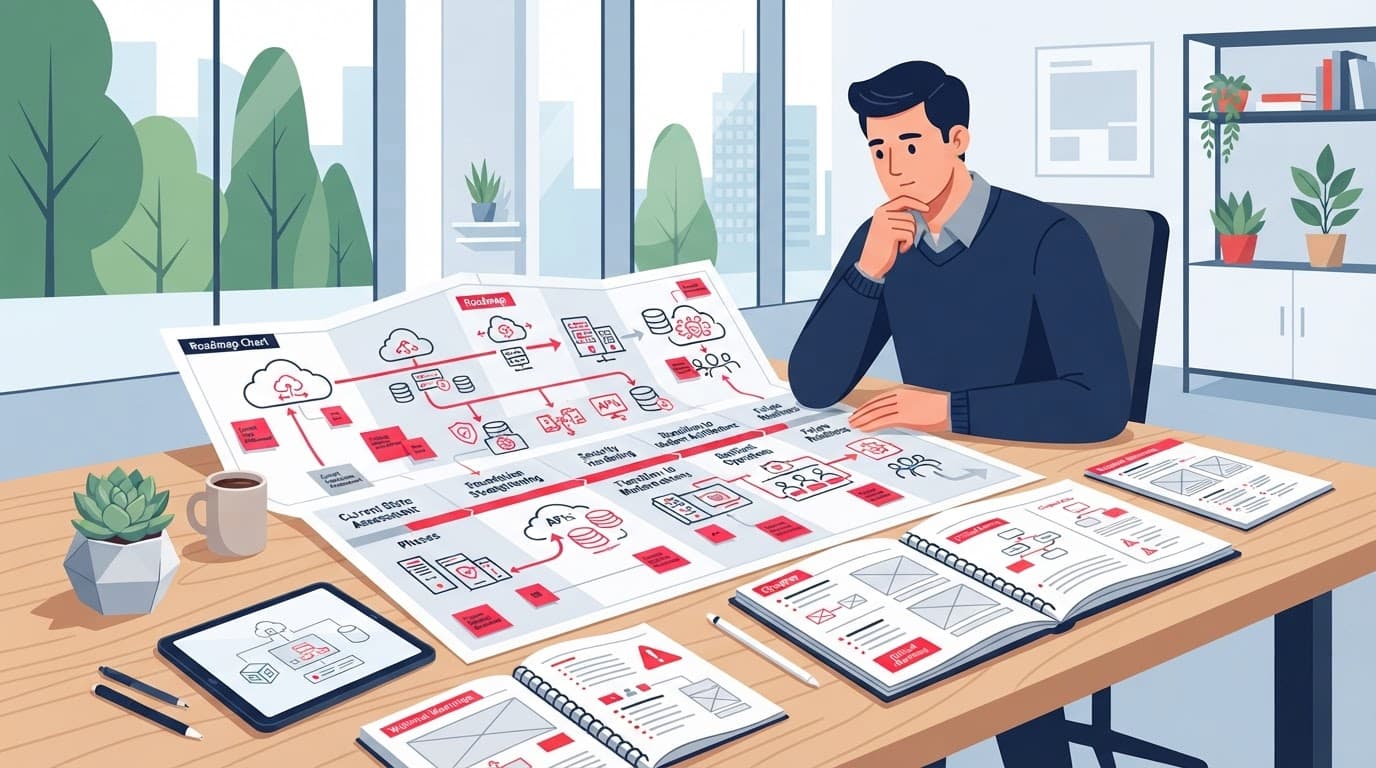
A one-page technology strategy is often enough to give executives a shared view of priorities. It should show what matters now, what is deliberately delayed, and what must be true before the next major investment.
Technology governance should clarify who recommends, who approves, who executes, and who accepts risk. The board owns oversight, not daily technology execution. Directors should receive board-ready technology reporting that explains material risks, spend, delivery confidence, vendor dependence, and the decisions that need attention.
Review vendors as part of the succession process. Confirm contract ownership, provider contacts, escalation procedures, renewal dates, data access, vendor offboarding steps, and the vendor incident response plan. Use knowledge transfer to ensure critical knowledge, provider contacts, escalation procedures, and access dependencies don’t remain with one employee.
If the departure occurs during acquisition preparation, an ownership change, or a leadership transition, weak documentation will surface quickly during the role transition. Prepare Technology for Diligence or Transition can help you organize systems, vendors, risks, reporting, and the roadmap around the change ahead.
Conclusion
Your only IT person quitting is not automatically a crisis. It becomes a crisis when access, knowledge, decisions, and risk all depend on one person.
Good IT succession planning produces a practical succession plan with named owners, usable documentation, tested recovery steps, and clear leadership coverage. It also helps you choose the right role transition, whether that means an internal promotion, a full-time hire, fractional technology leadership, or interim support.
If the situation feels scattered, Get an Executive Technology Clarity Check. The first step is not choosing a title. It is seeing clearly what the business needs to protect, who needs to own it, and what must happen next.
FAQs
Is an IT succession plan only necessary for larger companies?
No. Smaller companies often face greater exposure because one person may hold more access and institutional knowledge. Succession planning can be simple, but it isn’t optional. Start with critical systems, privileged accounts, vendors, backups, recurring tasks, and a named backup owner.
Should the board manage the IT succession process?
The board should oversee material technology risk, operational resilience, cybersecurity, and leadership exposure. It should not manage daily handoff tasks. Management should own the transition and provide clear board-ready reporting when the departure creates meaningful business risk.
How long should knowledge transfer take?
The timeline depends on system complexity and the employee’s notice period. Begin with the highest-risk systems and responsibilities. Prioritize access recovery, backup restoration, vendor contacts, security controls, renewals, critical knowledge, and undocumented processes before lower-risk improvements. Treat this work as a role transition, not just a documentation exercise.
Can workforce intelligence replace human judgment or a 9-box method?
No. Workforce intelligence and a 9-box method can surface and organize evidence, but neither can approve a successor. Management should use a talent review to weigh experience, judgment, access needs, and role coverage. Revisit that talent review as systems and responsibilities change.