
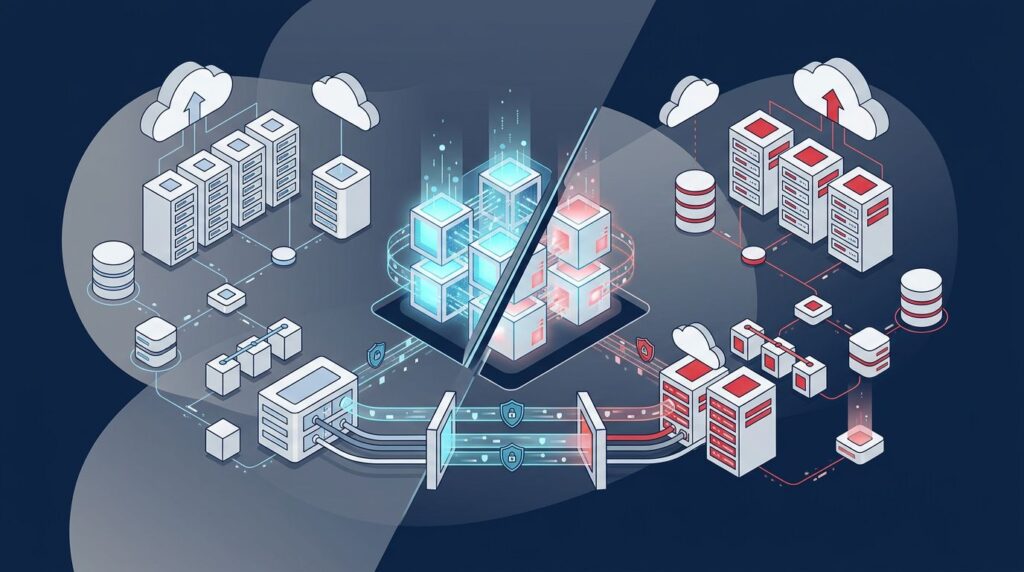
An IT carve-out can support value creation when operational risks are controlled. Shared systems, data, vendors, identities, and infrastructure rarely divide cleanly when the deal closes.
The target business must operate independently without losing orders, payroll, customer access, reporting, or security controls. Meanwhile, the parent company must keep those capabilities running through the separation. That takes clear ownership, a tested design, and an honest view of risk and responsibility.
Key takeaways for an IT carve-out
- Treat the separation as a business continuity program, not a technical cleanup project.
- Build a complete systems inventory and dependency map before choosing a migration method.
- Decide early which data moves, stays, or gets archived, and who can access it.
- Use Transition Service Agreements as temporary bridges, with clear owners and exit dates.
- Compare selective ERP data extraction with a greenfield rebuild before committing to either path.
- Give one executive authority over technology tradeoffs, delivery, risk, and the separation roadmap.
What an IT carve-out actually separates
An IT carve-out separates the IT systems and supporting technology required for a business unit to operate independently. That may include applications, infrastructure, data, contracts, licenses, networks, user accounts, security tools, and technical staff.
The work sits inside a larger divestiture strategy. The legal transaction may be straightforward on paper. The operating environment usually isn’t.
Carve-out, spin-off, and sale are different events
In a sale, the parent company transfers a business unit or asset to a buyer. In a spin-off, the business becomes a separate entity, often with ownership distributed to existing shareholders. A carve-out can support either structure.
The difference matters because the transaction determines ownership, timing, financial reporting, and legal obligations. The technology work still needs to answer the same question: what must the target control on day one?
The M&A separation strategy overview is useful because it distinguishes the transaction structure from the operating work required after separation.
Shared services create the real difficulty
A business unit may share the parent company’s ERP, Microsoft 365 tenant, identity provider, CRM, data warehouse, network, service desk, and cybersecurity tools. It may also rely on parent contracts for cloud hosting, software licensing, payroll, finance, procurement, and customer support.
One shared login system can affect thousands of employees. One integration platform can connect order management with finance, inventory, logistics, and customer communications. Removing one part without understanding the dependency chain can stop an otherwise healthy operation.

Why the business stakes are higher than an IT project
The purpose of an IT carve-out is not technical elegance. You may be trying to improve liquidity, focus management attention, or enable value creation. Technology has to support that outcome without creating a new operating problem.
A failed application migration is serious. A missed customer order, payroll failure, security incident, or loss of financial records can affect the transaction itself.
Business continuity is a deal requirement
Your separation plan should protect the processes that keep money moving and customers served. That includes quote-to-cash, order-to-cash, procure-to-pay, payroll, customer support, shipping, inventory, financial close, and regulatory reporting.
Document the minimum operating capability the target needs on day one. Then identify the systems and people behind each capability.
Recovery planning should cover disaster recovery, backup validation, incident response readiness, and recovery targets for each major process. Don’t treat recovery as a later infrastructure task. If the target cannot recover its systems, it isn’t independent.
A separate business continuity guide can help you pressure-test assumptions about recovery, dependencies, and operational resilience.
Independence changes the value equation
The target needs operational independence, with enough capability to run without permanent parent support. The parent company needs a credible plan for contracts, people, platforms, and costs it will retain after close.
Shared services often create operational synergies across finance, HR, security, and support. These must either be preserved temporarily or replaced before the target stands alone.
This creates two financial questions:
- What does the target need to buy or build?
- What costs remain with the parent after the business leaves?
A target may need new identity services, security monitoring, network connections, IT infrastructure, licenses, and support contracts. The parent may be left with unused capacity, shared software commitments, duplicate roles, and applications that no longer have enough users to justify their cost.
Post-merger technology integration is often discussed in terms of combining systems. A carve-out requires the opposite discipline. You must separate systems without losing the business process that connects them.
Start with a separation fact base
For an IT carve-out, the first phase of the carve-out process is not vendor selection. It is finding out what exists, who uses it, what it costs, and what breaks if it changes.
If the information is incomplete, project planning and cost estimation become guesswork. That is how avoidable surprises become executive problems.
Build a systems inventory and dependency map
Create one record for every important item in your IT systems, including each platform, interface, database, infrastructure component, vendor, and service owner.
For each item, record:
- Which legal entity uses it
- Whether the system is shared, dedicated, or partially shared
- What data it holds
- Which processes depend on it
- Where it is hosted
- Who administers it
- What contract and license terms apply
- What integrations connect to it
- What recovery objective it requires
- Whether it moves, stays, gets replaced, or gets retired
Do not stop at the application list. Map identity, DNS, certificates, email, endpoint management, backups, monitoring, privileged access, and support queues. These dependencies often sit outside the formal application portfolio.
Your technology audit should also expose technical debt, tool sprawl, shadow IT, undocumented scripts, and vendor-controlled integrations. Each one can change the effort required for separation.
Define the data perimeter and decision rights
Before anyone moves data, define the perimeter. Which customers, employees, suppliers, contracts, transactions, documents, and historical records belong to the target?
Then create a decision rights map. Name who recommends, who approves, who executes, and who accepts residual risk. Include the parent company, target leadership, Finance, Legal, Operations, security, and major vendors.
This work supports a usable data governance framework. It also improves data quality because you have to resolve duplicate records, unclear ownership, inconsistent retention, and conflicting definitions before migration.
A practical acquisition due diligence checklist should include systems inventory, data ownership, license rights, security exposure, privacy obligations, recovery capability, vendor dependency, and separation cost. Technical due diligence is not complete when the stack is described. It is complete when leadership understands the consequences.
The technical blueprint for ERP data separation
In an IT carve-out, ERP separation is where many projects become expensive. A shared ERP system contains more than records. It contains relationships, rules, workflows, permissions, custom code, reporting logic, and historical context.
A clean-looking extraction can still produce a broken business process.
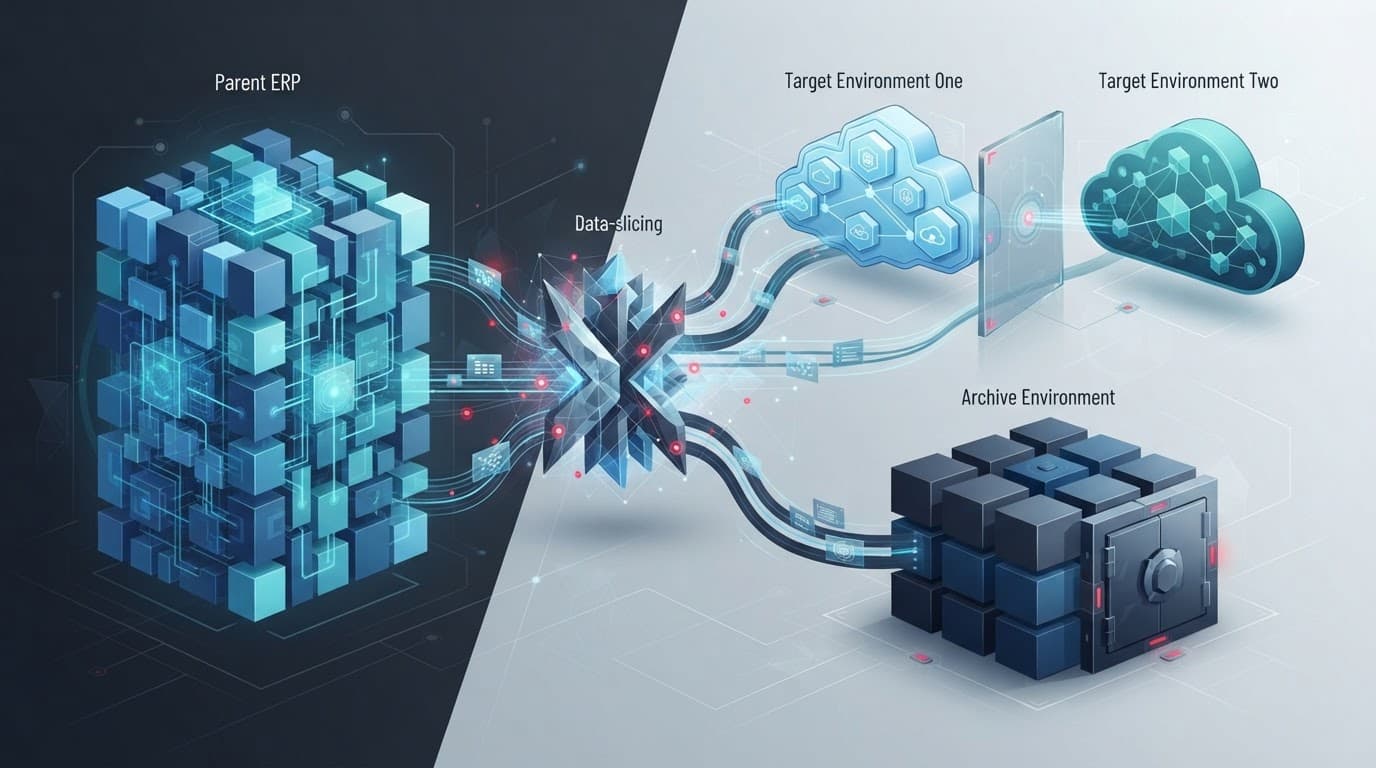
Choose between data slicing and a greenfield rebuild
You usually have three broad choices.
Selective separation keeps a shared platform or cloned environment but removes data and configuration that belong to the other entity. This can reduce business disruption, but it requires precise data classification and extensive testing.
A greenfield rebuild creates a new target environment and migrates only the data and processes the target needs. This can produce cleaner ownership, but it places more work on the target before independence.
A hybrid model often fits the actual business. You may build a new finance and identity environment while keeping a limited ERP connection or archive accessible under controlled terms.
For SAP, the analysis may include company codes, plants, cost centers, profit centers, master data, open orders, inventory, accounts receivable, accounts payable, custom developments, reporting structures, authorizations, and integration platform endpoints.
SAP carve-out examples also show why you must decide whether to retain a shared BW structure or create a separate one. Master data, transaction data, process chains, selection profiles, and authorization controls may all require changes.
Test migration with reconciliation, not confidence
A data migration is ready when the business can prove that the target data is complete, accurate, usable, and properly controlled.
Run mock conversions before the final cutover. Reconcile record counts, balances, open transactions, inventory, customer accounts, supplier records, user access, reports, and downstream interfaces. Also test system compatibility across the ERP, identity, reporting, and downstream interface landscape.
Test the business process, not only the data load. Can a user create an order? Can Finance close the books? Can Operations see inventory? Can a customer receive the right communication? Can an administrator remove access quickly?
Keep historical data available when law, contract, audit, customer service, or litigation requires it. That may mean a read-only archive rather than a full migration. An archive still needs ownership, retention rules, access controls, search capability, and a documented deletion process.
Protect data privacy, security, and continuity
Privacy, security, and data protection decisions belong in the separation design. They aren’t paperwork to complete after the technical work is finished.
A controller change affects the migration plan
When personal data moves to a buyer or newly independent entity, the parties may be dealing with a different or additional data controller. The UK’s Information Commissioner’s Office says M&A data sharing should be treated as part of due diligence.
That means you need to establish why the data was collected, the lawful basis for sharing, whether the purpose changes after close, and how the transfer is documented. You also need to review accuracy, retention, security, and access.
A data transfer between different systems can create loss, corruption, or degradation risk before anyone notices a privacy problem.
The European Data Protection Board’s controller and processor guidance also matters when vendors remain involved under a TSA. A processor can’t unilaterally rewrite the processing arrangement because the ownership model changed. The new responsibilities, instructions, and approvals need to be clear.
Employee data adds another layer. Payroll, benefits, timekeeping, HR files, and identity records may cross borders or move between service providers. International workforce separation guidance, including this carve-out strategy for global teams, can help you account for the people and employment systems that technology plans often miss.
Separate identity before you separate applications
Identity is the control plane for the new company. Establish independent domains, tenants, administrator accounts, multifactor authentication, endpoint management, privileged access, logging, backup administration, and security monitoring.
Access control best practices support data security by removing inherited parent access, reviewing service accounts, rotating credentials, separating encryption keys, and confirming that vendors can’t retain unnecessary administrative rights.
Your cybersecurity risk assessment should cover both environments during the overlap period. Update the technology risk management framework, cyber risk appetite, incident escalation paths, and vendor incident response plan.
A fractional CISO, virtual CISO, or interim CISO may fit when security ownership is the main technology leadership gap. The role should connect cybersecurity oversight to service continuity, cyber insurance renewal, customer commitments, and board accountability.
TSAs are bridges, not operating models
Transition Service Agreements (TSAs) keep the target running while it builds independent capability. They can cover IT infrastructure, applications, service desk, hosting, security operations, finance, HR, procurement, or other shared services.
The agreement is useful because independence rarely arrives on the same day as legal close. Transition planning must connect the close date with the target’s tested independent capability.
Price every service unit and exit condition
A TSA should name the service, volume, service level, provider, recipient, term, price, security requirements, data handling rules, escalation path, and exit condition.
Avoid a vague line such as “IT support.” Define the number of users, devices, tickets, applications, interfaces, sites, reports, and support hours. Record what is included and what triggers additional charges.
The TSA guide on scope, pricing, and exit planning covers the contract elements that need attention before close.
Assign an owner on both sides. Set a regular governance cadence. Track service quality, incidents, open dependencies, spend, and progress toward exit. A TSA without exit milestones can turn temporary dependency into permanent cost.
Decide whether zero IT TSA is realistic
A zero-IT-TSA approach can accelerate independence. It can also force a rushed, big-bang cutover before identity, data, support, security, and recovery are ready.
Use it only when the target has a tested standalone environment, trained users, independent vendors, validated backups, and an operating team that can respond after close.
Microsoft 365 separation is a common example. Tenant-to-tenant migration can affect mail, calendars, files, identities, mobile devices, collaboration spaces, security policies, and licensing. The Microsoft 365 tenant migration guide shows why the work needs more than mailbox copying.
A short TSA is often safer than a zero TSA that leaves the business without recovery or support. The right question is not whether you can avoid a TSA. It is whether you can operate safely without one.
Build a cost estimate leaders can defend
Carve-out cost estimation fails when teams count migration labor but ignore the cost of running two environments, buying replacement capabilities, and supporting the parent after separation.
You need a baseline that both the CFO and technology owner can challenge.
Separate one-time, recurring, and stranded costs
Your model should include:
- Discovery, architecture, legal review, project management, testing, training, and communications
- Data cleanup, extraction, migration, validation, and historical archiving
- New software licenses, IT infrastructure, networks, security tools, backups, monitoring, and support
- Dual-running costs during the overlap period
- TSA charges, minimum commitments, service management, and exit work
- Stranded costs left with the parent company, including unused licenses, retained staff, shared platforms, facilities, and contracts
- Decommissioning, contract termination, data destruction, and records retention
- Remediation for technical debt, security gaps, unsupported systems, and poor data quality
- Contingency for hidden dependencies and failed migration assumptions
Show the effect on both cash and accounting treatment. Implementation costs, capitalized development, depreciation, and recurring operating expenses can affect the financial story differently.
If separation spending affects Adjusted EBITDA or another non-GAAP measure, connect the technology assumptions to the financial statements. Don’t promise savings that you cannot trace to a system, contract, headcount, or process change.
Use bottom-up cost estimation and a top-down check
Start with a baseline of current run-rate spend. Then estimate demand units: users, devices, applications, interfaces, data volume, sites, tickets, and support hours.
A bottom-up model gives you traceable assumptions. A top-down comparison helps identify missing categories. Add sensitivity for longer TSA terms, delayed cutover, extra data remediation, license minimums, and parallel support.
Track value creation and technology ROI through measurable outcomes, not activity. Cost-per-outcome reporting can show whether the separation protects revenue, reduces duplicate spend, improves recovery, or removes a specific dependency.
Application portfolio rationalization, software platform evaluation, technology vendor selection, and vendor due diligence can reduce future spend. They should not be used to disguise the cost of becoming independent.
Run the separation with clear leadership
A technology separation exposes a leadership gap quickly. Vendors need decisions. Finance needs numbers. Legal needs evidence. Employees need working systems. The parent and target may want different outcomes.
Someone must own the tradeoffs.
Give one executive authority over the plan
The CEO owns the business outcome and strategic direction. The COO owns the operating rhythm and cross-functional execution. The CFO owns financial discipline and forecast integrity. Legal owns obligations and evidence. Security leaders own controls, access, and risk decisions.
A technology leader owns the roadmap, architecture decisions, dependencies, delivery tradeoffs, vendor management, and readiness recommendation. That leader coordinates decisions across functions and keeps the work tied to business technology strategy.
This is where executive technology leadership matters. A technology leader for a growing company connects CEO decisions, COO execution, Finance, Operations, vendors, and risk.
Options include a full-time leader, a fractional CTO, or fractional CTO services. You might also use an interim CTO, interim CTO services, an outsourced CTO, a virtual CTO, or a part-time CTO. A fractional CIO may fit when enterprise systems and data extend beyond engineering. The choice of fractional CTO vs full-time CTO depends on whether the need is ongoing and strategic or tied to a defined transition.
The fractional CTO vs IT consultant comparison is different. A consultant may deliver an assessment. An executive technology leader carries decision ownership and follow-through.
Use stage gates and short executive reporting
Create gates for design approval, build completion, mock migration, user acceptance, security readiness, cutover approval, and post-close stabilization.
Your technology dashboard should show only what leaders need to decide:
- Business processes at risk
- Budget against forecast
- Migration and testing progress
- Open dependencies and owners
- Security and privacy exceptions
- TSA spend and exit progress
- Recovery readiness
- Decisions required this week
A 90-day technology plan can stabilize the immediate work. A 12-month technology roadmap can sequence deferred remediation, technical debt management, vendor offboarding, and application rationalization.
Use board-ready reporting when the transaction carries material risk. Board technology reporting should explain exposure, management’s decision, accountable owner, timing, and any tradeoff requiring oversight. Board cybersecurity reporting should cover access, recovery, incident readiness, and third-party risk management.
If technology decisions feel scattered or ownership is unclear, Get an Executive Technology Clarity Check can help identify what needs attention first. For a transaction or leadership change, Prepare Technology for Diligence or Transition is a practical next step.
A practical sequence from planning to independence
Transition planning becomes easier when each phase produces evidence for the next decision.
Build the plan before you build the environment
Start with the transaction perimeter, systems inventory, dependency map, data classification, TSA assumptions, and cost baseline. Confirm the day-one operating model before choosing tools.
Next, design the target environment. Decide which IT systems stay shared temporarily, which move, which get rebuilt, and which get archived. Document the security model, support model, recovery model, and vendor responsibilities. Also document how the integration platform connects the target environment to any remaining shared services.
Then run mock migrations and business process tests. Record defects by business impact. A failed report, missing customer record, or broken interface may matter more than a clean technical completion report.
Cut over with a tested fallback
Before cutover, freeze the right changes, confirm backups, validate user lists, approve security exceptions, and rehearse communications. Give leaders a clear go or no-go decision based on evidence.
During cutover, use named workstream owners and an escalation path that reaches an executive quickly. Keep a rollback plan for each high-risk dependency. Don’t rely on a single person who knows the environment through memory.
After close, run hypercare with daily review at first. Track incidents, data issues, support demand, recovery tests, TSA consumption, and unresolved access concerns. Move stable work into the target operating rhythm to enable operational independence, rather than allowing transition work to become permanent shadow IT.
FAQs about IT carve-outs
How long does an IT carve-out take?
There is no responsible standard duration. The timeline depends on system complexity, data quality, transaction timing, regulatory requirements, TSA terms, and the target’s starting capability.
Measure progress against decision and readiness gates, not calendar optimism. Gates should confirm approved scope, accountable owners, tested access, reconciled records, recovery procedures, and support coverage. A simple environment with dedicated systems may separate quickly, while a shared ERP, global identity tenant, and complex data estate may require staged independence.
Can you complete a carve-out without a TSA?
Yes, if the target has independent systems, support, security, data, vendors, and recovery capability ready before close. Each dependency should have an accountable owner, tested fallback, and formal sign-off.
A zero-TSA plan increases the work that must be completed and tested before day one. If one critical dependency remains unresolved, a narrow TSA may be safer than forcing a full cutover. Price and document that choice during negotiations.
Who pays for TSA and stranded costs?
The transaction documents determine who pays, but the operating model should identify both categories before negotiations end. Assign owners for each shared service, contract, platform, facility, and role.
TSA charges are usually tied to the services the seller continues to provide. Stranded costs remain with the remaining organization when shared capacity, contracts, platforms, facilities, or roles lose volume after separation. Both affect the real economics of the deal.
What is the largest data migration risk?
The largest risk is usually unclear scope combined with weak ownership. Define which records belong to the target, what history must be retained, and who approves exceptions before technical work begins.
Data quality, privacy obligations, access controls, reconciliation, recovery, and archive retrieval all need named owners. Those owners should also approve unresolved exceptions before cutover.
Should you copy the parent ERP or build a new one?
Choose based on business process fit, data quality, timeline, license economics, integration complexity, and the target’s future operating model. Also test whether the target can support, recover, and staff the selected design after separation.
Copying can preserve familiar processes but carry old customization and technical debt. A greenfield build can create cleaner ownership but introduce training, data, and recovery risk. A hybrid approach may provide a safer path when the target needs independence without an immediate full replacement.
Conclusion
An IT carve-out succeeds when the target can operate independently, and leaders can explain what stayed behind, what was paid, and which risks remain.
The work starts with evidence: systems, data, dependencies, owners, costs, and recovery needs. It continues through tested migrations, disciplined TSA management, privacy review, security separation, and board-ready reporting.
You don’t need more technical activity. You need clear ownership of decisions that protect continuity, control cost, and support the transaction. Leadership gains confidence from evidence, accountable decisions, and a credible path to independence.